Category Archives: Book Reviews
Solitaire


Solitaire is a political thriller with a strong espionage pulse, and it opens by dropping us straight into a public shooting in Times Square that turns a mayoral campaign into a conspiracy story about surveillance, synthetic identities, and power hiding behind official systems. At the center are Grace Delgado, a relentless New York journalist, and Michael Sloane, a ghostlike operator tied to the Ace of Spades and a trail of old secrets, as they circle the murder of Deputy Mayor Robert Caldwell and the shadow network called KATSAI. What starts as a city corruption story grows into something broader and darker, with fake donors, weaponized tech, and a private apparatus trying to bend politics into obedience.
I really enjoyed the book’s momentum. Author Bill Pepitone writes like someone who knows how institutions sound from the inside, and that gives the novel a kind of hard floor under its feet. The scenes in City Hall, the FBI office, and the street-level New York moments have a lived-in feel that kept me leaning forward. I also liked that the book doesn’t pretend its people are clean heroes. Grace is stubborn, emotional, and smart in a way that gets her into trouble. Sloane is built like myth, but the book keeps trying to press bruises under the myth, especially in the quieter moments when his control slips. The dialogue can sometimes feel like everyone has a comeback in the chamber, but even then, the energy carries it.
I found the author’s choices around KATSAI and the fake donor machinery especially interesting because the book isn’t just chasing thrills for their own sake. It’s clearly interested in what happens when surveillance stops being a tool and starts becoming a nervous system for power. That idea lands. The novel’s best move, for me, is that it keeps tying giant systems back to private fear: Caldwell hiding a drive behind a picture frame, Shaw collapsing under pressure, Grace realizing too late that information itself can act like a flare in the dark. There is a pulp sheen to some of it, sure, and Sloane sometimes feels almost too competent, but that is also part of the book’s genre DNA. This is an espionage thriller fiction that wants to be sleek, tense, and a little larger than life, while still keeping one foot in recognizable political rot.
I came away feeling that Solitaire knows exactly what shelf it wants to sit on. It’s the kind of book I would recommend to readers who like conspiracy-driven thrillers, cat-and-mouse espionage, and stories where modern tech and old-fashioned power games collide in the same room. If you enjoy fast, cinematic fiction with a political edge, a wounded central duo, and a hero who moves through the world like a rumor with a passport, this will be very much your thing.
Pages: 259 | ISBN : 9781105802713
I Was Just Sitting There Eating A Salad…

I Was Just Sitting There Eating a Salad… is a loose, comic tapestry rather than a traditional story collection with hard walls between pieces. The book keeps circling back to Green City and its recurring cast, especially Edward Loomis, the salad-eating private detective whose disastrous encounters become a running joke, while other stories widen the town into something stranger and more affectionate. One minute, the book is leaning into broad farce with names like Randolph and Imogene Scary and a whole town rattled by an “alien” misunderstanding, and the next it opens into more ambitious comic sci-fi through Jerald Cross, Sarah Smart, Greg Lieberman, and the wormhole device that turns a small West Virginia town into the center of increasingly absurd adventures. What finally holds it together is the sense that Green City is its own comic universe, one where gossip, coincidence, pulp plotting, and homemade science all somehow belong in the same weather.
The opening salad story is such a good example of the collection’s method because it commits completely to repetition, timing, and escalation until Edward’s laugh becomes practically mythic. I also found myself genuinely charmed by the way the stories start cross-pollinating. “Wormhole” could have felt like it came from a different book, but instead, it deepens the world, giving the collection a stronger spine than I expected. The courtroom frame, the teenage inventiveness, and the uneasy moral turn after the Nevada chase give that story real momentum, and later pieces gain extra pleasure because they’re no longer isolated gags. By the time the book gets to ghosts, pranks, and military suspicion, it’s working with a whole local mythology, and I admired how casually it builds that mythology without ever sounding solemn about it.
Author Victor Coltey’s prose has a talky, easy-going looseness that can be funny, especially when a narrator is half deadpan and half delighted by his own nonsense, but it can keep pushing after the laugh has landed. Some of the character descriptions and comic premises are intentionally outrageous, though for me they worked. There were stretches where I felt the book’s affection for eccentricity and caricature was warm and knowing. The author’s note helped confirm what the stories themselves suggest, which is that the book is openly trying to mix humor, sci-fi, and what Coltey calls “a little idiocy,” and I think that self-awareness is important because it frames the collection less as polished satire than as a homemade comic world built out of tall tales, genre love, and an authentic voice.
This book is rough-edged, but also lively, distinctive, and cohesive. Its best stories have the pleasure of hearing a practiced raconteur keep a straight face while the town around him slips further into absurdity, and its larger appeal is the way it treats small-town life as a stage big enough for wormholes, ghosts, Sasquatch, and very bad lunches. I’d recommend it to readers who enjoy offbeat regional humor, linked story collections, and comic speculative fiction that feels homemade rather than slick. It’s the kind of book for someone who likes their fiction odd, chatty, and full of personality.
Pages: 203 | ASIN : B0GG7TV3TG

Donahue Pass: A Sierran Philosophy

Donahue Pass, by Charles Weeden, is a work of philosophical nature writing, part trail narrative and part extended dialogue, in which two friends hike from Rush Creek over Donahue Pass while talking their way through Darwin, Descartes, Heidegger, pragmatism, interpretation, and what it means to live with purpose. The book moves between mountain description and conversation, using the climb itself as both setting and structure, so the switchbacks become a kind of thinking pattern as the two men test ideas, joke with each other, and slowly arrive at a rough synthesis about evolution, meaning, and interpretation.
What I liked most is that the book never feels like it wants to lecture from a podium. It wants to walk beside you. That matters. The writing keeps returning to the body, to thirst, altitude, sore legs, a heavy pack, the small relief of water sitting in the mouth, and that physical strain gives the philosophical talk some grit. Without that, a lot of this could have floated away. Instead, the ideas stay tied to the trail. I also liked the friendship on the page. Mike’s sarcasm keeps puncturing John’s loftier turns, and that back and forth gives the book warmth and movement. It is often funny in a dry, relatable way. You can feel the book understanding that big ideas are easier to bear when somebody beside you is rolling their eyes.
I found the author’s ambitions more interesting than fully convincing, which is not a complaint. It is part of the book’s charm. Some stretches of the dialogue feel like a real conversation, and some feel more like a staged debate where each friend takes turns carrying a stack of books up the mountain. I did not mind that, exactly, but I noticed it. The book is strongest when the landscape and the thought are in balance, when a stream, a warbler, or the simple fact of climbing gives the philosophy something to push against. When it gets too deep into the argument, it can feel a little airless, which is maybe fitting for a book set above 10,000 feet. Still, I admired the reach. The author is braiding science and the humanities together and asks whether selection and interpretation are really separate ways of seeing the world.
I would recommend Donahue Pass most to readers who enjoy reflective nonfiction, philosophical fiction, and nature writing that is willing to stop and think instead of rushing to plot. It is especially suited to people who like books where conversation is the action, and where a hike through granite and water opens into questions about how to live.
Pages: 31 | ASIN : B07VV4X57K
Writing in the Wound: Acculturation, Trauma, and Music
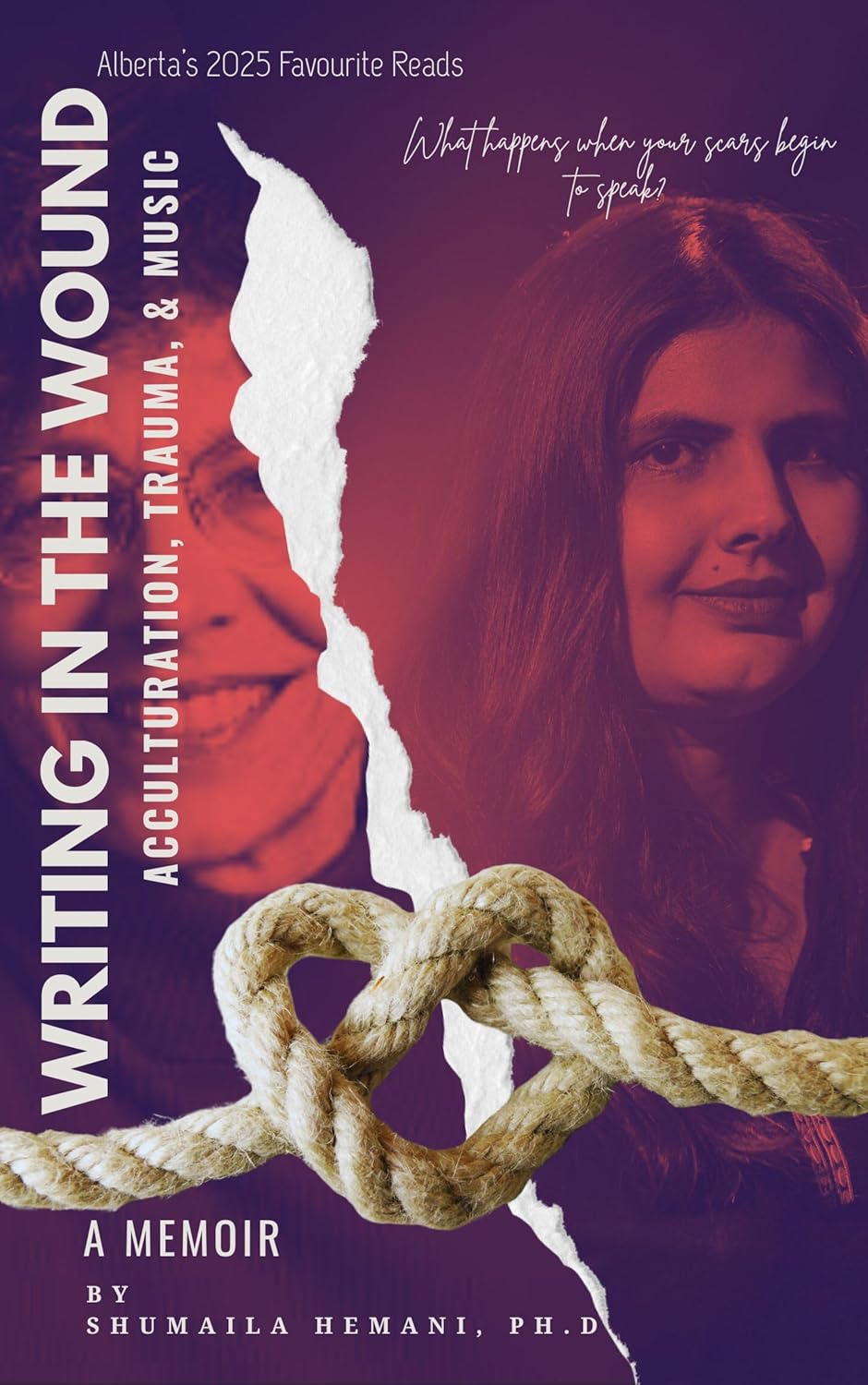
Writing in the Wound is a memoir about what it means to be shaped and repeatedly injured by migration, academia, gendered power, and the long bureaucratic violence of immigration precarity, while still refusing to let art go mute. Author Shumaila Hemani traces that struggle across Karachi, London, Edmonton, Harvard, Banff, Calgary, and beyond, returning again and again to music as both discipline and rescue. What stayed with me most was the book’s insistence that the “wound” is not just a private sorrow but a structural fact, something lived in the body and sharpened by institutions, and that song can become not a cure exactly, but a way of bearing truth without surrendering to it. Scenes like the freezing Alberta night when she seeks refuge in a restaurant lobby, her charged decision between Chicago and Harvard, and the later episodes of artistic endurance under precarity give the memoir a real narrative pulse beneath its reflective surface.
What I admired most was the book’s emotional candor and the seriousness with which it treats art. Hemani writes as if sound were breath, shelter, lineage, prayer, argument, and last defense all at once. I found that deeply moving. Some of the strongest passages are the ones where sensory memory and intellectual reflection fuse cleanly: Karachi’s street sounds and household textures, the strange thrill of hearing the theremin in London, the feeling of Cambridge as a place that “held” her differently, the sea storms aboard the World Odyssey, the pink-moon stillness that arrives after so much psychic abrasion. The prose can be overtly lyrical, but for me, that ambition is mostly earned because it rises from lived intensity rather than decorative flourish.
Its ideas are forceful and, at their best, unsettling. Hemani’s central claim that exclusion is often discussed in abstract policy language while its damage is absorbed by actual bodies felt painfully persuasive. The memoir is strongest when it shows that argument rather than merely stating it: in the humiliations of school and class performance, in the uneasy academic encounters where she feels reduced to a gap to be filled rather than a mind to be met, in the grinding absurdity of years of achievement that still do not translate into belonging. There were moments when I wanted a bit more compression, because the book sometimes circles its pain. But even that repetition began to make sense to me as part of the memoir’s design. Trauma here is not tidy, and Hemani refuses to fake tidiness for the reader’s comfort. I respected that.
I found Writing in the Wound arresting, thought-provoking, and fiercely alive. It’s a memoir that believes art can carry knowledge that institutions cannot properly hear, and that belief gives the whole book its tensile strength. It keeps faith with fracture while still making room for beauty, devotion, and survival. I’d recommend it especially to readers drawn to memoirs of migration, music, trauma, and intellectual becoming, and to anyone interested in how a life in art can be both exalted and terribly precarious.
Pages: 290 | ASIN : B0FVQB8XGV
Different Values: Cultural Shifts in America, From Covid to War in the Mideast

Karyn Elksong’s Different Values, the title of which speaks to well-worn values rather than more contemporary ones, is a wide-ranging moral travelogue through the last few bruising years, written as a series of linked reflections on what the pandemic, political fracture, technological acceleration, climate strain, gun violence, and the Israel-Gaza war reveal about the things we’re quietly choosing to prize. It moves from the intimate texture of Covid-era fear and isolation into big public questions about truth, power, and responsibility, repeatedly circling back to one steady claim: that a culture can modernize at warp speed and still be spiritually impoverished if it loses its capacity for empathy, conscience, and love.
What I kept feeling, as I read, was the author’s fierce insistence on tenderness as something practical. In the war chapter, she opens with that oddly perfect pop-culture parable: Sherlock asking a supercomputer, “What is love?” and the machine hungering for “more data” but never reaching the answer. It’s a scene that could’ve been cute or smug in another book, but here it lands like a small, cold bell. Elksong’s best pages do this often, taking a familiar headline-world object and turning it so you suddenly see the bruise underneath. I also appreciated how she lets grief stay grief. When she writes about children being swallowed by America’s gun “new normal,” the statistics aren’t abstracted into policy-speak; they sit there with a kind of terrible weight, especially when she threads Uvalde into the argument as a lived national trauma rather than a talking point.
Elksong writes in an earnest, essayistic voice that leans on quotation, reportage, and moral appeal, and the abundance of references can feel like a floodlight turned on the reader. Sometimes I wanted a little more trust in the image to do the work without being immediately explained. Yet, the book is also acutely aware of our exhaustion with overload. In the mental health sections, she draws on the language of loneliness and the strange seduction of “connection” without commitment, echoing Sherry Turkle’s warning that we keep people “in touch” while holding them at bay. That tension felt honest to me: the book is itself a product of the very era it critiques, an era where we cite and link and stack evidence because we’re terrified no one will listen unless the footnotes come marching in.
When the lens widens to nature’s retaliation and then narrows to Gaza’s “death world,” is where my emotional resistance broke. The volcanic plume rising into the stratosphere and the blunt reminder of forces that dwarf us felt like more than scene-setting; it read like a rebuke to human swagger. And when she quotes doctors and humanitarian officials describing collapsed hospitals and a society made uninhabitable, she isn’t chasing shock. She’s asking what it does to our shared soul when we learn to tolerate that kind of suffering as background noise. The conclusion she presses toward is clear: love, nonviolence, and moral imagination are not naïve luxuries but the only counterforce strong enough to interrupt revenge. I finished the book feeling sobered and strangely steadied, like someone had insisted I look directly at the worst of what we normalize and still believe in our capacity to choose differently. I’d recommend it to readers who want a reflective, faith-inflected, socially engaged meditation on recent American life, especially those who don’t mind a book that thinks out loud, cites heavily, and keeps returning to conscience as the measure of what a culture is becoming.
Pages: 344 | ISBN : 978-0692038093
Readora From BookTropolis, The Literary Superhero, ABCs in Sports


Readora From BookTropolis is a lively alphabet book that introduces children to sports from archery to zorb through brief haiku-style verses, framed by the larger fantasy of Readora, a reading superhero from the story-filled world of BookTropolis. The book opens by casting reading itself as a kind of magic, with Readora gaining her powers through words and then using them to spark curiosity in children. From there, it moves through the alphabet one sport at a time, pairing simple, rhythmic descriptions with bright illustrations and a cheerful sense of movement. It’s part concept book, part sports sampler, and part literacy pep talk, all filtered through an upbeat, child-friendly imagination.
What I responded to most was the book’s sincerity. It really wants children to feel that reading and play belong together, and that idea gives the whole thing a warm, encouraging pulse. I liked the way it doesn’t stay with only the most familiar choices. Baseball, football, soccer, and tennis are here, of course, but the inclusion of orienteering, quad skating, cross-country skiing, and zorb gives the book a slightly wider horizon. It tells a child that the world is bigger than the handful of sports they already know, and that discovery can be playful rather than intimidating. I also found BookTropolis itself rather charming. It adds a storybook glow that keeps the book from feeling purely instructional.
I admired the attempt to carry the whole alphabet in haiku form, because that constraint gives the book a distinct texture and a gentle musicality. Some of the lines land neatly, especially when they capture a sport in one swift image, like the football pass into the end zone or the tactile sequence in volleyball of bump, set, and spike. The book makes language memorable, not merely functional, and for a young reader that instinct has real value. The illustrations help carry that intention beautifully, keeping the pages animated, diverse, and inviting.
This is a generous, good-hearted children’s book with an imaginative core and a clear belief in what words can do. It has genuine charm, and its combination of literacy, motion, and encouragement gives it a sweetness that feels earned. I’d especially recommend it for young children who are learning letters, beginning to read independently, or already obsessed with sports and action-filled picture books. It would also work well for parents, teachers, and librarians who want something a little more spirited than a standard alphabet book. Overall, I found it earnest, colorful, and easy to like.
Pages: 32 | ISBN : 978-1665785839
Lycan Lineage

Lycan Lineage, by Dorianne Ashe, begins as a high-school love story and then sheds its skin fast: June, a cautious senior counting down to graduation, is attacked in a park by a police officer who turns out to be a werewolf, only to learn that she herself belongs to an ancient lycan bloodline. From there, the book widens from local panic to hidden councils, hunter ancestry, supernatural politics, and a deeper reckoning with lineage, desire, and power. It starts with lockers, gossip, and band rehearsal, then opens into a paranormal world with old hierarchies and older wounds.
I enjoyed this book most when it trusted its feral pulse. The early attack sequence has real momentum, and June’s voice carries a jittery, intimate urgency that makes the danger feel close to the skin rather than merely cinematic. I also liked the way the novel lets adolescence and monstrosity overlap instead of treating them as separate tracks: hunger, embarrassment, attraction, secrecy, self-invention, all of it gets folded into the werewolf mythology. That overlap gives the book its best voltage. Even when the prose leans melodramatic, it often does so with conviction, and conviction counts for a great deal in a paranormal romance. There is something unabashedly moon-drunk about the whole enterprise, and I mean that as praise.
Ashe’s writing is strongest in propulsion and mood. At times, the dialogue states emotion rather than letting it smolder, and some turns in the mythology arrive in a rush, taking June from shock to destiny quickly. But even there, I found myself pulled along by the author’s willingness to go full tilt: secret councils, bloodlines, hunters, Egypt, betrayal, desire, war. The novel does not nibble; it lunges. And while I wanted a bit more polish in places, I never had the bored, beige feeling that plagues so much genre fiction. This book wants to entertain you.
I’d hand Lycan Lineage to readers who like paranormal romance, urban fantasy, werewolf fiction, supernatural coming-of-age, and romantic fantasy with a strong first-person heroine and a taste for danger. Fans of Stephenie Meyer’s Twilight will recognize the charged human-monster attraction, though this novel is wilder, pulpier, and less interested in chasteness than in appetite. Lycan Lineage is messy in the way a storm is messy, loud, darkly glittering, and hard to look away from.
Pages: 307 | ASIN : B0GNCD1Q6Z
Escala’s Wish

David James’s Escala’s Wish is an epic fantasy told as a tavern performance: a gnome bard, Wigfrith Foreverbloom, promises his crowd a true story about a pixie princess whose impulsive kiss ripples outward until it nearly unthreads two realms. Escala Winter slips through a fey crossing, charms a mortal for the sake of curiosity (and vanity), and triggers a brutal chain of consequences, a wolf attack, blood on fern-fronds, and the death of her closest friend, Rihanna. The fey justice system is a cold machine, exile or erasure, and Escala is cast out with a maddeningly cryptic “quest” to remove “boulders” obstructing the True Cycle. What begins as a personal reckoning grows into a campaign of alliances, betrayals, and escalating Void-magic, ending in the shattered ruins of Blackthorn Tower and a final wish that costs her dearly while buying one fragile second chance.
What grabbed me first wasn’t the lore (though there’s plenty), but the audacity of the framing: the book keeps winking at the idea of story as currency, Wigfrith isn’t merely narrating, he’s working the room, shaping grief into something an audience can hold without dropping their mugs. That choice gives the novel a lively pulse: the big concepts, law, fate, the ethics of interference, arrive braided with humor and performance instead of dumped like a lecture. Even when the fey court’s rules turn severe, exile, the Wane, the pitiless weight of consequence, the voice keeps the pages turning, as if the book knows that dread lands harder when it’s delivered with a grin that’s one degree too bright.
My strongest reaction, though, was how insistently the story treats “love” as both weapon and wound. Escala’s first choice is selfish, almost childish; she wants to feel something, to test a myth with her own mouth, and the fallout is not abstract. Later, when the conflict widens into Void-storm spectacle and hard-won camaraderie, the book keeps tugging back toward the intimate costs: guilt that doesn’t wash off, loyalty that frays under pressure, and the particular cruelty of memory, what it preserves, what it erases, what it refuses to forgive. By the time the climax cracks open at Blackthorn Tower, the action is ferocious, but the emotional argument is sharper: power without care becomes hunger, and hunger becomes apocalypse.
Escala’s Wish is for readers who want epic fantasy, fae court intrigue, portal fantasy, and romantic adventure with a storyteller’s swagger and a moral spine, especially if you like your magic system half-mythic, half-legalistic, and always ready to bite. If The Name of the Wind by Patrick Rothfuss hooked you with its tavern-born narration and legend-making, Escala’s Wish offers a tale that knows performance can be a form of truth.
Pages: 662 | ASIN: B0G1XRP6DW


