Category Archives: Book Reviews
Our Extraordinary 300,000-Year Journey. Our Ancestors, Their Resources, and Their Incredible Story


Ruth Finnegan’s Our Extraordinary 300,000-Year Journey is an ambitious and searching account of human survival told through the oldest and most ordinary of necessities: food. Beginning with life in the deep ocean and moving through animal foraging, human migration, cultivation, trade, domestication, cooking, sweetness, ritual, and the fragile wonder of the present, the book argues that our history has never been a clean ascent of human mastery. It is instead a long, improvised, creaturely story shaped by hunger, chance, ingenuity, memory, cooperation, and the astonishing generosity of the earth. Finnegan’s central insight is both simple and profound: food isn’t merely what sustained the journey; it is the thread that reveals what kind of beings we are.
What moved me most was the book’s refusal to flatter humanity too easily. Finnegan keeps returning us to continuity, to the humbling fact that humans did not invent survival from nothing. Bees manufacture honey with exquisite precision, nutcracker birds store thousands of seeds against scarcity, ants “milk” aphids, honeyguides recruit humans to open nests, and chimpanzees hunt with tools and strategy. These examples could have felt like curiosities in a lesser book, but here they become part of a moral enlargement. I found myself increasingly persuaded by the author’s insistence that our story is less about domination than participation. Even the grand phrases of history, like “agricultural revolution” or “Columbian exchange,” are gently unsettled. Finnegan asks us to imagine not abstractions but hands, mouths, children, gardens, fear, hunger, luck, and small acts repeated until they became civilization.
The writing has a distinctive warmth, at times almost conversational, at times lyrical. I admired the way Finnegan braids scholarship with personal memory, especially the Donegal scenes of wartime foraging, nettles for soup, cockles in the sand, crab rock, wild strawberries, and the dangerous gathering of carrageen seaweed. Those moments give the vast historical sweep a human pulse. The manuscript can sprawl, and its abundance of examples sometimes makes the reading feel more like wandering through a richly stocked natural history cabinet. Yet that profusion is also part of its charm. The book thinks associatively, generously, with a mind alert to apples and olives, potatoes and oranges, milk and tea, hunger and hospitality. I often wanted to linger in the author’s wonder.
By the end, I felt the book had made the familiar strange again. A bowl of olives, a cup of tea, a potato, an orange, a cooked meal, even the phrase “put the kettle on” began to feel like small inheritances from an immense and precarious past. This is a thoughtful and intellectually capacious work, and its best passages carry both gratitude and warning. Our journey, Finnegan reminds us, was never guaranteed, and it still isn’t. I would recommend this book to readers who enjoy expansive cultural history, anthropology, food history, and reflective nonfiction that asks large questions without losing sight of ordinary human tenderness.
Pages: 3803
RECLAIMING THE EDGE: Risk, Responsibility, and Modern Masculinity


Reclaiming the Edge is Garrett Carr’s searching meditation on what happens when men are deprived of meaningful risk, honest consequence, and responsibility scaled to their capacity. Drawing from his years in the Air Force, his transition into civilian life, his work in real estate and entrepreneurship, the rupture of betrayal and divorce, and the clarifying demands of fatherhood, Carr argues that modern masculinity doesn’t need more theater, rage, or nostalgia. It needs contact with reality. The book moves through anxiety, discipline, sensitivity, leadership, romance, addiction, initiation, business, and fatherhood with a steady insistence that men are not broken so much as underutilized, misdirected, and often starved of the very pressure that would help them become whole.
What I found most affecting was Carr’s refusal to make masculinity either sentimental or brutal. He writes with the voice of a man who has been corrected by life, sometimes harshly, and who has chosen to turn those corrections into language rather than armor. The best passages have a clean, almost flint-struck clarity: the skipped preflight check that taught him consequence without humiliation, the first real estate flip where fear didn’t vanish but became irrelevant beside preparation, the painful recognition that sensitivity in his first marriage had gathered accurate signals long before he trusted them. These moments give the book its weight. Carr is at his strongest when he’s not explaining manhood in the abstract, but showing how judgment is forged in the body, in memory, in the bruise of having misread reality and lived with the bill.
Carr’s style can be aphoristic. It creates a drumbeat, a sense of moral pressure, and at its best it feels less like instruction than a man thinking aloud with hard-won seriousness. I especially appreciated how he treats sensitivity not as weakness but as perception requiring discipline, and how he connects fatherhood to risk without reducing parenting to authority or performance. His account of taking his sons hunting, where power is joined to consequence and restraint, is one of the book’s most quietly haunting images. The ideas are stern, but not cold. Beneath the discipline, there’s tenderness.
I found Reclaiming the Edge to be a sincere, bracing, and often moving book about becoming trustworthy under pressure. Its power lies not in offering a fashionable theory of masculinity, but in asking men to stop confusing comfort with peace, stimulation with purpose, and confidence with proof. Carr’s conclusion feels earned because the book keeps returning to the same lived truth: responsibility is not the enemy of freedom, but the thing that gives freedom shape. I’d recommend this book to men who feel restless inside a comfortable life, to fathers thinking seriously about what they’re modeling, to veterans navigating civilian drift, and to readers interested in a grounded, emotionally honest account of masculinity that values strength without cruelty and reflection without retreat.
Pages: 210 | ASIN: B0H22H3J6C

Managing the Bucket List: The Journey Begins Volume I


Carol McIlwain’s Managing the Bucket List: The Journey Begins, Volume I is part travel memoir, part bucket-list reference guide, and part wide-ranging meditation on how seeing the world can deepen a person’s understanding of history, culture, nature, and global politics. McIlwain frames her post-retirement “Travel Big Year” as both an adventure and an intellectual project, moving from explanations of bucket lists, UNESCO sites, wonders of the world, and religious landmarks into a packed year of trips through Portugal, Patagonia, Italy, Seattle, Switzerland, northern France, Australia, Alaska and western Canada, Spain and France, the Danube, Costa Rica, and southern Florida. What emerges is not a sleek little travelogue, but a big, earnest, densely packed record of a mind trying to make sense of the world by walking through it.
What I appreciated most about the book is its sincerity. McIlwain writes like someone who doesn’t just want to collect places, but to be changed by them. Her descriptions often have the feeling of a journal opened after a long day, still warm from motion. I felt that most strongly in Patagonia, when she describes eating a bag lunch across from Perito Moreno Glacier, listening for the deep crack of calving ice and trying, again and again, to catch the moment on camera. That’s the kind of travel writing I like, not merely “I went here and saw this,” but the small human comedy of awe, impatience, and wonder all tangled together. I also liked the way she treats travel as a form of education. A visit to the Vatican turns into a reflection on Michelangelo, power, faith, and artistic endurance; the Camino de Santiago becomes not just a route, but a symbol of fellowship and persistence; Costa Rica’s rainforests and renewable-energy commitments open into broader questions about stewardship. At its best, the book makes curiosity feel like a moral habit.
McIlwain’s style is informational, and there are moments when a castle, cathedral, glacier, or city arrives wrapped in a lot of background. I found that accumulation of detail endearing because it reflects the book’s central temperament. This is a planner’s travel memoir, written by someone who thinks in systems, lists, contexts, histories, and connections. The ideas are especially interesting when McIlwain lets travel complicate her thinking, as when she connects difficult histories, colonial legacies, religious conflict, UNESCO preservation, and the fragility of peace. I didn’t always need every detour, but I respected the ambition behind them. She’s asking the reader to see tourism not as escape, but as a way of becoming less provincial, less passive, and perhaps a little more responsible.
Managing the Bucket List: Volume I is less about checking boxes than about resisting the smallness that can come from staying too settled in one view of life. Its spirit is generous, practical, and urgent: go while you can, learn while you’re there, and let the world revise you. I’d recommend this book to thoughtful travelers, retirees planning a major season of exploration, lifelong learners, and readers who enjoy travel writing with a strong historical and geopolitical backbone rather than a purely lyrical one.
Pages: 544 | ASIN: B0G9BBB4DY
CLASS REUNION: Keep Your FRIENDS Closer
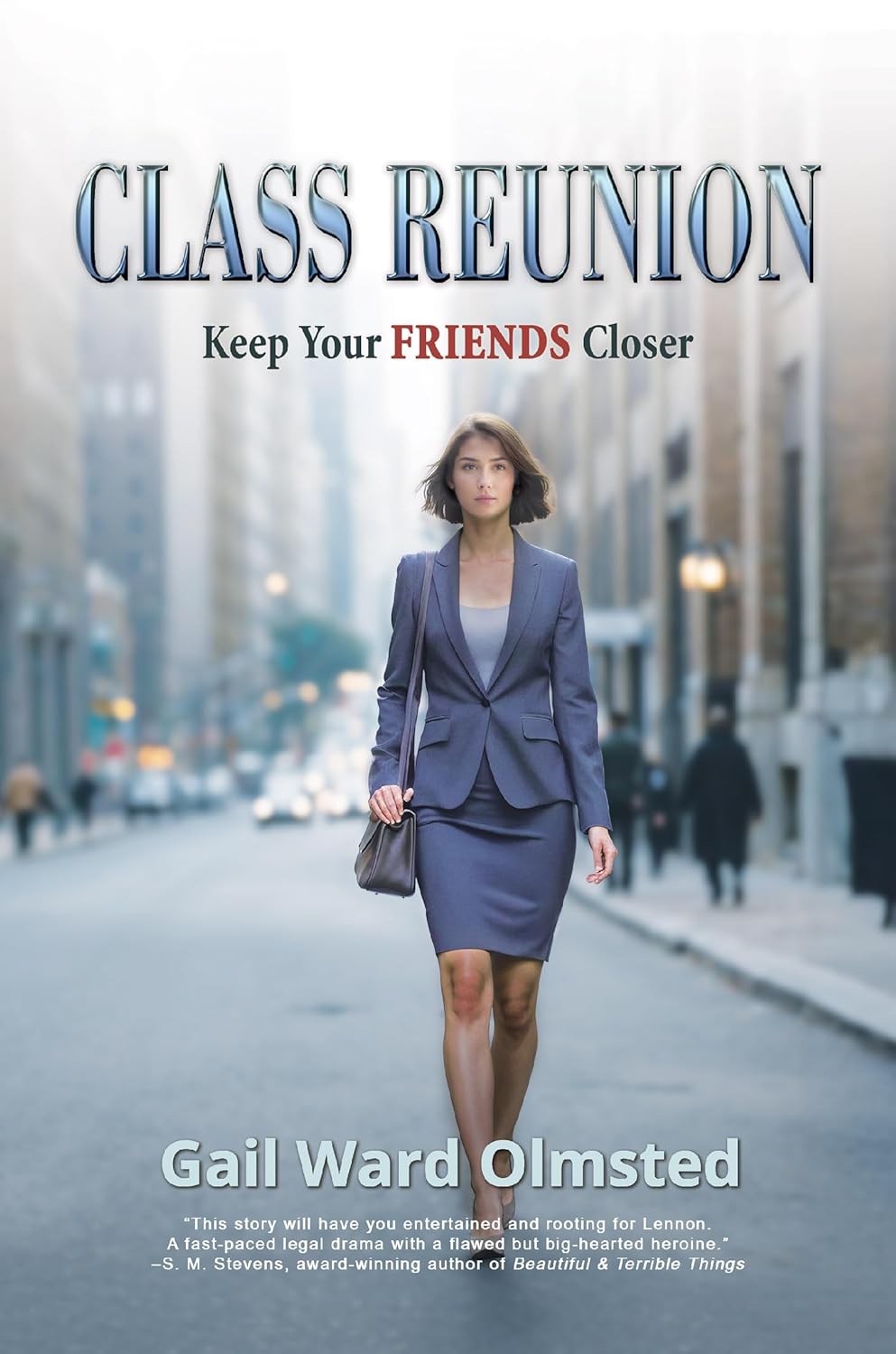
Gail Ward Olmsted’s Class Reunion follows Lennon Gallagher, a sharp, guarded Connecticut attorney whose carefully ordered life is interrupted when Erin Cooper, a former law school friend who once betrayed and saved her, resurfaces after being arrested for domestic violence. What begins as an uneasy favor spirals into a murder case, forcing Lennon to confront old wounds, professional risk, romantic strain, and the unnerving question of whether someone from the past can ever be fully known.
I enjoyed how the novel refuses to let Lennon remain comfortable for long. She is competent, funny, prickly, and deeply human, the kind of narrator whose sarcasm feels less like decoration than armor. Olmsted gives her a life beyond the case, Nick, wedding plans, family complications, friendships, work pressures, and that fullness makes the legal drama feel personal rather than procedural. The story’s best tension comes from Lennon’s divided instincts: she wants to believe in justice, but she also knows how easily charm can masquerade as innocence.
What stayed with me most was the book’s attention to friendship as a dangerous, shifting terrain. Erin is not simply a villainous presence or a wounded innocent; she is a provocation, a reminder that loyalty can be both noble and foolish. The pacing is brisk, with courtroom scenes, emotional reckonings, and sudden turns arriving in quick succession, yet the novel still leaves room for humor, tenderness, and those small domestic details, cake, coffee, dogs, and family dinners that make the danger feel more intimate. I found the result engaging, occasionally sly, and satisfyingly volatile.
Readers who enjoy legal thrillers, suspense, women’s fiction, romantic suspense, and courtroom drama will find plenty to admire here, especially if they like strong female protagonists whose private lives are as compelling as the case file. Fans of Lisa Scottoline may recognize a similar pleasure in the blend of legal peril, emotional candor, and female-centered storytelling, though Olmsted gives Lennon a distinctly tart, self-protective voice of her own. Class Reunion is a brisk, twisty reminder that I easily recommend.
Pages: 264 | ASIN : B0GX5Z7KJY
Played, A Jack Gilbert Slow Burn Thriller
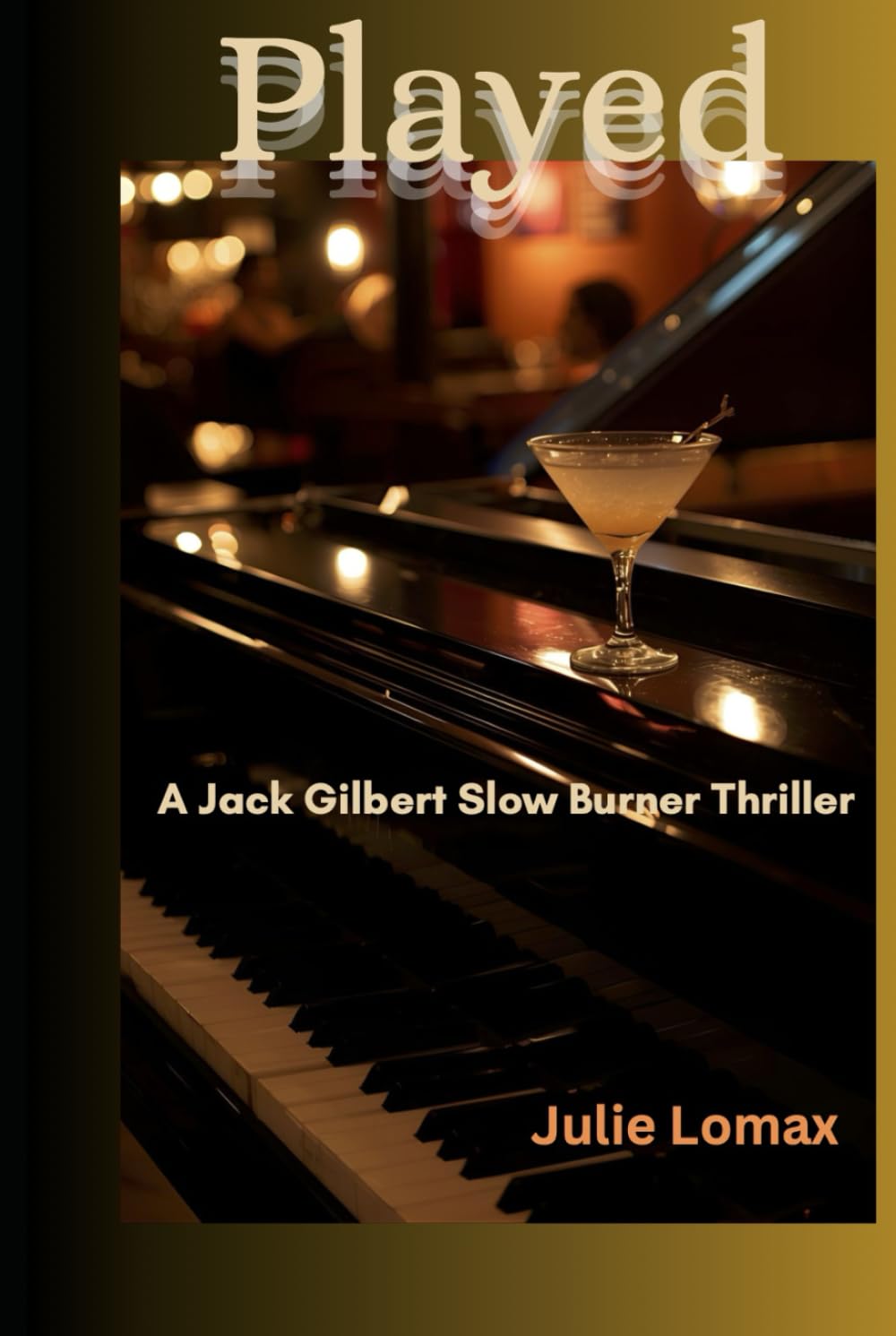
Played, by Julie Lomax, is a psychological thriller built around a sinister geocaching app, a string of disappearances, and a dangerous game that pulls several families into its path. Caroline Morgan, her daughter Bailey, piano man Jack Gilbert, and a troubled young man named Dwayne all become connected through JD, a calculating figure who uses technology, puzzles, and human weakness to control the people around him. As a work in the slow-burn thriller genre, the book takes its time setting up its players before tightening the trap.
What stood out to me first was the way Lomax uses ordinary spaces to create unease. A neighborhood walk, a bookstore event, a bar with piano music, a phone screen glowing in someone’s hand. None of these should feel threatening, but they start to. The danger doesn’t arrive as one big dramatic entrance. It seeps in. The writing is at its best when it lets small details do the work, especially around Jack’s quiet observations and Caroline’s growing discomfort. There are moments when the story feels somewhat crowded, with many characters and threads moving at once, but that also gives the book its restless energy.
I was also interested in the author’s choice to make technology feel both familiar and predatory. The app isn’t some far-off science fiction device. It feels like something people might actually scan without thinking, which makes the premise hit harder. The book asks the reader to keep up with a lot: family trauma, missing women, old secrets, shifting loyalties, and a widening criminal pattern. I wanted a little more breathing room between revelations. Still, the emotional core kept me reading. Dwayne, in particular, adds texture because he is not simply one thing. He is angry, damaged, foolish, and sometimes more aware than people expect. Jack also grows into a strong anchor for the story, the kind of character who watches the room before anyone else knows there is something to see.
I recommend Played to readers who enjoy psychological thrillers with a dark puzzle-box structure, a large cast, and a steady build rather than a quick sprint. Fans of crime stories that mix family tension, surveillance, manipulation, and small-town dread will find plenty to dig into here. It’s best for readers who like their thrillers layered and a little messy in a relatable way, where the danger isn’t just who has the weapon, but who has been watching all along.
Pages: 389 | ASIN : B0G48H14RG
Making Global Sense: Grounded hope for democracy and the earth (inspired by Thomas Paine’s Common Sense)

Making Global Sense is Judah Freed’s ambitious and personal attempt to carry the spirit of Thomas Paine’s Common Sense into the crises of the twenty-first century. Blending memoir, political argument, spiritual reflection, and social critique, Freed calls for a “global sense” rooted in interdependence, mindful self-rule, democracy, gender equality, ecological responsibility, and resistance to authoritarianism. The book moves through antiwar protests, illness, childhood wounds, cult experience, world travel, marriage, cancer, climate anxiety, and democratic peril, using the author’s life as both evidence and vessel for a broader plea: humanity must outgrow its craving for kings and learn to govern itself with courage, conscience, and care.
Freed doesn’t write as a detached theorist arranging ideas behind glass; he writes as someone who has been bruised by the very forces he’s trying to name. His recollection of the 1971 May Day protest in Washington, DC, with its mixture of youthful idealism, state violence, and spiritual awakening in the woods afterward, gives the book its essential grammar. Again and again, public crisis folds into private reckoning. The same pattern appears in his account of surviving Stage IV cancer on Kauai, where the body becomes a map of fear, will, dependence, and grace. I found those passages the most affecting because they keep the book from floating away into abstraction. Freed’s ideas are large, sometimes almost planetary in scale, but his best writing happens when he lets a single scene carry the weight: a medic armband, a hospital bed, a crushed car under a snow-laden limb, the strange quiet at the Chalice Well, a driver in Mumbai trying to understand an American who wants Gandhi rather than shopping.
I admired the book’s moral urgency. Freed’s central concepts, especially “alpha male rule” and “authority addiction,” are forceful and memorable, and at their best they illuminate the hidden emotional bargains people make with power. His argument that democracy is not only a political structure but an inner discipline feels genuinely valuable. Climate change, patriarchy, authoritarian politics, consumer culture, trauma, spiritual awakening, economics, and global governance all gather under one immense canopy. Freed is not interested in tidy compartmentalization. His style has the breathless drive of a lifelong journalist who has also become a survivor, seeker, and elder. It can be aphoristic, impassioned, blunt, tender, and occasionally overfull, but it rarely feels indifferent.
The ideas that stayed with me most were the ones linking personal growth to democratic responsibility. Freed’s insistence that inner work and outer work belong together feels less like a slogan than a hard-won conclusion. His proposal of “personal democracy” asks for something more demanding than voting or agreeing with virtuous principles; it asks for a kind of daily moral adulthood. I was especially moved by the way he returns to Thomas Paine not as a museum figure but as a living provocation. Paine’s challenge to monarchy becomes, in Freed’s hands, a challenge to every place we still secretly want someone else to think, choose, rescue, punish, or rule for us. Making Global Sense is a brave, searching, and unusually intimate book, written with the conviction that hope must be grounded or it becomes fantasy. I’d recommend it to readers drawn to political spirituality, democracy movements, climate ethics, memoir-driven social criticism, and big, earnest books that ask not only what the world needs, but what kind of person we’re willing to become.
Pages: 357 | ASIN : B0DLHMMS72
Encrypted Patriot: The Ghosts That Protect America

Encrypted Patriot, by D. M. Currie, is a hard-charging political and military thriller built around a covert team operating in the shadows while America faces an attack from the inside out. The story follows Cash, a private investigator pulled into the world of NCOD, where secret missions, hidden enemies, and impossible choices become part of his new reality. From the opening assassination attempt to the final pursuit of Locke, the book keeps its focus on people who operate where official records don’t reach.
What gives the novel its shape is its sense of mission. Currie presents Cash and his team as men and women who live by loyalty, sacrifice, and country, even when those ideas come at a brutal personal cost. The line “History will not remember them” captures the book’s view of these characters: they’re protectors who may never be known, but whose actions matter deeply. That idea runs through the entire story and gives the action a bigger emotional frame.
The plot moves quickly, jumping from desert compounds and safe houses to Greece, Mexico, Washington, and the Pacific. There’s a lot happening, including terrorist cells, corrupt officials, foreign influence, poisoned infrastructure, drone attacks, betrayals, and a national crisis that turns into a fight for the country’s future. Currie writes with an urgent, cinematic style, and the chapters often end on a hook that pushes the reader into the next mission.
Cash is the center of the book, but the team dynamic gives the story much of its energy. Tanner brings grit and personality, Wesells adds another layer of operational tension, and Locke becomes one of the most compelling figures because her role keeps shifting as the truth about her comes into focus. The relationship between Cash and Locke adds betrayal and personal pain to the larger conspiracy, especially once the team becomes “dead men walking” and the mission turns even more personal.
Encrypted Patriot is a patriotic thriller with a big scope, a fast pace, and a strong appetite for danger. It’s about covert warriors, compromised institutions, and the cost of defending a country when the enemy is already inside the gates. Readers who enjoy action-heavy thrillers with secret operations, political stakes, and a constant sense of escalation will find a story that leans fully into intensity and keeps pushing until the final page.
Pages: 422 | ASIN : B0GP6DH42Y
Outbreak (The Dark Days Series Book 1)

Outbreak: The Dark Days Book One follows Sonny, a young boy whose ordinary summer collapses into terror when a mysterious infection spreads across the world. What begins with family breakfasts, mall trips, and nervous rumors soon becomes a brutal fight for survival through quarantine zones, military violence, zombies, refugee camps, and fractured communities. The story is less about the outbreak itself than about what it steals: childhood, certainty, safety, and the simple belief that adults know how to fix things.
I was most affected by the novel’s insistence on filtering catastrophe through Sonny’s young perspective. His voice gives the horror a raw immediacy; he notices the strange details children notice, from favorite cartoons to birthday memories, even as the world around him is turning feral. That contrast gives the book its sting. The violence is often harsh, but the emotional damage lingers longer than the bloodshed. Sonny’s grief, fear, guilt, and stubborn loyalty become the real pulse of the story.
What really affected me, though, was the book’s bleak but persistent attention to human connection. Families are broken apart, friends are lost, and safe places keep proving temporary, yet the characters keep reaching for one another. The novel is at its strongest when it pauses amid chaos to let people comfort, argue, protect, or mourn. Some scenes are rough-edged and direct, but that bluntness suits the world author Christopher Cole is building: a place where tenderness has to fight for oxygen.
I think this book is best suited for readers who enjoy young adult dystopian fiction, zombie apocalypse horror, survival thriller, post-apocalyptic adventure, pandemic fiction, and coming-of-age horror. Fans of The Walking Dead will recognize the same grim question underneath the carnage: when civilization dies, what kind of person survives in its place? Outbreak is a fierce and grief-marked survival story about a boy forced to grow up while the world burns around him.
Pages: 245 | ASIN : B0G4GQ9J5N


