A Mix of Emotions

Is There Not a Cause? is a raw and unapologetic collection of poetry, songs, stories, personal reflections, and scenes of life that explore faith, pain, and personal development in a way that leaves the reader feeling raw and alive. What inspired you to write this particular collection of poems?
This collection was initially published in 2021. This re-release has over twenty-five new poems. My inspiration to write this collection came from time and experiences, loss, growth, pain, love, social climate around the world, faith, and more.
How do you approach writing about deeply personal or emotional topics?
I approach it the same way I do most of my pieces. I also do spoken word, so the majority of my poems are written from the perspective of me speaking to an audience or myself. For whatever reason, that makes it easy for me to share and or express deeply personal or emotional topics.
How did you go about organizing the poems in the book? Was there a specific flow or structure you were aiming for?
The beauty of the book is that there is no form or structure. The poems/stories/songs flow almost at its own pace, creating a mix of emotions, thoughts, concerns, and anthems.
How has this poetry book changed you as a writer, or what did you learn about yourself through writing it?
I learned how to truly lock in. This past year was a challenge in many ways. All in all, it made me a better writer, speaker, and performer. Writing this book was a great challenge in not depending so much on rhyming and rhythm. Allowing me to put greater effort into storytelling and free verse.
Author Links: GoodReads | Facebook | X (Twitter) | Website | Amazon
Published in numerous magazines and online, esteemed poet and wordsmith Nathaniel Terrell re-releases his first collection of unapologetically raw and honest reflections. If you are someone who prefers to experience life and savor its moments – sacred, painful, and true – you will find favorites in this collection that you will return to. The works will touch your soul in the way poetry should.
IS THERE NOT A CAUSE? by Nathaniel Terrell is a collection best taken one page at a time and is a collection worth savoring and rereading. Each poem is replete with the wisdom and enlightenment gained from someone who experiences life and savor its moments. His words are sacred, painful, and true, and his works will touch your emotions and will find their way into your soul, just as good poetry should.
This re-release is a powerful debut collection containing songs, stories, personal reflections, and scenes of life, with some new poems highlighting growth and maturity. Written from the perspective of a passionate, creative black man working hard to share his voice with the world, each poem paints a vivid picture of the soul of an artist. It grapples with topics such as life and death, racism, faith, anger, social injustice, division in the nation, and getting up after failure. These poems are meant to encourage and to provoke and desire, and will take you on a journey that starts fast and hard and dives deeply into the human condition.
Contemporary culture seeks to define us and forge our identities. Things are never that black and white. The real human condition is a personal journey through pain and ignorance as we seek hope, inspiration, and enlightenment. Each poem conveys important messages about the capacity to pry open our hearts and be connected with our true nature. His warm, inspirational words will encourage and provoke you to take a journey that will start fast and dive deeper. It’s an invitation to mindful presence where the words and artistic expressions compel you to find peace with yourself and the world.
For more on Nathaniel Terrell’s works, visit him on social media at natej.story or at http://www.natejstory.com.
Justice and Loyalty

Part of the Solution: A Mystery follows a New York professor who experiences a chance meeting that pulls her back into the 70s and brings her closer to a death that shook the community she once called home. What was the inspiration for the setup of your story?
Setting Part of the Solution in 1978 was an easy choice because the very first version of the book was written in 1978! I had just finished a dissertation in English literature, and I’d survived graduate school by sneaking off to read murder mysteries when I couldn’t bear one more page of “serious” literature. A few years ago, I reread my original manuscript and decided to rewrite it as a period piece. I thought it would be interesting to go back to that time and wrestle with who we “Boomers” were back in the day – idealistic, earnest, and hopeful but also very young and sometimes very silly. The book is completely different now. In some ways, it’s a comedy of manners as much as it is a mystery.
Yet comedy of manners though it is, I don’t want to overemphasize the humor in the book. In the process of rewriting, the mysterious death at the core of the original plot took on a deeper meaning. Now my main character, Jenifer, has had forty years in which she has had to live with what happened. The decisions she made at the time as the “amateur detective” have shaped her life in ways that she – and even I – could never have imagined at the time.
What is it that draws you to the mystery genre?
I have a complicated relationship with the mystery genre. I love the structure and discipline of the classic whodunit in which all the clues and red herrings line up in a way that plays fair with the reader. I love the puzzle at the heart of the genre and, to quote the title of my book, the `solution’ that is revealed at the end. But I am also troubled by how much fun such mysteries are because death, even in fiction, shouldn’t be fun. I worry that devouring mysteries the way a lot of us do ends up dulling our responses and thus numbing an important piece of what makes us human. I don’t want the characters, or even the reader, to get off scot-free.
In Part of the Solution, I tried to tell a story in which the characters don’t get off scot-free because they are changed forever by what has happened to them. I wanted them to have to wrestle on a deeply personal level with the issues that are raised. What does justice mean? What does loyalty mean? How do different people understand those terms, and what difference does that make? Jennifer and Ford – the amateur detective and the official detective – have very different relationships to questions of justice and loyalty, and those questions matter to them both. The very different answers they come up with have never stopped haunting them.
How did the mystery develop for this story? Did you plan it before writing, or did it develop organically?
The mystery plot was there from the beginning. I had a wonderful time inventing a set of wonky characters in an imaginary little hippie town in the Berkshires, with the challenge of trying to figure out who among these various peace activists, artisans and poets, leftwing intellectuals, and spiritual seekers would murder someone, and why. Once I had the mystery structured, I could relax into writing the dialogue and the scenes. What were they listening to on the stereo? What were they arguing about? Laughing about? What were all of them wearing? How did they understand the world around them, and how were they trying to change it for the better?
What is the next book that you are working on, and when will it be available?
I want to bring Jennifer and Ford back together in the present day. They are both in their late ‘sixties now, and they meet up again at a conference during which someone dies mysteriously. I have the plot lined up as well as most of the characters. I haven’t gotten very far in the writing yet, but I’ve booked myself some time away this winter just to write, and I’m planning to have it done by the end of this coming year.
Concern for her community prompts Jennifer to investigate the murder with the sometimes-reluctant help of Ford McDermott, a young police officer. Little does she know that the solution lies in the hidden past.
Part of the Solution blends snappy dialogue, unconventional settings, and a classic oldies soundtrack, capturing the essence of a traditional whodunnit in the era of sex, drugs, and rock-and-roll.
The Pressure of Testing

Tokyo Juku follows an eighteen-year-old student in Japan who, while studying all night in her cram school, discovers one of her teachers has been murdered, leading to an investigation into the education system. What was the inspiration for the setup of your story?
The main inspiration comes from talking with my students. Their struggles inspired me to write about them. I teach at a university, so hearing from my seminar students about what they’ve been through really made me rethink the Japanese educational system from their perspective. One of the largest problems is the pressure of testing. Students hate tests. I mean, really hate them! My job entails evaluation, but more as individual feedback than standardized testing as social gatekeeping. Over the years, when I tell people that I teach at a university, they often cast their eyes down and mumble the name of their school, a little embarrassed at their past failings. Or, just the opposite, very proudly. That’s a sad reaction to what should be a life-transforming experience. In the novel, I wanted to take my students’ stories, my observations, and others’ experiences and condense them into the struggles of the main character, Mana. Like most Japanese, she has to learn how to navigate treacherous educational waters. As an educator and a writer, I’m on the side of improvement, but that’s easier said than done.
How has character development for Detective Hiroshi Shimizu changed for you through the series?
Hiroshi has evolved through the series. In the first novel, he had just returned from America and found the detective job through a connection. He works the job reluctantly but gradually finds he is pretty good at it, despite being resistant to crime scenes and the grittier aspects of the job. He reconnects with his college girlfriend, moves in with her, and they start a family in the latest novel. That idea of fatherhood causes him great anxiety because of what he’s seen behind the curtain. Does he want to bring a child into the world he’s glimpsed while working in homicide? But he has a knack for finding the pattern in the chaos of cases, and he’s needed.
Was it important for you to deliver a moral to readers, or was it circumstantial to deliver an effective novel?
An effective novel comes first. The moral is something that occurs in readers’ minds. I think if you push a moral or make themes too explicit, it takes away from the beautiful ambiguity of reading. As a writer, I can nudge readers in specific directions, but they will draw their own conclusions. So, if you push a moral without a compelling story, it comes across as preachy. Nobody likes that. Readers have their own reactions to the characters’ conflicts, which might yield a moral they take away, but it might also be something more complex—a conclusion or understanding that doesn’t fit into the frame of a moral. The conflicts and confusions of characters are at the heart of an effective story. I focus on that. My job as a writer is to keep them turning pages, thinking, and enjoying the ride.
Can you tell us more about what’s in store for Detective Hiroshi Shimizu and the direction of the next book?
The next book will focus on the tourist industry, which has really taken off in Japan. I have culture shock—or maybe reverse culture shock—in parts of the city swamped with visitors from abroad. That’s changing the city. I’m not against that, but the influx of tourists and tourist money has not been clearly planned for. And much of Japan is highly planned. Japan is internationalizing, in good and bad ways, so that Hiroshi will be needed even more with his English and accounting skills. He’s got plenty more cases to work on.
Author Links: GoodReads | X | Facebook | Website
Eighteen-year-old Mana pulls an all-nighter at her juku, a private Japanese cram school that specializes in helping students pass the once-a-year exams. She failed the year before but feels sure she’ll get it the second time—if she can stay awake. The Japanese saying, “Four pass, five fail,” presses her to sleep just four hours a day, and study the rest.
When she wakes up in the middle of the night, head pillowed on her notes, she takes a break down the silent hallway. A light comes from an empty classroom, and still sleepy, she pushes open the door to discover something not covered in her textbooks. Her juku teacher, the one who got her going again, lies stabbed to death below the whiteboard, with the knife still in his chest and the AV table soaked in blood.
Detective Hiroshi Shimizu is called in, and though he’s usually the forensic accountant, not the lead detective, he’s put in charge of the case. With the help of colleagues old and new, he’s determined to find the killer before the media convicts the girl in the press, the new head of homicide pins it on her, or big money interests make her the scapegoat.
Hiroshi follows up on uncooperative witnesses, financial deceptions, and the sordid details of some teachers’ private lives. Even as he gets closer, the accumulating evidence feels meager amid the vastness of the education industry, and the pressures and profits of Japan’s incessant exams.
At the outset of the investigation, Hiroshi listens as an education ministry official lectures him on how education holds the nation together, but he soon discovers how it also pulls it apart, and how deadly a little learning can be.
Looking for Trouble
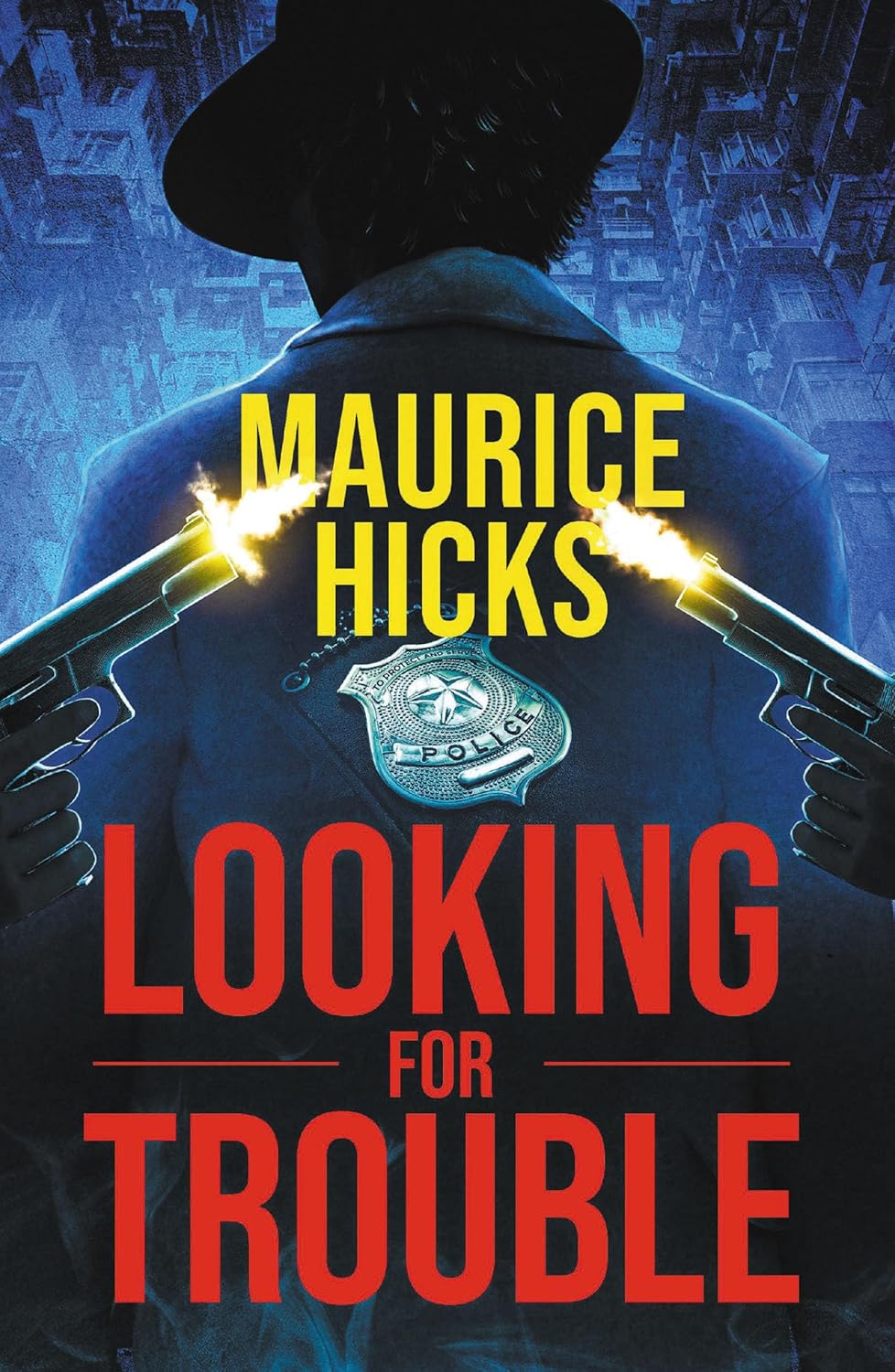

Looking for Trouble follows Maurice Hicks from his childhood in Baltimore through his early years in law enforcement. The book moves fast, almost breathless at times, as it shows a kid growing up in a rough world who somehow stays hopeful. It tracks his path from a paperboy with big dreams to a Marine and then to a police officer who ends up facing danger that feels unreal. The stories unfold with heat and sweat and fear and sometimes humor, and they paint a picture of a city that seems alive and angry and wounded all at once. What struck me most was the constant push and pull between survival and duty. The book never slows down. It grabs you at the start and keeps going.
The writing is blunt. It is raw in spots. It has a rhythm that feels like someone talking to you across a table late at night. The scenes inside the housing projects made my stomach knot. The tension builds so sharply that I kept catching my breath. At the same time, the author also slips in these little pieces of heart, small moments of gratitude or pride or humor that soften the edges. I liked that mix. It made the stories feel relatable. I found myself angry at the chaos around him, frustrated at the failures of systems that should have helped people, and surprised by how quickly small choices could turn dangerous. The book does not try to pretty anything up. It gives you the smoke and the noise and the fear straight up, and I respected that.
What stayed with me even more were the quieter reflections woven into the story. The author writes about the weight officers carry and the scars they collect along the way. He also writes about the people who shaped him, from family members to neighbors to teachers who saw more in him than he saw in himself. Those parts hit me hardest. They felt honest. They felt like memories he never stopped holding. I found myself thinking about how the environment shapes a person and how strength sometimes comes from the most unexpected places. The ideas here feel grounded. Nothing lofty. Nothing inflated. Just real life and the lessons scraped out of it.
I would recommend Looking for Trouble to readers who want a vivid, unfiltered look at police work, city life, and the long road a person walks to find purpose. It is a strong fit for people who enjoy memoirs that pull no punches and for readers curious about what it feels like to be inside the chaos instead of watching it from far away. The book is sharp, tense, and full of heart.
Pages: 535 | ASIN : B0C15B8JDB

Overlooked Corners of History

An Unsuitable Job follows the first woman detective in her Las Vegas agency, who is investigating the murder of a salesman at a hotel and encounters a dismissive attitude from those around her. What was the inspiration for the setup of your story?
The idea came from my fascination with overlooked corners of history, especially those involving courageous women who quietly broke barriers. When I discovered the real-life Harvey Girls—young women trained to serve with precision and elegance across the American West—I saw the potential for a deeper story. Many of these women had grit and ambition but were often remembered only for their uniforms or smiles. I wondered: what if one of them refused to fade into the background? What if she stepped into a role no woman had held before—like that of a detective?
The hotel setting, inspired by the historic Castañeda Hotel in Las Vegas, New Mexico, was the perfect place to explore class, gender, and secrecy. A grand old hotel invites both luxury and scandal—and that’s where Josie MacFarland steps in.
I found Josie to be an intriguing character, and I admired her determination to prove herself in a career dominated by men. What was your inspiration for this character?
Thank you—I admire her too. Josie is very close to my heart. She’s smart, observant, and deeply principled, but also shaped by the pressures of 1929: the Great Depression, limited choices for women, and expectations from her family. I gave her my own stubborn streak and added a longing for justice and belonging that I think many of us share.
She’s inspired in part by the women in my own family—strong, capable, and often under-recognized—and by the many female pioneers who were told they were “unsuitable” for one reason or another. Josie doesn’t just want a job; she wants to matter. And she wants to do it her own way.
How did the mystery develop for this story? Did you plan it before writing, or did it develop organically?
A bit of both. I began with a clear sense of the victim and the setting—who died, where, and why it would shake up the community. But the full mystery unraveled as I wrote. I’m a big believer in letting characters surprise me. Once I had Josie on the page, her instincts began to shape the investigation. Clues appeared I hadn’t planned for, and side characters revealed secrets I didn’t see coming.
Will this novel be the start of a series, or are you working on a different story?
Yes—this is the beginning of The Harvey House Mysteries, a new historical series set in the American Southwest during the late 1920s and early ’30s. Each book will feature Josie as the recurring protagonist. She’s now a “Harvey House Detective,” solving problems the company wants handled quietly—before the press or police get involved.
The next installment will take Josie deeper into the dusty corridors of power, family secrets, and crimes that echo far beyond one hotel room. I’m currently working on book two, and let’s just say: someone ends up dead in a very public place—and it’s not who anyone expected.
That’s part of the fun and challenge of writing a mystery. It needs a solid structure, but also room to breathe. I knew the ending early on, but the journey there? That unfolded like a case file opening in real time.
Author Links: Facebook | Website | GoodReads
1929 Las Vegas, New Mexico. When a man is murdered at the Castaneda Hotel, Josie MacFarland is given an impossible role: the first Harvey House Detective. Armed with only her determination, Josie faces a dismissive sheriff, the cold shoulder of old friends, and the hardships of the Great Depression.
She can either return home in disgrace—or fight to prove she belongs in a world determined to shut her out.
For readers of Jacqueline Winspear, Rhys Bowen, and Sulari Gentill.
The Diary of Vivienne – Is hope enough?

The Diary of Vivienne unfolds as a layered and haunting story. It follows a hidden journal discovered in the ruins of a future society that has scrubbed away its own painful past. The entries from Vivienne Rose, her partner Richard, and the ethereal teachings of Neferatu paint a world that swings between collapse and renewal. War tears through nations, faith shakes, and reforms itself, and ordinary people cling to hope as their only compass. The book wanders through violence, prophecy, political decay, and spiritual awakening, then suddenly shifts into a bright new age where humanity tries to forget what nearly destroyed it. The result is a narrative that asks, again and again, if hope can save us or if forgetting our darkness only guarantees its return.
I found myself caught between admiration and discomfort as Ashby moves from intimate confessions to sweeping political commentary. Sometimes the writing feels like a storm that refuses to settle. Other times it quiets into soft moments of grief or tenderness, especially when Vivienne speaks of her daughter or her friends. I loved those parts. They felt raw and human. But I kept circling back to the idea of Neferatu. His teachings land with a strange mix of poetry and severity. I felt drawn in, then pushed back out, unsure if I was reading wisdom or warning. That tension made the experience oddly addictive. I kept turning pages just to sit with that uncertainty.
The political edges of the book hit me differently. Ashby writes with open frustration about the collapse of governments, the decay of social trust, and the failures of institutions. Those sections made me pause because they echoed fears many people carry but rarely spell out so boldly. Sometimes I nodded along. Sometimes I winced. The diary style makes these passages feel personal rather than preachy. Still, the blend of prophecy, politics, mysticism, and dystopia can feel dizzying. But I liked the daring mix. The emotional swings, though, are what give the book its pulse. I felt alarm, sadness, wonder, and even hope that felt shaky but real.
I would recommend The Diary of Vivienne to readers who enjoy stories that blur the line between spiritual reflection and dystopian fiction. It fits anyone who likes a narrative that thinks out loud, pokes at uncomfortable ideas, and makes you question what you believe about society, faith, and the future. If you want a book that lingers in your mind long after you close it, this one will do just that.
Pages: 288 | ASIN : B0F6TFS5DG
The Grip of Grief

Out of Mind follows a woman rebuilding her life after trauma as the shadow of her violent ex closes in, drawing them into a tense collision neither can escape. What was the inspiration for the setup of your story?
Two years ago, I published Snap Decision, the novel that precedes Out of Mind. The story ended on a cliffhanger that left readers eager for more, and their visceral responses played a significant role in inspiring the setup for Out of Mind. I still remember receiving emails from readers mentioning how they were “up all night” thinking about the ending and begging me to tell what happens next. With that, heartfelt and serious conversations with readers at various events about Paige and her life served as powerful inspiration. One woman actually growled at me for how I ended Snap Decision! Moments like that made me realize how deeply people connected with these characters and their journeys. It was only natural to continue with Paige and how she rebuilt her life.
Paige’s grief feels so tactile and intimate. Were any personal experiences or research sources especially influential in shaping that emotional texture?
First, thank you for those words. Like everyone, I’ve lost people very close to me. It is impossible to forget the grip of grief- it’s a feeling that never truly leaves. When I write, I am inside the skin of my characters which allows me to create authentic emotional depth and texture. Deep emotions pull in readers and get them to care about-and connect with- the characters. Additionally, emotional connection pushes the reader to find out what is going to happen and want to read more. People begged me to write a fifth novel. I happily obliged.
Max’s chapters are unsettling in a very controlled way. How did you balance showing his perspective without over-humanizing or glamorizing him?
Again, thank you for your words. First, Max is an unsettled character who did not deserve to be over humanized or glamorized. Because I glamorized him in Snap Decision, I knew I had to balance his perspective by constructing realistic flaws/weaknesses-such as greed- to culminate in his deserved ultimate fall from grace. Again, I inhabit my characters and walk through every scenario, hear every word to create a perspective fitting of who they are at heart.
The pacing tightens dramatically in the middle of the book. Did you always envision that rhythm, or did it evolve during revisions?
Truth be told, that rhythm truly evolved during revisions. As I worked to tighten the pace, I discovered that alternating between Paige’s and Max’s perspectives created a tense rhythm that kept the story moving swiftly and intensified the suspense at crucial points. For instance, shifting from Paige’s vulnerable moments directly into Max’s unsettling mindset allowed the tension to build naturally, as each perspective threw the other into sharper focus.
Often, the book seemed to write itself—the tension would pour out unexpectedly, especially when the characters began to take on lives of their own. As the characters developed outside my initial intentions, the suspense/tension was naturally amplified helping to create an emotionally charged story.
Author Links: Amazon | Website | GoodReads
Last year, Paige Buckley survived an unimaginable terror at the hands of a former lover. In search of safety, she relocates far from home under a new identity, hoping peace will finally come.
Driven by a flash of her former life across her television, Paige travels to Florida in search of friends who stood by her in a time of darkness. Unexpected reunions bring comfort and the spark of a new love offers a glimpse of a life she never thought she would see again.
However, fate is not done with her yet. Her new life soon begins to unravel in unforeseen ways as she learns the man who wanted her dead is in Florida and has her in his sights. Paige knows she must end this situation—for good—to protect herself and those she cares about before they all become victims.
One Ordinary Man – A novel based on the true story of Harry Hopkins

One Ordinary Man tells the life story of Harry Hopkins in a way that feels both intimate and sweeping. The book opens with a touching prologue about Hopkins’s son meeting Winston Churchill, and then drops the reader straight into the turmoil of the Great Depression, where Hopkins begins his rise as Franklin Roosevelt’s trusted problem solver. The early chapters lay out the stakes with clear urgency. Americans are hungry, the economy is broken, and Hopkins storms into Washington determined to help ordinary people find work again. The writing blends historical detail with fictional color, and the story moves fast, jumping from train stations filled with despair to backroom political battles that shaped modern America. It is a story about duty, grit, and a man who constantly drove himself forward even as his health failed him.
I found myself caught up in the rhythm of the writing. It moves with a kind of pulse that mirrors Hopkins’s own restless energy. Scenes come alive with sharp little details that stick with you. The smell of Hoovervilles, the clatter of trains, the tension in overheated government rooms. I felt pulled along, sometimes faster than I expected, and I enjoyed that sense of motion. I also liked how the dialogue feels plainspoken and direct. It gives the characters a human quality that grounds the high stakes of the era. I did catch myself wanting a breather here and there. The narrative rarely slows. Still, that speed gives the story a sense of immediacy that worked for me, especially when Hopkins squares off with political opponents or barrels into new crises without hesitation.
The story keeps circling back to public service and sacrifice, and the emotional weight builds slowly. Hopkins is shown as flawed, stubborn, loyal, and deeply committed to helping people who have nothing left. I felt a quiet sadness beneath many scenes, especially the ones that remind you he pushed himself far past what his body could take. The foreword hints at this, and the novel delivers on it. I also appreciated the attention to the political climate of the time. It is unsettling to see how familiar some of the fears and arguments feel today. The book makes that point without lecturing. It just shows men trying to hold a country together and lets the reader sit with the echoes.
I would recommend One Ordinary Man to readers who enjoy historical fiction that feels close to real life. It is especially well-suited for anyone interested in the Roosevelt years, political leadership, or the hidden work behind major turning points in history. The story is lively, heartfelt, and often moving, and it paints a portrait of a man who shaped the world from behind the curtain while never thinking of himself as anything special.
Pages: 622 | ASIN : B0FTMVW16Q


 LITERARY TITAN