Hair Dreams, by Antwinette Scott, is a bright, joyful children’s book about loving natural hair and seeing it as something full of life, beauty, and possibility. The story moves through all kinds of hairstyles, from twists and locks to Bantu knots, braids, afros, and wraps, and it shows hair as playful, powerful, and deeply personal. This precious picture book feels like a celebration of self-expression and pride, told in a simple, rhythmic way that is easy for kids to follow.
I liked how warm and happy the writing felt. It has a sing-song flow that makes it feel made to be read out loud, and that gave it a lot of charm for me. The repeated line about dreaming of hair for “me” and for “you” stuck with me because it made the whole book feel open-hearted and sweet. It felt like the author was not just talking about hairstyles, but also about confidence, identity, and joy. I also liked how the hair is described, almost like it has its own personality. That made the book feel lively and fun.
This children’s book is clearly about more than hair. It is about being seen, being proud of who you are, and finding beauty in things that the world does not always celebrate enough. I loved that. It felt uplifting and full of love. At the same time, the language stays very simple, which works well for young readers. The heart of it is so strong that it made me smile, and it also felt meaningful in an authentic way.
Each page has colorful artwork that really brings the story to life. I liked how the illustrations show the hair and the character in lots of different situations, which makes the book feel lively and fun from start to finish. The artwork is clear, detailed, and easy to follow, so young readers can stay engaged while also enjoying all the different hairstyles and playful scenes. It adds a lot of charm to the book and makes the reading experience fun for kids to follow along as parents read.
Overall, I think Hair Dreams is a lovely book with a big heart. I would recommend it for young children, parents, teachers, and anyone looking for a positive story about natural hair and self-love. It would be especially great for read-aloud time, classroom shelves, or families who want books that help kids feel proud of who they are.
The Making of a Warrior of Light is part memoir, part motivational guide, and challenges readers to turn survival into strength through discipline, truth, and relentless self-reinvention. Was there a particular moment when you realized your experiences could help others?
I first realized my story could help others when I was in college at Alverno. Until that point, I carried a lot of shame about my childhood and almost never spoke about it. My focus was simple: survive it, bury it, and move forward.
Then I read A Child Called “It.”
While reading that book, something shifted inside me. For the first time, I saw how a painful story, when told honestly, could become a source of strength for someone else. Instead of something to hide, it could become something that helps others feel seen and understood.
At the same time, I was confronting the beliefs I had carried about myself for years. Growing up, I had internalized the message that I was dumb and worthless. Simply believing that I could succeed in college felt like a radical act of defiance against the past I came from.
In that moment, I made a quiet but powerful decision: my past would not determine my future. And I promised myself that when I made it to the other side, I would share my story so others could see what was possible. If I could overcome those beliefs and rebuild my life, then maybe someone else reading my story would begin to believe they could too.
That promise eventually became The Making of a Warrior of Light.
You describe how survival behaviors can look like personality. Can you explain that idea?
Most people don’t realize how much of their personality is actually built around survival. When we grow up in environments where we feel unsafe, unseen, or unsupported, the mind adapts quickly. It creates strategies to protect us, and over time, those strategies can start to look like personality traits.
Hyper-independence can look like strength. Perfectionism can look like ambition. Emotional distance can look like confidence. But often those patterns began as ways to stay safe.
One of the biggest survival patterns in my own life was overworking. From the time I was fifteen, I was working two to three jobs while going to school. That pattern continued through college and into adulthood. Even after I started my own business, I was working seventy-hour weeks while also being a full-time caregiver for my son and pursuing multiple degrees and certifications.
For a long time, I framed that as a positive identity. I told myself I was a “growth goddess,” someone who loved learning, building, and achieving. But underneath that drive was a deeper belief I hadn’t yet questioned: if I wasn’t producing, learning, or accomplishing something, I didn’t feel valuable.
What looked like ambition was actually survival.
Recognizing that was a turning point for me. When we start to see the difference between who we truly are and the version of ourselves we built just to get through hard circumstances, we can begin to release the patterns that keep us exhausted and disconnected from our worth.
Because the truth is, our value was never meant to be measured by how much we produce.
Worth is not something we earn through survival. It’s something we remember when we finally stop trying to prove we deserve to exist.
What does “Beast Mode” mean in the context of personal growth, and how can readers apply that mindset to their own challenges?
In the context of personal growth, “Beast Mode” means making a non-negotiable decision that you are done living the old way. It’s the moment when you stop negotiating with your limitations and commit to doing whatever it takes to transform your situation.
A lot of personal development advice focuses on gentle, daily practices, and those are incredibly valuable. A few minutes of meditation or a short coherence practice each day can create powerful shifts over time. But there are moments in life when things are collapsing all at once—your finances, your health, your emotional stability, your sense of direction. In those moments, transformation often requires a different level of commitment.
Beast Mode is when you decide that your breakthrough is the priority.
For example, creating heart-brain coherence through practices like breathwork or HeartMath can absolutely be done with a few minutes a day. But when I’ve gone through intense seasons of my life, Beast Mode meant something much more devoted. It meant practicing coherence every hour for several days, or committing to that level of discipline for weeks if necessary. It means regulating my nervous system, aligning my thoughts, and staying spiritually anchored again and again until the internal shift became undeniable.
Anyone can wait for life to improve. Beast Mode is when you become the person who decides it will. It requires devotion–a willingness to show up for your transformation with extraordinary focus until the old pattern breaks.
Because ultimately, a breakthrough doesn’t belong to the most talented people. It belongs to the ones who become relentless about their own evolution.
What advice would you give someone who feels stuck in survival mode?
The first thing I would tell someone who feels stuck in survival mode is this: start by regulating your nervous system. When your body is constantly operating in stress, fear, or overwhelm, it becomes almost impossible to see clearly or make empowered decisions. Practices that bring your body back into coherence—breathwork, stillness, movement, prayer, or meditation—create the internal safety required for real change.
But regulation alone isn’t enough. You also have to become devoted to aligning with your highest timeline.
What that means in practical terms is that you begin disrupting anything in your life that dishonors who you are becoming. Sometimes that’s a habit. Sometimes it’s an addictive coping pattern. Sometimes it’s the way you treat your own body through food or self-neglect. And sometimes it’s the dynamics within your relationships.
Growth often requires a reordering of your life. I’m not saying people need to abandon their families or cut everyone off. But many people do need to establish stronger boundaries around their time, their energy, and the environments they allow themselves to stay in. Survival mode thrives in chaos, depletion, and misalignment. When you begin protecting your energy and choosing environments that support your expansion, everything starts to shift.
Moving out of survival mode is rarely a single decision. It’s a series of courageous choices that gradually reshape your life.
Because ultimately, the life you’re meant to live can’t fully emerge until you stop making space for the patterns that keep you small.
#1 International Bestseller Unleash Your Inner Warrior: A Journey of Resilience and Hope
Discover the transformative power of resilience and hope in “The Making of a Warrior of Light” by Theresa Rubi Garcia. This gripping memoir delves into the heart-wrenching struggles and triumphant victories that have molded Theresa into a beacon of strength and inspiration. If you’ve ever felt overwhelmed by adversity or sought a beacon of light in your darkest moments, this book is your guide to finding that inner strength and forging a path to a brighter future.
As you read, you will find: A Journey of Courage: Traverse the raw and unfiltered path of Theresa’s life, from the shadows of abuse and prejudice to the radiant light of hope and empowerment.
Empowering Narratives: Discover the power of resilience through Theresa’s heartfelt stories that encourage you to find your own inner strength.
Universal Inspiration: Whether you face personal challenges or systemic obstacles, this memoir offers universal lessons on overcoming adversity and achieving personal transformation.
A Beacon of Hope: Theresa’s story serves as a guiding light, demonstrating how love, inner strength, and unwavering determination can lead to a brighter future.
A Call to Action: This book is more than a memoir; it’s a motivational call to rise, confront your struggles head-on, and emerge stronger and more empowered.
Heartfelt Connection: Feel a deep sense of solidarity and support as Theresa’s journey resonates with your own experiences, fostering a sense of community and shared purpose.
Join Theresa Garcia in “The Making of a Warrior of Light” and be inspired by the story of a woman who turned her darkest moments into a luminous future. Let her journey guide you to uncover your inner warrior and rise above life’s challenges. Embrace your own journey with the good, bad, and ugly, and find the strength to close the cycles that hold you back.
Captain Smiley: The Adventure of the Bouncy Frisbee follows a young boy who learns to solve his problems with the help of a police officer pal. What first inspired you to create Captain Smiley as a superhero for young readers?
In creating Captain Smiley, I envisioned a small community where the police officer knew everyone in the neighborhood. He knew how to handle easy to difficult situations. He handled these situations by using his words. I felt it was important to create a character who teaches children how to use their words when they feel upset, angry, or frustrated. After sharing my idea with a group of elementary school teachers, I realized the importance of creating an awesome hero like Captain Smiley. He motivates and encourages children to use their voices. Also, to teach them the importance of controlling their emotions while helping them understand that it’s okay to show emotions.
Why do you think it’s important for young readers to name their feelings while learning how to handle their emotions?
Expressing how you feel isn’t easy. Getting a young person to express how they feel can be very difficult. However, I feel it is important to identify the exact emotion to find a solution to the problem. When a person feels frustrated, it is not the same as being angry. Ace was angry about his frisbee. Once Ace expressed his feelings, it made it easier for him to calm down and focus on fixing the problem. It is important to identify the right feelings to help control the emotion being felt at the time. I think it is essential for children to feel free to express their emotions.
What is the most challenging aspect of creating a graphic novel? The most rewarding?
The most challenging is finding an illustrator to bring your vision to life. As a writer, I can visualize the story I would like to tell. Once you find a connection with the right illustrator, it is an amazing feeling to see what they can do. The most rewarding is a combination of telling the story and watching the illustrations tell the story without words. To answer the question, the illustrations are the most challenging and the most rewarding, from my point of view.
Can readers look forward to more adventures featuring Captain Smiley?
Yes! The second book is completed and waiting to be illustrated. I am hopeful it will be released this spring/early summer. . I will be releasing five books in the Captain Smiley’s series. I am super excited to share and introduce Captain Smiley to the world. Go Captain, Go!
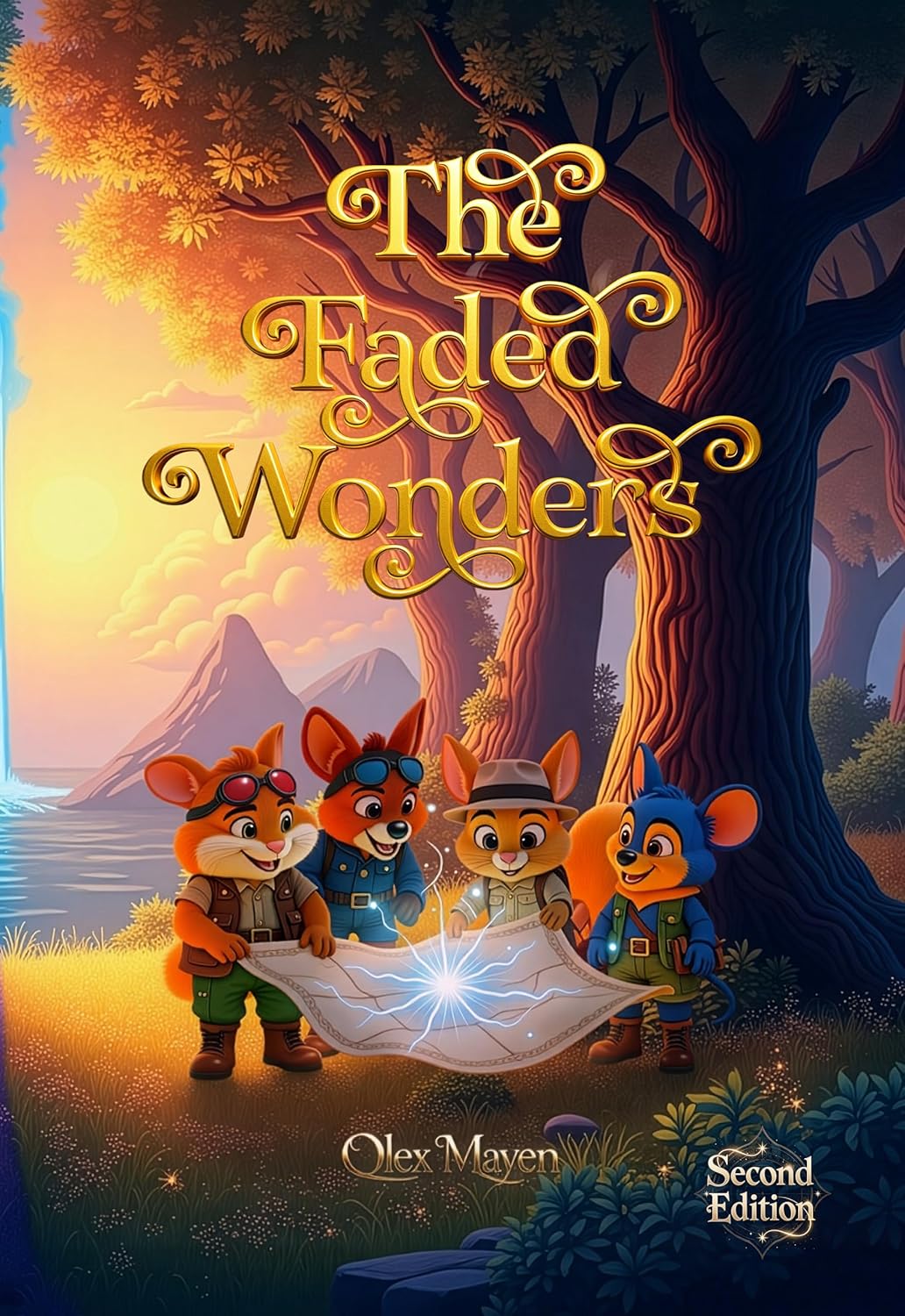
The Faded Wonders, by Olex Mayen, follows four little adventurers who crash into each other’s lives and end up following a strange glowing map that hints at forgotten “wonders” hidden all over their world. They hike through wild places, solve odd little mysteries, and meet some pretty weird, magical stuff, all while trying to figure out what these wonders actually are. It feels like being dropped into a cozy fantasy game where every new area has its own mood, its own challenge, and a tiny hint that something bigger is waiting just out of sight.
Reading it, I felt wrapped up in a really cozy yet big adventure. Like a video game level select, married to a bedtime story. The writing is rich and cinematic, with waterfalls that hiss like silver curtains and caves that hum with trapped songs and strange guardians. I liked how each character brings a different flavor to the journey. Blukky is pure wonder, Scouty is the careful map nerd, Vroomy is all speed and swagger, and Chippy keeps cracking grumpy jokes and practical comments, so the story never gets too serious. The structure is very questy. Forest puzzle, ice puzzle, ocean puzzle, sky puzzle, fire puzzle, space puzzle. That rhythm feels satisfying, especially for kids who enjoy “what’s the next level” stories.
The book keeps nudging at softer ideas, and that hit me in the feels more than the big magic. The Starforge scene, where they are told that power fades but wisdom sticks, lands gently but is impactful, and I really appreciated that choice. The theme of “wonder that never disappears, it just waits” runs all the way from the opening note to the final key that is meant for future dreamers, and that gave the whole thing a warm echo in my head after I finished. I also loved that the friends are allowed to be scared, or annoyed, or tired. Vroomy is not just a show off; he learns patience. Chippy complains, then steps up anyway. Blukky worries and still moves forward. Those little emotional beats make the big cosmic stuff feel more grounded.
The pictures in this book pop right off the page, all bright colors and soft glowing details that feel kind of like a Pixar movie in book form. The characters are super cute with big, expressive faces that make them feel alive. Every scene has a strong mood, from cozy and warm to cool and mysterious, and the art makes the world feel magical.
I would recommend The Faded Wonders to kids who are ready for a longer, chaptered adventure and for children who enjoy reading something lush and imaginative out loud. It feels like the start of a series that readers can grow with, and I can see this working great as a shared nighttime read for ages roughly seven to eleven, depending on reading level. If a child loves fantasy worlds with talking animal heroes, glowing artifacts, and a gentle lesson about curiosity and courage, this book fits nicely on their shelf. It suits readers who like maps, quests, puzzles, and that feeling of “one more chapter, then bed, promise.”
Philomena: The Brave Daughter of Light tells the story of a Greek king and queen who turn to Jesus when they cannot have a child, then receive a daughter whose whole life burns with faith and courage. As Philomena grows, she loves the poor, refuses the Roman emperor’s offer of marriage, suffers prison and brutal trials, and finally dies as a young martyr while staying loyal to God. The book ends with her in heaven, close to Jesus, and with hints of the miracles that later come through her prayers.
I really liked the writing style. The whole thing moves in gentle rhyming lines that feel almost like a lullaby, even when the story gets tense. The language stays simple and clear, yet the author sneaks in big feelings. I could feel the parents’ ache at the start, then their joy when Philomena is born, then that cold knot of fear when Diocletian appears. The book keeps saying the same core idea in different ways. God is near, God is kind, God gives courage. That repetition worked for me, especially for kids who need to hear it more than once.
The ideas behind the story were emotional for me. This isn’t a soft little tale about being nice. It’s about a girl who chooses God over safety, comfort, even her own life, and that is heavy. The book shows real danger and pain, yet it keeps the focus on peace and light. The prison scenes, the arrows, the river, all of that could feel scary, but the art and words keep pulling the mood toward hope. I found myself feeling both sad and calm at the same time. Reading this with children will lead to some deep talks afterward. Why would someone die for their faith? What does courage look like today? Those questions hang in the air once you close the book, and I like that it doesn’t spell everything out.
I would recommend this picture book for families and classrooms that want strong Christian stories about saints, especially Catholic families and parish schools, and for kids who can handle a serious, martyr-style story, maybe around ages six and up, with an adult nearby to chat. It feels perfect for bedtime if you want quiet, thoughtful talks afterward, or for feast days when you want to highlight a particular saint. If you want a beautiful, faith-filled tale about bravery, purity, and trust in God, I think Philomena: The Brave Daughter of Light is a perfect choice.
Michael LeBlanc’s What if Anger Is the Answer? is part war memoir, part philosophy class, part letter from a dad trying to raise a tough and decent son. He traces his path from working-class Ohio kid to classics student to Marine officer in Afghanistan, then out into business and family life. Along the way, he argues that anger is not a flaw to be erased but a force that can be trained, like a lion in the soul, and used for courage, loyalty, and leadership. The book moves through four stages of life and work, from the young man against the world, to learning to deal with friends and enemies, to sliding into cynicism, and finally to building something good in a broken world, all framed by tender letters to his son about what it means to become a man.
I found the writing surprisingly warm and funny for a book built around anger. The opening letter to his son hooked me right away, because it feels like a real dad talking late at night at the kitchen table, not a brand trying to build a “mindset.” You get sharp scenes from Afghanistan that feel chaotic and scary without turning into a stunt show, mixed with campus memories, office politics, and family moments. The stories land hard, then he undercuts the tension with a dry joke, so I kept getting this mix of a lump in my throat and a smirk. At times, the shifts in setting come fast, and the book jumps from a firefight to Aristotle to a boardroom, which can feel a bit jagged, but that roughness also matches the theme. This is a life lived out of order, then stitched together later, and the prose keeps that raw edge.
When he talks about anger that stands up for a friend, or keeps a leader calm and focused when everyone else panics, I felt a real jolt of recognition. The sections on how we slide from young idealism into adult cynicism, then either stay bitter or fight our way through it, hit me hard. I liked how he uses Plato, Aristotle, and Shakespeare’s Prince Hal not as decorations but as case studies in what it means to be warlike without becoming a brute, to be clever without turning into a fox who believes in nothing. Some of his talk about becoming a man leans on combat, competition, and traditional roles.
I felt moved by his honesty about his own screwups and by the way he lets his son see the ugly parts of his story, not just the medal-ready moments. The retrospective section near the end, where he gathers short lessons on cynicism, loyalty, and humor, reads like notes in the margins of his life, and I liked that quiet tone after so many loud scenes.
I would recommend What if Anger Is the Answer? to readers who enjoy books that mix boots-on-the-ground stories with old school ideas, especially men wrestling with questions of purpose, ambition, and how to handle their own temper. It will speak to veterans, to aspiring leaders, to fans of the Great Books, and to parents who want more than soft platitudes for their kids. If you are willing to sit with a book that argues with our culture, and if you are curious about how anger might be turned from something shameful into something disciplined and brave, this is a bold and thought-provoking read.
Leila: The Unheard Woman drops readers into a locked psychiatric ward and asks them to sit with Leila, a mother who has been turned into a “case.” The book moves back and forth between the hospital present and the life that led her there. Readers watch her give birth, hurt, ask for help, get brushed off, and slowly disappear behind labels like “unstable” and overly emotional. They see her marriage, the quiet grind of duty, the pressure to be a good wife and a happy mother, and then the breaking point, when fear for her child and the cruelty of her in-laws collide with a system that would rather sedate her than listen. Out of this, the novel builds a tight, painful portrait of a woman who is always seen and never truly heard, and of a society that calls itself safe while pushing her out of sight.
The prose is stripped down, almost bare, and the repetition works like a slow drumbeat. Short lines. Simple images. Iron doors. Cold floors. Keys that jangle at the edge of every scene. The hospital chapters in particular have this numb, almost hypnotic rhythm that made me feel stuck there with her, counting footsteps and pills. The way the book loops phrases and images made the whole thing feel like memories. It can be heavy, yet that weight fits the subject. I also liked how the author refuses big speeches or neat explanations. The worst moments often happen in small exchanges, in tired phrases like “everyone has their own cross,” or in the silence after a question that no one bothers to answer. That restraint gives the book a peculiar power and lets the ache build.
I appreciated the way the author represents women’s bodies and voices. Leila is in real pain after childbirth, and the people around her treat it as moodiness, as nerves, as something she should push through for the sake of the baby and the family. Her “no” does not count, in the bedroom or in the doctor’s office, and that slow erasing of her choices felt almost more violent than the scenes that are clearly abusive.
The psychiatry on display is chilling because it is so ordinary. The doctors use polite words. They note down facts. They talk about stability and safety. Yet no one asks what she feels, or what she wants, or what would actually help her live with her son. The system treats her like a problem to be managed, not a person to be met. That hit me hard, especially in the scenes where she tries to hold on to Gega’s name in her mind, almost like a last thread tying her to the world. The book turned abstract ideas like patriarchy and medical power into something intimate and raw, and I found myself thinking deeply.
By the end, I felt moved and more awake to a certain kind of quiet cruelty that can hide inside “care.” I would recommend Leila to fans of literary fiction who are willing to sit with hard topics, to people interested in women’s mental health, postpartum experiences, and the history of psychiatric institutions, and to book clubs that like to debate and dig into ethics and power. Readers who prefer narratives that hit like a punch and want a story that lingers beyond the last page will want to delve into Leila’s world.
Fang, Bang and the Midnight Mouse: The Call from Buckingham Palace is a funny and fast-moving picture book about two cat detectives who get called to Buckingham Palace to protect a giant wheel of cheddar at the King’s birthday ball. Of course, things do not stay calm for long. A sneaky mouse shows up, the cheese goes flying, and the whole story turns into a goofy royal chase before midnight. It is packed with humor, bright illustrations, and a playful mystery that feels perfect for a read-aloud.
I had a really good time with this picture book. It feels warm, silly, and full of life. Fang and Bang are easy to like right away, and I loved the addition of Tilly the guard dog because she gives the team a fresh spark. The writing keeps things moving. It has that nice storytime rhythm. I also really liked the interactive parts where you look for the Midnight Mouse in the scenes. That kind of thing makes a book fun to share, and it would have kept me hooked as a kid.
What stood out most to me was how the book mixes fun with heart. It’s not just chaos and cheese, even though that is a big part of the charm. There is teamwork, problem-solving, and a sweet sense of friendship running through it all. The illustrations are a huge part of the magic, too. They are colorful, lively, and full of little details that make each page feel busy in the best way. I also love the bonus bit about the history of cheddar cheese. That is such a wonderful extra. It made me smile because it feels unexpected and clever.
I would definitely recommend this children’s book to parents, grandparents, teachers, and anyone reading with kids around ages four to eight. It’s especially good for children who love animals, gentle mysteries, and stories that invite them to join in. I think it would shine at bedtime, during classroom read-alouds, or in family storytime. For me, it’s the kind of book that kids would ask for again, and the kind adults would not mind reading over and over.