Blog Archives
Stigma About Suicide

In Suicide: Hope Beyond the Darkness, you offer hope and healing through firsthand stories of those who have tried to take their own lives and those who have lost loved ones to suicide. Why was this an important book for you to write?
I felt like there was a growing need for information and awareness about suicide. The more involved I was, whether studying, counselling or training people, I saw such a lack of information and so much stigma about suicide. The problem with that was that people were being negatively impacted. People stopped talking about their suicidal thoughts, which is dangerous, and people who lost loved ones to suicide were unable to talk about how they were feeling, which complicated their grief process.
I felt I had something to offer due to my knowledge and experience. That was a big part of my motivation.
And sharing stories helps people connect. People can identify with parts or all of someone’s life experience. And when we hear other people’s stories, we don’t feel so alone. We don’t feel abnormal. It helps break down fear and isolation. It helps break down the stigma.
The stories you share are highly emotional. What was the most difficult aspect of putting this book together?
I think the most challenging aspect for me was ensuring that I truly honoured the people who shared their stories with me. I wanted to ensure the voices of those who are still here were heard and to acknowledge those who are no longer with us. I wanted to be their voice too.
What is one misconception you have found through your research that many people have regarding suicide?
Unfortunately, there are many misconceptions about suicide — and every one of them is harmful.
One of the most common is the belief that talking about suicide might “put the idea” in someone’s mind and increase the risk of them acting on it. Research consistently shows the opposite to be true. Talking about suicide does not cause suicidal thoughts or behaviour. Rather, it can bring relief and open the door to hope and help.
Having a compassionate conversation about suicide can reduce distress and encourage help-seeking.
In the book, I spoke with Sally, who shared that her son was severely depressed. She was terrified to raise the topic of suicide, believing that mentioning it might make things worse. Many others I spoke with shared the same fear.
In reality, people who are depressed have often already thought about suicide. Offering a safe space to talk about these thoughts can ease their burden and provide an opportunity for connection and support.
What is one thing you hope readers take away from your book?
My hope is that someone will read this book and relate to one of the stories or read some of the information, and it will help them manage wherever they are in the suicide spectrum. Whether they have suicidal thoughts or have attempted, or they are supporting someone who is suicidal, or if they are bereaved by suicide, I hope it gives people an understanding of the complexities of suicide and takes away the fear and judgment, reducing the stigma. I hope that people will see that even in our darkest moments, there is hope.
Author Links: Website | Instagram | Facebook
If you’ve been touched by suicide-whether you’ve faced crisis points, supported someone through suicidal thoughts, or lost someone to suicide, this book will reveal that You Are Not Alone! There is hope.
Suicidologist and mental health counselor Debbie Swibel shares powerful and educational insights while weaving together a collection of lived experiences, evidence-based research, clinical knowledge, and a candid but compassionate look at suicide and its impact.
This book has been hailed as a resource for survivors, therapists, the bereaved, caregivers, and those who face challenges around this often “taboo” topic in society.
Suicide: Hope Beyond the Darkness includes stories that are too often left untold-but these are stories that must be told. Real-life experiences of pain, strength, resilience, loss, and of course, the power of the human spirit.
This pioneering book confronts the silence and unravels the complexity of suicide; helping the reader gain understanding and awareness to a subject many don’t find answers to.
More than a book about suicide, this is a book about people: sons and daughters, parents and partners, families and communities. It is a call to awareness, a challenge to stigma, and above all, a gift of hope.
Surviving a Hostile City: Book 1
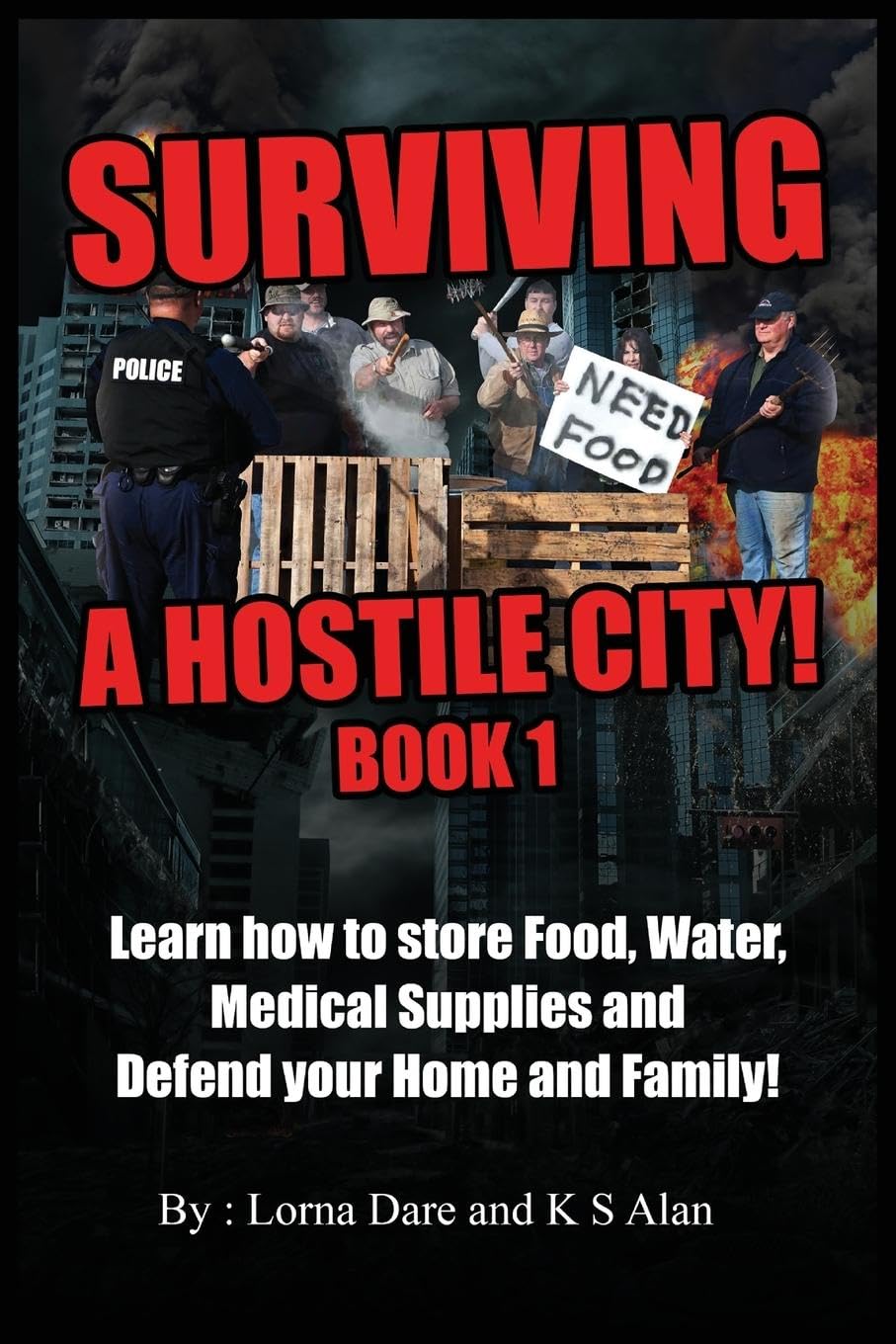

Lorna Dare and K.S. Alan’s Surviving in a Hostile City is not a leisurely read, it’s a wake-up call. The book serves as both a practical guide and a grim exploration of what happens when civilization falters and individuals must rely solely on their preparation and instincts. Through a combination of instruction and stark realism, the authors examine how to endure when systems collapse, including how to store food and water, defend one’s home, and maintain composure in the absence of order. From the very first scene, an unflinching depiction of a family facing looters, it establishes its purpose: to strip away illusions of safety and confront readers with what survival might truly require.
What stands out most in the writing is its clarity and conviction. The prose is urgent yet disciplined, relying on direct language rather than embellishment. The authors write as if time is running out, and that urgency drives the message home. When they state that “the whole city is six meals away from disaster,” the warning feels less hypothetical and more like a countdown. Their insistence on secrecy, particularly the repeated caution against telling anyone about one’s food storage, reveals a profound understanding of human desperation. The tone is not alarmist but sober, and it’s difficult to read these sections without reflecting on how fragile normal life actually is.
The book’s greatest strength lies in its ethical tension. In Chapter Four, which discusses whether one should survive alone or in a group, the text forces readers to grapple with uncomfortable questions: Whom would you save? Whom would you refuse? These reflections are not theoretical; they are presented as choices that demand forethought. Likewise, the chapter on scavenging acknowledges the illegality and moral ambiguity of such actions, leaving the reader to confront the boundaries between survival and conscience. The authors neither condemn nor endorse; rather, they present the realities of collapse and leave judgment to the individual.
Still, there are moments when the tone can feel unrelenting, even moralizing. The critique of modern comfort, references to “snowmobiles and golf lessons” as symbols of misplaced priorities, can verge on didactic. The book’s pragmatic approach sometimes overshadows compassion; it speaks of survival in terms of efficiency and secrecy more than community or empathy. Yet that detachment may be part of its purpose. It refuses to indulge sentiment, and in doing so, it reflects the harsh conditions it describes.
Surviving in a Hostile City is both a manual and a mirror. It reveals not only how to prepare for catastrophe but also how easily one’s sense of morality might bend under pressure. I would recommend it to readers who wish to think seriously about resilience and self-reliance, as well as those drawn to the psychological dimensions of crisis. It is not an easy book to digest, but it is one that lingers, challenging the reader long after the final page.
Pages: 128 | ISBN: 1965390145

Golem Mine


Golem Mine is a story that blends sensuality, faith, myth, and madness into a haunting exploration of creation and obsession. It follows Rachel Rabinowitz, a passionate film student whose fascination with cinema, particularly early horror and the Frankenstein myth, draws her into a spiritual and psychological descent. Through her study of Mary Shelley and Jewish mysticism, Rachel becomes obsessed with the idea of the Golem, the legendary creature made of clay and breath. Her journey from curiosity to conviction takes her from classrooms to synagogues to the quiet heartland of America, searching for the knowledge to create life and, maybe, to understand her own.
Author Donald Schwartz writes with a lyrical, fevered energy, almost like he’s channeling the story rather than crafting it. At times, the prose is hypnotic, sentences twist and roll like the waves of Rachel’s inner turmoil. I loved the audacity of it, how the story dared to tangle faith with lust, myth with modernity. Rachel’s voice lingers with you, raw and unpredictable, torn between intellect and impulse. I found myself alternately enchanted and disturbed, which I suspect was exactly the author’s intent.
This is a dense read. The language can feel heavy with philosophical weight. But there’s rhythm in it, a strange music that rewards patience. I admired how Schwartz stitched together cinematic history, Jewish lore, and feminist thought into something that defies genre. It’s erotic and sacred, tragic and funny in small flashes. Some moments made me squirm, others made me grin, and a few stopped me cold. Beneath the shock and sensuality, there’s a deep sadness in Rachel’s need to create, to be seen, to make sense of her own divinity.
When I closed the book, I felt a mix of exhaustion and awe. Golem Mine is not a casual read. It’s an experience. I’d recommend it to readers who crave something daring and layered, who don’t mind wrestling with big questions about creation, God, and the dangerous hunger for meaning. It’s for those who like their stories wild, intimate, and just a little unhinged.
Pages: 135
A Healthy Body, Mind, and Spirit

The Practice of Immortality is a deeply personal account of your journey from the quiet discipline of a monastery to a life of teaching and guiding others across the world. Why was this an important book for you to write?
This book holds deep personal significance for me because it encapsulates what shaped my own journey. The routines, life adventures, and the ancient Yogic systems that transformed my reality. These teachings form the very foundation, the building blocks, of a healthy body, mind, and spirit.
When I stepped into the world beyond the monastery, I observed that while people are incredibly skilled in their professional lives, many are limited not by their abilities but by their own inner state of being. I have an urge to offer the same resilience tools to the world – practices that are rooted in ancient wisdom that are further validated by modern science.
The Practice of Immortality is my way of making these wellness tools accessible to everyone. When individuals begin to heal, they naturally become the seeds of healthier, more compassionate communities across the world.
Can you explain what the Yoga of Immortals (YOI) protocol is, what it is used for, and how you developed it?
Yoga of Immortals (YOI) is a research-backed mental health program that I curated by integrating ancient Yogic systems with modern scientific validation. It is a series of structured practices designed to bring integrative health to the body, mind, and spirit. The protocol includes controlled breathwork, guided meditative techniques, and cognitive stimulation exercises that help regulate the nervous system and enhance emotional resilience for inner stability and balance.
The YOI journey began during the global pandemic crisis in 2020. As the world faced mental health challenges, I felt a calling to offer a practical, evidence-based solution rooted in Yogic wisdom. And they had to be easy to access during the lockdowns. Drawing from my years of rigorous monastic training, I curated specific meditative and breath-based modalities and shared them to help all navigate that period of crisis.
The overwhelming response from thousands of participants inspired me to bring scientific validation to these experiences. I collaborated with senior clinicians and researchers across the United States, India, and South Africa to conduct IRB-approved, double-blind clinical trials. Within just 4 to 8 weeks, the studies demonstrated remarkable results, showing up to 82% reduction in severe insomnia, generalised anxiety, and moderate to severe depression symptoms, along with significant improvements in overall quality of life.
Today, YOI continues to evolve as a bridge between timeless Yogic knowledge, based on Indian Knowledge Systems, and modern mental health science, empowering individuals globally to lead healthier, more conscious lives.
There is a common misconception about the meaning of immortality. In your book, you argue that immortality is not about living forever in the body but about changing our relationship with time, shedding illusions, and learning to live in the present moment.
Yes, in Yogic science, immortality is not about the physical body living forever. It is about realizing the part of us that is timeless. Knowing the pure consciousness that remains unchanged amidst chaos, joy, grief, or fear. Yes, that sounds hard, but it IS possible.
When we awaken to this awareness, we begin to experience life differently. We no longer live trapped in memories of the past or anxieties of the future; rather, become fully present in the now.
What is one thing that you hope readers take away from The Practice of Immortality?
My wish is that every soul under this blue sky, who is seeking healing or hope, may find a guiding light through this book. I hope they realize that within every challenge life presents, there lies a hidden diamond — a lesson, a strength, a success waiting to be discovered.
Author Links: Website | Facebook | Instagram | GoodReads
Rooted in the story of his own transformative journey, a monk and internationally beloved founder of Yoga of Immortals shares the methods he uses to help us tap into our unlimited potential.
Ishan Shivanand was born into an ancient lineage of yogis spanning twenty-one generations, and spent the first twenty years of his life in a Himalayan monastery. Grounded in the traditions of yoga, meditation, martial arts, storytelling, and herbal medicine, he developed the Yoga of Immortals (YOI) protocol, which is designed to help followers combat stress, anxiety, depression, and create healthy individuals and healthy communities. The Practice of Immortality shares these lessons and practices. In a world suffering the effects of fear, competitiveness, and anger, Ishan encourages us to take a step back.
Structured as a thoughtful narrative with practices based in the true intentions and meaning of yoga, The Practice of Immortality will help you achieve that which you never thought possible.
The Stories

Frederick Douglas Harper’s The Stories is a collection of deeply personal reflections that straddle the line between memoir and spiritual testimony. The book unfolds like a tapestry of moments rather than a straight narrative, each thread representing an encounter with faith, destiny, or divine intervention. Harper shares tales of near-death experiences, prophetic dreams, and ancestral guidance, interwoven with memories of growing up Black in the Jim Crow South and his long academic career. More than a life story, it’s a meditation on meaning, a spiritual ledger of lessons learned and messages received. The book moves through themes of faith, purpose, race, family, and love with honesty and heart, creating a body of work that feels both confessional and universal.
Harper writes with conviction and humility, his voice both scholarly and soulful. At times, his stories surprised me with their sincerity. His recounting of prophecies and clairvoyant encounters might sound far-fetched to a skeptic, but he presents them with such clarity and calm faith that I couldn’t help but lean in. I found myself feeling comforted by his certainty that life’s events, however strange, connect in divine order. His storytelling rhythm is slow and deliberate, full of pauses for reflection. He often circles back to the same questions: Are our lives predestined? Do spirits guide us? I liked that he didn’t try to convince me. He just invited me to listen.
What moved me most wasn’t the supernatural stories but the raw humanness underneath them. The moments where Harper described loss, or his mother’s death, or his early brushes with racism, those hit hard. There’s pain in these pages, but it’s wrapped in grace. His prose is plainspoken, but it carries warmth and wisdom. I could feel his gratitude in every story, even the hard ones. What I admired most was his lack of bitterness. Harper has lived through injustice, through grief, through brushes with death, yet what he chooses to write about is redemption and light.
The Stories is for readers who like to think, to feel, to question what they believe about life and what might lie beyond it. It’s for those who’ve wondered about coincidences that feel too perfect or dreams that feel like messages. Harper’s book feels like a long, heartfelt conversation with an old soul, and by the time it’s over, you can’t help but feel a little changed. I’d recommend it to anyone who finds comfort in faith, mystery, and the quiet beauty of lived experience.
Pages: 446 | ASIN : B085DYRJT7
The Backyard Peace Project

The Backyard Peace Project, compiled by Cathy Domoney, feels like a woven quilt of human experience stitched together with courage, pain, and healing. Each chapter comes from a different voice, yet they all hum the same melody of self-discovery, resilience, and love. From psychic awakenings to stories of grief, motherhood, and self-acceptance, every piece pulls at something tender inside. The narratives are raw and deeply personal, sometimes almost uncomfortably so, but they carry an undercurrent of light that keeps the pages turning. It’s not a book about perfection. It’s about peace found in the middle of mess and meaning drawn from the fragments of ordinary lives.
Some chapters hit me harder than others. Alice Terry’s account of her psychic gift and the fear that shadowed it as a child made me pause and think. Cathy and Skye Domoney’s mother-daughter dialogue about inherited trauma and forgiveness touched something familiar, that ache we all have for connection that doesn’t wound. And then there’s Gretchen Holmes, whose story of learning to love herself harder when everything hurt, felt like an echo of what many of us need to hear but rarely say aloud. The writing across these stories is conversational, imperfect, and real. It pulls you close instead of performing for you.
What I loved most was the honesty. These writers are trying to connect with the reader. There’s this feeling of being seen through their words, even when the subjects are heavy, like grief, illness, loss, and shame. I found myself nodding, sometimes tearing up, other times smiling at the resilience that sneaks through in small moments. The tone is hopeful without being forced, spiritual without preaching. A few stories reiterate lessons about self-love and empowerment. You can sense that every contributor truly believes in the peace they’re offering.
The Backyard Peace Project feels like a gentle nudge to look inward and to see our scars as invitations instead of flaws. It’s not just a collection of essays; it’s a movement of voices reminding us that healing happens in community. I’d recommend this book to anyone walking through their own transformation, anyone craving connection, or anyone who just needs to be reminded that there’s light even in the cracks. It’s for people who want to feel rather than analyze, who value stories told from the heart more than those crafted for applause.
Pages: 278 | ASIN : B0FSQWQ1GZ
Flee

Tracy Myhre’s Flee picks up where the first book of the Haven series left off, and it doesn’t waste a single beat. The story follows Sadie Masters, a young Marine Reserve and librarian-in-training, as her bus journey to a family reunion turns into a desperate fight for survival after a nuclear catastrophe devastates Washington State. Interwoven with her storyline are the perspectives of others, family, friends, and strangers, all caught in the chaos that follows society’s collapse. Myhre builds a world where every decision feels like it could be someone’s last, and every relationship is tested by fear, loyalty, and grief. It’s a book about what we hold onto when everything else falls apart.
I found Myhre’s writing raw and alive. She doesn’t dress things up or linger on flowery descriptions. Instead, she cuts straight to the emotion of the moment. The dialogue feels natural, sometimes painfully so, like listening in on real conversations you wish you hadn’t overheard. Sadie’s voice especially stands out. It’s strong yet vulnerable, brave yet messy in all the right ways. The pacing is quick. Chapters snap forward like jolts, each one dragging you into another cliffhanger or gut punch. Some scenes, especially the violent or intimate ones, feel real. They left me breathless and a bit shaken. That’s not a complaint, though, it’s proof that Myhre knows exactly how to get under a reader’s skin.
What impressed me most was how the book handles survival and morality without getting preachy. It’s not about heroes or villains, it’s about people just trying to live through impossible choices. I loved the smaller human moments, like Sadie’s flashbacks to her mother, or the quiet fear in characters who’ve already lost too much. At times, I did wish the story would slow down and let those moments breathe a little longer, but maybe that tension is the point. In Myhre’s world, there’s no time to rest.
I’d recommend Flee to anyone who loves survival stories that make your heart race and your mind spin. It’s perfect for readers who enjoyed The Road or Station Eleven, but want something a bit more grounded in family and personal history. It’s emotional, dark, and real. I finished it feeling wrung out and strangely hopeful, the kind of book that doesn’t just tell a story, it makes you feel like you’ve lived through it too.
Pages: 386 | ASIN : B0FQ1H1WRH



 LITERARY TITAN