Blog Archives
Monkey Flip
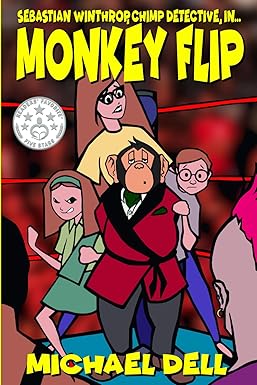

Monkey Flip is a quirky and heartfelt mystery about a has-been indie pro wrestler, a pair of precocious kids, and a reclusive talking chimpanzee detective drawn back into action to solve a murder. When Mitch Mayhem, an arrogant wrestling champion, is found dead, suspicion falls on his ring rival, Bonecrusher Brannigan, a part-time wrestler, full-time dad. His kids, Addie and Bennett, refuse to believe their father could be guilty, and they enlist the help of Sebastian Winthrop, a grumpy but brilliant chimp detective with a taste for banana cream cookies. What follows is an absurd, emotional, and surprisingly touching journey through wrestling locker rooms, family kitchens, and dusty detective tropes turned on their heads.
This book surprised me. At first, I thought it was just going to be another wacky comedy with talking animals and goofy dialogue. And sure, it is funny, very funny, but underneath the humor is a real story about self-worth, family, and redemption. The writing is sharp and packed with personality. I genuinely laughed out loud at some of the lines, especially the banter between Addie and her brother. Addie, in particular, is a standout. She’s pushy, stubborn, a little bit of a know-it-all, but she’s also fiercely loyal and has a heart big enough to carry the whole story. The author walks a fine line between parody and sincerity, and for the most part, it works. The world is weird, but the emotions feel true.
The story works best when it leans into the kids’ perspective, their scrappy determination, their silly arguments, the way they see the world in terms of good guys and bad guys. The wrestling backdrop is painted with affection and authenticity, which makes sense since it reads like it was written by someone who really loves (and understands) the theater of it all.
Monkey Flip is a delightful surprise. It’s weird in all the right ways and warm in ways I didn’t expect. If you love wrestling, kids who act like tiny adults, or detectives with a tail and a chip on their shoulder, this book is for you. It’s especially great for anyone who’s ever felt overlooked or underestimated, because sometimes the best heroes are the ones who’ve been counted out.
Pages: 193 | ASIN : B0D867KR4T

Dead Stars Shine Brightest: A Reckoning in Uvalde, Texas
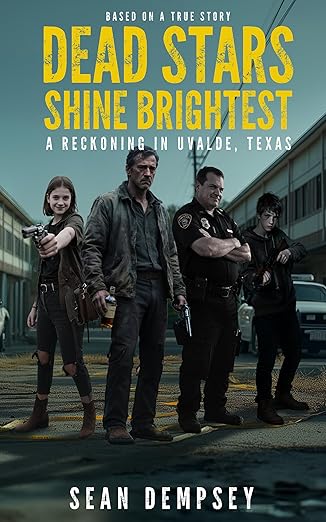
Sean Dempsey’s Dead Stars Shine Brightest: A Reckoning in Uvalde, Texas is a raw and emotionally intense novel that follows the fractured life of Derek Jackson, a broken veteran and struggling father, as he navigates grief, guilt, and growing dread in a small Texas town. Set against the real-life backdrop of the Uvalde school shooting, the story blends fiction with visceral social commentary. Told in two parts, the narrative first centers on Derek and his estranged daughter, Jade, then transitions into Jade’s perspective as the legal system and local authorities fail them in harrowing, all-too-real ways. Their shared journey, punctuated by violence, redemption, and a desperate need for justice, feels urgent and personal.
The writing is gritty and unapologetic, with Derek’s voice sounding like someone you might overhear at a bar right before he breaks into tears or a fight. Dempsey doesn’t excuse a single thing. This story aches with sadness and rages against everything from school bureaucracy to systemic cowardice. I was especially struck by how well the narrative captured the complicated love between Derek and Jade. Their bond is messy, but it’s real, and their slow road back to each other was one of the few hopeful threads in a book steeped in loss and despair. That said, the prose does lean on dramatic metaphors at times, but the emotional weight behind them always hits home.
The ideas in this book–justice, fatherhood, institutional failure, and community apathy–are yanked into the light and made to bleed. Some of the courtroom and legal scenes veer into a kind of moral theater compared to the messy truth of earlier chapters. But the real world doesn’t deliver justice cleanly. Dempsey clearly has a bone to pick with the way things are, and his anger pulses through every page.
I’d recommend Dead Stars Shine Brightest to anyone who isn’t afraid to sit in the uncomfortable. This book is not for the faint of heart or the politically squeamish. But if you want something that’ll grab you and then quietly pat your shoulder afterward, this is it. It’s for veterans, for fathers, for survivors, for anyone who’s ever been told to sit down and stay quiet while the system rolls on.
Pages: 178 | ASIN : B0F861W91V
Never Believe a Lie Twice
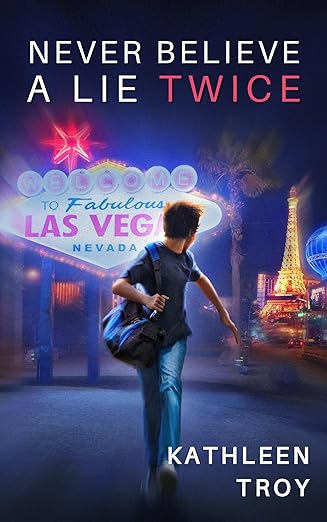
Kathleen Troy’s Never Believe A Lie Twice follows the rough-and-tumble journey of Sage Christopher, a sharp-witted thirteen-year-old suddenly orphaned and thrust from a seedy life in Las Vegas into a sleepy Connecticut town with relatives he’s never met. Sage’s dad, Marty, a grifter with a knack for making terrible choices, dies in a drunk driving accident, leaving behind a duffel bag full of mysterious clues tied to a decades-old disappearance. As Sage tries to dodge the foster system, he gets shipped off to Evansville where he finds new family, old secrets, and the creeping sense that someone dangerous may still be watching. What unfolds is part mystery, part coming-of-age, all heart.
I went into this book expecting a fairly straightforward YA mystery, but Troy surprised me. Her writing is snappy and clean, with a rhythm that grabs you right from the first jail cell scene. Sage’s voice is pitch-perfect, equal parts street-smart and vulnerable. There’s a thread of dry humor running through the entire book that kept me chuckling even when things got dark. The pacing never lagged, and the scenes often flipped with just the right mix of tension and heart. Troy doesn’t dumb things down for young readers either; she lets Sage wrestle with real danger, real grief, and real moral dilemmas. That kind of honesty, especially from a young protagonist, was refreshing.
What I loved most, though, was the way Troy builds her characters. Sage isn’t just another scrappy orphan hero; he’s damaged, sometimes too clever for his own good, and constantly teetering between trust and survival. The supporting cast, especially Pops and Gram, are warm without being sappy. I found myself rooting for Sage to get his happy ending, but I also wanted him to stay a little rogue-ish. There were a few plot turns that felt slightly convenient, but I forgave them because the heart of the story was so strong.
Never Believe A Lie Twice is the kind of book that sneaks up on you. It has guts, charm, and a whole lot of soul. I’d recommend it to readers twelve and up who love mysteries with a bit of grit and a lot of warmth. Fans of Louis Sachar or Kate DiCamillo will feel right at home here. And honestly, adults could do worse than spending an evening with Sage Christopher. I did, and I loved every minute of it.
Pages: 288 | ASIN : B09RQS93KQ
Sins of the Saviors Book 1: Escape From the Culling Box

In Sins of the Saviors, TJ Relk throws us into a grim but not entirely hopeless future where war, artificial intelligence, and blind patriotism have reshaped what it means to be human. The story centers on David, a soldier who returns from decades in a senseless, eternal war to a world governed by AI, propaganda, and engineered peace. The tale winds through his memories, regrets, and slow-burning defiance as he comes to understand the true cost of “utopia.” Flipping between David’s perspective and those of his aging mother Gale, his idealistic sister Mary, and his rebel sibling Jane, the book dives into what happens when free will is exchanged for safety, and what’s left when even memory is no longer trusted.
I liked how the book captured emotional decay. The slow erosion of identity in a world that insists it’s perfect. Relk’s writing is sharp. The style is lean and introspective, often haunting in how casually it delivers gut punches. There were pages I read twice because a single line kept ringing in my head, like David’s quiet desperation or Jane’s fiery truths about a world that stopped caring about real truth. Some scenes, like the slow fade of old friendships or Gale’s annual ritual to honor a son who might as well have been a myth, cut deeper than expected. They felt real. There’s no clean villain here, just systems of thought that got out of hand.
Sometimes the pacing slows, especially when the narrative shifts to Mary’s point of view. The dystopian future is vividly imagined. I was left wondering Goliath the network or a god? Sometimes both? Sometimes neither? I got the sense that Relk wanted that ambiguity, and it left me craving answers a few times. Still, I appreciated that the story didn’t spell everything out. There’s something gutsy in trusting readers to make their own calls about what’s real, what’s right, and who, if anyone, is actually free.
I’d recommend Sins of the Saviors to anyone who likes their dystopias philosophical, their heroes broken but not beaten, and their science fiction tangled up with questions about memory, identity, and whether safety is ever worth the soul. It reminded me a bit of 1984 with the heart of The Road, but written for today’s digital chaos. If you’re someone who’s ever worried about where all this tech and tribalism is going, this book might hit a little too close to home.
Pages: 199 | ASIN : B0FDBN6KMT
Energy Vampire

Bloodbound: Reverberations follows vampire-investigator as he races against time, monsters, and his own demons to save his partner in a world split between harsh realities and the haunting beauty of the Other Realm. What inspired the dynamic between Hunter, Kai, and Gibson?
Hunter and Kai are based on the relationship I share with my husband, Tyler. I would say there are aspects of our personalities, history, and experiences woven into their dynamic, just in different proportions than mine and Tyler’s. Gibson, on the other hand, has no real basis on anyone I’ve known personally. I feel he has no filter – like Sophia Petrillo of The Golden Girls – but for many centuries he lacked a moral barometer which allowed him to get away with literal murder in the past.
The Order feels both mythic and bureaucratically terrifying. Was it based on any real-world systems or structures?
I see most bureaucracies as a hellscape – too many cooks not only spoiling the broth but offering their own opinions as to how it got that way. The chain of communication and command always breaks down and never fails to cause chaos. No better way to demonstrate that, I felt, than at an underground organization whose sole mission is to prevent chaos!
How did you develop the concept of a “siphonic” vampire, and what does that metaphor mean to you?
I based the idea on the concept of an ‘energy vampire,’ which traditionally just means someone who wishes to be the center of attention. From that, I developed a demon that feeds off what you’d call “palpable energy,” or the moods created in tense and emotionally-charged situations. Add in the traditional concept of a vampire feeding off a life force, and voila – a demon (or demon-vampire hybrid) that can sustain itself on other people’s anger, fear, and other negative emotions.
If Bloodbound were adapted into a movie, who would you cast as Hunter, Kai, and Gibson?
I’d love Joe Alwyn as Hunter—he already has the sandy hair and that quiet intensity. Darren Barnet would nail Kai’s self-assured warmth, and Ludi Lin brings the long black hair and enigmatic edge Gibson needs.
Author Links: GoodReads | X (Twitter) | Bluesky } Website | Amazon
When vampire agent Kai Taylor is framed for a brutal murder, the secretive organization known as The Order activates its last resort: Safe Harbor, a deadly countdown that gives his allies six months to prove his innocence. As the clock runs down, a tangled investigation unfolds – one that stretches across dimensions, unearths buried betrayals, and reveals a conspiracy deeper than anyone imagined.
Meanwhile, Hunter Reeves – a vampire-demon hybrid still learning to control his volatile powers – must confront both external enemies and the darkness within. Alongside Kai and their partner Gibson, he navigates love, guilt, and a siphonic hunger that threatens to consume him.
But a forgotten past haunts them all. In a parallel narrative, we return to Kai’s earliest mission, where another frame-up nearly destroyed him – and where the seeds of a much larger war were first sown.
Reverberations is the fifth installment in the genre-defying Bloodbound series – a bold, queer, supernatural thriller blending espionage, horror, and romance. The past is bleeding into the present.
Within a Shadow

To Save a Life follows two young Jewish immigrants who have fled the violence of Eastern Europe, one escaping an arranged marriage and the other a past that haunts him. Where did the idea for this book come from?
Years ago, I visited the Orchard Street Tenement Museum on the Lower East Side of Manhattan and marveled at how the immigrants who’d lived in those apartments managed to hatch grand dreams in matchbox-sized rooms. More recently, the public outpouring of xenophobia and bigotry toward immigrants reminded me of that visit, and I decided to write about the early 1900s, when my grandparents came to America. As I believe that shame is the most potent motivator, I wondered what would happen if two immigrants carried secrets that prevented them from living full lives in their new country–and I had my premise.
How much and what type of research went into putting this book together?
I relied on diaries, contemporary newspaper articles and photographs, books published a decade or two after the early 1900s, and modern secondary sources about life on the Lower East Side. I also found books explaining the background of popular music, the Yiddish theater, or the garment workers’ union, aspects of my story. As a novelist, if I can see my characters, no matter where they go and what they do, I’ve done enough research; if they seem to move and speak within a shadow, that tells me I don’t know what I’m talking about and have to read more.
How did you decide on the title of this novel?
I took it from a famous Talmudic verse that says–I’m paraphrasing–that if you save a life, it’s as if you saved the world. Two secondary characters quote this verse, from different perspectives, but the title also figures metaphorically. My main characters seek emotional or spiritual rescue, and they try to understand what that means for them.
Can we look forward to more work from you soon? What are you currently working on?
Right now, I’m working on a Holocaust novel, a literary thriller based on a true story, in which three men try to stop a train headed to Auschwitz–with a lantern, pliers, and one pistol among them.
Author Links: GoodReads | Website | Substack | Amazon
In 1909, Malka Kaminsky steals her dowry to flee Russia and an arranged marriage, arriving in New York hungry for freedom. Drawn into the hustle of the Golden Land, Malka joins a sweatshop strike and is nearly beaten by thugs, but a stranger and fellow Russian Jew, Yaakov Rogovin, rescues her. Malka doesn’t thank him, refusing to acknowledge her debt, but when chance brings Yaakov to her Sabbath table, they laugh and trade warm glances—only to deny their mutual attraction. After all, they carry deep scars from Russia, where admitting to desires always led to heartache. But as they strive to become entrepreneurs—Yaakov as a musician, Malka as a dressmaker—they hope that independence will show them how to live unafraid, despite the past. And they will need that lesson soon, because when Malka’s fiancé arrives, determined to reclaim her, she seeks Yaakov’s help, neither of them aware what fighting for their dreams will cost.
An Uncomfortable Truth
That Dark Edge follows an exoethnologist as she investigates the culture of an alien species and faces rising tensions that result from linguistic and social differences. What was the inspiration for the setup of your story?
I’ve always been interested in anthropology, curious and fascinated by the interactions between the sophisticated cultures with those defined as less so. Two dear friends, both anthropologists, who joined the Peace Corps told me a true story that happened when such scholars were not allowed to interfere with the society they observed. The anthropologists watched as parents in a very poor community walled up a daughter so she would starve because she kept asking for food. The horror of this still makes my heart stop. The sharp difference in perspective burned an uncomfortable truth inside me, between those from abundant certainty and those living with unavoidable grim survival. I think I just wanted to “fix” this even if I couldn’t change the reality of it.
The science inserted in the fiction, I felt, was well-balanced. How did you manage to keep it grounded while still providing the fantastic edge science fiction stories usually provide?
We take our own everyday things like indoor plumbing, electricity, flying planes, etc. for granted without considering how they work (unless they break down). The humans, especially those who have gone off-planet, accept their technological advantages as part of the world they know. I also try very hard to make any advanced tech plausible from what we know or what we can extrapolate from science–I want it to be feasible rather than too fantastic, even if fantastic is more fun.
What experience in your life has had the biggest impact on your writing?
I was always telling stories. I made little people out of paper, pipe cleaners, and ice cream sticks from as early as six years old. My mom, who was often the audience for my “stories” told me one day: “You have quite an imagination. Why don’t you write that down?” I was eleven. And that was it. Whatever else I dreamed of being, I knew from that day I wanted to be a writer. Everything I experience, bad and good, is fuel for that creative fire.
Can we look forward to a follow-up to That Dark Edge? What are you currently working on?
Yes. I’m currently working diligently on the sequel to That Dark Edge, called Unbound We Arrive. We follow Hedda Tocq and her companions through world-shaking reactions and consequences, some painful, some wondrous, some unfolding in ways we can only imagine.
Author Links: GoodReads | X (Twitter) | Amazon
Maybe more than one.
Hedda Tocq is the manifest princess of a genetically-enhanced class on Mars, heir to the Bastet Company’s vast riches and biotechnological resources. But she rejects her legacy, especially after the perimeter planet Vyss is discovered to be inhabited by sentient humanoids. With diligent examination of every detail reported by those on the ground on Vyss, she becomes the expert on the Vyssae and wants to go to Vyss in person to study them but the Company continuously refuses permission. The civil authorities of the Unified Terran Alliance, who maintain jurisdiction over Vyss and are impressed by her scientific work, grant her official approval backed by the full power of the Office of Space Development and Xenology. After she arrives, the primary questions she has about Vyssaen reality becomes less important than learning everything about these extraordinary people and their culture. But she doesn’t know that there is more than one enemy trying to manipulate her existence and that of the Vyssae, enemies willing to do the unspeakable to accomplish their objectives.
The more she learns, the more she repudiates her inheritance to take a stand for Vyss and its people, whatever the cost.
A Diagnosis Doesn’t Define
Johnny and Type 1 is a heartfelt and empowering children’s book that follows a young boy’s journey from confusion to confidence after being diagnosed with Type 1 diabetes. What was the inspiration for the setup of your story?
Johnny and Type 1 is deeply personal—it was inspired by my son Azariah, who was diagnosed with Type 1 diabetes at just 2 years old. Watching him navigate the early days of his diagnosis—filled with confusion, discomfort, and questions—moved me profoundly. I wanted to create something that would help him, and others like him, feel seen and empowered. I co-wrote the book with my eldest son, Isaiah, making it not just a story about our family, but a story from our family.
What message did you most hope children living with chronic conditions would take away from Johnny’s story?
The core message I want children to take away is that with the right mindset and a strong support system, they can live boldly and joyfully even with a chronic condition. A diagnosis doesn’t define them. What defines them is their courage, their resilience, and the love surrounding them. Johnny’s story is a reminder that they are not alone, and that strength comes in many forms even the quiet, everyday kind.
How did you collaborate on the storytelling and illustrations to ensure Johnny’s emotions felt authentic and relatable?
Working with Scott, our illustrator, was a great experience. He has a unique ability to bring emotion to life through art. From the beginning, he took the time to deeply understand our story and connect with the character.
What is the next book that you are working on, and when will it be available?
At the moment, I don’t have another book in the works. My first book, Adventures of the Negassi Brothers, was written for my boys, and Johnny and Type 1 was written about my son’s journey. I tend to write when I’m deeply inspired, when a story feels meaningful and worth sharing. My goal is always to encourage others through authentic, heartfelt storytelling. So while I can’t say exactly what’s next, I know that when the time comes, the next story will find its way to me.
Author Links: GoodReads | Amazon
With this fun and educative rhyming story, young readers will learn all about living with type 1 diabetes. Whether it’s them, or a loved one, who is diagnosed with the condition, they will know that it’s not a burden, but a superpower.



 LITERARY TITAN