Blog Archives
The Turning Point

Too Strong For Your Own Good is an intimate blend of memoir and guidance that invites readers to explore the hidden cost of chronic strength and to show exhausted high achievers how to reclaim health, joy, and self-leadership by listening to their bodies. Why was this an important book for you to write?
This book wasn’t something I decided to write—it was something that asked to be written through me.
For decades, I lived the life of the “strong one.” The high achiever. The helper. The woman who could handle anything—until my body finally said no. After surviving multiple cancer diagnoses, chronic illness, and profound burnout, I realized that the very strength I had been praised for was slowly costing me my health, my joy, and my sense of self.
As I healed, I began to recognize this same pattern everywhere. In my years of coaching leaders and high performers, I watched capable, compassionate people quietly disconnect from themselves in the name of responsibility, success, and survival. The strongest people were often the most exhausted and the least supported.
I wrote Too Strong For Your Own Good so others don’t have to spend decades learning what nearly cost me my life—that real strength includes the wisdom to rest, the courage to feel, and the trust to finally come home to yourself. This book is both a truth-telling and an invitation to evolve from survival-based strength into a more soul-aligned way of living and leading. It’s the book I wish someone had handed me years earlier.
When did you first realize that being “strong” had become harmful rather than helpful?
I realized it when my body stopped responding to willpower. I could no longer push through symptoms, override exhaustion, or “mindset” my way forward. What once felt empowering began to feel like self-erasure.
As I slowed down enough to listen, I saw something more clearly: the strength I had relied on wasn’t a conscious choice-it was a survival strategy I had developed very early in life. Proving my worth through constant doing had once helped me feel safe, capable, and in control. But over time, it came at a cost.
Being strong became harmful the moment it required me to abandon myself. When saying yes to everyone else meant saying no to my own body, my own needs, and my own truth, I knew something had to change.
That realization was humbling and clarifying. I understood that my body wasn’t betraying me-it was protecting me. It was asking me to stop living from adrenaline and proving, and to begin listening. That moment became the turning point not only in my healing but in how I now guide others.
How does burnout in leaders quietly ripple into families, teams, and organizations?
Burnout doesn’t stay contained. Even when leaders are highly competent, their nervous systems set the tone. Chronic stress shows up as urgency, control, emotional distance, and reactivity- often without anyone naming it.
Families feel it as an absence. Teams feel it as pressure. Organizations feel it as disengagement and quiet erosion of trust. When leaders are operating from survival, they unintentionally teach others to do the same, moving faster, bracing tighter, and normalizing constant pressure.
Sustainable leadership isn’t just about resilience or performance. It requires regulation, presence, and self-trust. When leaders feel safe in their own bodies, they create environments where others can do their best work without burning out.
What does sustainable healing actually look like day to day?
Sustainable healing is quiet and relational. It looks like pausing instead of pushing. Listening instead of overriding. Setting boundaries that honor the body. Making decisions that feel congruent rather than impressive.
Day to day, it’s less about adding more practices and more about removing what no longer fits. It’s learning to notice when we’re slipping back into survival and choosing to respond with honesty and care instead.
Healing becomes lasting when strength is redefined – not by how much we can carry, but by how well we stay connected to ourselves.
Author Links: GoodReads | X (Twitter) | Anette Demattio | Facebook | Instagram | LinkedIn | Website | Amazon
Too Strong For Your Own Good reveals the hidden cost of pushing through, pleasing, and holding it all together—while your body quietly pays the price.
After surviving six cancer diagnoses, Anette DeMattio realized her body wasn’t broken—it was speaking. Now, with over 25 years of experience in transformational coaching, she helps high achievers and caregivers turn survival patterns into embodied self-leadership.
In this book, you’ll learn how to:
• Understand your symptoms as signals—not setbacks
• Break patterns that silently drain your energy
• Rest in a way that feels safe—not scary
• Lead and live from calm, clarity, and soul
This isn’t just a book about healing. It’s a powerful invitation to return to your truest self—strong, soft, and fully alive.
If your body is whispering for relief…
If you’re tired of pretending you’re fine…
If you want peace without burnout and strength without suffering…
Let this book show you how to stop surviving—and start living, vibrantly and freely as the real you.
Faux Fitness


Faux Fitness by author E J Neiman sets out to flip a whole lot of “common sense” fitness wisdom on its head. The book blends the author’s long battle with chronic pain and Dr. Thomas Griner’s work on muscles, lactic acid, and endorphins into one big argument that most of us are working out, dieting, and even “recovering” in ways that quietly damage our bodies instead of helping them. Pain means injury, not progress. Cardio that keeps your heart rate high means you sit in an oxygen-starved state and bathe your arteries in acid. Chronically tight, lactic acid-soaked muscles are behind everything from back pain to sciatica to carpal tunnel. The later chapters build on that idea and move into how to move, rest, breathe, and live in a way that lets muscles stay soft and “müshy” instead of hard and angry, and how to think more critically about every feel-good wellness trend.
I had a pretty strong emotional response to the core message. On one hand, the logic about pain and adaptation made a lot of sense to me and honestly felt a bit like getting my ears boxed. I have told myself “no pain, no gain” more times than I care to admit, so seeing that motto treated almost like a bad joke felt both refreshing and uncomfortable. The way the author connects lactic acid buildup, rigor mortis, and everyday soreness really stuck with me. The writing uses lots of stories, vivid examples, and simple analogies. That style made the ideas feel very human and grounded, not like a lecture from a physiology textbook. At the same time, the constant “sit down for this next part” tone sometimes felt like it was trying a bit hard to shock me. There were moments where I wanted the same clear idea, but with less buildup and fewer side comments.
As the book went deeper into endorphins, oxidative stress, vascularity, and “faux” health habits, I found myself going back and forth between “this is eye-opening” and “I wish this section had more balance.” I liked that the author owns his position as a layperson and keeps the language plain. I never felt lost in technical talk, and the metaphors about highways, gravity, and sports teams made the biology easy to picture. I sometimes wanted clearer boundaries between what is strongly supported, what comes from Griner’s clinical experience, and what is the author’s own reasoning. The passion is obvious and that passion is contagious. For me, the book works best when it shows patterns, shares cases, and invites skepticism, and it works less well when it leans into “we have been doing it all wrong” without pausing to meet readers who are already doing some things right.
I enjoyed Faux Fitness, and I came away looking at my own habits in a very different light. I would recommend this book to people who already like to read about health and training and who are open to having their current program poked and prodded a bit. It suits readers who appreciate clear, informal language and lots of concrete examples more than folks who want dense citations on every page. If you’re curious, frustrated with chronic pain, or just tired of yo-yo fitness advice, this is a bold, opinionated take that will give you plenty to chew on.

Sensory-Driven Experiences

Dissociative Effect is a visceral and introspective poetic journey through trauma, embodiment, and healing, revealing how returning to the body becomes an act of truth and transformation. What inspires you to write poetry?
It is said that there is almost nowhere on earth where you can stand more than six feet away from a spider. Poems too can also be found everywhere if they’re looked for – addressing every realm of what in our lives can feel broken: injuries of the heart, in love, in friendship, in family, grief, fear, anger, injustice, powerlessness, loneliness, and so many other places. Bringing words together in lyrical form helps us deal with some of the emotional intensity of living.
Amidst the trauma and the suffering of our lives, most of us can appreciate that powerlessness and invisibility are not minimal things. Poetry is the language that bridges our interior and exterior worlds. A person who asks words to do things with their feelings and emotions is not powerless. A person who makes phrases that connect people, that tell the truth, and expand reality is countering despair and depression. Anyone who has written a poem has felt this. I think this is the healing alchemy of poetry.
How did your work in medicine shape the way you approached writing about trauma and the body?
Practicing medicine for nearly two decades has taught me about the link between our personal stories and the universal or collective human narrative. Stories of health, trauma, and the body often rely on specific, intimate, and sensory-driven experiences which reflect broader shared human truths. I don’t want to minimize the personal effects of trauma, but to acknowledge that we are not alone in our experiences and our search for meaning.
The book moves from pathology to reclamation across its three sections. Did you always envision this structure, or did it emerge as you wrote?
I can’t speak to the process for all poets, but when I started writing poetry, I had no expectation that I would ever publish a book. I wrote poetry because I wanted to, because I needed to. After a couple of years, I realized that I had written several hundred poems. When I looked for themes in the content, I could see that there was a trajectory, a healing arc, which I had been living and writing about. As a physician, we are trained to see problems with a lens that matches the three sections of this book; namely, disease (pathos), diagnosis (diagnoses), and treatment (ad sanadum).
You write about dissociation with such clarity. What helped you reconnect with your own body enough to translate that experience into language?
In the process of writing the book, I was engaging regularly with several embodied or somatic practices (yoga, meditation, sauna with cold water immersion), which helped me to reflect on the ways in which we are present and not present in our lives. Sometimes, disembodiment involves distraction or a lack of mindful attention as we are going about our lives. Sometimes, disembodiment and dissociation are more than that when they serve as elaborate protective mechanisms against trauma, which might otherwise be unbearable in a moment.
I had mostly finished the book and chosen the title, Dissociative Effect, when ketamine became widely available as a mental health treatment. Before writing the intro and publishing the book, I researched therapeutic ketamine in an effort to understand if and how this might help my patients. Along the way, I received a ketamine treatment and experienced “the dissociative effect.” Through my own journey, I understood more deeply how dissociation can shift perspective, just as narrative voice shifts perspective in writing and storytelling. Therein lies our capacity for healing.
Author Links: GoodReads | Amazon
Taking Control of Your Health

When East Meets West offers readers a self-care toolkit derived from both Eastern and Western practices. Can you share with us a little about the research required to put this book together?
I have spent many years learning about complementary care, alternative medicine, and integrative healthcare. I completed a course on Complementary Therapies in my graduate program and a class on Hypnosis in my doctoral program. In preparing to write this current edition of the book, I spent months reviewing the literature on every topic in this book. Although many of the topics do not have strong research evidence, there are many anecdotal articles about the potential benefits and harms of the various self-care practices. This book serves as an introduction to the various practices and readers are strongly advised to consult with their healthcare providers and do their own research before incorporating these practices into their health and wellness plan.
What is one misconception you believe many people have regarding self-care?
One misconception regarding self-care is that it can replace modern medicine which can result in harm to self or others. I think it’s important to integrate self-care practices into your daily health and wellness regimen. For example, if you have hypertension (high blood pressure) it is vitally important to treat it with antihypertensives that are prescribed by your healthcare provider. However, it is also important to eat healthy, exercise, and reduce stress. The use of meditation, essential oils, and journaling can help to decrease stress levels. This is an example of how to integrate self-care practice.
What is one thing you hope readers take away from When East Meets West?
I hope readers will understand the importance of taking a holistic approach to their health and well-being and that reading this book will serve as a starting point in this journey. Taking control of one’s health and knowing you have the power to do so is so important. You may not be able to prevent certain illnesses but you can manage them betterwith a holistic/integrative approach.
Author Links: GoodReads | X | Facebook | Website
Discover the empowering world of complementary and alternative medicine in this approachable, informative guide to enhancing your health and well-being. Drawing on personal experience as a critical care nurse and lifelong learner, the author blends scientific understanding with holistic wisdom to offer a balanced, practical path toward integrative care.
Inside, you’ll explore the benefits, uses, and precautions of:
Essential oils and custom blends for mood, relaxation, and vitality
Herbal teas and tinctures that nourish the body and soothe the mind
Superfoods that can help optimize wellness from the inside out
Mind-body practices like meditation, journaling, therapeutic touch, and self-hypnosis
Energy work techniques to help restore balance and harmony
Whether you’re looking to complement traditional (Western) medical treatments or explore Eastern-inspired wellness methods, this book provides both the knowledge and inspiration to create your own personalized self-care plan. You’ll also find real-life stories-ranging from easing anxiety with meditation to surprising experiences with therapeutic touch-that illustrate just how transformative these practices can be.
This book is not a replacement for medical care-it’s an empowering companion for those who want to take a more active role in their health. With a “best of both worlds” approach, you’ll learn how to blend the precision of modern medicine with the timeless wisdom of holistic practices-helping you not just manage illness, but truly thrive.
Love Yourself

Indra’s Net offers readers a spiritual guide that blends personal experiences and grounded spiritual lessons within a Tarot-inspired structure. Why was this an important book for you to write?
For my own growth.
Is there anything you now wish you had included in Indra’s Net? Any additional anecdotes or bits of wisdom?
No.
What is one thing you hope readers take away from your book?
Love yourself.
Can we look forward to more releases from you soon? What are you currently working on?
Ideas, but nothing definite.
Author Links: GoodReads | Facebook | Website
Adult Nonfiction Book of the Year, San Francisco Writer’s Conference
FOR THOSE WHO SEEK ANSWERS, UNDERSTANDING, INSPIRATION, & INNER PEACE
Indra’s Net is a collection of themes about learning to live an awakened life and opening one’s mind and heart to the Self. It is for those who seek answers, understanding, inspiration, and inner peace. It discusses topics such as vulnerability, codependence, arrogance, impermanence, gratitude, and failure, and contains wisdom and teachings from many paths.
This book can be used as daily inspiration, a tool for self-improvement, a spiritual lesson plan, and a source of divination. Full of helpful techniques, hints, humor, and love, all oriented towards making sense of our human experiences and discovering a cosmic home here on Earth, it is a how to do and how to be manual.
The format mirrors a traditional Tarot card deck, although it offers a new take on both Tarot meanings and spiritual discovery outside of Tarot readings. The book can be used as a modern guide to reading and understanding Tarot card meanings.
In the two-thousand-year-old tradition of Indra’s Net, each perfect faceted jewel reflects every other jewel and is reflected by that jewel. It’s an image of interdependence, in that everything is connected to everything else. Indra’s Net is not a poetic or a philosophical idea, it’s the way life functions.
Indra’s Net is a product of author Indra Rinzler’s 50+ years of living on the spiritual path, assembled from decades of study, wisdom paths, practices, experiences, and revelations.
How we view life is our choice. This book is meant to encourage one to choose from a higher wisdom and connection to the truest Self. That which we wish to understand and become, transforms us in the very process of seeking. As we open to awareness, we awaken to the significance of all dimensions of reality.
When East Meets West: An Integrative Guide to Self-Care


When East Meets West is a warm and wide-ranging guide to self-care that blends Eastern and Western practices into an easygoing daily toolkit. Author Deborah Dolan Hunt walks readers through teas, essential oils, tinctures, foods, body-based therapies, mind-centered habits, and spiritual practices. She mixes personal stories with straightforward explanations. The book moves from herbal infusions and oils to yoga, meditation, hypnotherapy, and folk traditions. It also highlights the need for safety, moderation, and collaboration with a healthcare provider. The author urges readers to build a personal wellness plan that is realistic and kind.
I appreciated Hunt’s honest tone. The simple way Hunt describes her own anxiety and how meditation helped her made the material feel real. I liked how she shared moments of discovery, such as learning therapeutic touch or making her own tea blend. Her writing is plainspoken, almost conversational. It felt like sitting at a kitchen table with a friend who wants to help you feel better. The long lists of benefits were helpful, though I sometimes wished for clearer examples or stories to bring them to life. Still, the variety kept me turning pages because I never knew which soothing idea might show up next.
I found myself reacting emotionally to the mix of family warmth and practical advice. The book is full of heart. I smiled when she talked about her kids asking for her “magic” and felt moved when she described using energy work to help a friend’s dog. Some sections felt dense because of the many bullet points, yet the gentle spirit underneath held it together. I appreciated that she never positioned these methods as cures. She consistently framed them as supports. That made the book feel grounded and trustworthy.
I would recommend When East Meets West to anyone who wants a simple and friendly introduction to holistic wellness. People who enjoy herbal teas, gentle rituals, or calming daily routines will find a lot to try. Readers who feel overwhelmed by jargon-filled health books will, no doubt, enjoy the down-to-earth voice here. It is welcoming and steady. It would suit beginners, busy people who want small habits, and anyone curious about blending modern care with old traditions.
Pages: 144 | ASIN : B0G18V65H7

Grow, Evolve, and Blossom

Garden Quartz and Paper Flowers is a collection of stories and poems centered around a girl navigating the trauma of abuse and the healing process. Why was this an important book for you to write?
It was important for me to write, Garden Quartz and Paper Flowers as a way to finally close a chapter of my own life. I’ve been writing for as long as I can remember: poetry, music, and short stories but I lost all my original works in a very traumatic incident. That use to haunt me, endlessly.
I don’t know of many stories that tell the tale of resilience, that transcends through time with authentic but healthy coping mechanisms. In this story, the main character Calla recognizes that self-work was required to set her free. For you never have to be your childhood or adulthood circumstances. Those moments will shape you but you should not allow them to break you.
My fondness for precious gemstones and flowers with inspirational meaning were the metaphorical tools necessary to breathe life into this piece. Stones are shaped by their environment. Flowers can weather the storm. Both survive under tough pressure.
What was the biggest challenge you faced in putting together this collection?
My biggest challenge was simply starting. For years, I dwelled on it subconsciously, should I pick up my pen again and recreate what was destroyed. Eventually, I got to a place where I said this is going to be therapeutic for you and it’s time to get it done. My second challenge was struggling with remembering much of what I originally wrote, but once I started to complete the individual pieces one by one, I was able to weave them together into one fluid story. You can delay the inevitable but it’s still has to get done, even when it’s overdue. I also needed to live a little bit longer, to complete this work of art in full circle.
Have you received any feedback from readers that surprised or moved you?
I’ve received a lot of positive feedback on this piece of art. I’m honestly VERY surprised. I didn’t think it would move so many people to connect with it so deeply, especially since it’s a fiction. I know Art imitates life, and I know that some of the things I wrote could align as a lived experience rather than a collection of different occurrences. I just didn’t know it would resonate with some many people.
“Not for the faint of heart,” was the common themed remark. Which to me, shows I planted a seed and I hope it grows. Uncomfort as it relates to knowledge, has always been a sign that I’m headed in the proper direction. I remind myself every day, learn something new, try something different and feel something real.
What is one thing you hope readers take away from Garden Quartz and Paper Flowers?
I want readers to know that it’s okay to feel every emotion in the moment—but it’s not okay to live in the negative ones. We have to find the strength to rise, overcome pain, and to keep pushing forward. It’s not easy, but NOTHING in life is simple. After the all hard work, aches and pains, I promise greatness is waiting on the other side, ready to greet you.
You’re not your past. You’re not even your present. And you’re not even alone. Continue to actively grow, evolve, and blossom into who you’re meant to be. It’s time to do your due diligence. It’s time to rediscover your resilience. It’s time to heal. Let’s do this!
Pain has Transformed me. . .
Step into this immersive garden of ruin and bloom— a memoir told in fragments of memory, poetry, and survival.
This is the story of a girl named Calla, rooted in silence, shaped by shadow, and determined to rise.
Because not all wounds bleed. Not all truths are spoken.
And you never have to become what tried to break you.
Garden Quartz and Paper Flowers
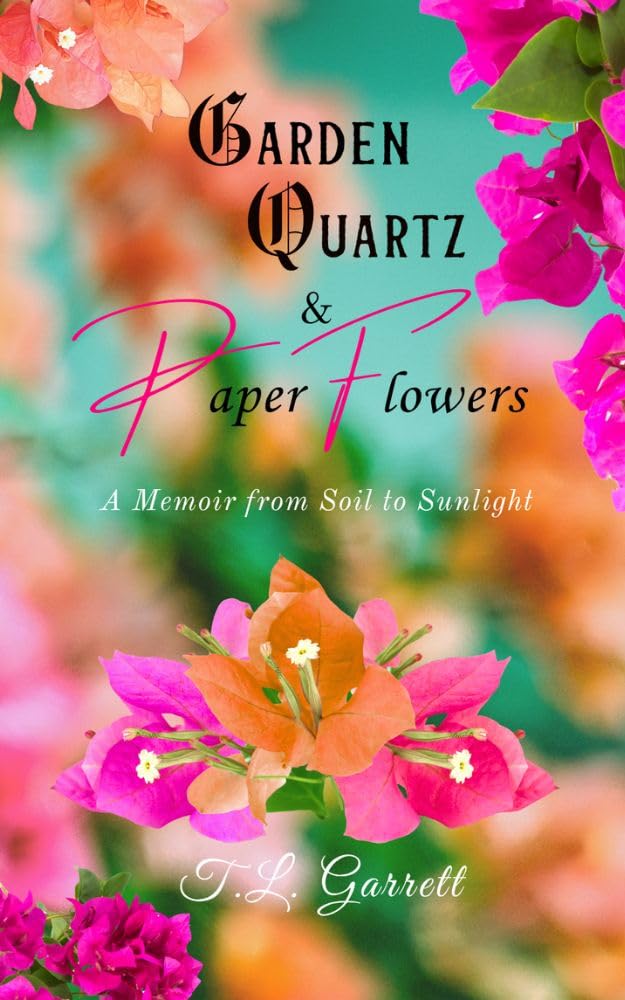
T.L. Garrett’s Garden Quartz & Paper Flowers is a raw and unflinching collection of stories and poems that trace the life of Calla, a girl navigating the deep scars of trauma, abuse, and healing. The book reads like a patchwork of memory. Each chapter a petal torn from her past, revealing a life marked by generational pain, silence, and survival. Garrett writes in a style that blends memoir and fiction, pulling readers into scenes that feel heartbreakingly real. The imagery of flowers, roots, and stones threads through the work, symbolizing growth from ruin and the fragile beauty that comes from endurance.
The writing is heavy with emotion, but there’s a strange softness to it too. A tenderness that lingers even in the ugliest moments. Garrett doesn’t hold back, and it shows. The prose feels like a scream written into poetry. I found myself pausing often, sometimes just to process. There’s a rhythm in her storytelling that’s both jarring and intimate. Her voice feels lived-in, like someone telling a truth they carried for too long. Some passages are uncomfortable to read, not because of how they’re written, but because of how real they are. You can feel the child’s confusion, the teenager’s anger, and the adult’s reckoning all colliding in one soul. It’s unsettling. It’s human.
What struck me most was Garrett’s way of turning pain into purpose. She doesn’t ask for pity. She asks for understanding. The book dives into spiritual themes like healing, intuition, and forgiveness, but never in a way that feels forced. Her honesty feels sacred. I loved how she wove resilience through the narrative like a vine wrapping around broken glass. It’s not a perfect book in a technical sense, but that’s exactly what makes it so powerful. Her writing feels like it’s bleeding onto the page, and yet, there’s beauty in every wound.
Garden Quartz & Paper Flowers isn’t for the faint of heart. It’s for readers who have lived through darkness and clawed their way toward light, or for those who want to understand what that fight looks like. It’s for anyone who believes survival itself is an art form. If you want something real, something that cracks you open and reminds you what it means to be alive, this book is worth every page.
Pages: 258 | ASIN : B0FJ4XM2JL


