Blog Archives
My Love Letter

Black Architects is a lyrical tapestry of poems and meditations that transforms Blackness into a sacred hymn that’s part prayer, part protest, and all love. What inspired you to write and publish this collection?
Well, first I want to thank you for the opportunity to reflect on the work. It was inspired by an incident that was racially charged, which occurred at a job that I had. I remember feeling the lowest that day, though refusing to let them see me cry. On the train ride home, I started to write this soliloquy/prayer, declarations if you will, by hand in protest. Every time I wrote a line I felt a sort of redemption that I knew, if no body else, the Almighty would be witness to me climbing out of the hole I was in. In that job space, and other spaces, I felt the compression and pressure of having to hide the majority of my identity. Though I dared anyway, in some ways, to embody the ideals, culture, and depth of what I encompass as a black woman, I felt the battle every single day to be, speak, do, and exist otherwise. Aversion for true expressions of blackness is so intricately and subtlety interwoven in the fabric of our society, that it becomes easy for that aversion to manifest, and the smart from it is hard at times to pinpoint, but undeniably experienced. Black Architects was born from this. It came as protest, as a resistance to extinction. It is my love letter to and celebration of black people, written to those who continue to build our legacies in this world. The architects are the young, middle aged and seasoned who see themselves as caring about this world, being architects of thought, experiences and manifestations that will lead people to honor themselves, despite how others may dishonor them. The work was also inspired by the community where I live. I see black faces, in all variety, everyday. Working, playing, growing, having setbacks, prospering, loving. So it was important to tap into this pulse of the people and show us in even the mundane aspects of living. In this predominately black community, we still don’t control resources or have many businesses, so in a way Black Architects is also how one dreams to be the architect that lives just beneath the surface in each of us.
How did you approach balancing vulnerability and defiance in your writing about Black identity?
I balanced the two by just being honest about my experience. I let my love for mankind in general shine through as an act of defending an oppressed identity, like I would for any other people I see being stifled. I practiced a sort of curiosity as though I was both outsider and member of the community, which informed the observations presented in the work. It was important for me to come straight from the heart and to say everything with my chest despite resistance because my only audience at the time of the work’s conception, was myself and the Almighty. Both of whom it is impossible to lie to, and I wanted to extend that courage to the reader. It came from love’s protest and can be seen as Love’s defense of me, who at the time of writing felt deeply wounded and dangerously vulnerable. That day at work, and many others in that work environment, I suffered almost disparaging defeat. The part of me that refused to die found a home in the larger tradition of struggles of black identity, and expanded within the honesty and authenticity of expression.
In the process of writing, I felt the support of my 10,000, my ancestors – and all of heaven, really – witnessing and celebrating with me. Even so, I knew I risked offending and that is also where defiance set in. There are some who expect that every other identity can be celebrated without question but when black people unite in this way, it is threatening. I’ve noticed and experienced that the black voice tends to be sacrificially inclusive, speaking for every and each, with associations to other black people only assumed, rarely explicit. Even in this interview as I express my love for black identity, I feel compelled and forced, almost, to remind about my love for other groups as if my expression of solidarity with my community would mean otherwise. Why is this?
We, like other groups, are not monolithic and I tried to show some of our diversity. I was not trying to speak for a whole group of people. These lines are simply a testament of how a single mind sees blackness and they are for any others that can see and celebrate this too. Being unapologetic about love is something I’ve had to practice and my fondness, deep affection and concern for my people, I hope, is apparent. Honesty, truth and love are the only ways to truly touch and reach people. In keeping with this reminder I was able to maintain the balance between the vulnerability and defiance so palpable in the work.
What were some themes that were important for you to explore in this book?
Vulnerability is one of them. In all our function and dysfunction, we are bared for the world to see. This work came through me while I was on the train, with my writing pad open for all onlookers to see – to some pleasing, and to others distasteful. Still the courage to be – considering and despite – persisted. Love is another theme. The multi-dimensional and variety of ways that we do exist and persist conveys, I hope, the beneficence of the Almighty who avenges the oppressed and reinforces the poor in spirit. We’re inspired to have this joy that for little reason, be. Redemption is also a theme. The work ends calling forth the youth, painting a picture of the architects of better days to be birthed from the sowing of this work.
Which artists, writers, or ancestral voices guided you while writing this book?
Christ Jesus guided me to be unflinchingly honest about the triumphs and despair of being a black woman. His walk on Earth inspired me to endeavor the universal heart through love and appeal to the cosmic conscience in man transcending identity throughout the work.
Emperor Haile Selassie I, the quintessential, cosmopolitan man, was a huge inspiration. His concern for the world has always been apparent to me, though his love for his own people never to diminish. Reflecting on the heights chartered by his words, inspired the loftiness of description in the text.
Dr. Maya Angelou was a huge influence. She took on the challenge so well of expressing her love for her people and for all people simultaneously and effortlessly. So I felt less alone in taking on the mission of this work.
They both were so masterful with the written/spoken word, that I could only dream to pave my own path and trajectory with their light as my guide.
E. E Cummings also has a quote in the same tradition of how the work was born: “To be nobody but yourself in a world which is doing its best, night and day, to make you everybody else – means to fight the hardest battle which any human being can fight; and never stop fighting.” Black Architects bandages the mind broken from this fight.
I identified with Frantz Fanon’s Black Face, White Masks and I ambitioned to be as astute an observer as he when it came to communicating and constructing the plight and positionality of the black architect.
I was also listening to this one Nina Simone song on repeat while composing the collection: it’s called “You’ll Never Walk Alone”. The work was written matching the ebb and flow and climax of her piece. It is very much woven into the every line of Black Architects.
Lastly, Marcus Garvey was a model because like Garvey in the whirlwind in one of his infamous speeches, I wanted this voice – this celebration – to be witness to the love and defiance enduring through time in the blood, DNA, genes and generations of a people. It is a message to the people at that job and in the world at large that they/it can never kill my spirit. Love, which I have chosen, will always outlast hate and though I may have died in battle that day, I am destined to be resurrected in the coming generation of architects that will redeem this world, black and otherwise.
Author Links: Instagram | Website
Black Architects is all the variations of ‘Black’ and ‘Excellence’ paired together. It is a rallying cry and celebration that interweaves an account of a people’s triumphs, their weaknesses, their shortcomings and their aspirations. It is a picture of what it is like to be Black in America. It is a protest against the monotony of invisibility of the Black plight in a Western purview demanding a reinvention of how we love ourselves: that we do love ourselves and our seed.
Fight For What Matters
American Entropy is a collection of poetry that swings from political outcry to spiritual yearning, from queer love to existential doubt, and ignites readers’ desire to fight for what matters. What inspired you to write this particular collection of poems?
It was largely just paying attention to the news and seeing how every day, Trump is violating the Constitution, trying to force universities and museums to adopt right-wing propaganda and treat it as fact. Like all fascist authoritarians, Trump hates it when truths that contradict his lies proliferate, so I felt it important to do my part to tell those truths.
Doing it in a way that makes readers want to fight for what matters, rather than just dwelling on the darkness of modern American life, was important to me too, because if you don’t focus on what we still have, it becomes all too easy for people to give up.
The poems about love, metaphysical, spiritual topics, and queer love are all just examples of me writing what I know.
Your poetry tackles deeply emotional and politically volatile topics while also touching on hope for the future. How do you approach writing about deeply personal or emotional topics?
“Power through and write what’s true,” like it says in the poem “It’s Not Too Late.” I just get it out onto the page as accurately as I can before giving myself a chance to question how honest is too honest. I feel like if I’m too reserved in writing my poetry it won’t be as relatable, and the reader will be able to tell I’m holding something back, and it won’t foster empathy as much as I hope my work does by being unflinchingly honest.
How has this poetry book changed you as a writer, or what did you learn about yourself through writing it?
This book really crystalized for me that poetry is an important type of resistance, which is something I think my work has always been when it comes to fighting heteronormativity and homophobia and other bigotries, but this is the first time I’ve dedicated so much of any one poetry collection to raging against one corrupt administration and detailing all the ways it’s trampling our rights and waging war against the American people.
I’ve learned about myself that I really just don’t give up no matter what, and I can help others not give up either.
What is one thing that you hope readers take away from American Entropy?
That this isn’t normal, the way Trump is shredding the Constitution and speaking to our worst natures, and the way Republicans in Congress and conservative Supreme Court justices are complicit in enabling it. That it’s bigoted Nazi fascism, and we don’t have to just roll over and take it.
Author Links: GoodReads | Facebook | Website | Amazon
Through explorations of the metaphysical, religion, and relationships, the poems delve into both darkness and the light born of efforts to expand human consciousness. Despair is given unflinching witness, making the discovery of hope all the more profound. And love—raw, imperfect, and essential—is celebrated as a balm for our plugged-in yet detached modern lives.
If you’re disillusioned with an America sliding toward fascism and the strain it places on relationships, American Entropy may reignite your fire to keep fighting for what matters, keep loving, and hold faith in something greater than ourselves.
Purple Summer, Gray Fall
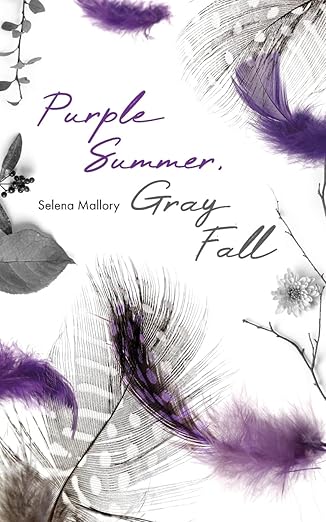

Selena Mallory’s Purple Summer, Gray Fall is a tender, raw, and often startling collection of poems that drifts between sunlight and shadow. The book is divided into two sections: “Purple Summer,” which hums with warmth, youth, and desire, and “Gray Fall,” which cools into introspection, loss, and renewal. Across both halves, Mallory writes with a confessional edge that feels both intimate and unguarded. Her voice slips easily between humor and ache, sensuality and solitude, all while painting vivid slices of womanhood, memory, and self-discovery. The poems read like diary entries whispered aloud on quiet evenings, revealing a life lived in color and reflection.
What I liked most about Mallory’s writing is its honesty. She doesn’t shy away from the awkward, the lustful, or the mundane. In one breath, she’s talking about shaving her legs for a Tinder date, and in the next, she’s describing grief, faith, or mental fatigue. That range feels human in a way poetry often forgets to be. Her language is unpretentious, even conversational at times, and that makes the emotional moments hit harder. The transitions from lighthearted pieces like “Shiny Hiney” to weightier ones such as “Sweat(H)er” are seamless, showing how closely joy and despair live beside each other. The humor never undercuts the pain; it just reminds you that both belong.
The collection’s imagery also carries a quiet rhythm. I loved how the “Purple Summer” poems glow with heat and motion, fields, sun, and laughter, while “Gray Fall” settles into stillness and introspection. There’s an arc of growing up here, or maybe just growing deeper into oneself. Mallory has a knack for turning everyday details into metaphors that linger, like the simple act of baking brownies or watching a storm. Her poems invite you to slow down and notice small, beautiful things, even when they hurt. Sometimes the structure feels loose, even meandering, but that looseness matches the emotional truth of the work. It’s messy, alive, and personal.
I’d recommend Purple Summer, Gray Fall to readers who love poetry that feels like conversation rather than performance. It’s perfect for anyone who’s ever laughed through heartbreak or found comfort in small, domestic rituals.
Pages: 56 | ISBN: 978-16629604444

Black Architects

Black Architects by Regina Shepherd is a symphonic celebration of Blackness in its many shades, shapes, and histories. The book unfolds as a lyrical prayer, a hymn to identity, love, and survival. It reads like a tapestry woven from poems, affirmations, and meditations, each line drenched in rhythm and reverence. There’s no plot to follow, no characters to cling to, only the pulse of language that paints the beauty and burden of being Black. Shepherd’s words are both intimate and universal, like a whisper passed down generations. It’s a work of devotion, and at times, defiance.
The writing is lush. I found myself rereading certain lines, letting the repetition of “Black” sink in until it became something sacred. It’s not just a descriptor, it’s a chant, a heartbeat, a home. There’s a rhythm in the way Shepherd builds her world, one that feels alive, like she’s conducting a spiritual ceremony through words. The imagery is vivid, the sound of it musical. It’s not always easy to grasp every metaphor, but that’s part of its power, it demands presence, not quick understanding. I could feel her pride, her pain, her joy, all twined together.
I also enjoyed how the book blurs the line between poetry and prayer. It’s vulnerable and fierce at once. The repetition might feel heavy-handed to some, but to me, it felt necessary. Shepherd insists that Blackness be seen, named, celebrated, again and again, until the world can’t look away. There’s so much love in these pages, and also a quiet kind of rage, a refusal to let beauty be forgotten or erased. It made me think about legacy, about ancestry, about the sacredness of existing in a world that often misunderstands you.
I’d recommend Black Architects to readers who love poetry that breathes, who find comfort in rhythm and repetition, and who crave writing that feels alive. It’s for anyone who wants to experience words not just as text but as ritual. This book would resonate deeply with artists, dreamers, and anyone who carries history in their bones. It’s not light reading, it’s immersive, emotional, and raw, but it’s worth every page.
Pages: 55 | ASIN: B09RGYC7FQ
Birth, Death, and Survival

Melanie Whyte’s Birth, Death & Survival is a raw and intimate poetry collection that traces a lifetime of pain, growth, and resilience. It unfolds like a memoir in verse, starting from the innocence of childhood and winding through heartbreak, abuse, motherhood, healing, and eventual renewal. The poems feel deeply lived-in, each chapter marking a phase of her life, from the trembling echoes of a broken home to the quiet triumphs of rediscovered love and strength. There’s a narrative thread that ties every piece together: the human instinct to keep breathing, to keep going, even when the air feels too heavy to bear.
Whyte doesn’t hold back, and I admired that honesty. Her words are simple but sharp, and she lets emotion take the lead. At times, the poems read like confessions whispered in the dark. Others feel like letters written to her past self, forgiving, reflecting, reclaiming. What struck me most was the rhythm of her healing. It’s not neat or linear, and she doesn’t pretend it is. Some verses gutted me with their quiet truth, like “The Room With No Windows,” while others, like “Still I Rise From Shadows,” filled me with soft and steady hope.
As I read, I found myself pausing often, not because the writing was difficult, but because it felt too close. There’s beauty in the way Whyte turns trauma into art without glamorizing it. The collection pulses with empathy, and even in the darkest corners, there’s light breaking through. I liked how she weaves motherhood, love, and survival together; it reminded me that rebuilding isn’t just about leaving the pain behind, it’s about learning to live alongside it.
Birth, Death & Survival is for readers who crave truth, who’ve walked through something hard and come out changed. It’s a book for survivors, for mothers, for anyone who’s ever had to rebuild themselves piece by piece. I’d recommend it to anyone who wants to feel seen, or to those who want to understand what resilience looks like when it’s written in poetry and inked with life itself.
Pages: 181 | ASIN : B0FPXNQFMP
Thru The Eyes of a Warrior

This book is both memoir and meditation. Merrill A. Vaughan blends poetry, storytelling, and raw personal truth to explore what it means to serve, survive, and remember. Through the fictional voice of Jack Delaney, a veteran haunted by his experiences in Vietnam, Vaughan builds a bridge between past and present, between the young soldier who went to war and the older man learning to heal. The story moves between letters, memories, and poems that capture the brutal honesty of combat and the quiet ache of coming home. It’s not a linear tale but rather a mosaic of moments, stitched together by grief, guilt, and grace.
The poems have grit and rhythm, the kind that comes from someone who has lived the words he writes. I could feel the heaviness in Jack’s silence and the relief when he finally found his voice again. Some passages felt personal, like peeking into someone’s private confession, yet that’s what made them so powerful. Vaughan doesn’t hide behind pretty phrasing or elaborate structure. He just tells it straight. The scenes in the jungle, the letters to Ella, the haunting of lost friends, they all stay with you long after you close the book.
What I loved most was the sense of hope quietly pulsing beneath the pain. The character of Claire, the nurse who teaches Jack to write, and Ella, the granddaughter who asks to hear the truth, turn this story into a full circle. It’s not only about what war takes but what art gives back. The poems woven throughout, about veterans, remembrance, and America itself, feel like collective prayers for understanding. The mix of fiction and poetry works surprisingly well. At times, it feels like a diary cracked open. I found myself pausing often, just sitting with the weight of the words.
I’d recommend Thru the Eyes of a Warrior to anyone who wants to understand the emotional landscape of a veteran’s life, beyond statistics and slogans. This book would especially resonate with veterans, their families, and anyone who believes that storytelling can heal what silence can’t. Vaughan has written something painful, tender, and brave.
Pages: 110 | ASIN : B0FPT9WGZP

American Entropy


Travis Hupp’s American Entropy is a gut-punch of a poetry collection that straddles rage, revelation, and redemption. The book unfolds across sections named for emotions, Anger, Politics, Metaphysical, Despair, Hope, and Love, each one a pulse of raw feeling. Hupp writes from the jagged edge of personal struggle and cultural collapse, his voice cracking with both fury and faith. The poems swing from political outcry to spiritual yearning, from queer love to existential doubt. It feels like watching someone fight off demons with words, sometimes literally, sometimes metaphorically, until the language itself starts to shimmer like something divine.
Reading Hupp’s work shook me up in the best way. His writing doesn’t just tell you what he’s feeling, it makes you feel it too. The anger is real, the despair palpable, and the hope stubbornly alive. His author’s note alone hit me hard. It’s this mix of confession and confrontation that sets the tone for the entire collection. There’s no pretense here. He talks about hearing voices, about spiritual warfare, about the cruelty of politics, and yet there’s a strange humor threaded through it all. The poems rage against Trumpism, systemic hate, and hypocrisy, but they also reach for angels and grace. His faith isn’t clean or easy, it’s a messy, miraculous survival instinct. That duality is what makes it powerful.
What I enjoyed most was how relatable it all felt. The writing doesn’t hide behind polish or perfect meter. It’s rough and raw and full of bite. Sometimes the rhythm stumbles, but that only makes it more alive. You can hear the exhaustion in his lines, the defiance, the flashes of tenderness. His metaphysical poems, especially, have this haunting, electric pulse that made me stop and reread. It’s poetry that talks back to God and politics in the same breath. I could feel his mind running hot, reaching for meaning in a country and a body both cracking under pressure.
I’d recommend American Entropy to anyone who’s ever felt overwhelmed by the noise of modern life and still wanted to believe in something good. It’s for readers who crave honesty over polish, for those who don’t mind poetry that bleeds on the page. Hupp’s voice is that rare mix of furious and forgiving, and by the end, I felt like I’d witnessed someone claw their way toward the light.
Pages: 231 | ASIN : B0FCD51KZG
Before They Are Lost Forever

Toward a Theory of Everything is a mix of science, spirituality, and poetry that examines the connection between the physical and the spiritual on a quest to make sense of existence. What were some themes that were important for you to explore in this book?
The first section of my book, about a “theory of everything,” was difficult to write, because I was challenged with concisely presenting and integrating ideas from my lifetime experiences with my current knowledge, beliefs, and worldview. In addition, I had to search for scientific research to back up some of my assumptions, while at the same time realizing that scientific findings and theory can and should be challenged.
What was the biggest challenge you faced in putting together this poetry collection?
Poetry has always been easy for me, because poetic ideas and phrases come to me as a gift. It is my awareness of the need to write poems and poetic thoughts down as they come to me during dreams or in my conscious state, before they are lost forever. I seldom or never experience writer’s block. All of my memorable lifetime, I have been a thinker.
What is one thing that you hope readers take away from Toward a Theory of Everything?
I write for my readers to expand their worldview vis-à-vis what they have been taught by their parents, culture (including religion), and formal education. Also, in all of my writings, if not most, I communicate for the purpose of helping and healing the reader.
Author Links: Amazon | GoodReads



 LITERARY TITAN