Blog Archives
A Mental Healing Place

Shmehara is a poignant exploration of human emotions and experiences through poetry, illustrations, and reflective notes, focusing on human experiences during times of conflict. Where did the idea for this collection come from, and how did it develop over time?
The genesis of this project traces back to my therapist’s office. Recognizing my enduring love for poetry, my therapist proposed leveraging this passion as a tool for healing from childhood trauma. It worked. It brought me peace and the ability to move on. This event also triggered a deeper self-reflection on my life and my identity.
From this initial spark, the project went on an extraordinary odyssey exceeding the bounds of my imagination. Let me guide you through each step of this remarkable voyage.
Self-reflection unearthed the profound influence of my maternal grandfather on myself. He was a very resilient man. Escaped from transportation to a concentration camp, and survived torture during the Second World War, and the tragic death of his first wife. He was the first to acknowledge me as a poet and encourage me to be myself. Therefore, I thought it was just the right thing to do to dedicate this book to him.
I started to dig more into my family’s past and discovered that I have a connection to the Ukrainian soil on my Mom’s side. It was at the time when the Russian invasion of Ukraine started. Consequently, you can find themes of war and peace rooted in personal and global narratives in my poetry.
While preparing for this book I attended readings by other poets. I noticed that they often tell stories about their poems during these live events. That gave me an idea to incorporate into the book a short, written story preceding each poem. A proem to a poem, you may say.
Researching books of other poets brought to my attention a fact about how visual art can enhance a poetry book. I recalled magnificent illustrations in my childhood books. Therefore, I decided to add visual art to my book as well. I reached out to over 40 different artists from all around the world and ended by selecting seven of them, based on their style, skills, abilities, and unique life stories. I also added to the book their short stories describing the process of making the art for the book showing this way the flow of creativity.
Next, came the idea of Dynamic Illustrations™. I once saw in a liquor store animated labels of some wines, and an increase use of QR codes in the post-COVID restaurants. I remember asking myself: “Why not animate the illustrations in my book using QR codes?” I’m so glad I decided to do that because this approach opened new doors to poetry. I was told that Dynamic Illustrations™ allows the neurodivergent members of our society or people with disabilities to enjoy poetry. This is so exciting.
Another unforeseen, yet gratifying development was a venture to the realm of independent film festivals. The Dynamic Illustrations™ are short animations, therefore we submitted some of them to independent film festivals. As we are conducting this interview (mid-April 2024) AIE has gathered 9 laurels so far at various film festivals across the globe, from Hong Kong through Dubai, Berlin, and Chicago to Chile to name a few. Receiving these accolades is beyond my imagination.
The next development was the inception of Amicus Librowitz (a play of words on a lover of books). In my written realms, distinction between reality and fiction is blurred, and Amicus is my alter ego on the other side. He appears in some of the Dynamic Illustrations™ yet, importantly, he appears also in this world and introduces my books to you. On the front cover of Shmehara, you will find a QR code, which will bring you to a short animation of the Amicus avatar telling you a story about the book. Amicus, and how he appears on the book’s cover is a unique trademark of my books.
Hopefully, you will find Amicus on the front cover of my next books. i’d like to briefly mention three books here: one coming later this year (2024), which is based on Plato’s Dialogues where I discuss fundamental questions regarding humankind with AI; a sci-fi novel in which I address the future evolution of human prejudice, and provide a satirical commentary on current social and political systems; and a novel based loosely on the life of my mother, who should be a feminist icon due to her grit, wit, and resilience in male-dominated medical field in communistic Poland. With the last one, I’m hoping also to bring to a Western reader intriguing, absurd, and funny realities of life behind the Iron Curtain.
The next, (and the last) development is very important. Shmehara started as a way of fighting my inner wars but evolved into addressing also real wars. It was paramount for me to provide long-lasting help to victims of these wars. Therefore, I decided to donate part of the proceeds to a great humanitarian organization, the Polish Center for International Aid (PCPM). PCPM uses these funds to provide scholarly and psychological support to Ukrainian children refugees forced to flee their country by the Russian army.
As you can see, this project went in some unforeseen directions and developed beyond my dreams, making this journey so full of thrill, excitement, and good deeds.
The title Shmehara is unique and memorable. How did you come up with it for this collection, and what is its meaning?
Thank you for this question. The title of this book, Shmehara has a special meaning. I coined that term by reaching out to ancient languages: Sanskrit and the Proto-Indo-European language. I combined sh from ikshana in Sanskrit meaning to look after, with me which is a part of the Proto-Indo-European (PIE) root s(mer) of to remember, and with hara from Sanskrit dharā meaning a flow of a stream. Sh-me-hara. Shmehara thus represents a mental healing place, a very special place in your mind where you are letting go of troubling memories. A special name for a very special place.
Creating a place like this was suggested to me by my therapist. When I started to explain to her my vision of this mental healing place, the explanation turned into a poem. I thought that this concept is very important and you may feel its presence in other poems throughout the book, therefore I decided not only to put Shmehara as the very first poem in the book but also to use it for the book’s title.
By the way, If you need shmehara for your own mental health, please feel free to use this term.
Many talented authors and artists were involved in this multimedia project, including the interactive experiences. What was the collaboration process like to put this book together?
The collaboration behind Shmehara was nothing short of extraordinary. All together seven visual artists contributed to this project, each extremely talented. Let me start with the cover art. The cover is so important. The cover is the very first thing that draws your attention to the book. I feel so fortunate that a gifted artist from Denmark, Caroline Bergstrom-Scheibel, agreed to design the cover for Shmehara. I think Caroline understood immediately and profoundly the fundamental message of the book and made the cover encapsulating it in a beautiful, mesmerizing way.
Illustrations were created by the following artists (in alphabetical order): Sofia Chantra, Katya Mayorova, Arina Nikolenko, Katerina Patak, Sofia Lo Pinto, and Polina Pluslem, who are living in several countries around the world including Ukraine. I’ve selected them based on their artistic skills and personal stories. The selection process was meticulous, with an initial interview allowing me to get to know each illustrator better as an artist and also as a person. Next, I selected a poem (or poems) for each artist, which in my opinion, would resonate with them the best. So matching a poem and an artist was not a random process. I wanted to bring the most of artistic prowess and authenticity out of each artist. I think each of them did a fantastic job.
I would like to emphasize that none of the artists worked before on creating Dynamic illustrations™ – a concept I have developed for this book. In most cases, that would require creating several GIFs for each poem. The GIFs needed to be done in a specific way, allowing me later to edit and stitch them to create a short, animated film. I have nothing but accolades for each of the artists. Their openness to suggestions fostered a collaborative spirit that elevated the project to new heights.
I would like to mention also collaboration efforts during creating soundtracks for the Dynamic illustrations™. Each soundtrack consisting of the main melody as well as special sound effects. In most cases, I went through hundreds of tunes to select the one. Sometimes, it required obtaining copyrights. Securing these permissions provided an unprecedented opportunity to collaborate with some amazing people in the music industry. I had the great pleasure of working with Ed Rakowicz from KMC Records to obtain permission to use a clip of music of Kvitka Cisyk for the Dynamic illustration™ of the poem Melancholia. Similarly, when obtaining permission to use a clip of music by Vivaldi performed by Jakub Jozef Orlinski for the Dynamic illustration™ of the poem AIE I had an amazing interaction with Guillaume Tabeau and Liza Rannou from Radio France, as well as with Jakub’s agent – Solal de Castillo.
I would like to add that the collaborations did not stop. I’m very fortunate to work currently with a very talented jazz musician and composer, Tyler Lustek, and his jazz ensemble on creating unique jazz compositions to some of the poems from Shmehara. We probably will make them available to the public next year, so stay tuned!
I think, that you can’t put a price tag for these direct, collaborative interactions. Meeting these amazing artists, extraordinary human beings and kind souls is breathtaking. Working together with them and seeing a flow of creativity between different artistic genres is astounding and unforgettable.
What is one thing you hope readers take away from this experience that you have created?
I hope this book will provide a reader with a deep, transformative experience. I observed that during reading events. I like reading events because they are a fantastic opportunity to have direct contact with the audience. Seeing firsthand people moved by my words, and coming to me after the event with tears in their eyes is deeply humbling and inspiring. I hope that Shmehara will invite every reader to embark on this emotional journey, and that after putting the book down, the reader will find themself more attuned to their inner self and the world around them.
Author links: Website | GoodReads | Facebook | Instagram | X | TikTok

This immersive multimedia project shows a flow of artistic vision and gives you a transformative, one-of-a-kind experience. You will run your fingers through the scars on the author’s soul and feel pain, sorrow, and outrage. You will also find solace and empowerment. And you will experience pure joy in watching (and endlessly rewatching) Dynamic Illustrations™. If you appreciate cutting-edge art, which addresses existential issues this is a must-read, must-watch experience.
Shmehara is a multi-layered book. In its core there are 21 thought-provoking poems. Each poem is accompanied by an author’s note describing creative process behind the poem. In addition, each poem comes with an illustration, as well as thoughts of an artist creating the illustration describing their work on that illustration. This way we show a flow of creativity from one artist to another.
On top of that, you can access an animated version of the illustration, called Dynamic Illustration™, by clicking on a QR code located next to the illustration. When watching Dynamic Illustration™ makes sure the volume on your device is up, so you can enjoy a unique soundtrack created for each Illustration. Dynamic Illustrations™ are similar to short, animated films. You can see some still images from each dynamic illustration in the poster product section.
Foreword is written by brilliant Steven Komarnyckyj, a UK-born distinguished British-Ukrainian writer, linguist, poet, translator, and a recipient of English PEN awards.
10% of sales go toward a humanitarian organization helping Ukrainian children refugees.
Shmehara
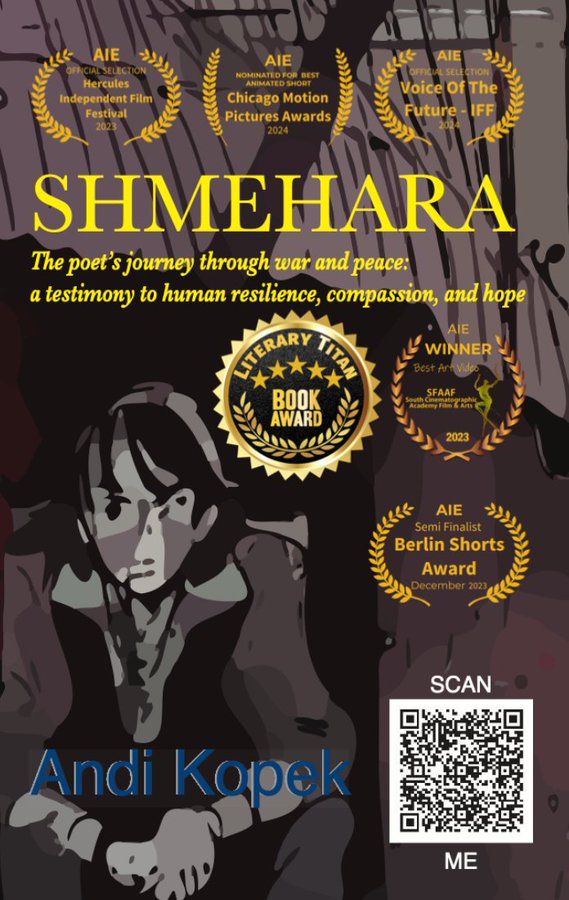

Shmehara, by Andi Kopek, is a poignant exploration of human emotions and experiences through the mediums of poetry, illustrations, and reflective notes. Kopek’s work is deeply rooted in the context of the Russia-Ukraine war, yet its themes of resilience, the human spirit, compassion, war, peace, and hope transcend the specific conflict, touching on universal aspects of the human condition.
Kopek skillfully blends poetry with visual art to offer a multifaceted reflection on the aftermath of conflict. The poetry in this collection is not just a mere arrangement of words but a lyrical journey that captures the essence of survival and the unyielding strength of the human soul. Accompanying these verses are illustrations that do more than just accompany the text; they deepen the emotional resonance of each poem, adding a visual dimension that enhances the reader’s experience. Perhaps one of the most distinctive aspects of this collection is the inclusion of notes that provide insight into the artist’s creative process. These notes add a layer of transparency and depth, fostering a deeper connection between the reader and the content. They offer a window into the mind of the creator, revealing the motivations and intentions behind each piece. Shmehara strikes a balance between acknowledging the harsh realities of war and nurturing the seeds of hope. It stands as a testament to the power of art in transcending boundaries and uniting people through shared experiences and emotions. This collection is more than just a response to a specific event; it’s a timeless exploration of how individuals and societies navigate through and emerge from adversity.
This book is a compelling read for those who are moved by the complexities of human experiences during times of conflict. It’s an invitation to understand and feel the journey of humanity amidst the turmoil of war, and the enduring spirit of hope that prevails. Shmehara is recommended for readers who seek a deeper understanding of these themes, as well as an appreciation for the interplay of poetry and visual art in expressing the inexpressible.
Pages: 115 | ISBN : 979-8-9889670-1-9
Camel from Kyzylkum
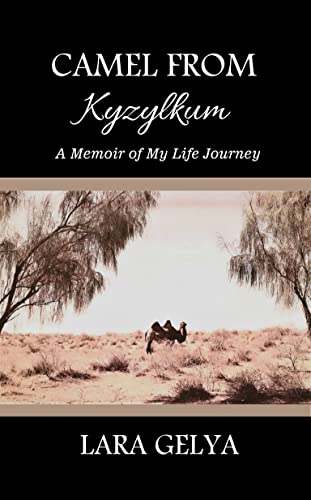

In this memoir, the author narrates her life journey as an immigrant, a mother, a grandmother, and an independent woman from Ukraine to the Kyzylkum Desert of Uzbekistan (then a part of the Soviet Union), through Austria and Italy, all the way to the United States. Standing as a testament to her indomitable spirit and sheer willpower, the book tells us an inspiring tale of grit and endurance in the face of unforgettable hardships. Using a simple and engaging tone, Lara speaks about her own diverse experiences and leaves the readers spellbound with her quest for a better life.
Written during the pandemic year, this memoir is a genuinely heartwarming account of the various challenges the author faced and overcame during her life. Although one can argue about the linearity of the plot structure, a rough chronology is followed throughout the story, most of which flows uninterrupted in the form of flashbacks. This particular characteristic of the narrative makes it seem almost like a diary, recording the various emotional upheavals of the author’s journey rather than the individual events themselves.
Lara describes her personal ordeals with surprising candor. Starting with her process of immigration, her struggle to re-establish herself in a foreign country, and her effort to learn the new language. Readers then learn of her constant fight to bring her daughter from the Soviet Union to join her and the painful break from her family. She was left feeling betrayed and filled with grief. To finally accept reality and reach towards other sources of fulfillment, we accompany her on her travels and witness each phase of her life as they shape the person she has become today.
But unlike memoirs of great people, who always seem to be placed on a pedestal and therefore seem detached from our lives, Lara’s story touches us deeply because we can empathize with her. This is the story of an ordinary person like us. A woman who got uprooted from her birthplace and was forced to leave behind everything she knew as her own to try and build her future in a strange land surrounded by unknown people. Yet, ultimately, what makes it inspiring is that it is a story about never giving up.
Pages: 191 | ASIN : B09Y7GTZQS

An Exploration of Choices

Leonora Meriel Author Interview
The Woman Behind The Waterfall follows Angela as she struggles to help her mother find happiness while trying to avoid her dark past. What was the initial idea behind this story and how did that transform as you were writing the novel?
When I started writing The Woman behind the Waterfall, I was at a crossroads in my life. I had turned 30, decided to leave my job running a business to write full-time, and had recently moved country to live in Barcelona. I was at a stage where I was evaluating what had happened in my life to date, and what I could consider mistakes or positive choices; also the example I was setting for my daughter, and the patterns I was consciously or not consciously following from my mother. Thus, the original idea was an exploration of choices and their consequences within the framework of generations. As the novel progressed, this developed into the wider theme of the search for happiness, and what happiness means at different ages and in different generations.
The writing in your story is very artful and creative. Was it a conscious effort to create a story in this fashion or is this style of writing reflective of your writing style in general?
I had always dreamed of being a writer, and at the age of 30, after many years of scribbling stories and poems, I decided to write full-time. This was my chance to create a novel that I hoped would be published and offered to the world. The language that came out when I wrote it was intensely poetic and full of dream and emotion. It wasn’t a style that I had written in previously, but it was the language that I found to express the story of the book – the generations and the regrets and choices, woven into the dream world of the subconscious.
As a contrast, in my second novel, I wanted to write in a style that was a clean, straightforward narrative. After the intense poetry of The Woman Behind the Waterfall, I wanted to focus on story and character rather than the beauty of the words.
Both Angela and her mother are both detailed characters that continue to develop in the story. What were the driving ideals behind the characters’ development throughout the story?
The character of Angela was intended to express the pure creative state that children exist in before their thought-patterns have been set by the surrounding world. I had observed in my own children this magical state when they hadn’t yet been told what was true and what was not, and so everything was possible. With Angela, I take this a step further and allow her to merge with the natural world. However, as the book progresses, she understands that she will lose this ability as she becomes an adult.
Lyuda, the mother, also goes through a transformation. She has been trapped in a debilitating depression and holds on for the sake of her daughter. When her daughter starts to see and be affected by this, Lyuda has to make a choice to come out of her internal world. This progression was really inspired by the idea of the things we pass on to our children, and the responsibility there is in being a parent, where each of your actions can create a pattern that can pass into your family for generations.
What is the next book that you are writing and when will it be available?
I published my second novel, The Unity Game, in May of this year, and I’m currently working on several projects which should be ready starting from 2019. The Unity Game was as different as possible to The Woman Behind the Waterfall, and is a speculative Science Fiction novel set in New York, a distant planet and an after-life dimension. It was a lot of fun to write and it has been getting some great feedback.
Author Links: GoodReads | Twitter | Facebook | Website
![The Woman Behind The Waterfall by [Meriel, Leonora]](https://i0.wp.com/images-na.ssl-images-amazon.com/images/I/51dxz9GQY3L.jpg?resize=311%2C459&ssl=1) Heartbreak and transformation in the beauty of a Ukrainian village
Heartbreak and transformation in the beauty of a Ukrainian village
For seven-year old Angela, happiness is exploring the lush countryside around her home in western Ukraine. Her wild imagination takes her into birds and flowers, and into the waters of the river.
All that changes when, one morning, she sees her mother crying. As she tries to find out why, she is drawn on an extraordinary journey into the secrets of her family, and her mother’s fateful choices.
Can Angela lead her mother back to happiness before her innocence is destroyed by the shadows of a dark past?
Beautiful, poetic and richly sensory, this is a tale that will haunt and lift its readers.

The Woman Behind The Waterfall
![The Woman Behind The Waterfall by [Meriel, Leonora]](https://i0.wp.com/images-na.ssl-images-amazon.com/images/I/51dxz9GQY3L.jpg?resize=285%2C420&ssl=1)
Lyuda was a lovely seventeen-year old girl with a potentially bright future. This was until she met Vova and the course of her life changed forever. Later, Vova would leave her orphaned and with a baby to care for. She was in pain and alone but she had a child. This meant she could not cry openly. Therefore, she tried to find momentary happiness at the bottom of a glass of Samohon.
Angela is a happy child. She is blissfully unaware of the harsh realities of life. She often wanders in her imagination without a care in the world. What does a seven-year-old girl have to worry about anyway? One day her night spirit appeared and warned her of an impending darkness. She did not understand this but the meaning soon became apparent. With the help of her grandmother, she embarks on a mission to make her mother happy again. Her mother needs to be reminded of the joy she derives from having Angela in her life. When all is said and done, Angela can finally grow up without being held back by her mother’s past. She can move on out of the dark envelope that is her mother’s mistakes.
Leonora Meriel successfully evokes intense emotion with this book. It is so sad and devastating to watch a child wish to be happy but hold themselves back to cater to their parent. She writes with vivid clarity and details the excruciating struggles Lyuda goes through. The author’s description of the Ukrainian countryside transports the reader to Lyuda’s little house with the lilacs outside. The Woman Behind the Waterfall is a good book about a mother’s desire to maintain her sanity. Not for her own sake but for the sake of her child.
Not enough stories explain, in heart wrenching detail, the struggle that mothers go through. Especially single mothers. This novel, to me, was told with an air of reverence. I’m always looking for books that take me beyond the words and transports me into new characters with interesting stories to tell. What you’ll find here is a story about people and passion and the moments that test both of them.
This book will leave you in tears. The story will ignite an urge to hug your mother and express appreciation for all the times she gave up her own life for yours.
Pages: 264 | ASIN: B01M078MOF
Apples Don’t Sing – They Shine
![Apples Don't Sing-They Shine by [Mardo, George J.]](https://i0.wp.com/images-na.ssl-images-amazon.com/images/I/51AlXHNQHvL.jpg?w=604&ssl=1)

Apples Don’t Sing–They Shine, by George Mardo, is a classic example of literary fiction. The story follows a family over generations from 1930 all the way to 1990. Some of the story does feel dated, but that might be because of historical events that frame the novel. In some ways, it is hard to simply summarize a novel that at its’ core deals with family drama of coming together in times of war and drifting apart after. Mainly it deals with Marie, a German immigrant and her struggles with her son and the family business.
Overall, Mardo does a great job with managing what would normally be an overly complicated or possibly self-indulgent topic to write on. The drama of an inter-generational story is more than enough for the reader to follow on and enjoy. The family does become expansive as it should through the decades, but remembering names and their relations can become cumbersome after a while. The conflict between the characters should be familiar to any reader who has a family and especially one that has first generation immigrants.
The story at times may seem U.S. centralized, but Mardo expands his scope by including a Ukrainian Monastery, family drama in England, and even venturing into South America. The global scale of his story enhances how far reaching and long the narrative is as we follow the rise and fall of family unity and how families change over the decades. As with any drama set over decades, the story can run the risk of being too brief or skimming over the details of the day to day. Mardo falls into this somewhat by giving us broad, quick snippets of events that happen. He sometimes jumps years ahead in the narrative to get to another point. He may have been able to do this with more skill to not create such choppy pacing, though it does lend to the novel’s biographical story of the families of the Nesbits and Reynolds.
In some ways, the main conflict involving the family’s business, Reynolds Enterprise, tends to become too central to what the novel is striving to be, an intimate tale of family and the relations that bind. The focus does seem to shift towards the end and recenter the novel, which is a saving grace.
This work is perfect for those that enjoy tales told over generations involving many different characters. A pure drama that is accessible to anyone of any age.
Pages: 204 | ASIN: B0190UKORY


