Blog Archives
Hard Times: The Extraordinary Life and Times of Nathan ‘The King Cobra’ Washington


Hard Times: The Extraordinary Life and Times of Nathan “The King Cobra” Washington, by M. Anthony Phillips, opens as a search story and widens into something far larger: a young magazine writer tracks down a vanished heavyweight champion, only to uncover a life marked by sharecropping poverty in Georgia, racist terror, war service, boxing glory, mob pressure, flight, reinvention, and old grief that never quite cooled. What begins as a sports mystery becomes a multigenerational saga about what a man loses when history corners him and what, against reason, he still manages to keep.
I appreciated the way Phillips portrayed Nathan’s emotional depth, instead of just listing things that happened to him. The early scenes of his family, the long shadow of Jim Crow, and the bruising detours of his adulthood give the novel a rough-hewn earnestness that suits its subject. I felt the book reaching not for polish so much as amplitude. It wants to tell the whole thing: ambition, lust, fear, tenderness, humiliation, pride. Nathan isn’t presented as an emblem or a sermon. He’s a battered, desirous, stubborn human being, and the book is strongest when it trusts that plain, unsanitized fact.
The prose can swing from vivid to blunt. Yet even when it can be melodramatic, I rarely felt indifferent. There’s a kind of unvarnished conviction here that kept me reading. I was especially struck by the book’s sense of aftermath: Nathan doesn’t simply vanish into legend; he survives into obscurity, sorrow, compromised second chances, and a late-life reckoning that is more melancholy than triumphant. That choice gave the novel a mournful aftertaste I found compelling. It refuses the easy coronation. It is more interested in the cost of surviving than in the glamour of winning.
I would recommend Hard Times to readers of sports fiction, historical fiction, and Black historical drama who want a big, old-fashioned story told with bruised sincerity rather than minimalist cool. Readers who respond to sagas of struggle, war, race, boxing, family, and redemption will likely find a great deal to hold onto here. In spirit, it sometimes feels closer to the broad emotional sweep of Walter Dean Myers or the combative American mythmaking around boxing narratives than to sleek contemporary literary fiction. Hard Times is not a delicate novel, but it is a heartfelt one, and its best blows land with the weight of a life fully lived.
Pages: 384 | ASIN : B00AA3PGRE

Complicated Relationship

Everything We Try to Hold follows a successful woman looking back across decades of family history, friendship, and loss, as buried secrets resurface, revealing how love, grief, and memory shape the lives we try to hold together. What was the inspiration for your story?
The inspiration for our story is taken from an actual event that Mikey discovered many years later. A complicated relationship! Using this as our basis, we layered it with some fictional characters and family situations.
The narration often feels conversational, almost confessional. How did you develop Caroline’s voice?
We wanted Caroline to speak openly to the reader, as a woman relating her personal trials and tribulations to a friend.
Caroline evolves professionally and personally over time. How does her creative work connect to her emotional journey?
As we developed Caroline’s journey, we compiled a comprehensive list of events drawn from our own and those we observed in our travels. Part of Caroline’s creative journey was taken from a nonfiction book I authored, and Mikey edited, detailing my several creative careers that produced my body of work. It detailed years of hard work with struggle and disappointment.
What do you hope readers feel after finishing the novel?
In the most difficult and demanding life stories, one can find happiness if you stay true to yourself.
“Collaboration is like carbonation for fresh ideas.” — Unknown
The creation of Everything We Try to Hold was borne out of a creative collaboration between two friends. My long relationship with Mikey (Michael) is based on an honest exchange of ideas without egos.

Thomas and the Magic Violin


I found Thomas and the Magic Violin to be a deeply moving picture book that I would be delighted to share with children in my classroom. The story follows Thomas as he works hard to prepare for a spring concert, facing the frustration, self-doubt, and perseverance that are such familiar parts of learning something worthwhile. What I loved most is the book’s gentle message that growth often comes through patience, encouragement, and the quiet support of others. It presents musical practice honestly, while still wrapping the story in warmth and wonder.
This book stands out because it treats children’s emotions with real respect. Thomas is discouraged, embarrassed, determined, and hopeful, and those feelings are shown in a way young readers can understand. The relationship between Thomas and the older violinist across the courtyard is especially beautiful. Their connection is not built through long conversations, but through music, listening, and kindness. From a teacher’s perspective, that makes the story especially powerful, because it shows children that mentorship can be quiet, meaningful, and life-changing.
Illustrator Sofia Panchyshyn’s artwork is soft, expressive, and full of feeling, using warm pastel colors, floral details, and flowing musical lines to create a calm, magical atmosphere. The pictures help tell the story by showing Thomas’s changing emotions, the beauty of the courtyard setting, and the almost dreamlike presence of the master violinist’s music. I was especially taken by the scenes where the music seems to travel through the air, turning sound into something children can see.
I would highly recommend this book for classrooms, libraries, and families. It opens the door to thoughtful conversations about practice, resilience, artistic expression, grief, and gratitude, all in a way that remains accessible to young readers. Most of all, it is a lovely reminder that encouragement can leave a lasting mark on a child’s life. Thomas and the Magic Violin is a tender, memorable book that I loved, and I believe many children will find both comfort and inspiration in its pages.
Pages: 38 | ISBN : 978-9528206088
The Observer Effect
Waves of Light and Darkness is a short story collection centered on themes of grief, desire, family, duty, and fear. Why was this an important book to share with readers?
I do not view this book as a message I needed to deliver, but rather as an investigation I needed to conduct. I did not write these stories to teach the reader something important, but to explore a specific question: How do we construct meaning when the lights, literal or metaphorical, go out?
The collection is an experiment in the observer effect. I wanted to look at how we survive the indifference of the universe through stubborn, necessary acts of human connection. If the book is important, it is only because it asks us to look at the labor required to truly see one another through the dark.
The collection frequently moves from social realism into moments where reality seems to bend. What attracts you to that blend?
I am drawn to that instability because strict realism often fails to capture how life actually feels during a crisis. Grief, trauma, and intense desire have a way of warping our perception; they make the ordinary world feel dreamlike or fractured.
By blurring the edges of reality, I can map the interiority of my characters more accurately. I am not interested in just recording the physical world; I want to show how a character’s emotional state literally reshapes the reality they inhabit. That bending is not fantasy; it is the psychological truth of being human.
What does the short story form allow you to do that a novel wouldn’t?
A novel can be, although not necessarily, a long journey with a single destination. A short story collection is like walking down a hallway and opening thirty different doors. The short story form allows for intensity without the obligation of a neat resolution.
It liberates me to explore the same theme, like the fragility of memory or the physics of loss, from dozens of different angles, ages, and backgrounds. In a novel, like my Entanglement-Quantum and Otherwise, you normally have to sustain one reality; in a collection, I can pivot from a domestic dinner to a cosmic mystery in the span of a few pages, creating a mosaic that feels larger than the sum of its parts.
But then, a third possibility, which I have explored and will soon publish, is a novel-in-stories. It is still a collection of short stories or novellas, but they tie together with one or more obvious common threads and symbols. I have titled this yet-to-be-published novel-in-stories, The Dying Cat.
Which story changed the most from the first draft to the final version?
I have no idea. It is not something that I track. I spend hours and days revising each story in minute detail. No story ends up close to the first draft since I work with concepts and ideas, which then are honed into stories and polished.
Author Links: GoodReads | Amazon
Whether they are set in the past or the future, in a Kansas farmhouse or a potentially supernatural cave, these short stories share one commonality: a search for something beyond what one knows is needed. Through a multitude of unexpected perspectives (a cat, a coma patient, a ventriloquist), this utterly novel collection of stories examines and reconfigures universal themes of life, death, and human connection.
Waves of Light and Darkness

Waves of Light and Darkness is a short story collection that circles big, tender questions, then keeps circling them from different angles: grief, desire, family duty, fear, and the stubborn need to make meaning even when life feels random or unfair. The book moves between intimate relationship dramas and more metaphysical turns, story by story. One early piece, “The Yellow Butterfly,” sets the tone: a widowed astrophysicist is knocked off balance by loss and then pulled into an uncanny encounter that feels half therapy, half dream, half cosmic riddle.
What I kept noticing, in a good way, is how Danenbarger writes feelings as physical states. A room gets too quiet. A routine becomes a trap. A conversation turns into a tight knot you can feel in your chest. Even when the stories lean surreal, the emotional footing is very human, like when that grieving scientist can’t decide if he’s being helped or manipulated, and either possibility hurts. The prose likes to linger on atmosphere, the smell of a place, the small habits people use to stay upright. Sometimes it’s almost cinematic. You can hear the café, feel the late-night glow, and then, suddenly, you’re somewhere stranger.
I also got the sense that the author is deliberately mixing “real life” tension with the itch of bigger ideas. One moment you’re watching people play social games at a fancy event, the next you’re hearing characters talk like reality itself might be bending. That blend can be compelling. It can also be a little blunt at times to make sure you do not miss the point. I respected the ambition. The stories keep asking: what do we cling to when certainty falls apart? In “Fragments of Existence,” a father’s sense of purpose snaps into focus while his kids are literally suspended above him on a ride, and it’s simple and sharp, like a truth you did not realize you were avoiding.
If you like literary short fiction with existential, occasionally speculative edges, this will probably land for you. It sits in the neighborhood of writers like George Saunders or Ted Chiang in the sense that the stories use unusual premises to press on ordinary human nerves, though Danenbarger’s voice is more earnest and romantic than wry. And it makes sense that he describes his own lane as “existential literary fiction.” Read this if you enjoy character-driven stories that are willing to get philosophical without turning cold.
Pages: 308 | ASIN : B0GFXPT5KM
Forge New Paths

Goldie Bird follows an 11-year-old girl who copes with her sister leaving for college and her great aunt’s death on the same day, and navigates grief and loneliness, while searching for belonging. What was the inspiration for the setup of your story?
When a longtime friend read through my first draft of the book, she asked me what percent of Goldie was ME. I hadn’t thought that I was writing bits of who I was into my main character, but in looking back, how could I not? We write what we know, and fiction gives us the power to embellish our own experiences and forge new paths and outcomes. I have memories of traveling with my mother and siblings to lay my great-grandmother to rest. The backdrop to my story, the small town of Charlotte, Illinois, is a fictional place that takes much inspiration from bits of things and places that have meant something to me. My characters, too, have qualities that remind me of pieces of personalities and mannerisms of people I have known.
Goldie experiences multiple losses at once. Why was it important to layer those changes together?
Goldie must certainly have anticipated spending time differently with her mother once Elise would be at college. She never got to find out what that would be like, though, as the timing of her great aunt’s death and the events that followed changed the course of what Goldie had expected. I believe the compounded losses have a strong impact on Goldie as well as readers of the book—Goldie has much to overcome and figure out, and the pain is magnified by her own grief and her mother’s unavailability. Goldie must figure out how to navigate her days as she settles into her new place in her family.
Why weave in references to The Little Prince, and what does that story mean to Goldie?
Goldie’s first and subsequent encounters with Kip revolved around The Little Prince, a book assigned to Kip as a class project. Goldie had also read the book with her beloved sister before she left for college. The book serves as a connection to Kip and to Elise, but also, as the story progresses, to Goldie’s father, who highlighted part of the text before sending his copy of The Little Prince to Goldie. Goldie finds parallels with characters in the book as she explores her new relationships.
The “small world” realization near the end is powerful. Why was that moment important?
I believe Goldie’s discovery of who her father is showed her that we are always growing and changing, and when we are going through losses and challenges, there is also hope—and there are new, joyful discoveries waiting for us.
Author Links: GoodReads | Facebook | Website | Amazon
But when she joins her mother for a trip to Heritage where her late aunt lived, Goldie forms an unlikely friendship with Kip, a sweet boy with an infectious sense of adventure. Kip shows Goldie the carefree thrills of birch bending and secret caves where the two bond over common experiences and escape the complexities of the adults around them.
As she reluctantly returns to her life, Goldie must adjust to being a middle schooler as things at home become more challenging. Despite her deep love for her sister and mother, Goldie feels unsure of where she fits in their lives, forcing her to grapple with the bittersweet aspects of growing up and letting go of the way things used to be.
With her frequent letters from Kip and her new friend, Kate, by her side, Goldie tries to navigate all that comes her way on the quest for acceptance and belonging. In this timeless, coming-of-age novel, Goldie symbolizes the universal experience of deep familial connections, friendship, and self-identity.
From the Shallow End to the Deep End
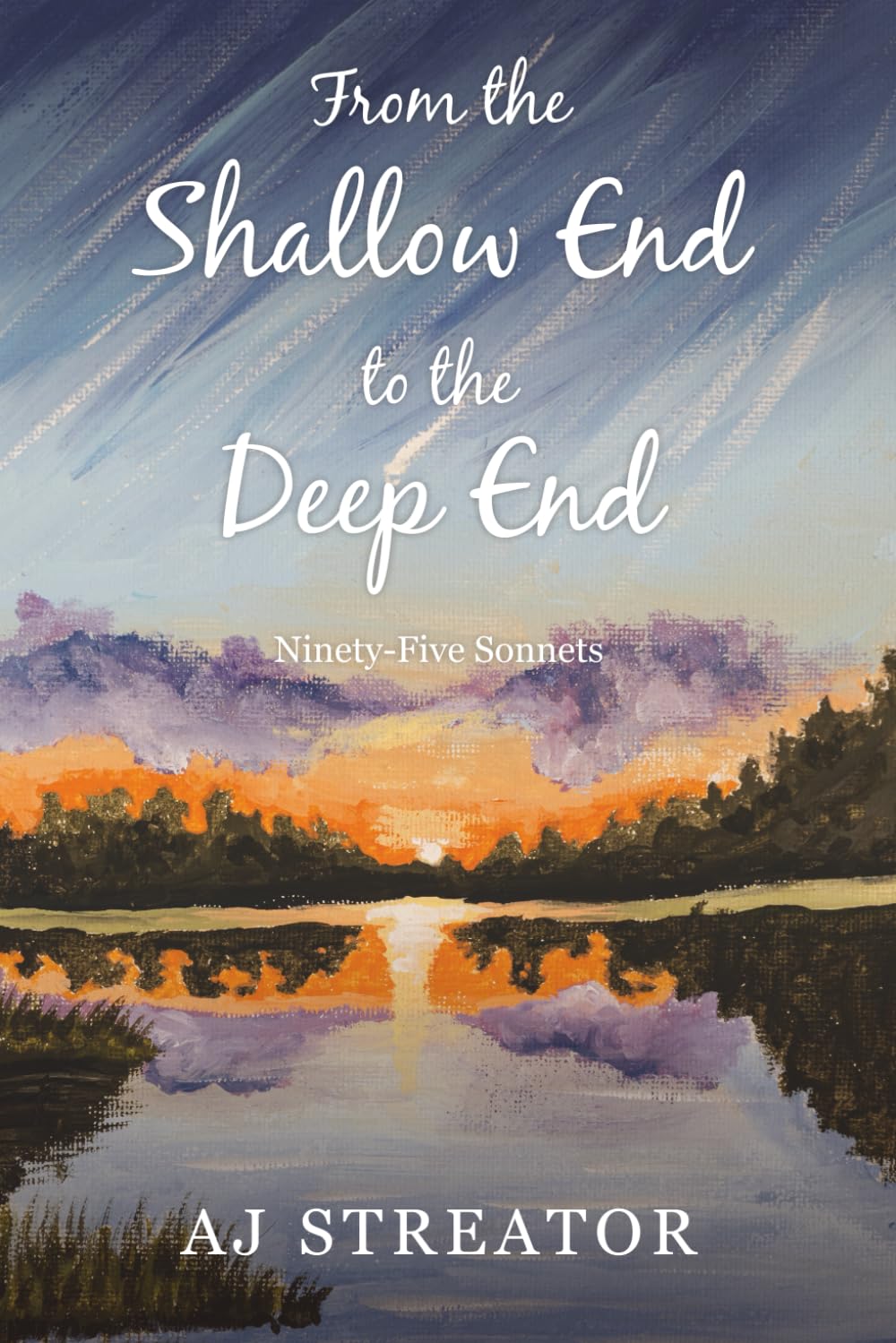
From the Shallow End to the Deep End is a rich and deeply personal collection of ninety-five Shakespearean sonnets that moves through childhood memories, family histories, heartbreaks, faith, despair, and redemption. The book travels in a steady descent from innocence to complexity and then rises again toward clarity and grace. Its structure mirrors the stages of a life that has been lived with open eyes and a bruised but persistent heart, and each section lays bare a different layer of the poet’s world. Streator uses the traditional sonnet form to anchor experiences that feel modern, messy, and often raw, and the tension between old structure and new emotion is one of the book’s strongest features.
I was surprised by how quickly the writing pulled me in. The language is formal on the surface, but beneath it flows a current of sincerity that feels warm and human. I kept pausing at lines that carried a punch not because they were fancy but because they were honest. The poems about childhood felt especially sharp. Scenes of brothers growing apart, parents missing from the stands, and friendships fading hit harder than I expected. They had this way of stirring old memories in me, making me nod along and think, yes, I’ve been there, too. The sonnets in the middle section became heavier and darker, and I admit they made my chest tighten. When the poet spoke about loss, depression, and the desperate quiet of survival, the writing felt intimate. I appreciated that. It made the collection feel alive.
Sometimes the rhyme scheme amplified the weight of the words and made the pain or the joy ring louder. I caught myself smiling at the poems about his children because they warmed the whole book. They softened the darker stories without pretending everything is fixed or simple. That mix of light and shadow felt real to me, and I found myself admiring how Streator holds both without flinching. The shift toward faith in the later sonnets felt authentic, not preachy, more like a man trying to keep his footing after being tossed by life one too many times. It gave the final stretch of the book a quiet sense of hope.
I walked away from this collection feeling both moved and grateful. I’d recommend From the Shallow End to the Deep End to anyone who loves poetry that speaks plainly about life’s messiness while still finding beauty in it. I think it’s well-suited for readers who appreciate traditional forms but want the content to feel fresh, personal, and unguarded. It’s also a meaningful pick for anyone who has lived through family storms, heartbreak, or the slow rebuilding of a life. The book isn’t afraid to wade into deep water, and it invites you to step in with it, one sonnet at a time.
Pages: 109 | ASIN : B0GCPRF4RD

Watery Eyes: Reflections of a Muslim Woman

Watery Eyes: Reflections of a Muslim Woman, by Yerusalem Work, is a wide-ranging collection of poems that moves through faith, womanhood, identity, memory, grief, and tenderness. It blends personal history with spiritual reflection and cultural pride. The book shifts from intimate whispers to big declarations, sometimes soft as prayer and sometimes sharp as truth. The themes that repeat across its many pages feel like a heartbeat. Love. Loss. Devotion. A soul trying to stay steady in a world that keeps testing it.
As I read, I felt pulled into the author’s inner world. Her writing is warm and direct, and I found myself pausing often just to sit with an image or a line. She talks about faith in a way that feels lived rather than taught, and that honesty hit me hard. I kept feeling this mix of ache and comfort. Some poems feel like opening a window after a long night. Others feel like stepping into a memory that isn’t mine, yet somehow rings familiar. Her voice rises and sinks, and I liked that the rhythm never stays still. It mirrors real emotion. Messy, surprising, sometimes contradictory. The work feels confident and vulnerable at the same time.
There were moments when the ideas felt bigger than the poem holding them, but I didn’t mind. I actually liked the looseness. It gave the book a raw edge. I loved how she writes about Ethiopia and womanhood and faith as if they’re woven into the same cloth, each thread tugging on the next until the whole thing glows. Some pieces felt playful, some mournful, and others almost like confessions. The writing invited me to consider my own ideas of belonging and purpose.
I would recommend Watery Eyes to readers who enjoy poetry that comes straight from the heart. It’s a good fit for people who like reflective writing, spiritual searching, and stories rooted in identity and culture. It would also speak to anyone who has ever carried love and loss in the same breath. This is a book for readers who want to feel close to another person’s inner life and who appreciate writing that is sincere, emotional, and alive.
Pages: 167 | ASIN : B0G6WHMTZ8


