Blog Archives
Stranger On This Earth

The Dream Collector: Book II: Sabrine and Vincent Van Gogh follows the relationship of Sabrine and van Gogh, who grow increasingly self-destructive, leaving Julie and Freud to find out why. What was the inspiration for the setup of your story?
The setup arose out of my passionate desire to understand why Vincent van Gogh, a genius of a painter, possessed his self-destructive impulses. I came to the conclusion that, in part, he perceived himself as a “stranger on this earth.” From childhood (in Biblical terms), a seed who fell by the wayside. Of course, for a more detailed (and explosive) explanation, one must read my novel. Sabrine, my fictional character, enabled me to mirror Vincent’s sense of abandonment and betrayal with her own backstory.
What experience in your life has had the biggest impact on your writing?
Hmm… another hard question. I remember, at age 14, the awe I felt after finishing Dostoevsky’s ‘The Brothers Karamazov’. It revealed to me the affective power of literature.
Can you tell us where the book goes and where we’ll see the characters in the next book?
This book reaches a definitive and (I will boast) a happy ending. There is no next book, but my ultimate plan has been a film in which to draw out more aspects of the characters in The Dream Collector.
Author Links: Facebook | Website
Sabrine, hospitalized for five years at the infamous Salpêtrière Asylum for Women, gains her release due to intervention of her sister Julie Forette and a young Sigmund Freud. The reunited sisters are introduced to the dazzling art milieu of 1886 Paris, and soon become close friends to the leading Impressionists. Sabrine attracts a cult following as a poetess, the enigmatic “Haiku Princess.” Seemingly cured by Freud of her Grand Hysteria, Sabrine soon enters into a tumultuous relationship with Vincent van Gogh.
Jule and Sigmund Freud, alarmed by the eerie parallels between the emotionally volatile couple and their self-destructive impulses, begin an urgent search to discover the root causes for Sabrine and Vincent’s growing psychoses. Julie, ‘The Dream Collector’ seeks their most unforgettable dream for Freud’s interpretation and revelations occur.
The Dream Collector is an exploration of the psychological consequences of betrayal, abandonment–and the redemptive power of art.
The Dream Collector: Sabrine & Vincent van Gogh – Book Two


In The Dream Collector: Book II: Sabrine and Vincent Van Gogh, RW Meek presents the captivating continuation of Sabrine’s journey, set against the rich backdrop of 1880s Paris. Following a prolonged stay at the Salpetriere Asylum for Women, Sabrine, now freed through the efforts of a young Sigmund Freud and her devoted sister Julie, delves into the vibrant Parisian art scene. Here, she meets the enigmatic Vincent van Gogh, and together, they embark on a passionate, albeit tumultuous, affair fueled by their shared artistic fervor and personal demons.
This sequel explores new dimensions of Sabrine’s character as she transitions from her intricate interactions with Freud to the equally complex Van Gogh. While the series blends historical fiction with elements of magical realism, it also evokes the adventurous spirit of “The Young Indiana Jones Chronicles” through its integration of historical figures and fictional narratives. Fans of art history will find much to admire here, as Meek vividly reimagines the lives of cultural icons such as Van Gogh and Freud. The portrayal of these figures is meticulously crafted, bringing an immersive authenticity to the narrative. Despite the larger-than-life personas surrounding her, Sabrine holds her own as a compelling protagonist. Her multifaceted personality—humorous yet fragile, unpredictable yet endearing—ensures that she resonates deeply with readers, making her more than just a mere adjunct to the historical luminaries she encounters.
Meek’s novel, The Dream Collector: Book II: Sabrine and Vincent Van Gogh, celebrates the turmoil of the creative process and offers a poignant exploration of identity and belonging through the eyes of an unforgettable heroine. This series promises to be a rewarding journey for those intrigued by the intersections of history, art, and human emotion.
Pages: 654 | ISBN : 1962465357

Burchfield’s Corner of Ohio
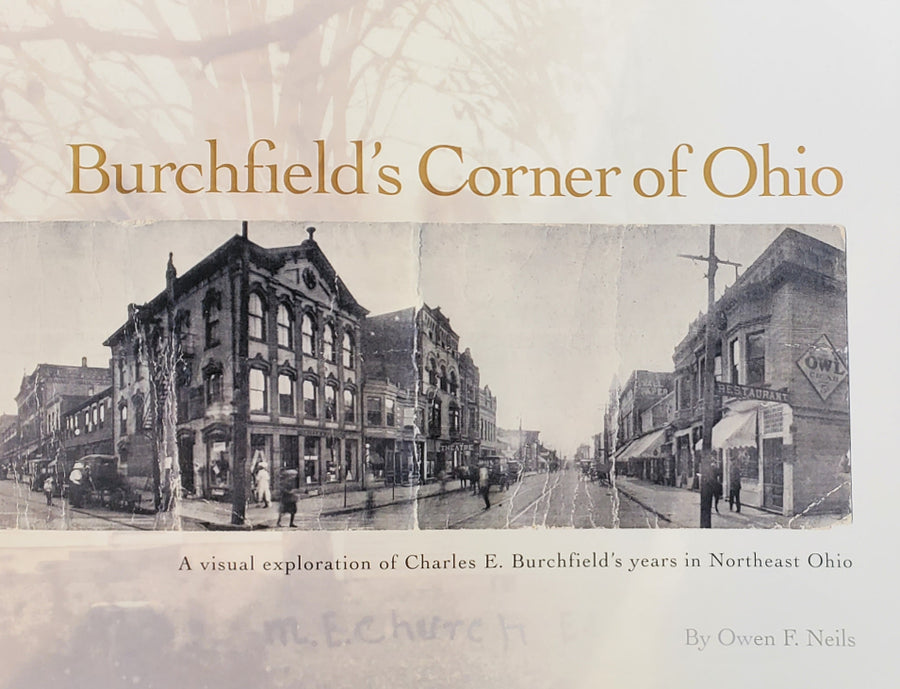

Owen F. Neils’ Burchfield’s Corner of Ohio vividly portrays the landscape and times of Salem and Northeast Ohio between 1898 and 1921, the formative years for artist Charles E. Burchfield. The book beautifully traces the journey of Burchfield, born in 1893 in Ashtabula Harbor, Ohio, through his childhood, artistic development, and his enduring connection with Salem, Ohio. A critical turn of events in his early life led to this bond with Salem, where he later pursued his artistic career, married, and refined his skills at the Cleveland School of Art.
Neils’ narrative is enriched by insights into Burchfield’s character and creativity derived from his journals. The descriptions of Burchfield’s vivid imagination and optimistic outlook, coupled with his love for exploring and artistically interpreting Ohio’s landscapes and communities, offer readers an intimate glimpse into his life and works. The book particularly resonates with those with a penchant for history and nostalgia. It captures the transformation of Ohio over time without losing sight of its intrinsic charm. The inclusion of photographs and vintage postcards enhances the reader’s experience, evoking the spirit of early 20th-century Ohio. This element of the book showcases the serene and communal aspects of the era and its simple and peaceful nature.
Neils’ comprehensive research and skillful presentation of Burchfield’s life and work make Burchfield’s Corner of Ohio a compelling read. This book will undoubtedly appeal to enthusiasts of art and history, offering a window into the life of a significant figure in American art history. Its addition to one’s collection offers not just an exploration of Charles Burchfield’s legacy but also a journey through a pivotal era in Ohio’s history.
Pages: 56 | ISBN: 979-888627617-6
Empowerment of Art
The Dream Collector Book I: Sabrine and Sigmund Freud follows a young woman working in a women’s asylum who meets Sigmund Freud, and together they explore mental health and the world of 19th century Paris. What was the inspiration for the setup of your story?
In 1886 Freud had been awarded a grant to study with famed hypnotist Jean-Martin Charcot at the Salpêtrière Asylum for women. Vincent van Gogh came to Paris to study the new art emerging, Impressionism. Here were two iconic figures who found themselves, their path, their calling, during that one special year. Annus Mirabilis. I only needed a protagonist with an interest in mental health and art to entwine their stories. Julie Forette, a self-educated woman, became my storyteller.
With so many famous people from history in your novel, what was your writing process to ensure you captured the essence of these characters?
Research, extensive research on each historical character, including letters, journals, anything which revealed their experiences, thoughts, and tone. And maintaining individual files, with sections like “His words/Her Tone’ so that when dialogue occurred in the story, I had a go-to resource, to capture their individualistic tone.
What were some themes that were important for you to explore in this book?
I’m so glad you used the plural, themes. My overarching theme was the empowerment of art, how a painting, book, poem can enable us to resonate with our own identity. How art can touch our hearts, raise our consciousness, and–––to risk addressing the spiritually inclined–––uplift our souls.
But a subsidiary theme emerged when learning that famed author Émile Zola, in 1886, betrayed his childhood friend Paul Cezanne by writing a roman à clef. In the novel, a failed artist, confronting his mediocrity, commits suicide. All of Paris knew that Zola was describing Cezanne. When Cezanne read the novel, entitled ‘Masterpiece’, he was heart-broken and never spoke to Zola again. I wanted to explore the tragedy of how someone you trust, you love, betrays you. And whether you can overcome the pain and trauma of betrayal. Can you recover? If so, how? So the theme of betrayal and abandonment becomes mirrored in my major characters, especially the protagonist Julie Forette and the Salpêtrière hysteric, Sabrine Weiss.
When will book 2 be available? Can you give us an idea of where that book will take readers?
Publication for Book II “Sabrine & Vincent van Gogh’ is scheduled for April 2024. We will follow Sabrine and Julie’s continued journey toward self-realization as they immerse themselves into the art milieu of late 19th century Paris. Under the watchful eye of Sigmund Freud, Julie and Sabrine become intimately involved with the major luminaries of the period, especially the van brothers, Theo and Vincent.
Julie Forette forms a friendship with the young, visiting intern Sigmund Freud who introduces her to the altering-conscious power of cocaine. Together they pursue the hidden potential of hypnotism and dream interpretation. After Freud receives the baffling case of the star hysteric, Sabrine Weiss, he is encouraged by Julie to experiment with different modes of treatment, including “talking sessions.” Their urgent quest is to find a cure for Sabrine, Princess of the Hysterics, before Dr. Charcot resorts to the radical removal of her ovaries.
In Paris, Julie finds a passion for the new art emerging, Impressionism and Post-Impressionism, and forms friendships with the major artists of the period, including Pissarro, Monet, and Degas. Julie becomes intimately involved with the reclusive Cezanne only to be seduced by the “Peruvian Savage” Paul Gauguin. Julie is the eponymous ‘Dream Collector’ collecting the one unforgettable, soul-defining dream of the major historical figures of the period.
The Dream Collector: Sabrine & Sigmund Freud

Set against the backdrop of Paris in the late 19th century, The Dream Collector Book I: Sabrine and Sigmund Freud, by R.W. Meek, immerses the reader in an era of remarkable transformation. The novel deftly intertwines the worlds of medicine and art, capturing the essence of a period marked by pioneering ideas. The story follows Julie Forette, an ambitious young woman who joins the Salpetriere, a mental asylum home to thousands of women with varying psychological conditions. Here, she encounters a young Sigmund Freud, and together they explore the enigmatic world of mental health, united by their curiosity and a shared interest in cocaine.
The narrative becomes increasingly intriguing with the introduction of Sabrine Weiss, a patient suffering from hysteria, whose condition puzzles both Julie and Freud. As Julie’s journey progresses, she meets several prominent historical figures, including artists like Paul Gauguin, Monet, and Cezanne. This not only enriches the story but also triggers a significant psychological evolution in her character. Meek’s novel shares similarities with the ethereal style of George Saunders, particularly his work Lincoln in the Bardo.
The Dream Collector stands out with its vibrant portrayal of Julie Forette. While initially seeming like a mere narrative device to facilitate encounters with famous personalities, Julie emerges as a character as compelling and dynamic as her historical counterparts. She navigates the shifting landscape of France, deeply affected by the societal and cultural revolutions around her. Her interactions with artistic and medical luminaries are marked by intellectual depth, showcasing her evolving consciousness and understanding of the world.
The Dream Collector: Sabrine & Sigmund Freud offers an engaging journey through a pivotal period in history, filled with intellectual exchanges and vivid portrayals of renowned figures. Each page promises a new discovery, making it a rewarding read for enthusiasts of the genre. Its blend of historical depth with a lively narrative makes it a notable addition to historical fiction.
Pages: 723 | ASIN : B0CP8P5SWL
Fifteen Minutes

In Fifteen Minutes, author Michael F. Rizzo takes readers on a journey through the dynamic intersection of artistic creativity and political bureaucracy. This engaging narrative explores the fascinating conflicts at the heart of several notable artistic endeavors, particularly those of Billie Lawless III. Rizzo’s meticulous research and detailed compilation illuminate the delicate balance between art, political institutions, and community interactions.
The book delves into various compelling stories, including how Billie Lawless III successfully installed his monumental sculpture, Green Lightning, in Buffalo, New York. These narratives offer insightful perspectives on the turbulent realm of public art and its impact on city landscapes.
Rich with knowledge, Fifteen Minutes invites readers to explore the nuanced relationship between art and culture in urban settings. The background information on Billie’s life, especially his stance as a conscientious objector and his legal actions against military conscription, is particularly revealing. It helps readers appreciate the depth of his character and convictions.
Michael Rizzo’s writing style is clear and accessible, making the book a smooth read for those who may not be familiar with specialized art terminology. The inclusion of striking photographs and artwork further enhances the reading experience.
While I thoroughly enjoyed the depiction of the tension between artistic expression and political considerations, I felt the narrative could benefit from a more lyrical touch. At times, I felt the focus on varied topics and stages seemed somewhat hurried, leaving me with a desire for a more interconnected storytelling approach. Nevertheless, fans of historical narratives and urban studies will find these sections appealing.
Fifteen Minutes is not just a vivid account of artistic endeavors; it prompts significant reflections on artistic liberty and the misuse of power. Those interested in public art, as well as general art enthusiasts, will find this book a treasure trove of information about history, creativity, and the challenges artists face in public projects. It’s a worthwhile read for anyone seeking to deepen their understanding of the art world.
Pages: 377 | ASIN : B0CLYV9LC1

It’s About the Chaos

Dave Droge Author Interview
The Game Changer revolves around the life of creative businessman Henk who finds himself in trouble after an art robbery takes place in the heart of Rotterdam. This book is a genre-crossing novel with elements of a romance, crime, and art history as well. Did you start writing with this in mind or did this happen organically as you were writing?
Thanks first for all the time and effort to read my book. This is a very good question and maybe therefore not easy to answer: it’s both in a mixture I would say. I started with some basic ideas and investigations, did some research on the subjects and meanwhile, on the other hand, write highly intuitive. Then I switch from these two mindsets every now and then, like in a loop that rolls forth until you get the feeling it’s almost finished. I certainly have no idea how it will end when writing and I am surprised at times about the direction the novel or characters takes… so then I change the research and idea’s to be able to go on a bit further. In the end, it takes a lot of editing, and in this process the book is also enriched a bit, blended.
The relationship between Henk and his daughter Julia is intriguing and risque. What was the driving ideas behind these characters traits and relationship?
Emancipation and seeking of one’s identity/freedom of Julia and maybe also the idea that world problems might need to be solved by women. But in this novel, it’s mainly about Henk, the businessman whom you might in some ways see as a Donald Trump kind of guy (thinking now of the open letter I read on the website of Michael Moore written to Ivanka Trump: ‘your dad is not well’, but it’s written after writing my novel). It’s about the chaos in Henk’s mind, the obsession of dominating, maybe caused by fear of women taking over power, confused with and entangled in the love for his daughter.
There is some fantastic art history in this novel. Was that intentional? Did you have to do research for this book?
Yes, I did quite some research, but in the intuitive writing process most of it is done for nothing probably, you never know for sure. The general idea I guess is indeed that art can maybe help us, it’s an investigation if so and if the answer is yes, how this can be done. What role can art play, seen from the viewpoint of the eighteen-year young Julia. She wants art to be decisive.
Why did you choose Rotterdam as the setting for this novel?
It’s close to my hometown, Vlaardingen, and plays a major role in the area where I live, historically and still from this day on, although the work in the harbour gets more automated nowadays. Furthermore, I would like to emphasize that Elias Canetti’s Auto-da-fe (‘Die Blendung’), written in 1935, was an inspiration for my novel, mainly regarding the atmosphere. As a tribute, I mentioned his name once deliberately within the novel in the middle somewhere, as well as using the term ‘stipendium’, which I came to know reading this novel and ‘Masse und Macht’. I consider this novel my personal and modern ‘die blendung’.
What is the next book that you are working on and when will it be published?
The next book is all about Julia, Henk his artistic daughter. At this point in time I feel that it can still take a while before it will be finished, although there are more than 100k words written and severely edited so far. I tend to be rather ambitious regarding goals and ideas of a new book I guess, so to finish it, to pull it off is unsure: it might not work at all. Especially since the new novel will partly be science fiction, playing in 2050, I wonder if I will manage.
Author Links: GoodReads | Facebook | Website
Sneak preview of the new novel:
 The floating pavilion called The Game Changer, peacefully located between the landscaped garden and artistic attributes crammed with solar – panels, foils and conductive basins along the eaves – is virtually deserted, a rarity. As if Providence feels there is something special happening since I will, after all these years, speak privately with her. After several decades, the moment finally arrives. The ring gives an orange signal, I will have to do sport for half an hour the least, followed by a silent meditation to bring my blood pressure and pulse combination back to acceptable levels. The nerves vultures in my throat, my nasal breathing is irregular, but I consider it too late for intense exercise; I can at best apply a short-term yoga technique, click the ring signal back to inactive and start enjoying the view. In the distance I see a dot rising, it could be the amphibian taxi, one that brings her to this magnificent pavilion, two miles off the coast of Hoek van Holland situated in the North Sea, a sea largely transformed into a sea farm: one big floating habitat of many thousands of hectares. It remains beautiful to see how the east side of our integrated Maasvlakte has become a place for handling assembly of environmentally friendly products surrounded by renewables and encapsulated between tens of thousands of wind turbines, seaweed farms and solar generating systems with modern forms of salt mining. We are a leader in the world, people! Mom will not believe her eyes. In a country like the U.S.A., they are still jealous; they have looked with uttermost suspicion at our ultra-modern business, our activities that saved the planet and ourselves, mankind, from The Great Catastrophe.
The Game Changer


The Game Changer, written by Dave Dröge and set in Rotterdam, revolves around the life of creative businessman Henk van Wijnen-Swarttouw. Henk finds himself caught up within a web of trouble with the law after an art robbery that takes place in the heart of Rotterdam.
Meanwhile Henk’s daughter, Julia, attempts to reach for liberty and human rights through art that is confrontational and provocative. She showcases her talent within her parents art gallery, located in the famous Witte de Withstraat. Henk’s clear distaste for Julia’s “shock value” art drives a dividing wedge between father and daughter and he becomes obsessed with knowing every aspect of Julia’s life.
Through the help of German psychiatrist Von Stürmer, Henk and his daughter must come to grips with understanding her desires for a green sustainable future, whilst facing investigation on his own business practices.
Dave Dröge’s words are enriched with an artistic flair that allows the reader to feel as though they are more than just a spectator in the story of flamboyant Henk van Wijnen-Swarttouw. A mixture of modern era and a touch of old school, The Game Changer allows the reader to easily picture the charming life within Rotterdam. The wine, decadent buildings and lively characters of the novel piece together a picture of beauty and intrigue.
If you enjoy an element of lust in your novels, The Game Changer will satisfy your needs in an elusive room 33. However the relationships in this novel are often short lived and instead the novel draws focus towards the father-daughter relationship and the relationships with Henk’s business associates. Secret meetings, codes lined with dark, red leather and a detective are all part of the mysterious circumstances surrounding art and business.
Henk’s daughter Julia is a free bird, a lover of all things green and a passionate advocate for creating a green, sustainable future. Julia has plans to go to medical school however during her sabbatical she uses her father’s art gallery to display her provocative art. In retaliation, Henk becomes obsessed with his daughter as he fights to control every element of her life. This sometimes leaves the reader feeling slightly uncomfortable as he borders the line between concerned father and an obsessive stalker.
The Game Changer switches between first and third person easily in order to portray various characters points of view. Cor Figee, an account manager, is one character that I came to admire due to his unwavering moral compass, even in the face of adversity. Figee’s neighbour, Elenoor, is handicapped and with her low IQ is often the target of bullies and Figee heroically defends her- even if he needs to cross cultural boundaries. Hard working, he establishes himself with Russian businessmen and creates an honest lifestyle for himself and soccer mad son, Daan.
Many of the characters find themselves stumbling through life and the excessive drinking implies lavish lifestyles of ordinary folk, such as Johanna the barmaid. She indulges in liquor and is almost sycophant to Henk but proves her friendship to Henk loyal when the time arises. Henk’s German psychiatrist, although small in stature, proves to be an integral part of reviving the relationship between father and daughter.
Best read with a pot of fresh mint tea, I would recommend this for anyone who is interested in learning about life within Rotterdam whilst indulging in a spoonful of romance, crime and art history.
Pages: 384 | ASIN: B01N5CQY1A



 LITERARY TITAN