Blog Archives
Curious Questions

Nurse Florence, Tell Me About Adipose Tissue follows three girls talking with the school nurse at lunch, who want to learn what purpose body fat serves in keeping the body working. Why was this an important book for you to write?
The Nurse Florence® series explores the curious questions that people have about the body, so this book serves to answer the questions some may have about adipose or fat tissue.
With the human body being so complex, and some areas doing many jobs, how do you determine what medical facts to include in your books?
Sometimes, it’s just intuition about what should be included and what should be left out. All of the books can’t be 100 pages long, so we just have to choose to cover different concepts in multiple books.
What were some ideas that were important for you to share in this book?
I was surprised to learn myself that adipose tissue produces some hormones, so if I thought that was interesting, then I thought others would find that interesting as well.
What is one thing that you hope readers take away from Nurse Florence, Tell Me About Adipose Tissue?
The human body is complicated, and it’s ok to learn new things about the body for all our lives.
Author Links: GoodReads | Facebook | Website | Essay Contest | YouTube | Dow Creative Enterprises® | Nurse Florence Series | LinkedIn | Amazon
Where Reality Tips Into Wonder

Shinbone Lane follows a runaway teenager in 1974 San Francisco who finds refuge and a found family in a hidden street of artists, misfits, quiet magic, and a wisecracking pigeon. What first sparked the idea for Shinbone Lane as a hidden pocket of San Francisco?
When I moved from San Francisco to Sonoma County about 20 years ago, I was looking for additional freelance writing work. I answered a Craigslist ad and met a young man at a coffee shop for an interview. The ongoing work he had in mind would have required more time than I had, so it wasn’t a good fit. Still, we enjoyed talking and shared things about our backgrounds.
He was a Gen Xer; I’m a baby boomer. I told him about arriving in San Francisco in the 1970s with about $200 in my pocket. I thought I’d visit for a couple of weeks and wound up living there for almost 30 years. He said my early adventures in San Francisco sounded like a fairytale to him—something a young person couldn’t replicate so easily anymore. Housing had already become so much more expensive.
That conversation stayed with me. The idea of writing about that time sat on the back burner for years, gradually taking shape as I returned to it from time to time, until Shinbone Lane emerged.
San Francisco does have many real hidden pockets—places so beautiful they seem magical, and people so inventive and intriguing they seem magical too. I just followed my imagination where it wanted to go. As a storyteller, I’m drawn to spaces where reality tips into wonder. This is true for both my written work and for stories I tell live in performance.
Shinbone Lane almost feels alive. Did you think of the lane as a character?
Yes, I did. The area where I situated the lane is one I’m very familiar with. I lived near the corner of 29th and Sanchez streets for eighteen years, so I walked our dog up the 29th Street hill and drove up to Diamond Heights to shop routinely. That steep hill feels like a part of me now.
Shinbone Lane, an imagined side street easy to miss when driving by, became a living, breathing presence with its own rhythms and moods.
Place has always been important in my work, and Northern California continues to shape my imagination. It was a great amount of fun bringing the lane to life and letting it influence the characters who find their way there.
Found family is central to the story. Why is that theme important to you, and why was it important that the community be imperfect, messy, and sometimes conflicted?
I think almost all of us have some issues to work out with our families when we grow independent as young adults. For some, the issues are minor and family support is a constant. For others, too much trauma stands in the way of family ties being anything but harmful at the time. And there are many shades in between.
It’s a blessing that people can find each other and build a supportive base that becomes a different kind of family. How lucky we are to be able to do that for one another.
As for the community being imperfect, messy, and sometimes conflicted, that reflects both life in this world of ours and my approach to storytelling. And while I want love to be the most powerful force in the end, I don’t shy away from the complications that come with being human.
I lost both of my parents by the time I was eleven, so there’s an undercurrent of loss and darkness that finds its way into my work. At the same time, I am optimistic and delight in my connections with loved ones, as well as the beauty in the world. That tension between light and shadow, hope and hurt is something I return to often, and I hope it resonates with readers.
What is the next book that you are working on, and when will it be available?
I’m at work on another magical realism novel, Ripplewood, set in an out-of-the-way town of that name in Sonoma County, California. The town was named for a forest of ripplewood trees that once existed, though now only one remains, deep in the woods. It’s the same kind of tree that appears in front of Ted’s home on Shinbone Lane, but this book is not a sequel.
The story begins with Emlyn Grady driving home. She was raised in Ripplewood and has been attending San Francisco State University for six years, changing majors along the way and still not quite finding her footing. When she receives a text from her father urging her to come home immediately because of a crisis, she drops everything—including an important meeting her boyfriend has arranged with investors interested in his startup—and heads directly to Ripplewood.
There she finds out her mother is missing, but she’s gone missing before. So what could have happened is a mystery in a town where family roots and history are imperfect, complicated, messy, conflicted and unresolved (of course). There is folklore unique to Ripplewood, but how much is real, how much is fiction and what effect it has had on the town is a topic debated without resolution by the locals. In this setting, the story begins to unfold. And like Shinbone Lane, the story’s layers reveal themselves over time.
I’m interested in how place, memory, and inherited stories shape us, and how we decide what to carry forward. I’m still in the process of writing and discovering the full shape of the book, which is one of the things I love most about the work. I hope to finish the book this year and publish it in 2027.
Author Links: GoodReads | Substack | Facebook | Website
San Francisco, 1974. Sixteen-year-old runaway Maddy is escaping the blame for a crime she didn’t commit. Miles from home, she is taken under the wing of the elderly Clara and her neighbor Ted, and soon finds a place among the kaleidoscope of personalities on the oddly named Shinbone Lane.
Ted’s three-story Italianate Victorian house overflows with travelers, free spirits, and artists. His backyard is a haven for all who are willing to see its magic. But burdened dancer Eloise Watkins can’t tolerate the transient “riffraff” in her neighborhood. Their frivolity flies in the face of her grief over friendship lost and her daughter who’s missing. And nobody — nobody— understands.
But like all who tread on it, Shinbone Lane has secrets of its own. And like all secrets, they lie uneasily in the dark, until the truth emerges to lay the past to rest.
At the intersection of magic and reality lies Shinbone Lane and its lively cast of characters who intertwine in the mesmerizing brew of life.
Click ‘buy now’ to step into Shinbone Lane today!
Teaching Kids About Chronic Diseases
Nurse Florence: What Is Sickle Cell Disease or Sickle Cell Anemia? is a clear and structured introduction to a complex medical condition, covering genetics, symptoms, complications, diagnostic methods, and potential treatments. Why is this an important topic for children to learn more about?
Unfortunately, this disease affects some children in the world and it is important that all kids learn about their body and how to manage chronic diseases.
What is your process for taking the medical information and developing a way to present it so that it does not overwhelm children but still gives them enough knowledge to understand this complex condition?
I try to simplify concept to one main idea per page.
Do you offer any additional resources for families who want to learn more about the topics you cover in the Nurse Florence books?
I use medical resource documents and research for the source of my book information and highly recommend Mayo Clinic information at www.mayoclinic.org.
What is your goal in creating this series, and how do you see it growing in the future?
I would like to see a global health movement for health promotion and literacy sparked and the whole world be able to have competent conversations with their doctors. The series should end at around 700 books in the series. As of April 2026, there are currently 261.
Author Links: GoodReads | Facebook | Website | Essay Contest | YouTube | Dow Creative Enterprises® | Nurse Florence Project | LinkedIn | Amazon
Inner Space Aliens


Inner Space Aliens picks up with real momentum, taking Erik, Finna, and Kalli out of the afterglow of their earlier victory and dropping them into something murkier, stranger, and more subterranean. This time, the threat isn’t just a villain bent on conquest, but a whole hidden system of corruption under Iceland itself: Fjólsvin inherits Loki’s plans, the Morphytes dig toward geological catastrophe, and Erik, with his tetrachromacy and his ability to read Óðin’s aurora messages, is pushed into the role of leader whether he wants it or not. Along the way, the book braids together volcanic tremors, Huldufólk politics, Reme’s grief-haunted testimony about the attack on his village, and a cavern climax where Erik’s athletic discipline finally becomes destiny when he uses an arrow like a javelin and blinds Fjólsvin in the middle eye.
What I liked most is that the book understands Erik’s fear and doesn’t cheapen it. He isn’t brave in that polished, effortless way that can make young fantasy heroes feel prepackaged. He’s frightened, uncertain, analytical, often overwhelmed, and the novel lets that matter. His scenes have a nice inward pressure to them, especially when he’s trying to decode patterns in the aurora or convince himself he’s capable of carrying what Óðin expects of him. I also found the mythology unexpectedly affecting. The material around the Huldufólk, the fractured glyphics, and Queen Borghildur’s grave understanding of what Loki exploited gave the story a sadder undertow than I was expecting. Reme, too, adds a bruised human ache to the novel. His memories of seeing impossibly tall invaders with a third eye could have been handled as mere plot fuel, but they land with genuine trauma behind them, and that gives the book moral weight.
The writing itself is earnest, vivid, and sometimes wonderfully odd in ways I found charming. When it leans into landscape and atmosphere, it can be quite evocative. The northern lights as a coded language, the glittering blue caverns, the steaming grotesquerie of Fjólsvin’s lair, and the waterfall reveal near the end all have a bright storybook intensity that suits the novel’s mythic ambitions. The prose is a little overinsistent, and the dialogue can state emotions rather than letting them appear subtly. Still, I kept feeling the force of the imagination behind it. The book’s ideas are more interesting than they first appear to be. Beneath the adventure, there’s a recurring concern with inheritance, diluted power, betrayal born from resentment, and the burden of being chosen before you’re ready. I was especially drawn to the notion that lost grandeur and envy make the younger Huldufólk vulnerable to Loki’s promises. That gives the conflict a tragic contour rather than reducing it to simple good-versus-evil machinery.
Inner Space Aliens is imaginative and surprisingly tender beneath all its lava tubes and cosmic peril. It’s the kind of sequel that expands its world by making it weirder and sadder, while also giving Erik a satisfying turn at the center. I finished it feeling that the book’s heart is one of its strongest qualities, especially once the surviving characters come back together and the victory is shaded by the warning that the struggle underneath Earth is not over. I’d recommend it most to readers who enjoy YA fantasy with Nordic myth, hidden worlds, earnest heroism, and a taste for adventure stories where emotion and lore are allowed to sit side by side.
Pages: 230 | ASIN : B0GM8X2TSF

The Hidden Curriculum

Mastering the Hidden Curriculum reveals how the unspoken rules, hidden expectations, and subtle power dynamics of medical training can shape who struggles, who advances, and who learns to succeed in medicine. What first convinced you that the “hidden curriculum” in medicine was not peripheral, but central to trainee success?
This is an excellent question, as my recognition of the hidden curriculum was not an immediate revelation. Several years ago, while conducting a literature search, I encountered the concept of the hidden curriculum, and it immediately resonated with me. It captured something I had long been interested in but had not previously been able to clearly define. At that point, however, I had not fully appreciated its significance.
As I explored the topic more deeply, including areas that have received limited attention, and reflected on my own experiences, I began to recognize that the hidden curriculum is far more expansive and influential than is typically acknowledged. This realization created a sense of responsibility to share these insights, which ultimately led me to begin writing a book. Despite recognizing its importance, I had not yet concluded that it was central to success in medical education.
What ultimately solidified that perspective was engaging in conversations with colleagues and peers about my work. Regardless of institution or setting, the themes in their experiences were strikingly consistent. I began to hear a steady stream of examples, many involving seemingly minor missteps by trainees that nonetheless had outsized consequences. In some cases, a single incident could shape a supervisor’s perception of a trainee in a lasting way, effectively becoming a label that is difficult to overcome.
How did you decide which invisible forces in medical training were most important to name for readers?
In developing a comprehensive framework for the book, I aimed to identify the forces that most meaningfully shape the training experience. Broadly, I focused on two categories. First, I highlighted foundational influences (those that are highly impactful yet often difficult to recognize) because they are so deeply embedded within the culture of medicine. Second, I emphasized more visible, surface-level forces that nonetheless have a significant and immediate effect on trainees’ experiences and trajectories.
Examples of foundational influences include medicine’s historical shift from a spirituality of transcendence to one of immanence, the role of humanism in shaping medical practice, and the lasting influence of William Halsted, who established the first U.S. surgical residency under motivations that were likely, in part, self-serving. These forces are less frequently discussed, yet they fundamentally shape how training is structured and experienced.
In contrast, surface-level influences include factors such as the impact of role modeling on professional behavior and the drivers of specialty segregation by sex. While these may be more readily observable, they carry substantial consequences for how trainees navigate their environment and make career decisions.
What do you most hope a first-generation medical student or early-career resident feels after finishing your book?
Beyond the practical guidance such as the importance of actively seeking out strong mentorship, I hope that a first-generation medical student or early-career resident finishes the book with a genuine sense of belonging. That sense of belonging is a fundamental human need, and it can be especially elusive in environments where the hidden curriculum is not made explicit.
My hope is that, by understanding and navigating these often-unspoken dynamics, first-generation trainees feel empowered not only to find their place, but to do so as their authentic selves. With the support of meaningful mentorship and a clearer understanding of the training environment, they can begin to recognize that their unique perspectives are not liabilities, but strengths that can enhance both their own experience and the field more broadly.
Author Links: GoodReads | Website | LinkedIn
Key Features:
– Unravels the many unspokens―the hidden curriculum―of medical training
– Povides basic background material and strategies to succeed in medical training, focusing on information left out of the formal curriculum and often not conveyed to trainees
– Features a balanced, evidence-based discussion on many areas of misinformation and controversy, such as statistical testing, the gender pay gap in medicine, the replication crisis, generational trends and biases, and more
The Walking Wounded

The Walking Wounded is a crime novel with strong police procedural and romantic drama threads, but what it is really about is damage, loyalty, and the long afterlife of abuse. It opens with Phil Dobson and Li Zhang meeting as children, then follows them into police work as they become central to a murder investigation tied to missing boys, institutional corruption, and child abuse, while the book also tracks Noah and Levi, two brothers caught in that system, and the deep bond between Phil and Li that keeps growing underneath everything else. By the end, the book is less about solving one case than about what it takes to survive, protect other people, and keep living with what cannot be neatly fixed.
The writing does not circle pain politely. It walks straight at it. Sometimes that bluntness works very well because it gives the book an unfiltered emotional charge, especially in scenes involving Noah and Levi, or in the way Phil’s buried trauma slowly rises back to the surface. I also liked that the book is willing to be messy. The dialogue can be rough, funny, tender, and awkward in the same breath, which made the characters feel more lived-in than polished. At the same time, I did feel the novel occasionally leans so hard into intensity that subtlety gets crowded out. There were moments where I wanted the story to trust its strongest scenes a little more and explain a little less. Still, I never had trouble understanding what the book cared about. It cares about wounded people. It cares about children who are failed by adults. It cares about the difference one loyal person can make.
I was especially interested in the author’s choice to braid genres together instead of staying in one lane. On one level, this is a police story with detectives, interviews, raids, corrupt figures, and an expanding case. On another, it is a queer love story that takes its time, almost to the point of frustration, with Phil and Li circling each other for years before finally moving toward honesty. And under both of those is a trauma novel, one that keeps asking whether justice is ever enough when the damage began in childhood. I found that mix compelling because the ambition is real. The book wants to expose systems, hold onto tenderness, and still leave room for recovery, new family, and love. That is a lot to carry, and not every part lands with the same force, but I respected how fully it committed to that emotional and moral scale.
I’d recommend The Walking Wounded most to readers who can handle dark material and who like fiction that mixes crime, trauma, and character-driven relationships without sanding off the rough edges. I would especially point it toward readers who enjoy police procedurals that are less about procedural neatness and more about the people carrying the case home with them, as well as readers who want a romance shaped by history, grief, and trust rather than easy chemistry alone.
Pages: 881 | ASIN : B0GJTVHHS4
The Diaries of a Teenage Pilgrim: The Early Journey
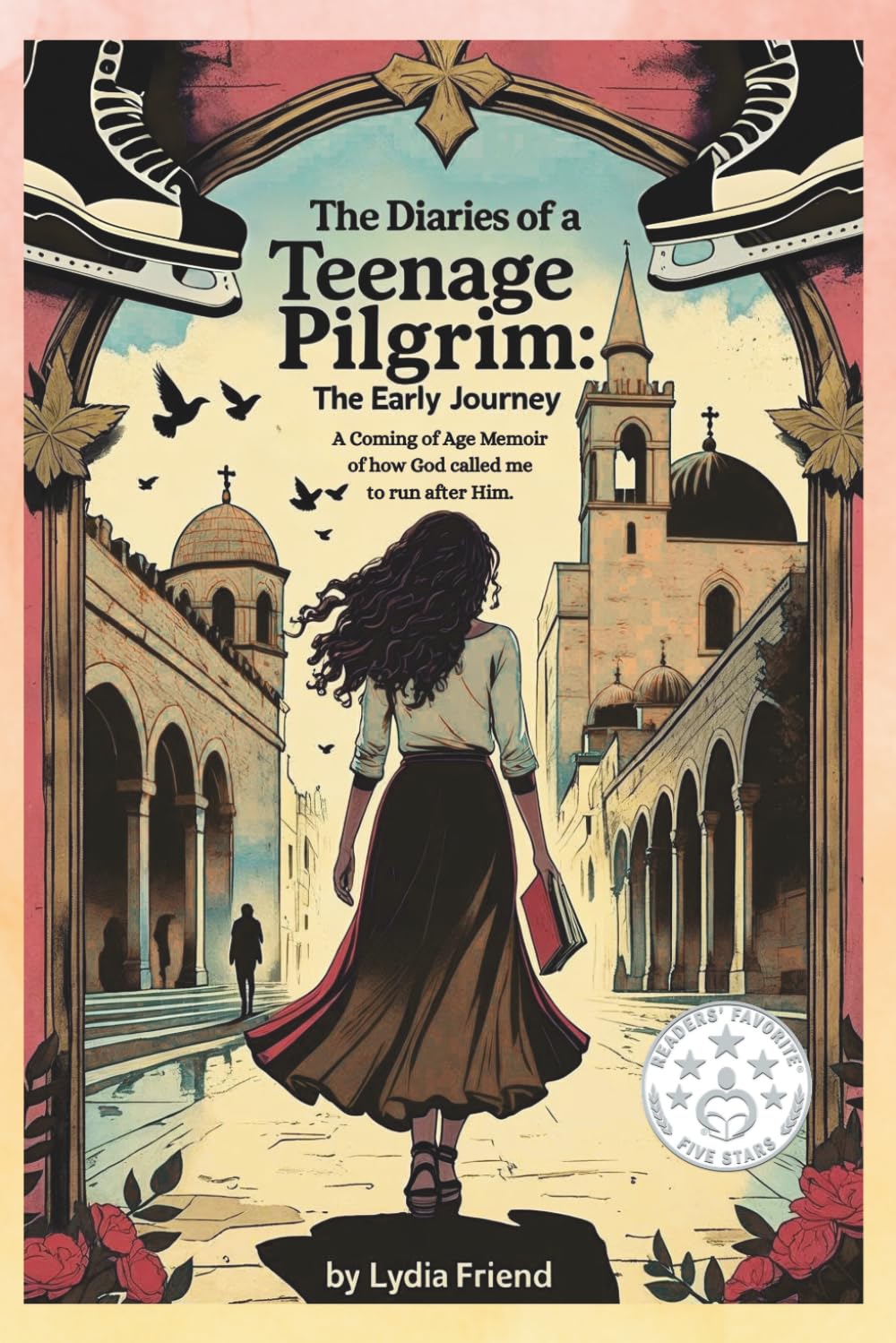
I found The Diaries of a Teenage Pilgrim: The Early Journey to be, at heart, a coming-of-age memoir about spiritual identity under pressure. Lydia Friend begins in the warm, enclosed world of Spooner, Wisconsin, then is swept into a family move to Israel that feels at once providential and deeply destabilizing. What follows is not a tidy overseas faith ministry narrative but a long, uneven apprenticeship in exile: Jerusalem and Metulla, homesickness and fervor, poetry and loneliness, the ache of being pulled between the Ozarks and the Galilee, and finally a devastating car accident that becomes a hinge point rather than a climax. The book keeps returning to one question in different forms: what does it mean to belong when every earthly home feels provisional, and when faith asks not for certainty but for surrender?
I liked the book’s emotional candor. Friend has a gift for rendering memory through texture and atmosphere, so that a white cat in an airport carrier, a farewell quilt from a small church, or a frantic run through Atlanta with a harp on her back can carry real emotional voltage instead of merely serving as anecdote. I admired the way she lets adolescent intensity remain intense. She doesn’t flatten her younger self into someone wiser or more ironic than she was. That gives the memoir a rawness I found moving, especially in the sections where she feels caught between two worlds and can’t tell whether she’s being formed or simply undone. The prose has a luminous, devotional quality. It lingers over rain, cedar, songs, hospital fear, and the strange tenderness of being cared for after catastrophe. There were moments when the language tipped toward repetition or overstatement for me, but even then I felt the pressure of a real inner life behind it.
I also found the book’s ideas both compelling and specific. Friend’s central vision of pilgrimage, displacement, and what she calls being “Stranger Lovely” gives the memoir its theological spine. She reads exclusion, longing, and even creative repression as part of a larger divine romance, and whether or not a reader shares every article of that belief, it’s hard not to feel the force of how fully she has lived inside it. I was especially struck by the way the accident and recovery chapters reframe suffering not as abstract lesson material, but as something bodily, terrifying, and humiliating before it becomes meaningful. That sequence gave the book real gravity.
The Diaries of a Teenage Pilgrim is a sincere memoir, and sincerity here is not a small thing. What I valued most was its refusal to separate spiritual formation from embarrassment, adolescence, longing, family history, art, or pain. Friend writes like someone trying to recover her own song while she’s still hearing its echoes, and that gives the book an intimacy I found affecting. I’d recommend it especially to readers who are drawn to faith memoirs, overseas faith ministry childhood narratives, and stories of displacement that are as inward as they are geographical. It will likely speak most powerfully to readers who have felt out of place in the world and have tried to make meaning of that estrangement without denying its cost.
Pages: 322 | ISBN : B0FP31B2LW

Floo Flocky Doo to the Rescue

Floo Flocky Doo to the Rescue is a buoyant and rhyme-driven picture book about a spirited little girl, Floo, who follows her hummingbird friend Peanut to a baby squirrel, rescues him, names him Lucky Lou, and then discovers that loving a creature doesn’t always mean bringing him everywhere. The story moves from cozy domestic play to mild chaos at the grocery store, where one sneeze sends Lou flying into Miss Nellie Faye’s hair and turns a simple errand into a comic chase through produce, jam, and aisles full of alarm. It’s a small adventure, but it has that enlarged picture-book feeling where every mishap becomes momentous, funny, and just a little breathless.
What I liked most was the book’s wholeheartedness. Floo’s voice is earnest and excited, and the writing understands the peculiar intensity of a child’s logic, especially that wonderful conviction that affection and improvisation can solve almost anything. I found the repeated “What should I do?” and “Hootie Hoo” refrains genuinely effective. They create a chant-like rhythm that feels made for reading aloud, and they give the story a playful musical spine. At the same time, the book’s emotional center is sweeter than it first appears. Under all the commotion, it’s really about care, attachment, and the moment a child realizes that good intentions aren’t always enough. That note of dawning responsibility gives the silliness a little weight.
I also think the illustrations deliver a great deal of the book’s charm. They have a soft watercolor brightness that suits the story’s gentle mischief, and they know when to lean into absurdity. The image of Lou tangled up with Miss Nellie Faye’s wig is the sort of visual joke that children will instantly seize on, but I was equally taken with the quieter scenes, like the baby squirrel tucked into a floppy shoe or Lou smugly sticky with blueberry jelly. Those details keep the book feeling fun.
Floo Flocky Doo to the Rescue is endearing and relatable. It’s funny, warm, slightly chaotic, and rooted in a real fondness for family lore, which gives it more heart than many breezier picture books manage. It believes in imagination, in little messes, in love that learns as it goes. I’d recommend it especially for children who like animals, repetition, and read-aloud stories with a lot of motion, and for adults who don’t mind a picture book being a little rambunctious as long as it has tenderness to spare. This is a lively and affectionate children’s book that shows its heart right on the page.
Pages: 38 | ASIN : B0GPPGLK1V


