Blog Archives
Beyond the Paddock
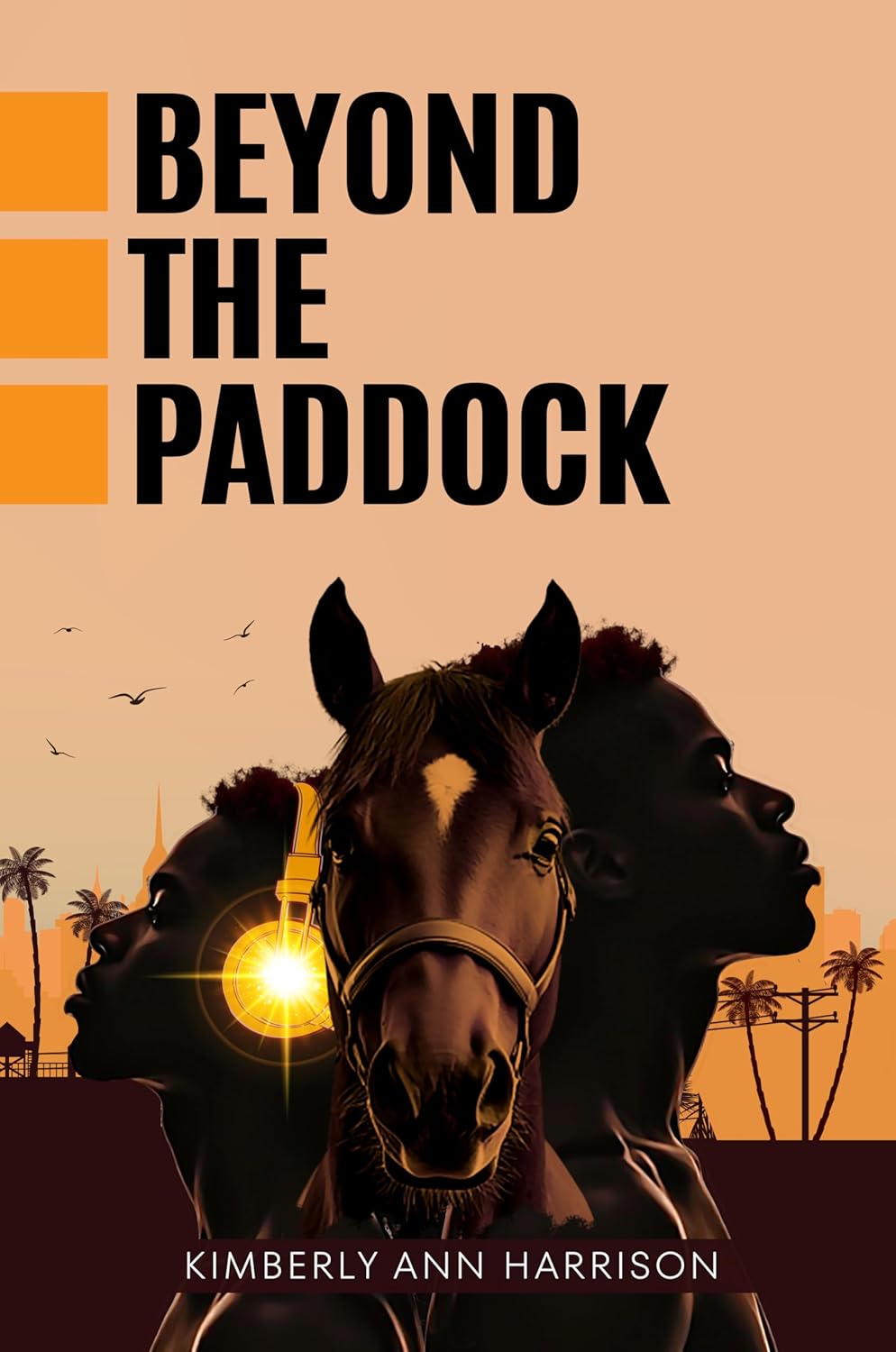

Beyond the Paddock is a coming-of-age novel that weaves together street racing, foster care, and elite equestrian sport into a powerful story of brotherhood and transformation. Set against the vibrant and chaotic backdrop of Inglewood and the tranquil horse farms of Kentucky, the book follows foster brothers Julian and Cameron Taylor, two Black teens navigating a world stacked against them. After a brush with the law, they are unexpectedly placed in the custody of their court-appointed attorney, Reign Brooks, and sent to rural Kentucky to live under the eye of her estranged father, a horse trainer embroiled in scandal. What begins as punishment slowly transforms into purpose, as the boys discover their unlikely talent in show jumping, ultimately rewriting the legacy of their upbringing.
What struck me most about Beyond the Paddock was how seamlessly Kimberly Ann Harrison blends grit and grace. Her writing is rich with texture. The dialogue pops, especially between the brothers. It’s fast, funny, and raw. The emotional tension never lets up, but it doesn’t feel heavy-handed. Harrison balances moments of fear and heartbreak with humor and hope, creating a rhythm that feels like real life. I appreciated the details of the world she built, from the foster system’s red tape to the unfamiliar traditions of equestrian sport; every element felt lived-in and personal.
What really got me, though, was the heart. This story isn’t just about fast cars and fancy horses. It’s about found family, second chances, and fighting like hell to stay together. Julian’s fierce protectiveness over his brother resonated with me. His desire to rise above and still cling to his roots is painfully relatable. And Cameron is a spark, sometimes reckless, always real. Watching him fall in love with horses, despite himself, made me feel like I was falling too. The arc they travel together is bumpy and full of bad decisions, but it’s never without love. Harrison makes you root for them, even when they’re messing up big time.
Beyond the Paddock is a story about rewriting the rules and reclaiming your place in a world that never expected much from you. It’s gripping and full of swagger, but it’s also soft where it counts. I’d recommend this to anyone who’s ever felt out of place, especially teens and young adults who crave stories where street smarts and heart collide. If you loved The Hate U Give or Friday Night Lights, this one’s for you.
Pages: 447 | ASIN : B0FBHCXKGQ

Blood on the Mountain

Blood on the Mountain, by Kristian Daniels, is a deeply personal coming-of-age story set against the backdrop of family conflict, small-town traditions, and the slow unraveling of childhood innocence. The story follows Noah as he navigates a tangle of faith, family expectations, and the painful realities of growing up different. Through his eyes, we see the sting of bullying, the quiet terror of not fitting in, and the tentative steps toward self-discovery both in terms of identity and sexuality. The novel blends these intimate struggles with generational drama, love stories, and moments of hope, creating a portrait of adolescence that feels as raw as it does real.
The writing pulls you right into the emotional center of each scene. The author captures the ache of wanting to belong and the fear of being yourself, especially in a world that can be both judgmental and unkind. The depictions of bullying are tough to read but impossible to ignore. They’re sharp and often mirror the subtle cruelties that linger after the school bell rings. Against this backdrop, Noah’s quiet journey toward accepting his sexuality unfolds in small, tender moments that contrast beautifully with the hostility around him.
The ideas here resonate on multiple levels. This isn’t just a story about teenage hardship. I think it’s about the courage to live authentically in the face of fear. The book speaks to the LGBTQ experience without turning it into a cliché or a token subplot. Instead, it weaves identity and sexuality into the fabric of Noah’s growth. It also asks hard questions about family loyalty, faith, and the cost of speaking your truth in environments that demand silence. While I enjoyed the novel, I believe that some of the antagonists felt a bit too black-and-white, but the emotional honesty in Noah’s perspective more than balances that out.
I’d recommend Blood on the Mountain to readers who value heartfelt and character-driven stories. Especially those interested in LGBTQ narratives, anti-bullying themes, and the messy, beautiful process of self-discovery. It’s a moving, sometimes difficult, but ultimately hopeful read.
Pages: 393 | ASIN : B0FLVW2J1J
The Nameless Dead

The Nameless Dead, by Leta Serafim, follows Greek police chief Yiannis Patronas as he investigates the murder of a child and uncovers a tangle of prejudice, corruption, and personal vendettas in a small village. The plot moves between the procedural grind of the investigation and the tense undercurrents of rural life, where long-held grudges and deep suspicion run through every interaction. As Patronas digs deeper, the case grows darker, revealing the complicated human motivations behind violence and the cost of seeking truth in a place where silence often feels safer.
Serafim writes with a sharpness, letting tension seep in without shouting it at you. I liked how she allowed the setting to act almost like another character, with its own moods and shadows. The pacing wasn’t always even, but that slow burn worked for me. It gave time for the moral weight of the case to settle in. What I liked most was the way the story dealt with bias, not in a grand, preachy way, but in the small, sideways glances and unspoken assumptions that shape the investigation.
Still, there were moments when the dialogue felt a bit stiff, almost like it was holding back. I sometimes wanted the characters to spill over more, to show the rawness behind their guarded expressions. The plot itself is clever, though, and Serafim manages to weave in enough misdirection to keep me second-guessing my hunches. There’s a certain melancholy in the writing, a recognition that not every mystery can be tied up neatly, and that honesty often comes at a price.
I’d recommend The Nameless Dead to readers who like their crime fiction steady and thoughtful, with more emphasis on atmosphere and moral complexity than flashy twists. If you enjoy stories where the setting feels alive and the characters live in shades of gray, then you’ll enjoy this book.
Pages: 224 | ASIN : B0DF51DJ22
Adora’s Dance With the Prince

Adora is a bright, imaginative young woman living in a vibrant West African kingdom. Her heart longs for the grand festival newly announced in the capital, yet her days are consumed by the thankless drudgery imposed by a cruel stepmother and selfish stepsisters. Just as hope begins to fade, a shimmering twist of fate arrives, her Spiritual Mother appears, bearing a gown of breathtaking beauty, elegant shoes, and a magical palanquin to carry her to the palace. There, among the lantern light and music, Adora captures the attention of a handsome prince. But magic has limits. When the enchantment dissolves, she flees into the night, leaving behind a single shoe and a prince determined to find her.
Adora’s Dance with the Prince, by Tricia Knights, offers a fresh, culturally rich reimagining of the timeless Cinderella legend. Targeted toward children aged five to nine, the book blends a familiar story arc with vivid West African flair and a generous infusion of magic.
Cinderella’s enduring appeal lies in its universal themes. Children, across cultures and generations, understand the sting of unfairness, being excluded from something wondrous, as Knights so vividly portrays with the festival. At the same time, they embrace magical thinking with ease. The sudden arrival of a benevolent Spiritual Mother at the very moment she is needed feels not just believable, but inevitable in the boundless logic of childhood.
Knights, however, doesn’t simply retell the classic. She bends the arc, subverting expectations in small but satisfying ways, keeping even seasoned readers leaning forward. And while the plot charms, the illustrations astound. Each page bursts with color and life, every detail layered with texture and movement. These are not incidental embellishments; they elevate the narrative, making the book as much a visual feast as a storytelling delight.
The combination of luminous imagery, lively pacing, and a heroine worth cheering for ensures Adora’s Dance with the Prince will resonate with young readers everywhere. It is a story that celebrates courage, beauty, and the belief that magic, whether literal or not, can change everything.
Pages: 32 | ASIN : B0FCD8KGSD
Our Ability to Judge
GRQ is a dark, fast-talking spiral into the absurd world of crypto schemes and capitalist delusion, told through the unraveling life of a man who’s equal parts hustler and fool. What was the inspiration for the setup of your story?
Well, because I live and work in the motion picture world, there is this proximity of art and commerce. That seems innocuous enough, but invariably, the commerce has a pernicious effect on the art, and maybe commerce has a pernicious effect on virtually everything else that we do as well. Whether that’s true or not, it’s still something that I ruminate on. I have seen many people in my world compromise their vision or themselves in the service of short-term financial reward. The thinking is, I will compromise now, but later I will make things right with the world, the family, or God, or whoever one must make things right with to get absolution. I am fascinated by this process. “For what will it profit a man if he gains the whole world and forfeits his soul?” (Matthew) Fair enough. But maybe this gaining the world buys a person time until they can figure things out, while we search for real meaning. In the meantime, we get to eat.
Marlon is such a compelling character. Was he based on anyone you’ve known or read about?
I know a lot of people like Marlon. When directing actors, I often have to say to them that they are the hero of the story, no matter who their character is, because most of us believe that we are either heroes or victims in the grand narrative of our lives, and characters should reflect that. Rarely does anyone think of themselves as genuinely culpable for anything that befalls them. So I think “Marlon type” behavior should be seen as something that is done in degrees by everyone. Some rationalize better than others, some disguise their actions more effectively, some are pathologically unaware that they are doing it, and others do it reluctantly out of necessity. But rare is the person who is not only pure in intention and in behavior. They might even admit this, but then want a moment just to explain.
I tried very hard not to pass judgment on Marlon, and although we can objectively be critical of him, I wonder how differently anyone behaves in a crisis? How many of us actually reject the precept of slightly corrupt means justifying a virtuous end? We probably should, but we probably don’t.
What were some themes that were important for you to explore in this book?
I work in the fictive world, and I recognize that fiction and narrative provide us with solace by suggesting order in a chaotic world. It doesn’t mean that the perception of narrative order is correct, but it is essential. Each of my characters creates their own moral universe, in which their behaviors make perfect sense to them, if not to other characters or the reader. The term unreliable narrator is introduced early in the novel, and it is essential to the understanding of the themes that I’m examining. Everyone is an unreliable narrator because none of us experiences the objective world objectively. Our ability to judge others is compromised, as is our ability to judge ourselves. The nature of this faux ordering is at the very heart of the book, as is the world’s essential chaos. It is the struggle between these two elements that is the space where we live, hoping to make sense of everything, and when that is impossible, accepting pretty much anything. Money? Love? Religion? Conspiracies? Metaphysics? Anything.
Nobody in GRQ really gets a neat ending. Was that a commentary on redemption in late-stage capitalism?
The short answer is yes. Although I would add this addendum, it extends beyond capitalism. I think most people’s efforts to build satisfying and rewarding lives are ultimately futile, and that little they do will ultimately provide them with spiritual succor, a resonant foundation, or give them a sense of genuine purpose and meaning. It’s a huge risk to build one’s life on bigger philosophic understandings that don’t offer immediate or palatable rewards, but building our lives on material accumulation has certainly revealed itself to be a form of madness. To me, my characters are essentially comic because it is the human comedy; the repetition of the same actions to which we are predisposed, with the same tragic/hilarious outcomes. If our lives were screenplays, we fail to do the necessary rewriting. Instead, we recast, thinking that’s going to change the outcome. I can tell you from making a lot of films, casting doesn’t change our story or our ending.
Author Links: GoodReads | Facebook | Amazon
Unfolding over a single tension-filled day, Marlon must confront not only his financial ruin, but the dark secrets haunting his family.
A pulse-pounding descent into the dangers of unchecked ambition and the real-world costs of chasing the dream.
Rome’s Culture

In The Altar of Victory, you take readers on a journey into the days of the Western Roman Empire and the political fallout following the death of Emperor Valentinian I. Why was this an important book for you to write?
It was important to me for several reasons. My interest in this era began long ago, when I was a European History major in college and had taken a class on the period from Late Antiquity through Charlemagne (300-800 AD roughly). The period up to Constantine was well covered, as was the actual catastrophe of the sack of Rome in 410 AD and the subsequent barbarian invasion. However, the course jumped past the last half of the 4th Century, when the Roman empire was still intact and just before these catastrophes began to increase. The more I read in the intervening years, the more evident this gap appeared. Even Gibbon’s Decline and Fall of the Roman Empire tended to treat this critical period of European history in summary fashion.
I also decided that the question of how such a technologically advanced civilization like Rome, with the most organized army and engineering in the world, could fail to see the threat and fall so quickly to less organized enemies. Was there a point when the decline could have been arrested? Did it really come down in part to the deaths of perhaps three key emperors (Valentinian, Valens, and Gratian)? Was it cultural change and the loss of a Roman identity? What role did the advent of organized Christianity play? It was a host of puzzles that I wanted to understand, if not solve.
Can you share with us a little about the research that went into putting this book together?
Before I began writing, I spent several years accumulating various non-fiction sources- books by more contemporary historians like David Brown and Michael Grant; biographies of Ambrose of Milan, etc. I also went to the limited primary sources- Ammianus Marcellinus, of course, Zosimus, the letters of Symmachus, St. Jerome, Ausonius, the Notitia Dignitatum, and others; the military manual of Vegetius. Even as I began to outline the plot and write the first chapters, I continued to read and learn what I could, and still felt that so much was still missing from the historical record. Which was also good, because it enabled me to fill in with a plot of my own devising!
What were some themes that were important for you to explore in this book?
I wanted to explore what remained of Rome’s culture in the 4th Century, and how it had been eroded or replaced as the empire had grown and the city of Rome was no longer the center of the empire. I was also interested in the courts of the emperors, when the emperors no longer came from Rome or even visited very much. The idea that the key military and administrative figures had now become Gauls, Franks, and other nationalities/tribes who had only recently been enemies of Rome seemed to me to be critical in understanding how “Romanness” could have been disappearing for decades before a military transition occurred.
Another theme of importance to me was the figure of Gratian. By all accounts, he was a decent and brave military leader and tried to be a good emperor. He was also a fairly devout Christian and took an interest in the ecumenical issues of the day. And yet, he did not last, and after his reign, the Roman army did not do well in the west. I wanted to explore whether he was the last, best hope for Rome and what factors worked against his success.
Can we look forward to more work from you soon? What are you currently working on?
I am both researching and writing the sequel to The Altar of Victory, in which I intend to conclude Gratian’s story. I am also trying valiantly to finish a collection of short stories set in the 19th and early 20th centuries of Louisiana and Texas before year end.
Author Links: GoodReads | Facebook | Website | Amazon
Demons Were Banished
Storms is a heartfelt coming-of-age tale where eight-year-old Annie Ryan faces the emotional turbulence of family, loss, and identity during a storm-ridden caravan journey across 1970s Australia. What inspired you to tell this story through the eyes of an eight-year-old?
I felt that it would have more of an impact if it were told by the person who was the same age, rather than as a retelling from the benefit of the perspective of age. These events happened to the child, not the adult, and as time passes, we tend to gloss over events. I didn’t want that for Annie. These events were real for her, and they needed to remain that way.
How much of Storms is drawn from your own life, and what was the most difficult part of the book to write emotionally?
The book is a fictionalised account of my own experience as an 8-year-old travelling in a caravan with the rest of the family. Most of the events are real, with a few exceptions. For example, my stepfather didn’t die until I was pregnant with my fifth child; however, in Storms, he does meet an untimely end. The most difficult part to write emotionally was the sexual assault scene. My original draft had it all in graphic detail, but this was for my own benefit and was my way of expunging the event from my life. I was then able to sit back and write it so that it would still have an impact, but the graphic detail was no longer there. Although it was emotionally draining to write, it was also cathartic, and those particular demons were banished.
The metaphor of storms is used throughout. Was that a conscious framework from the start, or did it evolve as you wrote?
Yes, indeed it was. It was a stormy time from the perspective of the weather, which became a metaphor for the events of the whole year. Just like storms have their calm centres, so too did that year. This only made the turbulence of the key events stand out more. And like all storms, the storms of that year did end in rainbows and sunshine – literally and figuratively!
What is the next book that you are working on, and when will it be available?
That’s a very good question! I find myself at a bit of a standstill now, overwhelmed by all the stories I have in progress, and unable to focus on just one. I’d like to write Annie’s sequel, Snake in the Grass, and will do that soon. Before that, though, I hope to have a collection of Private Investigator/Detective stories ready for May 2026, but I will have to get a move on if I am to do that!
Author Links: GoodReads | X (Twitter) | Facebook | Website | TikTok | Amazon
Leaving their home in Brisbane, Australia, at the height of the 1974 floods during intense cyclonic weather, the Ryans set off on their epic journey, traveling ahead of the storms everywhere they go.
But storms of the heart are more difficult to navigate, and Annie faces more tragedy and heartache in this one year than a young girl should in a lifetime.
Award-winning author, Phoebe Wilby, was raised in Australia. She has lived in several countries and considers herself a ‘citizen of the world’.
Storms is her debut novel, following two short story collections and a memoir.
Mood and Mystique

Midnights in October is a collection of thirty-one fifty-five-word tales offering glimpses into the supernatural, giving readers an eerie story to cherish each night in October. What was the inspiration for this unique collection?
October is my favorite month of the year. I love the changing light, the temperature cooling, and the overall anticipation of All Hallows Eve. It occurred to me that having a nightly morsel to read would be a great way to add to the mood and mystique of such a month while enticing us, every night, to spend an hour or two by candlelight making up our own fables on the spot.
What was the biggest challenge you faced in putting together this book?
As Angel Numbers go, five is an intriguing one, and so are double fives. Infected by the notion of combining powerful numbers and words into a spellcasting fest, I committed to keeping my micro-fictions within a 55-word limit. I won’t lie, the revisions were numerous, at least five for each one, and word placement was maddening, but after extensive beta-reading, editing, and proofing, each micro fiction felt just right. It helped that there are specific observances in the month of October, which gave me a ready topic to explore. The other 13 days became a mixture of supernatural slices, wishful thinking, or expressed views.
Do you have a favorite selection from Midnights in October? One that was especially fun to write.
My favorite is October 31, “Halloween.” Every time I read it, I pat myself on the back because it paints such a dreamlike picture. As far as fun ones to write, I’d have to say October 2nd, “The Sky is Falling,” and October 17th, “¡Salud!”
What is the next book you are working on, and when will it be available?
My Faerie Legacy series, chronicling the lives of 3 matriarchs in hybrid faery-human family, is currently a trilogy (now available in Spanish), and I’m contemplating writing a 4th book. I’ve barely started the outline process, so it won’t be a 2026 publication— 2027 might be more on the mark.
Author Links: GoodReads | BlueSky | Facebook | Website | Amazon
But words said in October will inevitably conjure a spellcasting fest.
‘Tis the season for lit-tricky-treats, so dive in, make a ritual of it and, on the fly, compose your own nightly fable in fifty-five words or less.
Why fifty-five?
It’s all about the energy double fives lend to the moment or task.
When casting in October, let your words, or the components of your spell, be 55 in number. Its power will infuse your intention with signature energies like adventure, change, development, opportunity, and transformation, all vital when seeking to begin afresh.



 LITERARY TITAN