Blog Archives
A.W.A.R.E. : A Personal Safety Playbook for Leaving the Nest


S. Gale Bleth’s A.W.A.R.E. is a practical and cautionary guide for young adults stepping into college, work, social freedom, and the wider world without the immediate shelter of home. Built around the acronym Alert, Watch, Assess, Respond, Escape, the book argues that most personal safety begins before a crisis, in attention, preparation, intuition, and the willingness to leave a risky situation early. Through recurring campus-centered stories, especially Lili’s devastating experience at a party, Sara’s encounter with the white van, and Jack’s bar-night assault, Bleth turns self-defense into something broader than strikes and escapes. It becomes a mindset, a way of reading a room, a parking lot, a drink, a stranger, and sometimes one’s own fear.
This book treats safety as a form of self-respect rather than suspicion. Bleth’s central idea, that “90 percent” of safety happens in the mind, feels persuasive because she keeps returning to ordinary moments where danger begins quietly. A laptop left in a library, a drink accepted too casually, a car approached without noticing the open van beside it, a concert entered without clocking the exits. Those examples have a plainspoken force. They made me think not only of college students but of anyone who has mistaken familiarity for safety. The book’s emotional weight comes from that tension between freedom and consequence. It doesn’t ask young people to shrink their lives, but it does ask them to stop sleepwalking through them.
A.W.A.R.E. is direct, repetitive by design, and informative. The repeated reminders to “just leave,” trust your gut, use the buddy system, and stay in your Yellow Color Code can feel insistent, but I came to see that insistence as part of the book’s method. Bleth is trying to make the reader remember under pressure. Lili, Bri, and Sara sometimes seem shaped more as instructional figures than fully dimensional people. Still, the clarity has its own integrity. The chapter on consent, with its discussion of the familiar “tea” analogy and its blunt insistence that no means no, lands with necessary moral firmness.
I admired A.W.A.R.E. for its urgency, its compassion, and its refusal to confuse independence with invulnerability. Its best pages feel like the voice of someone who has seen too many preventable harms and is trying, with both hands, to place a flashlight in the reader’s grip. This is a useful, earnest, and often sobering book, and I’d recommend it especially for high school seniors, first-year college students, parents preparing to send a child out into the world, and young adults who want practical safety guidance without being told to live in fear.
Pages: 161 | ASIN : B0GSGXTLLG

The Expectant Author: A Trimester-by-Trimester Guide to Writing and Delivering the Book Inside You

The Expectant Author is a practical and encouraging guide for aspiring nonfiction authors, especially coaches, entrepreneurs, speakers, and experts who feel they’re carrying a book but don’t know how to bring it into the world. Heidi Richards Mooney structures the writing and publishing journey around pregnancy, moving from conception to development to delivery, and she uses that metaphor to guide readers through clarifying an idea, setting a “due date,” building an outline, writing through doubt, revising with care, choosing a publishing path, and launching with intention. The book is part memoir, part workbook, part steady hand on the shoulder, with Mooney drawing from her own experience turning a series of floral-industry marketing articles into Rose Marketing on a Daisy Budget, then learning self-publishing, speaking, promotion, and authorship as she went.
What I appreciated most was the book’s emotional intelligence. Mooney understands that most unfinished books don’t fail because the author lacks material; they stall because the author is afraid, scattered, overextended, or waiting to feel legitimate. Her chapters on “morning sickness,” comparison, and writing through real life felt especially honest. I liked the humility of her examples, such as making a one-page-a-day commitment, building a binder with chapter tabs, taking solitary beach weekends to hear her own voice again, and learning that outside editors could catch what her own devoted eyes could no longer see. The book and its advice respect the private tenderness of creating something that may eventually be judged in public.
The writing has a gentle, rhythmic quality, and that warmth is the book’s great strength. Mooney writes like someone who has sat across from many would-be authors and heard the tremor underneath their ambition. I found the book most compelling when the metaphor gave way to lived specificity: Bill Healy affirming that her marketing book could help small business owners, Dan Poynter demystifying self-publishing, a Barnes & Noble friend helping her get placed correctly in stores, Evie Diaz asking whether she had a launch team, and speaking engagements slowly widening into larger stages alongside figures like Jay Conrad Levinson. Those moments remind us that authorship is not only a process, but a web of relationships.
I found The Expectant Author to be a sincere, useful, and motivating guide, one that treats a book less as a product to be manufactured than as a message to be carried responsibly into the world. Its ideas are not radical, but they’re wise in the way practical truths often are: finish the thing, get help, keep returning, don’t confuse perfection with integrity, and remember the reader waiting on the other side. I’d recommend it to first-time nonfiction authors, especially service-based professionals and entrepreneurs who need structure, reassurance, and a grounded path from idea to publication. It’s best for readers who want both a plan and a little tenderness as they learn to deliver what they’ve been carrying.
Pages: 117 | ASIN : B0GX2V31PH
The Asia Code: A Million-Dollar Handshake: How to Build Relationships That Win in Asia

The Asia Code is a practical, story-driven guide to doing business in Japan, China, and South Korea, built around the idea that deals in Asia are won less by perfect pitches than by patience, trust, emotional intelligence, and the slow art of being known. Author Gadi Sznajder frames Asian business as a world where the real negotiation often happens beneath the spoken one, in the silence after a presentation, the dinner after the meeting, the questions about family, or the careful preservation of face. Through examples like Innovate Corp misreading a Japanese boardroom, Antoine fumbling a Seoul relationship by treating culture as a checklist, and Michael Chen losing a Chinese partnership despite fluent Mandarin, the book keeps returning to one central truth: business is personal before it’s transactional.
What I liked most is the book’s insistence that cultural intelligence can’t be reduced to etiquette. That gives the whole thing a warmer pulse than many executive guides have. The strongest moments are the ones where Sznajder pulls the reader away from surface behavior and toward motive, especially in his discussions of guanxi, mianzi, nemawashi, ringi, jeong, nunchi, and pali-pali. I found the Japanese sections particularly elegant because they capture the ache of ambiguity, that strange Western discomfort when silence feels like refusal but may actually be an invitation to listen harder. The writing can be grand, with Tokyo boardrooms gleaming, tea being poured slowly, and whole business cultures unfolding like weather systems. That style works beautifully. It makes abstract ideas feel lived-in.
I also appreciated the way the book returns to its central wisdom from several angles, letting the idea settle in rather than simply stating it once and moving on. The message that relationships matter more than transactions gains weight through repetition because each chapter refracts it through a different cultural lens. Frameworks like BRIDGE, TRUST, and ADAPT give the reader practical handles without pretending that human encounters are simple, and Sznajder’s humility keeps the book grounded. The Korean field notes were especially memorable to me, with their sharp observations about visible busyness, after-hours obligation, loyalty, and even the theater of leaving a car at work. Those details gave the advice a grainier texture and made me trust the book more because it felt observed.
I appreciated The Asia Code as a reflective argument for slowing down, paying attention, and taking people seriously. Its best idea is also its simplest one: the “code” isn’t really a code at all, but a disciplined way of showing respect before asking for commitment. I’d recommend it to executives, founders, consultants, and sales leaders preparing to work in East Asian markets, especially those who are smart enough to know that data alone won’t carry them across the room.
Pages: 213 | ASIN : B0GSD2SHTB
Faith Is the Foundation

Discover Your Gold Mind offers readers a reflective guide focused on a disciplined inner life shaped by self-awareness, faith, and purpose. Why was this an important book for you to write?
This book came from a combination of personal interviews and research I conducted back when I was a newspaper reporter. Reporters have the privileged opportunity to meet some of the wealthiest and most successful people from all walks of life. Just as a reporter wants to provide valuable information to their readers and subscribers, I felt that what I had learned should go beyond just the immediate weekly audience who read my newspaper articles. I felt this information should be shared with the public at large. So, I started conducting more research, which eventually became the book.
Media is known as the 4th Estate. Our purpose is to inform the public. As a journalist, it is my purpose to gather and distribute as much useful information to people as possible. That’s what I hope this book does.
Who did you have in mind as your primary reader while writing this book?
The book grew out of my speeches given at colleges and universities. The bulk of the book is the text – almost verbatim – from my speeches. So, I would have to say the book was geared towards college students. However, I believe the principles can be practiced by anyone. And that’s my desire. Only a select community read my newspaper articles. Only the audience in attendance heard my speeches. I wanted to preserve a version of my speeches and spread the information to as many people as possible.
What role does faith play in developing a “gold mind”?
Faith is the foundation. The bible describes faith as the evidence of things unseen. That means our vision for ourselves comes from having faith. Others have no idea why we do what might seem impossible or ridiculous to them. But every physical reality that we enjoy from nice homes, cars, cell phones, and even artificial intelligence came from a vision that originated in someone’s mind. Having faith is what allows us to persevere patiently in the midst of naysayers as well as endure through trials and hardships. Becoming the best version of yourself is not going to be easy. Making a change is not easy. Change is uncomfortable. There’s always some resistance and pain involved in making a change. But we have a choice: We can accept the pain of discipline or the pain of regret.
What daily habits most effectively help someone build a stronger mindset?
The way you start your day is the most important part of the process. Do not start your day with any form of media – radio, television, or social media. Begin each day with prayer and/or meditation in complete solitude for at least 5 minutes. I wouldn’t go longer because the body needs to be active. Start a 15–20-minute exercise regimen. Exercise will kickstart your endorphins. Skip breakfast and drink only water. Make sure you get sunlight early in the morning and throughout the day. Vitamin D does wonders within the body.
I know it might seem cliché, but reading, writing, and arithmetic are best for direct mental stimulation. The mind is a muscle, and it has to be exercised to grow stronger. Read and write every day. Do one or two mathematical word problems each day. Word problems combine reading, writing, and critical thinking to help solve real-world problems.
The second most important component is to end your day with reflection. This allows us to assess the effectiveness of our plan to reach the goal. Daily exercise, word problems, and meditation will develop a stronger mindset in as little as three weeks if it’s done consistently.
Author Links: GoodReads | X (Twitter) | Website | Amazon
Hypnotherapy: The Art and Science of Transformational Healing


In Hypnotherapy: The Art and Science of Transformational Healing, Danielle Aitken presents hypnotherapy as both a clinical discipline and a deeply human practice, moving from definitions and myths into neuroscience, stress physiology, self-hypnosis, metaphor, regression, and practical applications for anxiety, depression, insomnia, pain, IBS, infertility, autoimmune illness, PTSD, phobias, performance, and functional neurological disorders. The book’s central conviction is clear: healing is not something imposed from outside, but something awakened through the mind-body connection, especially when the subconscious is approached with care, repetition, imagery, and emotionally resonant suggestion.
Aitken writes with the confidence of someone who has lived close to suffering, both personally and professionally, and that gives the material an uncommon tenderness. Her discussion of stress as the thread running through so many conditions felt especially persuasive because she returns to it with practical patience. The case examples give the book its pulse: Sam’s perfectionism and headaches, Jody’s belief that rest meant laziness, Sally’s grey heaviness after grief and depression, Jason’s school anxiety softened through imagination, and Layla facing birds after years of panic. These stories help translate theory into felt experience. I found myself most moved when the book paused over the small interior shifts that precede visible change, the moment someone begins to imagine safety, dignity, or relief before the body fully believes it.
The writing is at its best when it blends explanation with metaphor. Aitken has a generous, almost pastoral voice, and she can make clinical ideas feel accessible without stripping them of emotional weight. I liked her insistence that hypnosis is not magic, mind control, sleep, or theatrical surrender, but a collaborative state of focused awareness. That correction matters, and she makes it repeatedly. The book’s wide-ranging chapters create a useful map of hypnotherapy’s possibilities. The prose circles claims about stress, subconscious patterns, and inner resources. Still, I valued the repetition when it served the book’s deeper rhythm: change is practiced, not merely understood.
Hypnotherapy asks the reader to take the mind seriously without abandoning the body, and to see healing as a disciplined partnership between science, language, feeling, and imagination. This is a compassionate, earnest, and useful book, especially for readers curious about hypnotherapy, wellness practitioners seeking a broad overview, and clients who want reassurance before entering the therapeutic room. It is best suited for those who are open to reflective, holistic approaches to change and who appreciate a guide that speaks not only to symptoms, but to the wounded, hopeful person beneath them.
Pages: 319 | ASIN : B0GF8SWYGJ
So You Want To Be A Treasure Hunter (Archaeologist)

So You Want To Be A Treasure Hunter is a fun and enchanting guide for any curious kids who have ever picked up an old coin, a strange rock, or a broken piece of pottery and wondered, “Who left this here?” Aimed at readers ages 10–14, the book takes the exciting idea of treasure hunting and turns it into something even better: real archaeology. Instead of focusing on movie-style traps, secret tombs, and piles of gold, Soules shows readers that the true treasure is the story behind an object and what it can teach us about people who lived long ago.
One of the best things about this book is how clearly it explains the science behind archaeology without making it feel boring or complicated. Readers learn about tools and methods like ground-penetrating radar, LIDAR, magnetometry, stratigraphy, dating methods, conservation, and lab analysis. That may sound like a lot, but the writing keeps things easy to follow and exciting. The book shows how archaeologists figure out where to dig, how they carefully record what they find, and why even a tiny pottery shard can be just as important as something shiny or expensive.
I liked how the book explains the difference between archaeology and looting. Soules makes it clear that digging up an object without understanding where it came from can destroy part of its story forever. The book shows that context matters more than the artifact itself, which is a powerful lesson for young readers. It also highlights the teamwork involved in archaeology, from field crews and scientists to conservators and local communities, helping readers understand that major discoveries are rarely made by one person working alone.
So You Want To Be A Treasure Hunter (Archaeologist) is an inspiring and smart book for kids who love history, mysteries, ancient civilizations, and hands-on discovery. It respects its young audience by giving them real information about the hard work, patience, and responsibility that archaeology requires, while still keeping the sense of wonder alive. This is a great read for any child who dreams of uncovering the past and wants to know what it really takes to find the stories buried beneath our feet.
Pages: 38 | ASIN : B0GZHKQ7VK
So You Want To Be A Professional Athlete
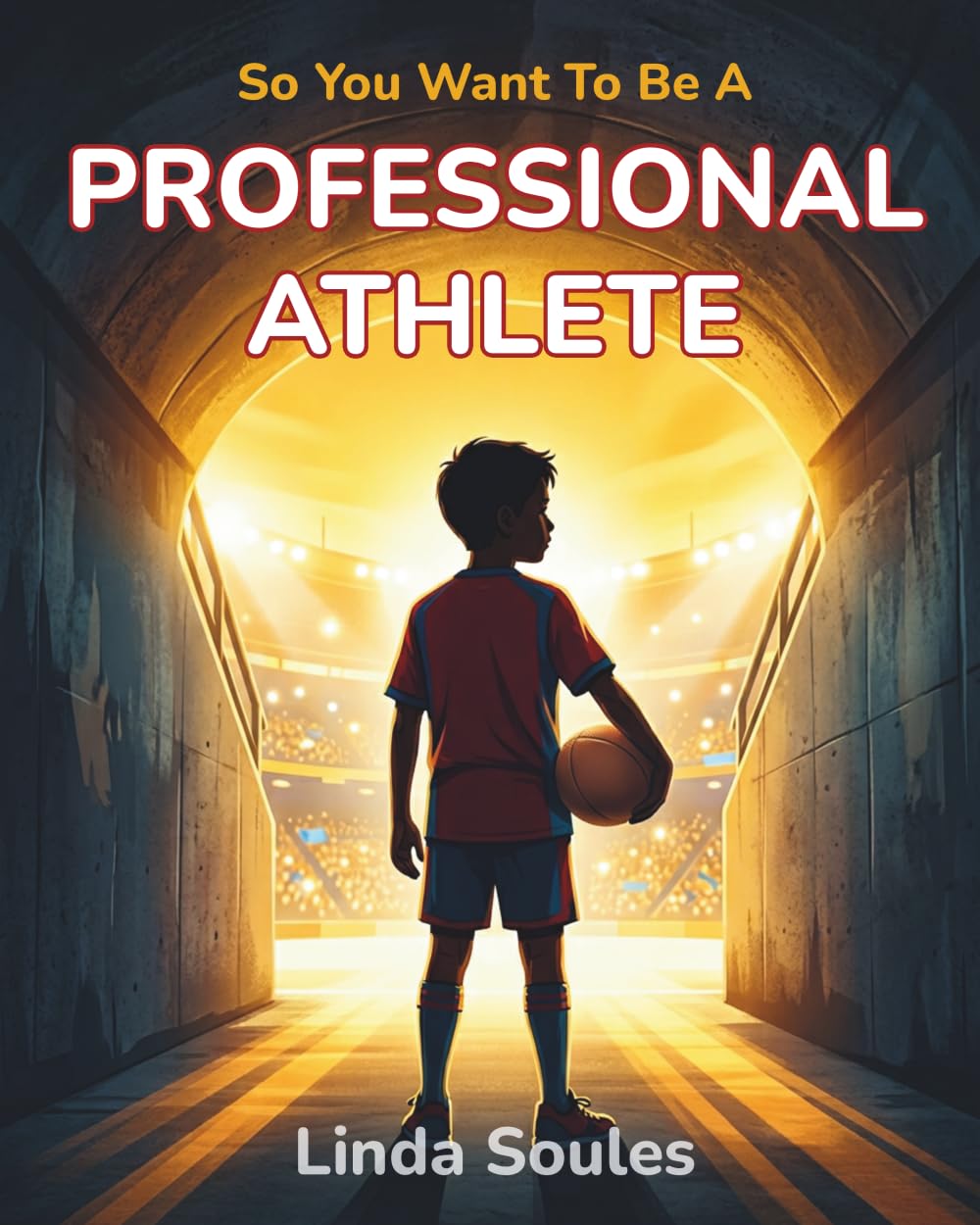
So You Want To Be A Professional Athlete, by Linda Soules, is a smart and encouraging nonfiction guide for kids who dream about playing sports at the highest level. Instead of focusing only on fame, trophies, and big game moments, this book shows what being a professional athlete really looks like behind the scenes. Soules makes it clear that talent matters, but it is only the beginning. The real work comes through practice, discipline, training, recovery, and learning how to handle pressure.
One of the best parts of this children’s book is how honest it is without being discouraging. Young readers learn about strength training, nutrition, sleep, film study, mental toughness, and the team of coaches, trainers, nutritionists, and sports psychologists who help athletes perform their best. The book also explains the less glamorous parts of the job, like injuries, early mornings, strict routines, public failure, and the fact that an athletic career does not last forever. That honesty makes the book feel useful, especially for kids who may think professional athletes mostly just show up and play.
The writing is clear, casual, and easy for kids to follow, while still treating them like serious readers. Soules doesn’t talk down to her audience, and she gives enough detail to make the world of elite sports feel real. The colorful illustrations, fun facts, real athlete stories, glossary, and “day in the life” sections help keep the book engaging. Some parts are packed with information, so it may appeal most to curious readers who enjoy learning how things work, but sports-loving kids will find plenty here to keep their attention. I also liked how it mentions that “The mental dimension is as demanding as the physical.” I don’t think many children’s book go into this aspect enough, and I was happy to see this book tackle that side of sports.
So You Want To Be A Professional Athlete is a great choice for young athletes, sports fans, families, teachers, and coaches. It gives kids a realistic look at the hard work behind greatness while still encouraging them to dream big. More than anything, it shows that being “professional” starts long before the crowd cheers your name, it starts with the choices you make when no one is watching.
Pages: 38 | ISBN : 978-1972766200
Effective Care Leader

Breakthrough Alzheimer’s Care is a practical guide in which you transform your experience caring for your mother into a five-pillar framework for building safer, warmer, and more loving dementia care. Why was this an important book for you to write?
After my mom passed people told me I did some amazing and creative things that helped my mom live much happier and and nearly three times longer than expected and that I should write a book to help others in the same way. I thought I could help people, it was also therapeutic to help me with my grief of losing her, and it was a testement to my amazing mom too. So that is why I wrote my book.
How did your mother’s personality shape the care system you built around her?
My mom was always so loving and caring of me, my sister, and all the kindergarten children she taaught. So I wanted to show the same kind of loving and caring for her in her most serious time of need with Alzheimer’s. She was also so trusting of me my whole life; this made it fairly easy to try lots of things that helped her, and bringing in the most amazing home caregivers that helped me help her with happiness and longevity.
What advice would you give families who feel overwhelmed by the practical demands of Alzheimer’s care?
Just because there is no cure for Alzheimer’s does not mean you can’t make a huge difference in your loved one’s happiness and health. When you do make this big difference, you will feel happier and healthier too. Your positivity, energy, and happiness are key to your being a bold, empowered, and effective care leader for your loved one.
What do you hope caregivers remember most after reading Breakthrough Alzheimer’s Care?
1) Be positive, empowered, hopeful, and follow my plan, and your loved one will benefit immensely and so will you!!
2) Love is about sacrifice. Showing your loved one this love and sacrifice may be the hardest thing you have ever done, but it will make you a better version of yourself, and you will be so glad you had the privilege of being your loved one’s care leader.
Author Links: GoodReads | Facebook | Website | Amazon
Part memoir and part how-to guide, this compelling book blends personal reflection with research-based insights and practical tools that help families transform their Alzheimer’s care experience. Readers will find detailed guidance on how to:
Design a daily routine that supports physical, emotional, and cognitive well-being.
Apply nutrition and brain health strategies proven to enhance function and mood.
Use cognitive stimulation to preserve memory and engagement.
Select, coach, and lead caregivers as an effective care team.
Improve communication and outcomes during doctor visits.
Access mobile medical support and technology-based care solutions.
Prevent caregiver burnout through strong leadership and self-care.
Unlike traditional caregiver manuals, Breakthrough Alzheimer’s Care goes beyond coping to offer a vision of thriving-showing how compassionate leadership and innovative thinking can dramatically improve quality of life for both the person with dementia and those who care for them.
Drawing from his personal journey, Mark shares hard-won lessons, practical systems, and heartwarming stories that illustrate what’s possible when caregivers combine love with strategy. His unique approach reframes caregiving as a mission of empowerment rather than endurance, encouraging readers to build hope, resilience, and teamwork every step of the way.
Whether you’re just beginning to navigate the challenges of Alzheimer’s or have been caring for a loved one for years, Breakthrough Alzheimer’s Care will help you find renewed purpose, strength, and connection. It’s an inspiring and transformative guide for every family touched by dementia-one that proves a better, brighter caregiving experience is within reach.


