Blog Archives
One of the Earth’s Oldest Civilizations
In Temple in the Sand, you give readers an in-depth look at the life of a lesser-known historical figure of Pharaoh Seti I. What inspired you to write this book?
It wasn’t until the pandemic, when like the rest of the world, I was at home with time to view videos, that I came across Seti’s magnificent temple in Abydos, Egypt. Like his burial chamber, which is sometimes referred to as the “Sistine Chapel of Ancient Egypt,” the raised relief artwork inside its walls is considered to be some of the best, if not the best that ancient Egypt ever produced. Looking at the artwork captured by photographers on Flickr, allowed me to enlarge their photos on my computer screen to see the fine details of those high-relief carvings. I got a quirky idea of writing a type of ghost story in which a woman gets inadvertently locked in the temple overnight and is visited by the spirit of the pharaoh, who talks to her about art, aesthetics, and politics.
That idea lasted until I heard a discussion with Egyptologist, Dr. Kara Cooney, about a woman called Omm Sety, who seems to have had past life memories of a life lived at that temple and an affair with the pharaoh. My “ghost story” was nothing compared to her story. However, I got a book by Jonathan Cott on Omm Sety and in it, I found a wonderful idea. It is written in the temple that Pharaoh Seti left a personal diary hidden somewhere in the temple. It has never been found, but if it ever is, it would be the only such document written by a pharaoh himself. Then the real initiating spark lit things up: I would write the pharaoh’s diary.
I imagine this book required quite a bit of research. Can you share with us one of the things you found most surprising about Pharaoh Seti I’s life?
As I researched, I began to discover a person from a non-royal background, whose life as a soldier, commander, and even vizier was fantastic enough, without the added accolade of being pharaoh. As improbable as it might seem, Seti’s family was handed the throne when Pharaoh Horemheb realized he would have no heirs. He chose the family of his trusted comrade-in-arms, Paramessu, (Ramesses I) who had a capable mature son (Seti) and a healthy young grandson (Ramesses). Ramesses I held the throne for only about 18 months before dying around the age of 70. His son, Seti, did the heavy lifting to restore
Egypt to its former glory which had fallen away during the reign of Akhenaten.
The idea that Seti, this supreme soldier and superb administrator, was also someone with an extremely refined aesthetic sense and a taste for art was something that I wanted to present to the world. I wanted to show how someone of fairly “common” origins was indeed a stellar entity who always brought his A game to the table, whether in war, politics, or artistic creations. I wanted the reader to see that behind all that power and royal regalia, there was a real person, not so different from us, but one who was able to grasp the reins of destiny and move a whole nation in a different direction. Yet, he was also someone who suffered sorrowful defeats in his personal life. As we all know, no one gets to have it all.
What is one thing you hope readers take away from Temple in the Sand?
I’d like the readers of Temple in the Sand, the Memoirs of a Pharaoh to be able to sit with the humanity of this person as he writes in the wee hours of the morning, revealing his life in relation to the chapels in his temple. Each chapel deals with a different god who rules a different aspect of life which the pharaoh contemplates in terms of his own lived experience. I’d like for the reader to enter the world of one of the earth’s oldest civilizations and enjoy their time on the Nile in the company of the king.
What is the next book you are working on, and when will it be available?
In terms of other books that I may write, I am updating a novella, Beautiful Imperfections, which deals also with art and two cities that I love, San Francisco and Toronto. It will reappear with a new cover this spring on Amazon.com. I have a partial outline for another novella set in Avignon, France where I lived for eight years. I would like to finish that one, a fun, whimsical piece with a bite (it deals with a local folklore creature known as the Tarasque) before I go to Egypt (depending on world conflict conditions). Once there, my focus will be on that wonderful raised relief art found in the Seti Temple and in his tomb, as I’d like to create a novel about the artisans who created the work that the pharaoh commissioned.
Author Links: Goodreads | Website | Facebook | Amazon
It is that temple, the Temple of Seti, that forms the structure of this novel which attempts to recreate the diary of the pharaoh. It is written on the temple walls that the king kept a diary and had it hidden somewhere in the temple. As yet it has not been found, but one can easily imagine the king in the solitude of the night writing of his life, as he realizes his shortness of breath and pressure in the chest may mean it is the last year of that magnificent life. Temple in the Sand, the Memoirs of a Pharaoh is a tribute to the mysterious and beautiful sacred structure built by Pharaoh Seti I in Abydos and to the man behind the royal regalia.
Infinity: The Fifth Bride of Pharaoh
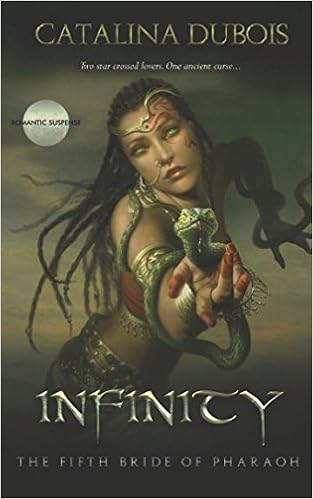

Sara of Nubia, a princess and free spirit in her own right, has been promised to Pharaoh Amenemhat, but she is not one to go quietly into her duties as a bride and the mother of future rulers of Egypt. When Sara and her best friend, Sobek, disguise themselves as commoners and venture out, Sara’s journey of the heart begins abruptly with a clumsy moment, a chance encounter, and a kiss born out of tradition. The stage is set for a long and harrowing struggle to be with the one love of her life and to gain back what is, and always was, rightfully hers.
Catalina DuBois’s Infinity: The Fifth Bride of Pharaoh is the tale of Sara and Matthaios, two people destined to be together against all odds and against the destiny laid out for Sara by her family. Sara is a strong, determined, and admirable main character whose tenacity makes her an easy favorite. Matthaios, imprisoned and forced into servitude, fights with every fiber of his being not to cross the line when it comes to his charge, Sara. His ability to control his overpowering feeling for Sara and the restraint he is able to maintain is touching for his love for her is genuine. DuBois constructs some of the most moving love scenes involving Sara and Matthaios. I am not a fan of romance that contains gratuitous scenes, but DuBois has maneuvered around that type of writing to create stunningly beautiful pictures of two lovers whose hearts are truly one.
DuBois has managed to change a lifelong habit of mine. I have never been a fan of the prologue. More times than not, I skim the prologue to get the gist of what is to come. DuBois, however, has written a prologue so gripping, so detailed and vivid, that I can say it hooked me within the first paragraphs. She has drawn Matthaios as a man of tragedy in juxtaposition to the horrifying Pharaoh as she quickly reveals a backstory steeped in lost love and betrayal of the worst kind.
Infinity: The Fifth Bride of Pharaoh gives readers the best of both worlds with regards to genres. DuBois manages to combine romance and history with an added layer of mystery. I appreciate an element of the unknown when reading fiction of any type. Without a doubt, readers are kept guessing as to the identity of Sara’s and Matthaios’s evil shadow, and the ultimate reveal is breathtaking given the buildup of the character to that point.
Another of my favorite characters is Dimp. A faithful and focused doctor, Dimp is ever willing to help Sara and her friends throughout the book. Not one of the characters who gets a lot of attention, Dimp stands out as one of the most loyal and caring in the kingdom.
Romance fans and those who appreciate elements of mystery in their historical fiction will be drawn to the striking cast of characters created by DuBois. Nowhere else will readers, hungry for historical fiction, find a more well-drawn plot brimming with intrigue, adventure, and perfectly-tied together story lines.
Pages: 181 | ASIN: 1973288710

Faithful to Egyptian Style

George Neeb Author Interview
Pharaoh’s Arrow is a picture book that tells a fascinating story using authentic hieroglyphics and historic papyrus paintings. What was the inspiration that made you want to put this book together?
I have taught elementary school for over 25 years. I have always found that using picture books is a great way to teach subjects like history and art to students. Picture books bring history alive. I found in teaching about Early Societies that there was an abundance of information books but not picture book narratives. I wanted to create a resource that teachers or any Egyptology fan could use and enjoy that included factual information but was also entertaining. I have always been fascinated by Ancient Egypt, so I thought this would be a great way to break into writing and illustrating picture books.
Each piece of artwork in the book was done by you on papayri. What was that process like?
The illustrations are actually done on paper to replicate the look of papyrus. I included directions in the back of the book, so readers can create similar drawings. The secret is to colour with pencil crayon, as this medium will resist paint. Then I painted over the coloured illustration using brown and yellow tempera paint. I used a large paint brush and painted both directions leaving the brush strokes showing. Last, I covered the wet paint with a disposable cloth and rubbed the cloth then removed the cloth. That is how the look of papyrus is achieved. It is simple yet works. I hope readers will try it out. I made a Youtube video to demonstrate the technique and colouring pages are found on my website https”//georgeneeb.ca
I felt that you did a great job of getting the facts of ancient Egypt correct. What kind of research did you undertake for this book?
I spent months researching how the Egyptian drew everything. I looked through lots of information books about Ancient Egypt. The Egyptians had a distinct way of drawing. Their style is simple yet graceful. I’ve heard the Egyptians described as the first graphic artists. People were drawn in profile but with forward facing eyes and shoulders. It is almost a contorted look. I also researched how trees, homes, palaces and animals were drawn. Egyptians didn’t uses perspective and size differences were usually due to importance, so sometimes the Pharaoh was drawn larger than everyone else. This made illustrating the book challenging because I couldn’t draw a lot of varied perspectives, such as a bird’s eye or an ant’s eye point of view. I really could only do some close ups in order to keep faithful to Egyptian style.
What is the next book that you are working on and when will it be available?
My next book is totally different. It is a story about an overweight girl that longs to be a super hero, but her mother and aunt really pressure her to act like the other girls and try to be pretty and popular. When some bullies befriend her, she has to decide if this is the person she wants to be. I did the illustrations using cut paper and also dyed paper backgrounds. The book is in the editing stage, so I hope it will be ready by late summer. I am also writing a book about an Emperor and a dragon in Ancient China. It will be illustrated to look like Chinese silk paintings have come to life to tell the story.
Author Links: GoodReads | Twitter | Facebook | Website
![Pharaoh's Arrow by [Neeb, George]](https://images-na.ssl-images-amazon.com/images/I/514W8IcmfgL.jpg) Akia loves living in an oasis far from the Nile River with her father. But when she is faced with another family tragedy, Akia embarks on a plan of revenge that takes her to the ancient capital of Memphis and to meet Almighty Pharaoh. She quickly learns that vengeance isn’t as easy as it may seem! Come visit Ancient Egypt through a tale told in rhyming couplets, authentic hieroglyphics and historic papyrus paintings come to life. Ages 8 – 11 or any Egyptology fan!
Akia loves living in an oasis far from the Nile River with her father. But when she is faced with another family tragedy, Akia embarks on a plan of revenge that takes her to the ancient capital of Memphis and to meet Almighty Pharaoh. She quickly learns that vengeance isn’t as easy as it may seem! Come visit Ancient Egypt through a tale told in rhyming couplets, authentic hieroglyphics and historic papyrus paintings come to life. Ages 8 – 11 or any Egyptology fan!




 LITERARY TITAN