Blog Archives
The World of Extremism
So You Want to Be an Extremist is a satirical guide that traces the origins and evolution of conspiracy theories from ancient Rome to modern-day social media. Why was this an important book for you to write?
I think people know bits and pieces, but there wasn’t a full picture of extremism in one place. I wanted to create a single piece of content that anyone could pick up and easily learn about the world of extremism, from its humble origins to a major part of society today. And also laugh a bit at the horrors they learn along the way because it is a dark, scary place. Whether we like it or not, these people, these products, these movements are affecting all of us in some fashion.
Did you learn anything during your research that surprised you?
How truly ubiquitous this level of extremism and conspiracy thinking has become, particularly among the younger generation. Twenty years ago it was your crazy uncle sending emails. A decade ago it was older people falling for Facebook memes, believing anything that was written online. Now, it is a younger, seemingly displaced generation, who are very tech-savvy, failing at even baseline critical thinking on many topics.
Why was it important for you to take the satirical approach with this book?
For me, satire has always been a way to convey certain ideas and vices as laughable, but also reprehensible. I have a penchant for poking fun at the horrible people that take advantage of others: dictators, oligarchs, and now, extremists. I like to strike a balance between comedy and learning, and I do think they can complement each other. So, I wanted to give the audience that same balance. Plus, they don’t have to read a 400-page academic paper to learn about this stuff. I suffer for them.
What is one thing you hope readers take away from So You Want to Be an Extremist?
Extremism isn’t fringe anymore! It has been normalized to the point that it is a part of everyday media, politics, religion, business, and society. This isn’t going away anytime soon. These ideas and movements are only becoming more prevalent and worse, more accepted.
Author Links: GoodReads | Facebook | Website | Amazon
With Extremism, explanations can be simple – and exciting. You’re not a “loser.” Nope, It’s just an international cabal of lizard people holding you back from greatness.
In this satirical leadership guide for oven-ready radicals and greedy grifters, uncover a mind-blowing myriad of crazy conspiracies, insane ideologies, and meet the fabulous fanatics who promote them.
Join former government lackey turned humorist, C.T. Jackson as he takes you from the quiet corners of sanity to the far fringes of social implosion, as you learn to reach your full radical potential.
So You Want To Be An Extremist? Well, This Book Is For You! (And The Voices In Your Head.)
Cleave the Sparrow

Some books tell a story. Others drag you into a chaotic, unrelenting experience that scrambles your brain and leaves you questioning everything. Cleave the Sparrow is the latter. It’s a fever dream wrapped in satire, political absurdity, existential horror, and bursts of unfiltered genius. The plot follows Tom, a hapless nobody turned political pawn, as he stumbles through a world of cults, conspiracies, and reality-shattering revelations. With a cast of characters that includes a lizard-skinned scientist, a woman who smells fantastic but may or may not be leading a revolution, and a man hell-bent on proving existence itself is a lie, the book barrels forward like a runaway train powered by hallucinogens and bad decisions.
There’s something hypnotic about the way the book is written. The dialogue is rapid-fire, the narration drips with cynicism, and the absurdity is turned up to eleven. One moment, Tom is navigating political disaster control for a debate where his candidate is outed for a romantic relationship with a coffee machine, and the next, he’s deep in a cave listening to a ten-year-old mutant threaten to cut off his genitals. The pacing doesn’t just keep you engaged, it holds you hostage. The prose shifts between sharp, witty banter and sprawling, mind-bending monologues about the nature of perception and reality. And yet, it never loses its bite. The humor is dark, the satire is ruthless, and the commentary on politics, media, and human nature is as unsettling as it is hilarious.
The concept of tetrachromats (people who can see more colors than the rest of us) expands into an existential metaphor about perception and control. The idea that we only see what we need to survive, and that our understanding of reality is inherently flawed, becomes a driving force behind the book’s most unsettling moments. Tom is thrown into a world where people want to break the system, not by fixing it, but by blowing it up, sometimes literally. And, disturbingly, the book makes a compelling argument for why they might be right. One of the best moments is when Wilder Crick, a lunatic or a prophet (or maybe both), lays out his plan to destroy the cosmic projector that creates our false reality. It’s so ridiculous that it loops back around to being plausible. The book constantly dares you to laugh at its insanity only to make you realize, with a sickening twist, that the joke is on you.
That being said, Cleave the Sparrow is not for the faint of heart. It revels in discomfort. It gets grotesque. It crosses lines, sometimes gleefully. The Howitzer House sequence, where people willingly undergo extreme psychological torture as an entertainment experience, is a stomach-churning look at human masochism and our obsession with “real” horror. It’s sick. It’s fascinating. It’s also an extreme version of things that already exist. And that’s what makes this book so effective. It takes absurdity and stretches it just far enough that you can still see its roots in our own world.
Cleave The Sparrow is for people who enjoy satire so sharp it draws blood, philosophy so deep it makes your head hurt, and humor so dark you feel guilty laughing. It’s for fans of Catch-22, Infinite Jest, and Dr. Strangelove. It’s for anyone who has ever looked at the world and thought, this can’t be real. Because maybe, just maybe, it isn’t.
Pages 300
Animal Lab
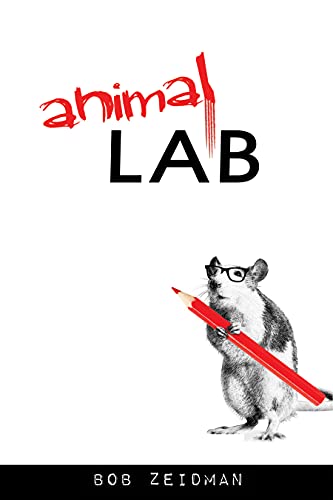

On day one, the humans are gone.
A testing lab full of animals is left to fend for themselves when their humans suddenly vanish. The animals develop a new self-awareness; they start to think and act for themselves, and together they form a society in the absence of human oppression.
Rizzo, Cagney and Billie, three rats, bring together the animals of the lab to form a new nation, a constitutional democratic republic. Representatives are elected, and the government starts to form laws upon which to build their nation. Progress is forming and animals take on a new, wholesome way of life. Though peace cannot last forever, politics clash, murders run rampant, and crime is a new concept our characters are forced to face.
In Animal Lab author Bob Zeidman creates a world dominated by animals that represent the struggles we see in society today. This novel will engage readers in a philosophical discussion about American politics and how society can be viewed as a whole. Readers will find this book to be riveting and educational. The gradual development of the characters’ personalities as they form their nation and become more independent and free-thinking is captivating.
Billie and Cagney, two of the main characters in the story, are great examples. The two rats have been in an on-and-off-again relationship, but as they develop their rational thinking, through reading philosophical books, they quickly become inseparable. One of Zeidman’s characters remarks that they have practically become one person/animal. Though, as we get to the end of the book, we see Billie is no longer the shy little rat she once was; she turns into a domineering leader who controls and manipulates not only her partner but also the nation of animals in the lab. Cagney’s personality is mellow compared to Billie’s. But we can see how committed he is to Billie and would do anything for her, which leads him down an uncomfortable, immoral road.
Animal Lab is a quick read that packs an amazing amount of action and drama into the pages. Fans of political fiction and satirical fiction will enjoy this poignant novel. There are a few sensitive topics like the animals’ murders that could be upsetting to sensitive readers, but the overall theme of societal downfall and rebuilding will keep readers engaged. It has an uncanny resemblance to George Orwell’s Animal Farm so readers that enjoyed that novel will find this one a worthy read as well.
Pages: 149 | ASIN : B09HHMW3BB

Beneficial Accomplishments of Joe Biden
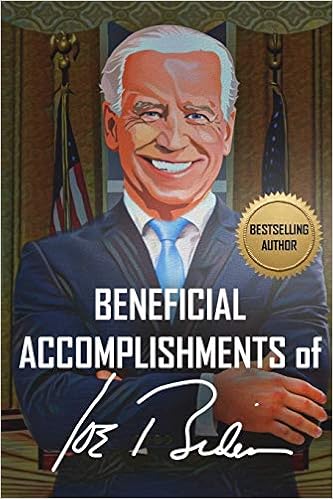
When Joe Biden won the presidential election in November of 2020, it was an election that saw the country at its most divisive point in generations. Since taking office in January, opinion has remained divided as to his success in the role. How has he done so far? Have things gotten better or worse? Have campaign promises been fulfilled or even addressed? The list of achievements might surprise you.
Beneficial Accomplishments of Joe Biden, by BB Denson, is a political satire detailing the list of things that have been done by the Biden administration. Or, to be more precise, the lack thereof. Covering subjects such as education, free speech, American job stability, and race relations, just to name a few, Denson makes it clear that in the past 11 months, the output of Joe Biden’s presidency has been underwhelming, to say the least. With a few snarky asides referencing previous presidents and their own achievements, the chapters leave no doubt as to what Denson thinks about number 46. Following a pattern that has often been used in satirical “informational” or how-to books, this one effectively uses an old trick on a new subject to entertaining effect.
This book is definitely worth a few chuckles and has given me a new perspective on current politics and political satire. Author BB Denson does well to make her point clear here, even though there is not a lot of substance behind it. (An ironic comment honestly, since that is the point of the book itself.) I was a thrown off by the empty pages. But don’t worry, it’s part of the satire, and once I got it I couldn’t stop laughing.
Beneficial Accomplishments of Joe Biden is funny, poignant and well worth the short read.
Pages: 152 | ISBN: 0997588373

End of Knighthood

End of Knighthood Part I: The Chess Pieces by Joshua Landeros is a ripping tale of military science fiction. The novel follows the continued struggle of William Marconi a cyborg super soldier as he continues to figure out his place and duty as a soldier and knight in this futuristic warzone. Will ends up joining the resistance movement. Fighting the UNR, the new world government superstructure, or curbing its growth becomes the center of conflict. Chancellor Venloran is the locus of these plans and wishes to destroy his enemies completely. Can non-UNR countries survive the rising tide and hardened troops? The principal question is, what will Will do to make up for his past transgressions on behalf of his former role?
Landeros paints a picture worthy of the classic military science fiction writers in their hay day. Robert Heinlein’s Starship Troopers can be felt in every leap of Will from rooftop to rooftop. He masterfully borrows what made these novels great by their action and dialogue. One of the strong parts of the End of Knighthood is not just the fantastic action, but the dialogue between the soldiers is some of the best I have ever read. This is what keeps these soldiers human and what makes them instantly relatable to the reader. Sure, it is cool to read the amazing action scenes that Landeros crafts, but in the quiter moments we get to see how these individuals struggle with their in between status and their struggle in the midst of war.
As far as action goes, you can’t get too much wrong when you have cyborg on cyborg action, but Landeros takes painstakingly careful steps so that the reader does not become lost in the rain of bullets and blows. We are able see every body fall, but we are also able to see the glimpses of humanity from these soldiers as they reflect later their deeds. Will, the main protagonist, and one of the few carry overs from the previous book, is one such character that we get to see who continues to develop.
In our current times of political upheavals and nation states, one would think a book such as End of Knighthood would be hard to swallow. The UNR seems to be something that could occur in the not so distant future, but with the addition of these tech enhanced soldiers, Landeros has given the reader enough of an escape to enjoy oneself rather than wallow in more reality. Despite having a military science fiction bend, the novel could appeal to anyone looking for an action centered yarn along with some political thriller overtones. The genre blending on Landeros’ part is spot on and should please a wide variety of readers.
All in all, the reader may lose some sleep going through one battle scene and turning the page for another, but it is sleep happily given up. I look forward to the next installment of the Reverence series.
Pages: 233 | ASIN: B06ZZCDJ44



 LITERARY TITAN