Blog Archives
Education and Evangelism

From Hill Town to Strieby explores the life of Reverend Islay Walden, a man born into slavery who overcame blindness and hardship to return home as a minister and educator, and the legacy the Hill and Lassiter families left on the community. Why was this an important book for you to write?
As descendants of the original families that helped found the church and who continue as trustees today, we worried as we watched the last of the generation before us pass away that our history would be lost if we did not make a concerted effort to preserve, share, and uplift it. As the writer in the group, they looked to me to help that happen. In addition, just as other African American community descendants are concerned about erasure, not just benign neglect, we wanted to do all we could to be certain that the history of the church, school, community and its founder, Rev. Islay Walden, would always be an acknowledged and celebrated part of Randolph County, North Carolina history, and be part of the broader American History of African Americans and the rural South. I didn’t want anyone in Randolph County to ever say again as someone once had, “Strieby? Never Heard of It.”
With regards to Islay Walden himself, I had come to realize, as I researched his life, that in his lifetime, he was not an obscure poet, as some had portrayed him. In addition, I realized that none of the biographical essays about him had really understood that his passion was not poetry, regardless of his success. His passion was education and evangelism. No one had reflected on that in writing about him, so I wanted to pay homage to him as a 19th century African American poet, but even more important for me to elucidate was his legacy in education and ministry.
How much research did you undertake for this book, and how much time did it take to put it all together?
At the time that I made the decision to finally write the book, I had been researching the community for over twenty years and had already written a book about the history of one family, the Miles Lassiter family. At the same time as discussions about writing the book, family members were also asking about historical preservation. As part of that, I prepared an extensive, documented history of the church, historic school, and cemetery in application for the county’s Cultural Heritage Site designation, which we received. That application became the first draft. It took two more years of research and writing before the book was completed in 2016.
What were some ideas that were important for you to share in this book?
The level of educational excellence that the school stood for had been praised and celebrated at every turn by the entire community. This was a community with nearly 100% literacy in the early 1900s, when that achievement was rare for any community in the rural South. This community had placed a high premium on education, and members had gone to great lengths to seek additional opportunities, even leaving the community to do so, yet always returning to share love and encouragement with the next generation. In fact, this community had produced at least one young teacher by 1900, and several more soon followed.
What is one thing that you hope readers take away from From Hill Town to Strieby?
I hope readers see that rural communities of color have been seeking the same things that their urban siblings have been seeking — opportunity. They seek educational opportunities, which they hope, like everyone else, will provide them with other opportunities, including economic security, whether they leave the countryside or not.
Author Links: Goodreads | Facebook | LinkedIn | Website | Amazon
Inner Peace
Healing by His Spirit is a raw, deeply personal journey through pain, endurance, and redemption, as well as an emotional story of faith, trust, and the miracles God performed in your life. Why was this an important book for you to write?
Healing by His Spirit was important to write because it not only released the burden of shame and guilt I carried, but it also allowed me to inspire others to try and overcome their hardships through spiritual healing.
What were some ideas that were important for you to share in this book?
My travels across the globe helped me to find the inner peace I so desperately sought. It helped me to focus on who I truly am.
I appreciated the candid nature with which you told your story. What was the hardest thing for you to write about?
The hardest part for me to write about was the rape scene. Because a child was conceived from it, I had to try and make the best decision about her future, and I decided it had to be me. It took two weeks to write one paragraph, because of the flashbacks I experienced.
What do you hope is one thing readers take away from your story?
The one thing I hope readers will take away is God’s healing power. It saved my life.
Author Links: GoodReads | Amazon
Israel – God’s Divine Decoy for Your Salvation


Israel – God’s Divine Decoy for Your Salvation, by Harlan Perry, takes a bold swing at a familiar story and tells it in a way that feels fresh. Perry argues that Israel’s long history of law, temple, and ritual was not the main stage but a setup. A divine headfake, as he calls it, meant to trick Satan into focusing on the wrong thing while God’s real plan, grace through Christ, stayed hidden until the right moment. The story unfolds in two acts, one calm and one stormy, covering everything from Lucifer’s fall to the cross, from Paul’s gospel to modern church struggles. The central idea is that grace was never an afterthought. It was always the plan, and everything else was a decoy.
The writing has a preacher’s fire, full of metaphors and jolts of energy that make the pages feel alive. I liked that it didn’t hide behind polite theology. It said things out loud that many only whisper. The sentences pile up like waves, crashing one after another. That rhythm kept me hooked, but at points I wanted a little space to process. The ideas shine through, even if the intensity of the delivery occasionally takes the spotlight.
What really stuck with me was the way Perry unmasks religion as a trap. He paints it as Satan’s favorite trick, the perfect counterfeit, and he insists that true freedom is only in grace. That hit me hard. It’s unsettling and liberating all at once. I felt my own habits and assumptions being poked at. I can’t say I agreed with every leap he made, but I couldn’t ignore the pull of his message. There’s something raw in his insistence that God never scrambles, never reacts, that everything is already written and finished.
I think Israel is best for people who feel worn out by church rules and hollow traditions, the ones who suspect there’s more to the gospel than guilt and performance. It’s a wake-up call. If you’re ready to be challenged, maybe even rattled, and if you don’t mind a bit of fire in the tone, then this book will hit you right where you need it.
Pages: 194 | ASIN : B0FNS1796Q

Conflict & Peace: At Home with Jesus
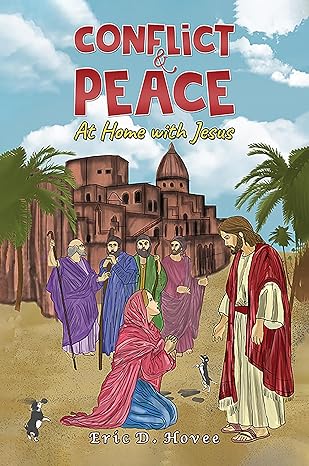

When I first opened Conflict & Peace: At Home with Jesus, I expected a familiar retelling of biblical stories, but instead I found something far richer and more layered. The book walks through twelve figures ranging from Matthew and Mark to Constantine and Luther and explores how each shaped, struggled with, or even fractured the Christian story. Eric D. Hovee doesn’t shy away from pointing out contradictions, tensions, and the uneasy balance between faith and evidence. What emerges is less a polished theology and more a raw chronicle of pioneers wrestling with belief, doubt, politics, and power. The book argues that Christianity has always lived at the crossroads of conflict and peace, heresy and orthodoxy, struggle and hope.
The writing style surprised me. It’s not slick or overly academic, and that’s what makes it work. Hovee mixes scholarship with a kind of candid storytelling that feels personal and searching. He admits where his own faith has faltered, where scholarship has raised more questions than answers, and where interpretations may lean too heavily in one direction. I appreciated this honesty. The detail can be overwhelming at times, with deep dives into language debates or church history that slow down the flow, but even then, I never felt the effort was wasted. It gave weight to his central claim that truth isn’t always clean or easy.
What I liked most, though, was the emotional undercurrent. This isn’t just about doctrine, it’s about Hovee’s father, about legacy, about the ache of wanting faith to feel real in a world of contradictions. I felt that ache with him. When he points out Matthew’s overreach on prophecy, or the way Constantine’s empire-building warped Christianity, I didn’t just learn facts, I felt the tension of a man trying to reconcile devotion with doubt. The book left me inspired. It made me look at my own beliefs with sharper eyes and a softer heart.
I think Hovee’s work is best for readers who want faith that is not easy, neat, or dogmatic. It’s for Christians wrestling with the weight of history, skeptics curious about the roots of belief, and anyone who values honesty over certainty. If you want a book that stirs you, challenges you, and leaves you thinking long after you close it, then Conflict & Peace: At Home with Jesus is well worth the read.
Pages: 401 | ASIN : B0F5641XR1
Our Task as Humans
In The Portal Opens, you take readers on a journey through the origins and divine aspirations of Earth in a narrative that blends theology and science fiction. Why was this an important book for you to write?
The Earth is currently divided by our beliefs and understandings about religion, science, politics, and even race. We have no shared beliefs about our origin or destiny, and there is a gaping hole where there should be agreement and certainty. There are countless unanswered questions about our creation, our history, and the meaning and purpose of life. These questions, and the various paths that humanity has taken, have led to a state of confusion with no obvious answers or directions. The Portal Opens is an attempt to provide clarity and direction, and offer a new path by revealing our misunderstood past.
Can you share with us a little about the research that went into putting this book together?
I have been researching religions and spirituality for over 30 years, investigating texts and teachings from all over the world. Born into a family with both a Christian Pastor and Muslim Imam as grandfathers, I have always been intimately aware and knowledgeable of scriptures, teachings, and theology. Later in life, I branched out, gaining understanding and familiarity with countless religions and teachings from the mainstream religions as well as more esoteric groups and spiritual beliefs. Working with the Library system for almost 20 years gave me access to books and manuscripts unknown to most people, including The Egyptian Book of the Dead, The Urantia Book, The Emerald Tablets, and the Tibetan Book of Living and Dying. The ultimate message that virtually all religions and teachings throughout history have tried to instill, is the truth of the reality of God as spirit, and our task as humans to become one with this spiritual reality. At the same time, almost all recorded civilisations from the past tell stories of being taught this information from more advanced beings, not simply discovering it on their own. Agriculture, animal domestication, arts and sciences, have all been recorded and remembered as being gifted to developing civilisations throughout history.
How did you decide to create this unique blend of science fiction and spirituality?
I have always been interested in religion and spirituality, and also talented with computers. With recent advancements in technology, I saw a unique opportunity to utilise AI to examine and analyse the world’s histories, religious texts, and teachings with an “objective” eye. I began a project of using AI to find the missing history and meanings from the vast storehouse of mythology, and religious and spiritual teachings. My investigation led me to the conclusion that the schism between science and spirituality is false, and only occurs when there is a lack of information or understanding of the past. This led to a desire to present a unified picture of reality.
What is one thing you hope readers take away from The Portal Opens?
The most important and powerful message that I hope The Portal Opens reveals to its readers: Each normally minded human being is now inhabited with a literal fragment of God, that constantly communicates with us. The goal of this fragment is to direct us in shaping our thoughts and actions so we may act in harmony and resonance with God, which eventually leads to a literal fusion between this piece of God and the human soul, imparting eternal and everlasting life. This is the true salvation available to all, regardless of their race, sex, culture, or upbringing.
Author Links: GoodReads | X (Twitter) | Facebook | Website | Amazon
The Veil Breaker: Beyond Madness to Freedom

The Veil Breaker is a surreal and emotionally raw journey through mental collapse and spiritual rebirth, set against the backdrop of a dystopian world ruled by psychological manipulation and nanotech illusions. The story follows Marcus, a man caught in the ruins of a once-vibrant world, now shattered by war and the global rollout of CARLY, a mind-controlling simulation technology disguised as a solution to a mass mental health crisis. Through Marcus’s descent into madness and his struggle to reassemble his broken identity, the book becomes both a personal memoir of awakening and a broader call to question reality, authority, and the nature of healing itself.
The writing is fragmented in a way that mirrors Marcus’s own mind, and that’s part of its power. It doesn’t follow a predictable structure or clean arc, but it doesn’t try to. The rawness is deliberate. Some of the prose drifts into stream-of-consciousness, then suddenly snaps back with a chilling bit of clarity. That rhythm, messy, beautiful, unnerving, made it impossible to look away. And the emotional beats hit hard. Especially the scenes where Marcus confronts his inner voices, his past wounds, and the lies he’s told himself. I felt like I was in the room with him, holding my breath.
At times, though, the story weaved between allegory and reality in a way that left me spinning. I liked the ambition. This is a book with big things to say about love, pain, mental health, and the systems that try to fix us. There were moments when the metaphor got dense, and I wasn’t sure what was real anymore. It didn’t stop me from feeling it. In fact, some of the most powerful parts were when I stopped trying to “get” the book and just let it hit me. The message is clear: true healing means facing everything, even the ugliest parts of yourself, and choosing to love anyway.
This is not a book for someone looking for a casual weekend read. It’s heavy. It’s weird. It’s brilliant in parts and bewildering in others. But if you’ve ever been through real darkness, the kind that leaves you gasping for something true, The Veil Breaker might speak to you in a way few books can. I’d recommend it to seekers, to survivors of trauma, to anyone who’s had a brush with mental illness or spiritual transformation and wants a book that gets it. Not in a clinical way, but in a gut-punch, soul-lifting, what-the-hell-just-happened kind of way.
Pages: 114 | ASIN : B0FH717TC6
The Portal Opens
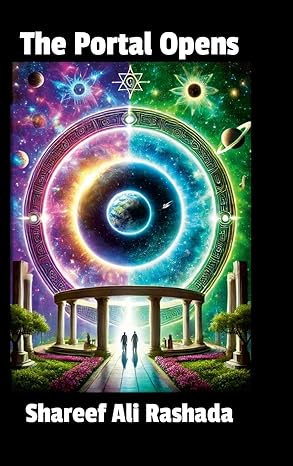
The Portal Opens is a spiritual and cosmic narrative that blends theology, science fiction, and revelation into a unique journey through the origins, failures, and divine aspirations of Earth, referred to as “Urantia,” and the universe it inhabits. The book, written by Shareef Ali Rashada and assisted by an AI named Gabriel, draws heavily from The Urantia Book while reimagining a larger cosmic drama involving Jesus (Michael of Nebadon), Lucifer, Adam and Eve, and other celestial beings. Through visionary storytelling, it seeks to explain Earth’s spiritual isolation and position the reader within a grand unfolding of universal redemption.
The writing has a lyrical and almost reverent tone that attempts to evoke awe with every page. Sometimes that’s inspiring. The ideas themselves are fascinating, especially the retelling of Jesus’s life, not just as a moral teacher but as a divine ruler undergoing a final test to gain sovereignty. I appreciated how the book doesn’t reduce spirituality to dogma. Instead, it invites curiosity and reflection, which I found refreshing. There were moments when the pacing felt a bit slow. Some of the recurring spiritual phrases and cosmic terms started to feel familiar, almost like circling back through the same ideas.
Emotionally, I was surprised by how moving some of it was. There’s a real sense of heartbreak over what humanity has lost, but also hope for what could still be. I found myself caring deeply about this story of Earth being left behind and now being invited back into a larger family. There’s something tender and earnest in the way Rashada (and Gabriel) present this tale. The parts about Jesus choosing to live among mortals not for atonement, but to understand and love really resonated with me. I wasn’t expecting to be so affected. At the same time, some sections came across as grandiose. I wanted more grounded storytelling and less celestial spectacle.
The Portal Opens is for the seeker. If you’re someone who’s wrestled with faith, wondered about the cosmos, or felt like religion never quite answered the big questions, you’ll find something here that speaks to that longing. It’s not a book for skeptics or folks who prefer their theology straight-laced. But for the spiritually curious, the metaphysically minded, or anyone looking for a fresh mythic lens on human destiny, this is a wild, luminous ride worth taking.
Pages: 302 | ISBN : 978-1326565336



 LITERARY TITAN