Blog Archives
Blaming the Victim
The Soul’s Reckoning follows a woman as she passes through the Barrier into a vivid, confusing, and emotional afterlife where she is forced to confront former relationships and truths she had avoided in life. What was the inspiration for the setup of your story?
After my brain injury, my relationships went into a downward spiral. I became acutely aware of the differences between communities and countries in how they handled social life with people who’d suffered catastrophic injuries or whose communication styles had changed. Some communities or countries focused on maintaining the relationship while adjusting to the challenging needs of the injured member. Others blamed the injured one and left. Yet Christianity, or the church, anyway, continually teaches that God will restore relationships.
Does that happen, I asked. I’d read the Book of Job years ago, which realistically portrays how friends mischaracterize suffering, blaming the victim. And it reveals what God thinks about all that. Several years ago, I wrote an ebook and a Psychology Today post on the Book of Job, including God’s perspective on Job’s friends. The book’s lessons remained in the back of my mind, and I married those lessons with my own and others’ experiences of relationships after brain injury.
I think too many put off trying to restore relationships, perhaps because they don’t want to confront the bad thoughts, bad words, and bad actions that had led them to abandoning their injured loved one. Then that person dies, and it’s too late. Or is it? And how do you reconcile with a dead person? That’s what I sought to answer.
Was there anything from your own life that you put into the characters in your novel?
As I was writing The Soul’s Reckoning, the character Shireen Anne popped up. It was rather surreal watching her name appear on the screen as I typed. It was like my past self, or a version of who I used to be, hopped into my story, declaring, “Here I am!” I wasn’t sure what to make of her appearance. But I couldn’t delete her. Turns out Charlotte Elisabeth, who isn’t anything like me, needed a friend and guide like Shireen Anne. She appears again in novel three.
What was one scene in the novel that you felt captured the morals and message you were trying to deliver to readers?
This is a tough question. My immediate inclination is to suggest the scene where Charlotte Elisabeth reconciles with her client. From the moment she decides that’s her next goal until she leaves.
Can you tell us where the book goes and where we’ll see the characters in the third book?
Book three of The Q’Zam’Ta Trilogy follows Revelation’s storyline from the time just before the cataclysm to just after the Book of Life. I’d originally intended to go to the end of Revelation, but there is so much to explore and unpack in those metaphorical thousand years without Satan, governments, and elites, that I realized I had to end it at the Book of Life. I’m thinking I’ll write another trilogy to cover the last part of Revelation.
In the third book, titled The Soul’s Turning, the characters leave Heaven and return to Earth, either as resurrected beings or, in Charlotte Elisabeth’s case, in a specially created new physical body. She doesn’t lose her memory of her experiences in Heaven, yet she no longer exists as an energy being.
In The Soul’s Turning, she must learn who she is.
Like so many of us, she equates her identity with her job. But in order to avoid second death, she must let go of that myth and face herself and learn and accept alien concepts in order to unearth her created identity.
And she must do all this in a far-future world that’s experienced eight degrees of warming, whose population is divided by economic systems, without governments, and with The Reigners, a Council led by Jesus that ensures no elites can rise.
As she’s becoming comfortable with what she believes about herself and the world, the Accuser-Adversary is released, and Charlotte Elisabeth faces a final, deadly challenge that requires her to grow courageous insight she’s never had before or be obliterated in a galactic Lake of Fire.
Author Links: GoodReads | Bluesky | Website
In this powerful continuation of The Q’Zam’Ta Trilogy, the afterlife is not an ending but a crucible where souls are tested, relationships are stripped bare, and choices echo with eternal consequence.
The Soul’s Reckoning leads readers into a realm where mortality and eternity meet, where faith collides with doubt, and where the love that once brought comfort now demands sacrifice. Every step forward raises questions of loyalty, forgiveness, and the courage required to face the truth of one’s soul.
This Christian novel is more than a story of belief. It is a profound exploration of family dynamics, the complexities of Christian relationships, and the enduring power of friendship.
With lyrical prose and piercing insight, Shireen Anne Jeejeebhoy weaves the mystery of the afterlife with the raw struggles of human connection. The result is a moving book on the afterlife that illuminates the bonds that hold us together and the grace that can heal even the deepest wounds.
A novel for readers who seek Christian books that inspire, challenge, and linger in the heart, The Soul’s Reckoning invites you on a journey where every choice matters and redemption remains possible beyond this life.
Plunge into Charlotte Elisabeth’s reconciliation quest today.
The Crucible Principle


The Crucible Principle follows Jackson Cade, a high-powered leader whose world collapses when a corporate crisis exposes not only cracks in the company he built but cracks in his own life. The story tracks his forced sabbatical, his exile in the woods, and his painful unraveling as he confronts the distance he has created with his family, the weight of buried failures, and the truth that leadership means nothing if a man is falling apart inside. Through conversations with mentors, memories that cut deep, and a growing list of words he has avoided for years, the book traces his path from blindness to honesty. It shows how adversity becomes the place where identity is stripped down and rebuilt.
I found myself pulled into the emotional tension more than I expected. The writing is clean and vivid, and the scenes feel authentic. I liked how the author blends storytelling with lessons without turning it into a lecture. The words carry emotional weight. Some passages lingered in my mind, especially the moments with his daughter. They felt real and tender and a little painful. The interactions in the lodge worked well, too. They had a slow rhythm that made me lean in. At times, the metaphors came on a bit thick, yet the honesty in them still made me feel something.
I also appreciated how the book handles the idea of failure. It doesn’t glamorize it. It doesn’t soften it. It lets the reader sit in it. I could feel the ache of regret, the pressure of ego, and the slow, stubborn work of self-reflection. The pacing dips here and there, but the emotional payoff stays strong. The writing avoids jargon, which makes the lessons easy to absorb.
The Crucible Principle is a story I would recommend to leaders, parents, high achievers, and anyone who feels stretched thin and quietly afraid. It is a good fit for readers who want a mix of story and soul searching, wrapped in language that feels simple and relatable. It reminds you that purpose grows in hard places and that the fire you fear may be the thing that saves you. If you liked the raw self-reckoning and emotional grit of The Leader’s Journey, you’ll find The Crucible Principle just as compelling and well worth your time.
Pages: 110 | ASIN : B0G1JC75F7

The Soul’s Reckoning

The Soul’s Reckoning follows Charlotte Elisabeth as she passes through the Barrier into a vivid, confusing, and emotional afterlife. She travels through stunning flower fields, meets a strange calico guide, and collides with old wounds that stretch from her family to the spiritual beings watching over her. The story shows her struggle to grasp her new form, face the truth of her first death, and confront relationships she thought she had left behind. The book blends cosmic mystery with raw memory and pushes Charlotte toward a reckoning she never expected.
Reading this felt like being pulled into someone’s dream and sitting there with my heart in my throat. The writing swings between soft, bright moments and sharp emotional punches. I found myself leaning in during scenes where Charlotte battles her own disbelief because the author captures that messy mix of fear, awe, and irritation so well. I loved the strange charm of the world-building. The cat who talks in feelings, the towering flowers, the people who know her before she knows herself. It all surprised me and made me grin even when the story turned heavy. The pacing sometimes jolted around, yet that uneven rhythm matched Charlotte’s inner chaos, so I rolled with it.
The book tackles death in such a personal way that I felt myself tensing up, then softening as Charlotte pushes through each truth she avoided in life. I was moved by the mix of grief, wonder, and unexpected humor. I also caught myself getting frustrated on her behalf when Heaven came across as bossy or confusing. That tension hooked me. I wanted her to find her footing, and I wanted the people around her to stop lecturing her. The author’s voice carries a lot of honesty, and that honesty hit hard.
I walked away feeling like I had watched someone peel back the layers of their own soul. The journey is strange in the best way. I would recommend The Soul’s Reckoning to readers who enjoy emotional fantasy, introspective stories about life after death, and character-driven narratives that sit close to the bone. If you like books that make you feel a little off balance, a little curious, and a lot reflective, this one is worth your time.
Pages: 369 | ASIN : B0G3DW3DH9
Sinful Oath: Book 1 On The Wings Of Angels Series
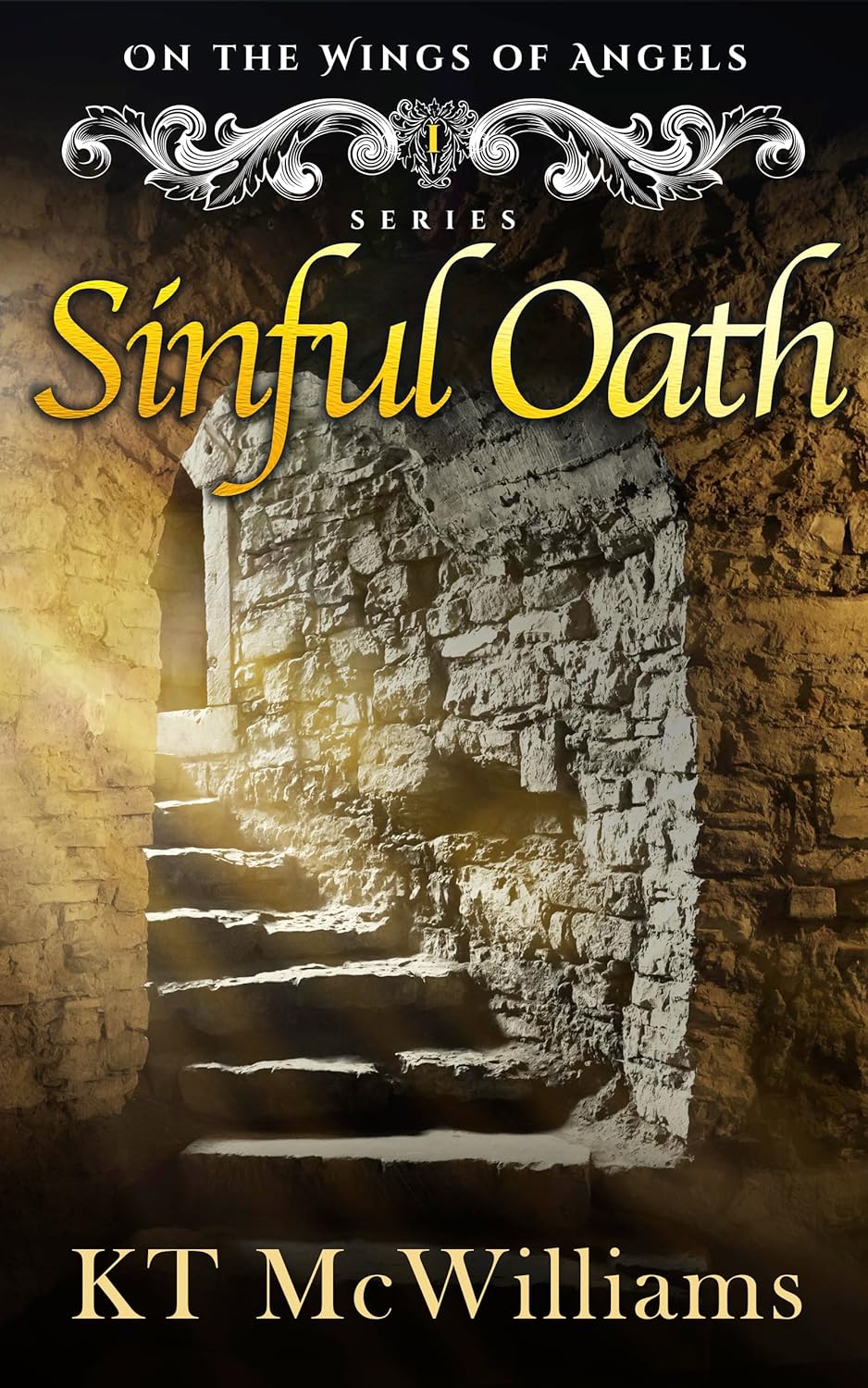
Sinful Oath is a blend of historical fiction, Christian fiction, and historical mystery, set in 1618 London and centered on Elizabeth Bowmar, a young apprentice midwife with a fierce moral compass, and Alexander Berkley, a man tangled in his own duties, loyalties, and regrets. The book opens with Elizabeth reflecting on her past, her faith, and the weight of responsibility she carries, then pulls us into a widening web of injustice, danger, and compassion. Author KT McWilliams paints the world with gritty street life, tense family dynamics, and the looming shadow of Newgate Prison. By the time I settled in, I already felt the stakes tightening around both Elizabeth and Alexander in ways that promised more than simple historical drama.
I was surprised by how intimate the writing feels. Elizabeth’s voice in particular comes through full of honesty and vulnerability, especially in her private thoughts by the hearth as she burns her written worries, believing the smoke carries them to angels. Even with the book’s heavier themes like poverty, violence, faith, and control, the storytelling stays grounded in the everyday textures of life. I liked that the author doesn’t treat the period like a costume. It feels lived in. And even when characters lean into ideals or spiritual reflection, the language never pushes toward sermon; it reads instead like people trying to make sense of their choices, which made it easy to stay with them.
What I appreciated most was how McWilliams balances tenderness with hardship. The moments between Elizabeth and her father feel warm and steady, and they’re a strong counterweight to the scenes with her mother, whose sharpness cuts deeper than some of the book’s villains. Alexander’s chapters add another layer, especially when we see him navigating the dangerous corners of London and the people who operate in them. The tension between old loyalties and present conscience gives his storyline weight. Sometimes the book lingers on internal rumination a bit longer than I expected, but even then, it felt true to the characters’ emotional lives. I got the sense that both leads are standing at a threshold, stepping into versions of themselves they don’t fully understand yet.
I feel like Sinful Oath is less about a single mystery and more about courage, the quiet kind that comes from tending to others, and the louder kind that comes from facing what’s broken in a community or in oneself. If you enjoy historical fiction with strong moral undercurrents, detailed atmosphere, and characters who wrestle honestly with faith and justice, this book will be right up your alley. Readers who like a mix of Christian historical fiction and historical mystery will probably enjoy it most, especially if they’re drawn to stories that move with both heart and grit.
Pages: 459 | ASIN : B0FPMT9YVC

River Talk


River Talk is a sprawling and dreamlike journey through myth, memory, and human frailty. It drifts between fables, folklore, and deeply personal reckonings with place and time. At its heart is Marchon Baptiste, a man both haunted and blessed by a heightened sense of connection to the world around him. His story, interwoven with echoes of gods distracted by their own games, high-stakes gamblers rising from the dead, and tribes living outside the reach of modernity, circles endlessly around the question of what it means to belong, or not belong, within the noise of humanity.
I enjoyed how the writing feels unpinned. Sentences sprawl and snap. They carry the same restless energy as the rivers and forests that pulse through the story. Sometimes I felt lost, like I was dropped into someone’s fever dream without a guide, and other times I felt stunned at how vividly the world cracked open. The language is raw, but that’s what gave it its weight for me. I loved how the prose could be coarse one moment, then suddenly dissolve into passages that felt more like prayers than storytelling.
The book kept circling back to this deep divide between human-made noise and natural rhythm. I felt admiration because it made me think about how little we listen, how much we dismiss in our rush to build walls of words and explanations. I can’t shake certain images: Marchon in the swamp hearing the river sing, the gods playing careless games with human lives, the silent communication of tribes who never needed words. These moments felt alive in a way I rarely get from fiction.
I’d recommend River Talk to readers who like stories that don’t walk straight lines. If you enjoy Faulkner’s twisting voices or the mythic strangeness of Toni Morrison’s Song of Solomon, you might find something here to savor. It isn’t a book for quick reading. It’s for anyone who’s willing to wrestle with the unsettling question of what it means to really be connected.
Pages: 222 | ASIN : B0FJR45LQK
Grounded in Hope

Angelica follows a young girl who discovers she’s gifted by God to enter dreams, battle fear, and bring light to the lost with the help of heavenly allies and unshakable faith. What inspired you to combine dream journeys with Christian symbolism and spiritual armor?
I’ve always been fascinated by dreams—how they can feel so real, symbolic, and even spiritual. As a person of faith, I believe God can speak to us through dreams, especially when we’re young and open-hearted. I wanted to create a story that showed children their fears are not the end of the story, but an invitation to rise in courage. The spiritual armor from Ephesians 6 became the perfect foundation—each piece carries meaning and power, and I wanted kids to see that faith is both imaginative and real. Combining dream journeys with Christian truth allowed me to explore big themes like identity, fear, and calling in a way that feels magical but grounded in hope.
How did you approach writing about fear in a way that would feel both honest and comforting to children?
I’ve worked with many children over the years—some of whom are dealing with very real fears: nightmares, family struggles, feeling different or left out. I didn’t want to minimize those feelings. Instead, I wrote Angelica as a mirror for kids to see their own emotions—especially fear—and realize that even in the middle of fear, they are not alone. Angelica learns that bravery isn’t the absence of fear; it’s showing up anyway with faith. By giving fear a shape, a voice, and then surrounding Angelica with divine support, I hoped to show kids that fear can be faced and defeated—not through force, but through light, truth, and love.
Todd the squirrel and the Eagle Fort are so unique. How did you come up with these dream-world companions?
Todd the squirrel actually came to me in a moment of prayer—I pictured this fast-talking, witty little creature who balances Angelica’s seriousness with joy and humor. He represents the voice that reminds us to laugh and trust, even in dark places. The Eagle Fort was inspired by Isaiah 40:31—“They will rise on wings like eagles.” I imagined a soaring place of refuge where warriors gather and children are trained in truth. I wanted every companion and setting in Angelica’s world to reflect part of God’s nature—His protection, joy, wisdom, and strength—while still being imaginative and memorable for young readers.
When and where will this book be available?
Angelica: Enter into the Dream will be available in the month of August 2025, in both print and digital formats through Amazon and select bookstores.
Joint Salvation

Judging Athena follows a humble and kindhearted research assistant who meets a curator at an art gallery, and what begins as a chance encounter over a necklace for a young girl’s birthday unfurls into a deep and poetic romance. What was the inspiration for the setup of your story?
The idea came to me while I was walking one evening last October. There is a real art gallery gift shop in a charming New England town. Many years ago, I purchased some custom nickel jewelry from the shop manager, a lovely woman with an accent (the nationality of which I cannot recall). On my walk, I suddenly suspected a story was lurking in the memory. As I strolled along, it all began to coalesce in my mind, blending with a few other ideas. I decided to go home, start typing, and see how far it went. Three and a half weeks later, I had a rough draft.
I enjoyed the romantic relationship between Josh and Athena. How did their relationship develop while you were writing it? Did you have an idea of where you wanted to take it or was it organic?
I’m glad you enjoyed it! I had a notion about both characters and their interaction. While they eventually presented themselves well in the first draft, initially, both were somewhat difficult for me to conceptualize. Josh was a challenge because of his humility and piety, and because I wasn’t sure how he would relate to Athena. She was very challenging due to her rarified nature and utterly unique circumstances. And her essence changed quickly in my mind, from a mere legend into something higher and in keeping with her arc of redemption. Fortunately, all my quandaries were resolved as I wrote. Once I was used to the sincerity and kindness in both characters, writing them became a nearly effortless pleasure.
Because of my marital deliverance theme, and partly in defiance of postmodern trends, I knew I wanted the relationship to progress from meeting to matrimony as quickly as possible. Yet in getting there, I decided to dwell on the details of dates, thoughts, emotions, and so forth. And many, many roses! That is why the betrothal period, less than two months long, essentially occupies half the book. I felt the emphasis on clean and honest dating and development, along with genuine understanding behind the marriage, was that important. As an aside, part of me almost wishes I could have dedicated the same level of attention to the rest of the story. However, that would have resulted in a book of 95,000 pages, not words, and I was pleased with the second half anyway.
I did have an idea of where I wanted Athena and Josh to go, though the idea evolved a bit. Most unusual for me, the ideas pretty much landed in the word processor in an organic fashion. Ordinarily, I erratically plot, fill in via scattershot, overthink, and stall manuscript development for months or even years. I practically wrote Judging Athena straight through from page one to “The End.”
What were some themes that were important for you to explore in this book?
Perhaps the most important element is the Christian concept of joint salvation, manifested through the three primary reasons for marriage, as explained by Father Josias in Chapter Four. This is a core tenant of the Church, however, too much of its veracity has been lost or diluted in our era. The tale I tell is, sadly, not my own. Rather, it is an idealistic expression of the ideal romance. My plot device or hook regarding Athena’s true nature is an admittedly extreme use of speculative theology. However, given the extreme state of the real world around us, I thought it was important to provide a strong counterbalance.
Another important concept, for me and, hopefully, for readers, is the complete deference to God offered by two imperfect people who, by dispensing with solipsism, offer anathema to the postmodern concept of the individual über alles. Fiction provides a forum for letting be what should be, even if the imagined vehicle approaches the fantastical.
Many of the themes and subthemes in Judging Athena stem from First Corinthians. I really enjoyed working various metaphors into the characters’ perceptions, their relationship, and their interaction with God, others, and the world. In addition to all else, the titular matter of judgment requires a real apophatic leap of faith. While hinting all around, I do not expressly explain how it happens. I don’t know technically how these matters unfold. No one does. Hence, a degree of trust is warranted. Had I delivered a detailed verdict, I doubt anyone would have liked it—least of all the author.
Also, I really like writing “innocent” fiction. All too often, my work veers into the polemical and the expositive. I may have finally discovered it is better to suggest than to force certain matters. Beyond telling what I hope is a sweet and entertaining story, I ultimately hope to encourage young men and women to defy the world, unite, be fruitful, and help each other redeem themselves through and into the glory of the Almighty.
What is the next book that you’re working on, and when can your fans expect it out?
Next up, Tom Ironsides returns in AURELIUS, a hard-charging action novella wherein the CIA’s former best blasts through the ranks of assorted international criminals. It’s another book that’s been simmering for a while, since around 2020. With any luck, it should be out late this year or in the winter of 2026. As with Judging Athena and The Substitute, it will come to market via Green Altar Books, the growing and outstanding literary imprint of Shotwell Publishing.
I generally have four or five manuscripts in development at any given time, and now is no exception. My “save the world” inclinations are slowly giving way to something more genteel and with more genuine literary quality. I have a few more romances in the works, including an outline for something of the levels of apologetics in Judging Athena. And there’s always more coming along—in due time.
Author Links: GoodReads | Telegram | Website | Amazon
JUDGING ATHENA is an exciting foray into innocent, pure, and productive love. It is also a clarion call to return to the traditions of marriage, large families, and genteel society.
Judging Athena

Judging Athena is a slow-burning and intense romantic tale wrapped in layers of faith, wonder, and philosophical exploration. The novel follows Josh, a humble and kindhearted research assistant with a troubled past, as he meets the mesmerizing Athena, a seemingly otherworldly curator at an art gallery. What begins as a chance encounter over a necklace for a young girl’s birthday unfurls into a deep and poetic romance. But the book is far more than a love story. It is a meditation on grace, providence, redemption, and the mysterious forces that shape our connections with others. Lovett weaves Christian themes and classical imagery into a narrative that’s both gentle and spiritually charged.
Reading this book was like watching a candle flicker in a dark room—it’s quiet, but it draws you in with its warmth. Lovett’s prose is clean, sometimes florid, and undeniably heartfelt. He leans heavily into emotional introspection, and there’s a timelessness in how the characters speak and behave. I found Josh’s sincerity almost disarming. His faith isn’t just tacked on; it’s baked into the bones of who he is. Likewise, Athena, with her mythic presence and veiled depth, feels like a figure out of legend—yet she’s also relatable. Sometimes the writing feels deliberately old-fashioned, almost theatrical, but it works here. It feels earnest, not forced. There were scenes—particularly Josh’s interactions with the orphaned children—that made me tear up. This book is tender and idealistic, and that’s its charm.
Judging Athena won’t be everyone’s cup of tea. Some readers might find the pacing slow or the emotional tone a bit too syrupy. There’s also an idealization of the romantic female figure. Personally, I didn’t mind that. The mythic vibe—the goddess-like presence of Athena—is part of the book’s fabric. Still, it’s good to know what you’re walking into. I also appreciated how the novel wrestled with ideas of spiritual identity and belonging without sounding preachy. Lovett trusts the reader to wrestle alongside the characters. And for a book grounded in religious themes, that kind of subtlety is rare.
I’d recommend Judging Athena to readers who are believers in second chances, hopeless romantics, and anyone who finds beauty in the quiet corners of life. If you like books that wear their heart on their sleeve and aren’t afraid to slow down and feel deeply, this one’s worth your time. It is full of love for people, for faith, for redemption.
Pages: 330 | ASIN : B0F6KQ6C9S



 LITERARY TITAN