Blog Archives
The End: Omicron
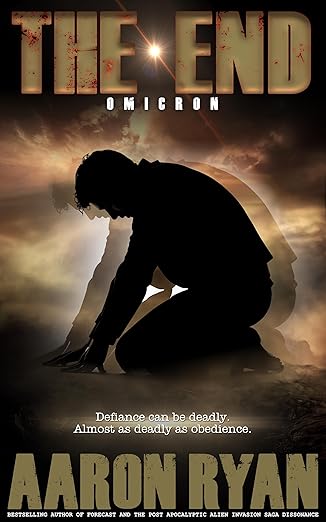

Aaron Ryan’s The End: Omicron is a breathless and gut-wrenching continuation of a harrowing dystopian saga. Picking up in a devastated future where a tyrannical leader named Nero hunts down Christians marked by a branded scar, the story follows young Sage Maddox and a ragtag group of survivors struggling against a monstrous regime of mechanoids and propaganda. Meanwhile, former High Vassal Maximillian—reborn as Darius Antone Forrester—defects and seeks redemption, setting the stage for spiritual warfare, betrayal, personal transformation, and rebellion. The world is brutal, the stakes are high, and the faith of every character is tested in fire.
Reading this book was like being pulled behind a speeding train. The pacing is relentless, the emotion runs raw, and the characters are utterly drenched in pain, doubt, and hope. Ryan’s writing is often visceral and unfiltered—sometimes jarringly so—but it’s always from the gut. You feel Sage’s grief claw at your chest. You feel Maximillian’s shame and longing for a second chance. It’s not polished in a traditional literary sense, but that’s exactly what makes it powerful. It’s not trying to be subtle or slick—it’s just honest. And in that honesty, it punches hard. Some of the dialogue feels intentionally unrefined, like real people speaking in the worst moments of their lives. I respected that.
On the flip side, the writing leans heavily into its message. Ryan is unapologetically Christian in theme and tone—this is not a book that hides its worldview. That might throw off some readers looking for a more ambiguous or secular apocalypse. But if you go in knowing that, it delivers with sincerity. I found myself torn between frustration and admiration at times—the moral dilemmas, the extreme stakes, the black-and-white battle between faith and evil. It’s not subtle storytelling, but it is bold. And sometimes bold is exactly what a story needs to break through the noise.
If you’re a fan of Christian dystopian fiction, if you like stories about persecution, faith, rebellion, and endurance under fire, this one’s for you. I’d recommend it for readers who want more soul in their sci-fi, and more fire in their faith. If I had to put The End: Omicron on a shelf with other books, it would sit somewhere between the Left Behind series and The Hunger Games, with a dash of 1984 and This Present Darkness. It’s got that same blend of high-stakes rebellion, faith under fire, and a world cracking under tyranny.
Pages: 263 | ASIN : B0F6VWDM2H

Good For The Soul

Philip Rennett’s Good For The Soul is an ambitious, genre-blending novel that tosses political satire, spiritual conflict, and small-town Irish charm into a single, messy but compelling stew. At its core, the book follows Andrew Blackwell, a former UK prime minister, now a reluctant recluse, as he’s dragged back into the world of global influence through a secretive “Global Conclave.” Meanwhile, in the quiet Irish town of Clonbrinny, a troubled priest is caught in the moral chokehold of a criminal syndicate. It’s a story about power, guilt, reinvention, and the weird, awkward humanity that binds it all together.
What grabbed me first was how effortlessly Rennett shifts tone. One moment, you’re in a confessional booth listening to Margaret Doyle deliver an outrageously inappropriate dream confession about cassocks and spanking. Next, you’re in the thick of Blackwell’s emotional unraveling or sitting in a church watching Declan Kelly, a violent gangster, toy with religion like it’s a game of poker. These tonal shifts shouldn’t work. But they do, mainly because Rennett has a wicked sense of humor and a sharp ear for dialogue. Margaret’s appearances, especially in the “Confession” chapter, had me laughing out loud, while Father Aidan’s slow disintegration genuinely broke my heart.
What surprised me most was how Good For The Soul uses the setting almost like a character. Clonbrinny feels lived in, grimy, rain-soaked, and steeped in secrets. Peace Castle, where the elite gather to decide the world’s fate, is jaw-dropping in its opulence, but it feels hollow, too. There’s a beautiful contrast between those two worlds, and Rennett plays them against each other masterfully. When Blackwell stands before the Conclave in “The Opening Statement,” what he says feels honest, even raw, not just because of what he reveals, but because we’ve seen him wrestle with it. I didn’t expect to feel sympathy for a politician on the brink of a second act, but here I am.
The writing itself is tight and conversational, but it’s never dumbed down. I loved how Rennett injects intelligence without arrogance. He keeps the language accessible, even when the stakes are philosophical. There’s also a lot of heart under all the satire. One of my favorite moments was in “Help Me,” when Father Aidan, drunk and broken, finally whispers, “Help me.” That wrecked me.
Good For The Soul feels like a modern-day parable, soaked in Guinness, lit by lightning over crumbling churches, and filtered through the lens of people just trying to figure out what the hell matters anymore. I’d recommend it to anyone who likes their fiction smart, funny, and a little unhinged. Especially if you’re into layered plots, Irish settings, and characters that make you feel something, even when they’re being completely ridiculous.
Pages: 369 | ASIN : B0F44DQKCK

Myth or Reality

Pope Joan follows a woman who defies all odds when she disguises herself as a man and rises through the ranks in the Catholic church and secures the position of Pope. Where did the idea for this novel come from?
I came across an article about the myth or reality of a female who became pope. Her real identity as a woman was revealed when her water broke in public, and she began to deliver a baby. According to the legend, she was stoned to death as she was about to enter one of the churches in Rome. I started to imagine how a woman back in those days, when a woman was heavily restricted, could climb the ladder through the church to become pope. What was her back story? My curiosity soon took over, and I did extensive research on the times in which she lived and the struggles she had to endure to succeed and become Pope Joan.
Can you share a little about the research that went into putting your book together?
The Internet offered a wide range of great resources to help me locate specific materials: timelines, biographies of people who lived during the age that I was interested in, places that housed certain religious orders, and the ongoing conflicts of the age. Generally speaking, I have had a fascination with the Middle Ages and now have a small reference library dedicated to the Crusades and the Reconquista.
What was your favorite moment in Joan’s story? Is there one scene that resonates with you?
I was most touched by Joan’s time in prison when she was awaiting execution. What was going through her mind? Surely, the uncertainty of being executed or not weighed heavily and gave her a feeling of dread. But also she thought about the safety and well-being of her child. No matter how old children are, their parents want to know they are safe.
Will your next book be historical fiction? What are you currently preparing for your fans?
I have written and my editor is currently finalizing my next historical fiction novel, Kitty Schmidt: My Life as a Prostitute. Kitty managed the Gestapo’s brothel during World War II. How did she find herself in this position? Did she have a family? What happened to her during the bombing of Berlin and the subsequent Russian invasion of the city? I wanted to explore all of these aspects of her life.
Author Links: GoodReads | Amazon
While Andrew pursues the world of numbers and accounting, Joan becomes an avid student, learning to love reading and acquiring knowledge, eventually – through a string of circumstances – propelling her to higher and higher offices within the church and finally becoming the first and only female pope.
How long does Pope Joan keep her gender a secret?
Pope Joan


Pope Joan, by Pablo Zaragoza, is a historical novel that tells the gripping story of a woman who defies societal norms and disguises herself as a man to rise through the ranks of the Church, ultimately becoming the Pope. Set in the brutal and unforgiving world of the ninth century, the book weaves history, myth, and speculation into a rich narrative about ambition, intelligence, and survival. Joan, born into a world that limits women to silence and servitude, refuses to accept her fate. She thirsts for knowledge, a rare and dangerous trait for a female, and her relentless pursuit of learning leads her on a path few could imagine. The book follows her struggles, victories, and the immense risks she takes to carve out a place in a world that would see her destroyed if the truth were known.
One of the things I loved about this book was how vivid and immersive the writing felt. The details of medieval life are gritty and raw. Joan’s intelligence shines through every page, and her thirst for knowledge is portrayed so powerfully that I felt her frustration every time someone tried to snuff it out. There’s a scene early on where her father, a rigid and cruel priest, beats her simply for being curious. That moment alone set the tone for the kind of world she was up against.
Another thing that stood out to me was how the novel balanced historical depth with emotional intensity. Sometimes, historical fiction can feel weighed down by facts, but this book never lets the history overpower the human heart of the story. Joan’s relationships—her forbidden love with Gerold, her conflicts with the men who underestimate her, and her silent struggle to remain hidden—kept me glued to the pages. The tension was constant. Every moment, I was bracing for the inevitable discovery of her secret, yet I couldn’t stop hoping she’d keep pulling off the impossible.
There are moments throughout the book that are very dramatic. Some of the characters, particularly the villains, left me wanting more depth to their character to understand their intensity. Joan’s father, for instance, was especially harsh, which emphasized the struggles she faced. While I understood that his role was to represent the oppressive forces of the time, I occasionally wished for a little more nuance in how those forces were portrayed. Still, the book remained engaging, and even in its most heightened moments, it never lost its emotional depth.
I’d recommend Pope Joan to anyone who loves historical fiction, particularly readers who enjoy stories of strong women defying the odds. If you’re looking for a novel that combines rich historical detail with a gripping, fast-paced story, this one is worth picking up. It’s intense. It’s emotional. And it’s the kind of book that stays with you long after the final chapter.
Pages: 179 | ASIN : B0CW1JH88C
Nuggets of Insight
Brothers in the Cross follows an archaeologist who, while investigating a murder in the West Bank, unearths a clue that leads his team to the Cross of Jesus. What was the inspiration for the setup of your story?
Finding that I have terminal diseases convinced me to rethink my understanding of faith. I had never been comfortable in talking religion. Somehow I sensed that my characters could, if we had something meaningful to say. I had read an article about the Ein Gede scroll and subsequently was musing about the Dolly the Sheep cloning, when the idea of cloning Christ exploded into my brain. I had to write that story!
Brothers in the Cross is my introduction to publishing to the public, and my only work of historical fiction. It is my second book, though my first, Tales from Bedside Manor, a non-fiction memoir of the most memorable cases in my fifty year medical career, was written for my family and close friends and not released for sale or distribution.
I wrote Tales from Bedside Manor to preserve in short stories the ironies and bittersweet memories of life as an Internist (Internal medicine: a pediatrician for adults). It was to leave to my family an understanding of what those experiences had been like. My health was faltering, major irreversible coronary disease intruded soon overlaid by cancer. I could see the light at the end of the tunnel drawing closer and wanted to leave my mark. That was in 2010, Obamacare was passed and physician-directed primary care medicine began to die.
Writing Brothers in the Cross was different. Since childhood, I held a fascination with stories of the Holy Land. I was the questioning sort and the glib answers of true believers were never quite convincing enough for me. I wanted to believe, but I wanted to be convinced by something beyond blind faith. So I cocked my ears for discoveries that evolve with time and was rewarded by nuggets of insight that arose in random fashion over the years.
And then the threads collided. I was musing one evening and recalled the story of Dolly the Sheep and her cloning in Scotland. Furthermore, there had been articles about rogue doctors cloning human children in Korea and Mainland China. That was the epiphany that sparked my leap to consider what would happen if The Holy Cross of Jesus was found. What men with technology would do was never in question.
How much and what kind of research went into putting this novel together?
The book would write itself. Research required only confirming the facts that had accumulated over time. The closest distance between two points is a straight line. The closest hiding place for the Cross was near Jerusalem. Simon of Cerene was the man who carried it to the crucifixion. The most obvious source of Christ’s genes was the fatal Cross. The surrogate Mother would be Mary (Mariam is the Arabic translation). The Bible’s Revelations would suggest the other character, the Anti-Christ. Armageddon would pre-suppose a nuclear end. And the death of my primary care physician practice relegated me to the role of Chief of Occupational Health at White Sands Missile Range where I became acquainted with the nuclear accidents including the Demon Core incidents at Las Alamos Laboratory. Fate mixed with reason, so I wrote the book.
What is the next book that you are working on, and when will it be available?
I don’t have any plans to write another but stranger things could happen.
Author Links: GoodReads | Amazon
In the mid 1900s archeological studies unearthed the Dead Sea Scrolls, and then the Ein Geli scroll. Technologies brought to bear on the latter revolutionized the study of ancient artifacts and allowed scenarios like the one in this book to be achieved. Jesse, the archeologist gets roped into a murder investigation in the West Bank. The ‘clue’ is found. When it is deciphered the treasure hunt is on.
The trio that collaborate to solve this riddle becomes ensnared in the emotions of their discovery. That they find the Cross of Jesus seals their belief. But will anyone else believe them? Dr. Craig Carpenter is a fertility specialist on sabbatical and quite naturally wants to see if the blood of Jesus is in the Cross. He reasons that the chromosomal patterns will be unique because the male components were supplied by GOD, not man. His hypothesis is confirmed. Now the fertility specialist holds the genes of Christ. What could possibly go wrong?
Myriam is the key. Thanks to the technology of Dolly the Sheep, she becomes the surrogate mother for the blood of the Lamb. The “reincarnate Christ” is born and his life evolves. The admonition of the Book of Revelations looms heavily over this story now, and the possibilities expand.
Eventually the question arises: How does one eliminate undesirable genes in this day of GMO’s?
The Christmas Letter
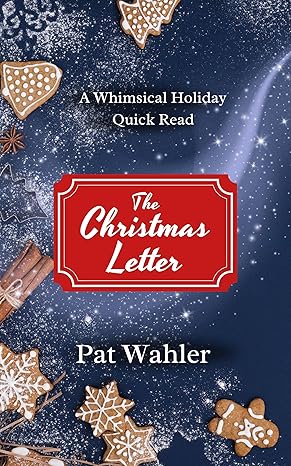
Pat Wahler’s The Christmas Letter shines as a beautifully crafted, heartwarming novella that weaves the spirit of Christmas into the tapestry of real-life struggles. This touching story introduces us to Zoe Kendrick, a teacher on the brink of burnout, trying to balance the demands of her job, a sick friend, two young children, and an often-absent husband. As the weight of her responsibilities grows, she finds herself merely trying to keep her head above water. Yet, with Christmas approaching—a season rich with the promise of miracles—hope begins to flicker when Zoe encounters a stranger in an elevator. Although quirky at first glance, this stranger’s warmth and wisdom bring unexpected comfort to Zoe, rekindling her hope.
Despite its brevity, this story holds an abundance of depth. Wahler’s writing is rich and evocative, painting emotions vividly so readers can almost feel what each character experiences. Every interaction is thoughtfully detailed, from subtle gestures to deeper connections that reveal the resilience of friendship. One striking example is Zoe’s relationship with her friend Viola. Although Viola’s presence in the story is brief, the strength of their bond and mutual understanding is undeniable, a friendship most of us would be lucky to have. Set against the festive backdrop of Christmas, the story brims with holiday warmth and wonder while delving into relatable adult themes like marital strain and personal sacrifice. Wahler skillfully balances the enchantment of Christmas with realistic issues, crafting a narrative that resonates with readers while preserving its magical atmosphere.
The Christmas Letter is a compelling reminder of the courage it takes to face life’s challenges and the strength found in meaningful connections. This novella is perfect for those seeking a gentle nudge to appreciate the unique bonds that lift us and bring warmth to our lives.
Pages: 39 | ASIN : B0DKB6TQFP
Part of God’s Plan

Becoming Forever Families follows the experiences of a woman who finds love later in life and marries in the LDS church. What was the inspiration for the setup of your story?
This woman, Sarah, was previously married and had three children with Randy. He later divorced her; however, she felt that she needed to be married to a faithful husband, and prayed to God that this would occur. This story shows how God answered her prayers, and how she was married in the Lord’s House according to her desires.
Is there anything from your own experiences that you include in the lives of your characters?
Foremost is Ethan’s autism, which was introduced in my prequel Living a Miracle. I show how he was able to overcome many of its characteristics, as I have. I also relate Ruth’s situation of living alone with my being single and living by myself until I met my wife. She then later passed on, placing me in the same situation.
What were some themes that were important for you to explore in this book?
The main theme is the Lord’s plan for families to be together forever, as we have strong family bonds which we want to continue forever. Our struggles in life now are part of God’s plan to help prepare us to achieve this result after this life is complete. Another theme is that God will bless us during our difficulties in life as we stay faithful to Him.
Can readers look forward to seeing another installment following the Wilkinson family?
I have no immediate plans to continue this story; however, I may continue it later, with a message about how a high-functioning autistic adult can teach and help other people so that they can realize that their family lives are able to continue forever.
Author Links: GoodReads | Website | Amazon
We desire our strong, loving family connections we presently experience, to continue in the Spirit World and beyond.
What is Christ’s real plan for our families after this life?
This great question is answered here. You will learn about:
• What Christ’s blessings are for us, now and forever
• What the real purpose of this life is for us and our families
• What Christ’s plan is for those with no family in this life
• How we can actually become as Christ is now, and the purpose of doing it
• How Christ can lovingly help us
This sequel continues the life story of the Wilkinson family, showing us how to become a forever family. It illustrates how we can view ourselves from an even greater perspective, and shows our true missions in life.
Included is a thought-provoking Reading Guide, to assist you to have a much better understanding of yourself. You will truly see the great significance of living this life, individually and with your family, along with your incomprehensible potential after this life is completed. Becoming Forever Families will prove to be very beneficial for everyone.
This work also promises to make great reading for a book club.
Blue Dream

Blue Dream, by Keith Gillum, transports readers to a futuristic dystopia where virtual reality and human emotions clash in a meticulously crafted narrative. Through the eyes of Dom, a young man grappling with the remnants of a world dominated by technology, the story explores themes of memory, identity, and resistance against a backdrop of pervasive digital control.
From the very first page, Gillum hooks readers into a world where reality and virtual existence blend seamlessly. Dom, who spends his days recycling digital waste in the Trop, is both an everyman and an anomaly, caught between the remnants of a tangible past and a controlled, virtual present. His journey through fragmented memories, such as those of his father, and surreal experiences like fishing on a crystalline river, forms the core of the narrative. These memories are under constant threat of deletion by the ever-watchful Halmarc, Dom’s case file manager, who embodies the intrusive nature of the state. The interactions between Dom and Halmarc are vividly depicted, highlighting the tension between personal autonomy and imposed conformity.
Gillum’s writing shines with its rich, descriptive language and a knack for crafting immersive scenes. The dialogue is sharp and often laced with dark humor, especially in Dom’s exchanges with Halmarc. The portrayal of Halmarc’s obsessive control over Dom’s memories and emotions serves as a chilling commentary on surveillance and psychological manipulation. One of the most compelling scenes symbolizes the broader struggle to retain personal history in the face of an erasing authority. The book delves deeply into Dom’s inner turmoil and his virtual reality experiences, providing a rich exploration of his character. These segments, while reflective, contribute significantly to understanding Dom’s psyche and enhance the story’s emotional depth.
The world-building is intriguing and thought-provoking, hinting at a vast and complex digital dystopia. While it leaves some mysteries about the system’s origins and mechanics, this sense of enigma adds to the novel’s allure, inviting readers to ponder and engage with the speculative aspects of the narrative.
Blue Dream is a thought-provoking and visually compelling novel that will resonate with fans of dystopian fiction, psychological thrillers, and religious science fiction. Keith Gillum has crafted a story that not only critiques the pervasive influence of technology but also celebrates the resilience of the human spirit. I recommend this book to readers who enjoy exploring the interplay between memory, identity, and societal control.
Pages: 305 | ASIN : B0D1H9BMV3



 LITERARY TITAN