Blog Archives
Love of the Community

Run traces the extraordinary story of Wilmot Collins, whose life carried him from the devastation of Liberia’s civil war to the mayor’s office in Helena, Montana. As both a writer and filmmaker, how did your background influence your approach to the book?
I came to this project without any direct connections to an extraordinary life such as Wilmot’s. But I DO have an abiding interest in stories about courage, resilience, and survival. And Wilmot’s is chock full of all those things. (I explored some of these themes in my feature documentary work, FEBRUARY ONE: THE STORY OF THE GREENSBORO FOUR, about the 4 young men who took on the entire racial order in the U.S. when they sat down for service at the Greensboro Woolworth Store on Feb 1, 1960, thus unleashing much of the youthful driving force behind the civil rights movement of the 1960s. So Wilmot’s treacherous journey from the Liberian civil war (which killed over 250k of his fellow countrymen, including two of his own brothers, one of whom was beheaded) was a powerful attraction to me: how could someone take on that much danger and not only survive an ocean way (in Helena, MT) but thrive, indeed LEAD an entire community? Incredible.
A recurring theme throughout the book is that leadership begins with service. How did you see that idea reflected in Wilmot Collins’s life? Why do you think so many people connected with his message?
People were attracted to him because over the course of more than 20 years living in Helena, they had come to know and respect, even admire, him. He demonstrated his love of the community and commitment to being an American citizen–by joining the US military; serving as a youth counselor, coaching youth soccer, even singing karaoke at local bars. To him, it was all about being a public servant–listening and learning what the community needed and wanted, and then serving those needs. NOT styling himself as some ideologue or professional politician. We could learn a lot today about his ‘politics of decency’, far healthier than our current polarized, hyper-partisan politics of destruction.
The book devotes considerable attention to the long process of immigration and family reunification. Why was that aspect of the story so important to include?
Family was and is a pivotal feature of Wilmot’s life–and that goes for his wife, Maddie, and their two kids (now grown), Jaymie and Bliss. Everything was done by majority vote in their household. The difficulty and long wait he had to endure (his own daughter, born two months after arriving with her mother, Maddie, was two years old before a patient, but long-suffering Wilmot, could join them in America for the first time. But being resilient, persistent, and pursuing education (which got Maddie over to the US in the first place–to pursue a nursing program at Carroll College in Helena, MT) were binding threads in their family tradition.
What do you hope readers will remember most about Wilmot Collins and his family?
I hope readers remember how love takes courage and resilience, and the Collins family epitomized those traits. Also, I hope people will see in their remarkable journey the essence of the American Dream at work – a fast-fading goal for many native born Americans, but on vivid and compelling display with Wilmot Collins!
Author Links: GoodReads | X (Twitter) | Facebook | Website | Amazon
Run tells the inspiring story of Wilmot Collins, who fled the brutal and bloody Liberian Civil War in the early 1990s—where over 250,000 Liberians were killed, including two of Collins’s brothers—and managed to make it to Helena, Montana, one of the whitest places on the planet. Enduring and overcoming racism and xenophobia, he joined the Montana National Guard, became an active member of the Helena community, and in 2017 rose to become mayor of the capital city and the first Black mayor in Montana’s history.
Collins garnered a national reputation not only as a beloved Democratic politician in a ruby red state but also as a shining example of how being a racial and political outsider in a highly partisan society can be transformed into an effective and engaging form of political leadership.
Wilmot’s story highlights the tragic decision to abandon one’s homeland when it turns on its people. Collins came from a highly educated family and, when civil war erupted, he was fresh out of college working as a middle school teacher at Monrovia’s SOS Children’s Village School. He had recently found a great companion, Maddie Muna, whom he met after college graduation. They became fast friends and soon life partners in marriage. But they first had to negotiate forces threatening their very lives.
Through extensive interviews and his masterful command of storytelling, award-winning author and filmmaker Daniel Blake Smith tells how Wilmot and Maddie, through great perseverance, plenty of ingenuity, and inspiring displays of generosity, journeyed to the United States and have made their new home a better place for everyone. Run offers an emotional, inspiring, and deeply personal story of survival, racial injustice, political hope, and the challenges one family faced to realize the American dream.
RUN–The Wilmot Collins Story: From Liberian Refugee to First Black Mayor in Montana
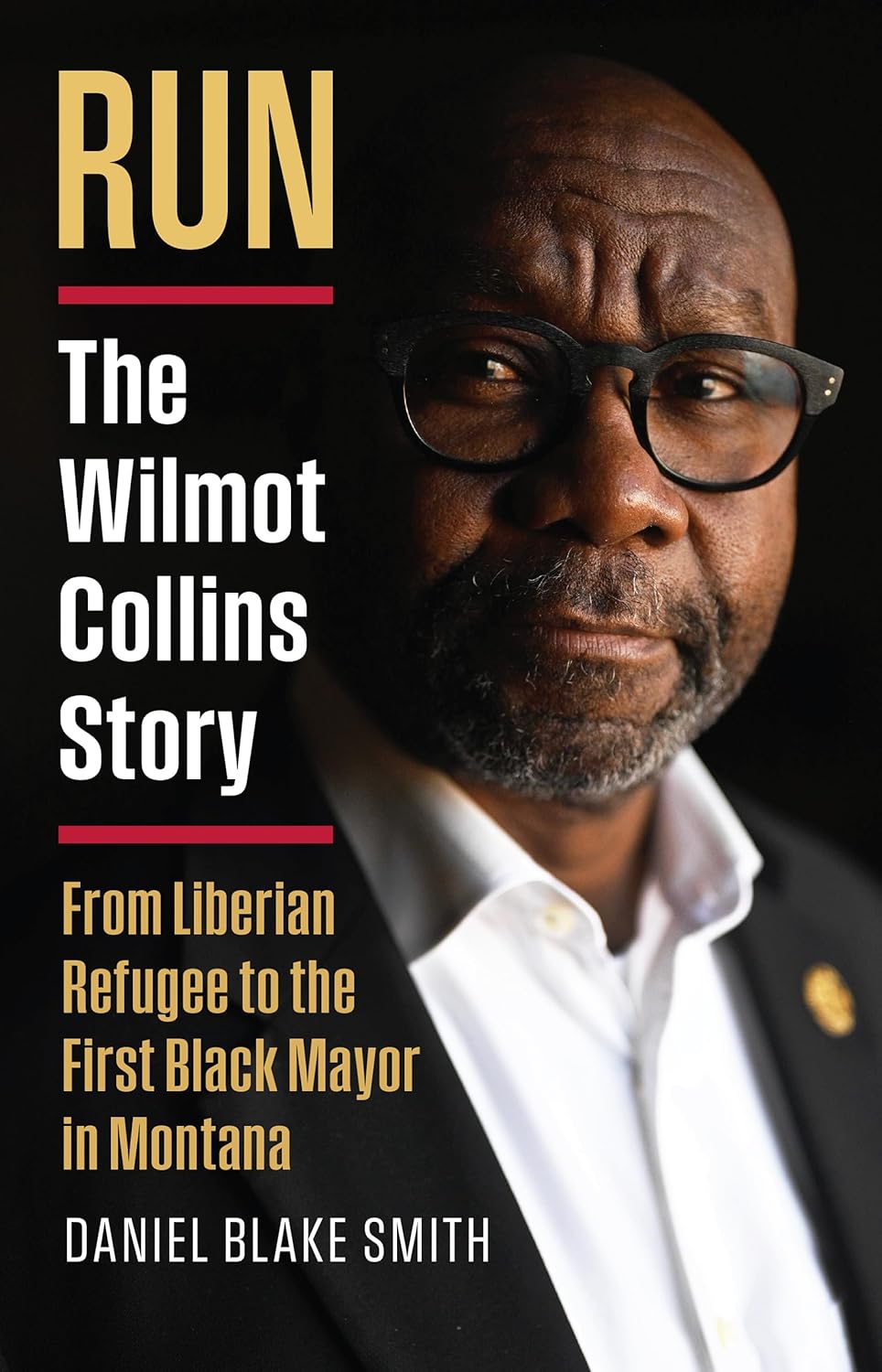

Daniel Blake Smith’s Run is a compelling political biography and refugee narrative about a life shaped by survival, family, public service, and the search for belonging. The book follows Wilmot Collins from the violence of Liberia’s civil war to his historic election as Helena, Montana’s first Black mayor. Smith opens with scenes of hunger, gunfire, and desperate escape, then carries that urgency into the long bureaucratic struggle that separated Collins from his wife, Maddie, and their young daughter. It’s an American immigrant biography with a remarkable trajectory, but its emotional center remains the bond between Wilmot and Maddie as they keep building a future through uncertainty.
The early chapters are the book’s most intense, placing Wilmot and Maddie inside a Liberia where ordinary routines have been overtaken by terror. Smith writes these passages with the momentum of narrative nonfiction, moving between historical context and intimate moments of fear, grief, humor, and devotion. Once the couple escapes, the story becomes an immigration history centered on waiting: waiting for paperwork, interviews, sponsors, approvals, and the chance to reunite. That slower stretch has its own tension because every administrative delay carries a human cost. Wilmot’s persistence gives these chapters warmth, while Maddie’s determination and practical intelligence make her much more than a supporting figure.
When the story reaches Montana, it expands into a thoughtful civic leadership biography. Wilmot takes whatever work he can find, joins the military, becomes active in his church, counsels young people, coaches soccer, advocates for human rights, and gradually becomes part of Helena’s public life. Smith doesn’t separate this community work from Collins’s later political success. He shows that the campaign was built through years of conversations, service, and personal trust. The book also addresses racism directly, including threats and vandalism against the Collins family, while paying equal attention to the neighbors and friends who stood beside them. That balance gives the account a conversational honesty and helps explain why voters eventually saw Collins as one of their own.
As a political biography, Run is especially engaging when it examines Collins’s idea of leadership as service. His mayoral years, policy priorities, public meetings, Senate campaign, and responses to national debates all grow naturally from the experiences that came before them. Smith’s admiration for Collins is clear, and the book sometimes states its lessons more directly than it needs to, but the wealth of family memories and community voices keeps the portrait grounded. Ultimately, this refugee success story is about how citizenship gets practiced in daily life. It presents Wilmot Collins as a gifted connector whose political achievements came from showing up, listening closely, and treating public office as another way to care for his community.
Pages: 168 | ASIN : B0GFPCY9R1:

Unimaginable Lengths

In Run, a woman must protect her son after he witnesses a crime and the gang responsible sets out to silence them both. What was the inspiration for the setup of your story?
My inspiration for this story is loosely based on a real-life experience. When my son was a teenager, he was jumped by two gang members who put him in the hospital for two weeks with a serious injury. During the investigation, and before his subsequent arrest, one of the gang members involved moved into the same condominium complex we lived in, constantly harassing us, and eventually necessitating our relocation. After his arrest, he continued to contact us via a cell phone smuggled into jail, threatening my son if he testified against him. Needless to say, I was frightened for my son’s life and was very close to moving him out of the area until the trial started.
That experience made me think about what I would do to protect my son if the situation escalated and the police couldn’t protect us. What would I do? Where would I take him? And how would we ever be able to resume our normal lives after that? Of course, my book is fiction, and very loosely based on our experience, as thank goodness, things turned out well for my son and his perpetrators are still in prison today.
Are you a fan of the crime thriller genre? What books do you think most influenced your work?
I have always been a fan of the thriller, suspense, and adventure genre. I am a huge fan of David Baldacci, Harlen Coben, and Lee Child, to name a few of the all-time greats.
Do you find that you relate to any of your characters? If so, which one(s)?
I can definitely relate to my protagonist, Kendra Thompson. She had to make some tough choices, but it was all done in the name of protecting her son. I believe most mothers can understand going to unimaginable lengths to save your child. Even when they are a typical snarky teenager with attitude, as Kendra’s son is!
What is the next book you are working on, and when will it be available?
I am just wrapping up my next thriller, which will be released on December 5, 2024. This next book is centered around a young woman named Megan Hamilton, who has just been dumped by her fiancé. After her mother guilt-trips her into going on a cruise to Mexico with her to heal from the heartbreak of her failed relationship, Megan meets a charming man onboard. However, no one is who they appear to be and when Megan goes missing, she soon realizes the truth is much worse than anything she could have imagined. Her perfect vacation is about to turn into a total nightmare. You’ll think twice before booking your next getaway.
Author Links: Facebook | Twitter | Instagram | Website
Now Kendra and her son are running for their lives, hunted by a vicious street gang with eyes and ears everywhere, who are determined to silence Kyle forever. In a deadly race to stay one step ahead of a ruthless gang, a crooked cop, and a corrupt politician, Kendra is the only one who can save him from a web of corruption that leaves her with almost no one she can trust.
Their lives hang in the balance as two strangers become their best chance for survival-a gutsy truck driver and her brother, a retired DEA agent with a questionable past.
Kendra’s fierce determination to save her son and outmatch their pursuers is put to the test as she discovers just how far she is willing to go and what she will sacrifice to protect her child.
But where can a desperate mother turn for help when she can’t trust anyone, and everyone has a stake in finding them?
Run

Run, by Christy Cooper-Burnett, is an action-packed contemporary novel that immerses its readers in the harrowing life of Kendra Thompson, a nurse and single mother. The plot thickens dramatically when her son, Kyle, becomes an unintended witness to a gang crime, thrusting them both into imminent danger. This novel echoes the tension and intrigue of classic thrillers, where survival is contingent on outwitting pursuers.
Set in a modern American setting, Cooper-Burnett skillfully merges the urgency of a high-stakes chase with the mental strain of being relentlessly pursued. The author’s adept storytelling grips the reader from the onset, employing a rapid pace and convincingly realistic characters. A distinctive feature of this novel is its exploration of the gang’s ties to influential figures, a development that not only elevates the risks involved but also challenges the protagonists’ reliance on the justice system for safety. The journey of Kendra and Kyle, navigating through perilous and unpredictable circumstances, is engaging and maintains suspense throughout.
Cooper-Burnett demonstrates a talent for sustaining a tense atmosphere, underscored by a pervasive fear of the unknown. The alternating perspectives of mother and son add depth to the narrative, offering varied viewpoints that enrich the plot. The characters’ unwavering uprightness amidst the story’s darker elements effectively injects moments of humanity and relief into the narrative, which is otherwise marked by continuous tension. This contrast serves to retain the reader’s engagement, offering a balanced rhythm that prevents desensitization to the story’s swift developments.
Run is not exclusively for aficionados of the thriller genre but is equally inviting for newcomers intrigued by such storytelling. The novel presents a riveting combination of unceasing action and intricate ethical quandaries, marking it as a noteworthy contribution to contemporary thriller literature.
Pages: 275 | ASIN : B0CW1GGG38
Fighting for the Long Haul
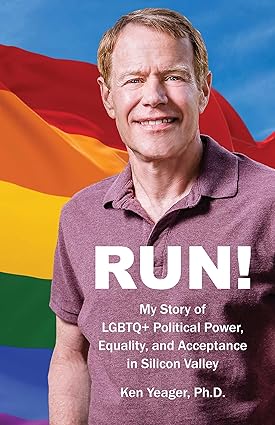
Run! is an engaging memoir where you share not just the highlights of your political career but the struggles you faced because of being a member of the LGBTQ+ community. How hard was it to put this story out in the world for people to read?
Given my own circumstances of coming out, it was not hard for me to put my story out to the world. For many queer people, coming out is a slow and laborious process involving one-on-one conversations with family and friends. I chose a different path. On a March 1984 morning, I came out to the entire readership of the San Jose Mercury News when I wrote an opinion piece denouncing the statements of an anti-gay state legislator. While I might have trouble telling people individually about my sexual orientation, I was comfortable notifying the whole town.
Another reason I was okay with telling my story is from being an elected official for 26 years. When I first ran, I knew there would be a spotlight on my personal and professional life. Most people want to protect their privacy and shun publicity. For whatever reason, I accepted the public exposure because of what I wanted to accomplish once in office.
For all these reasons, I was comfortable telling my story. That isn’t to say I wasn’t nervous about it. I didn’t know if colleagues would agree with my version of history or if critics would find fault with my political strategies. Ultimately, I decided to tell my story as accurately as possible, remembering things as they were without a revisionist history.
What were some ideas that were important for you to share in this book?
One main reason for writing Run! was to show that regardless of how bleak things look politically, a group of like-minded people can make a difference over time, even if it takes years. To bring about social change, you have to be in the fight for the long haul. For me, that meant the last 40 years.
Also, I wanted to demystify running for office. I do this by covering all aspects of my four competitive races so others can learn how it’s done. In the chapter titled “Run, Baby, Run: Planning and Executing a Winning Campaign,” I offer advice for how LGBTQ+ candidates can survive negative attacks against them by deploying various strategies to attract voters’ support.
Last, I wanted to emphasize that winning isn’t enough. It’s what you do while in office that matters most. Many elected officials serve for years and never leave a mark. This should never be the fate of queer politicians. I think one reason why LGBTQ+ officials can be so successful is due to the discrimination and stereotypes that they have to overcome to win elections in the first place.
What is one piece of advice you wish someone had given you when you were younger?
I’m not sure it was ever articulated to me, but looking back, I think one thing that saved me from doing or saying any number of stupid things was surrounding myself with people I trusted and could bounce ideas off of. Politics can be a pretty unforgiving profession, and mistakes aren’t always forgiven or forgotten. To avoid that, be sure to talk things through with your advisors. Once everyone agrees on the appropriate action, you can go forward with confidence.
What is one thing you hope readers take away from your story?
From the beginning, I saw my audience being two groups of people: First, younger queer people who are just starting out and want to take up the mantle to fight social and political injustices. It can often be hard to know how to go about that, especially in more rural or suburban towns without a large queer community. I hope the book inspires them to take action either by forming a political organization, working to elect allies to office, or running for office themselves.
Second, I want Run! to serve as a recollection for older queer folx of how far we have all come. Our battles may have been different depending on our cities and states, but we were all headed in the same direction. This led to the legalization of same-sex marriages and the repeal of Don’t Ask, Don’t Tell, along with many other significant victories both large and small. I don’t want any of that history to be lost or go untold.
Author Links: GoodReads | Website
Having lived and breathed queer activism for almost 40 years, Ken Yeager is uniquely positioned to tell the story of how this happened. The strategies he used and the lessons he learned will serve as a guide for activists organizing to counter the current uptick of anti-gay and anti-trans hostilities in their communities.
Run! also serves as a primer for LGBTQ+ people thinking of running for office. As the first openly gay elected official in Santa Clara County who served 26 years in public office, Ken Yeager details his numerous campaigns and provides a checklist for how to achieve electoral victory.
Winning by itself isn’t enough. It’s what you do while in office that matters. Known as one of the most effective local elected officials, read how Ken Yeager crafted landmark legislation to improve the quality of life of LGBTQ+ people and all residents of Santa Clara Valley.
After reading his book, you’ll be inspired to take him up on his call to Run, Baby, Run! for office.
Run!: My Story of LGBTQ+ Political Power, Equality, and Acceptance in Silicon Valley

LGBTQ+ individuals are found in every corner of the globe, intertwined in the very fabric of our societies. They are our neighbors, family, colleagues, and those we might pass by without a second thought. Yet, for many, the simple act of loving someone can lead to profound discrimination, whether at work or in everyday life. Ken Yeager’s Run! dives deep into this narrative.
In Run!, Yeager takes us on an intimate journey of his life as an LGBTQ+ individual, detailing the challenging path he navigated to eventually secure a seat on the San Jose City Council from 2000 to 2006. His unwavering advocacy for LGBTQ+ rights, even during times when such advocacy was viewed with skepticism, is beautifully chronicled. This enlightening book provides invaluable insights into his fight for acceptance and equality, making it an essential read not only for LGBTQ+ individuals aspiring to enter politics but also for a broader audience.
Yeager paints a vivid picture of the struggles faced by the LGBTQ+ community, confronting head-on the negative rumors and misconceptions and addressing pressing issues like HIV and AIDS without hesitation.
One of the book’s most empowering features is its practical guide for those intrigued by the political arena. While Yeager does not sugarcoat the difficulties, his testament to hard work and perseverance inspires others to follow. His narrative, at times, may be emotionally taxing due to its raw depiction of discrimination, but therein lies its strength. Ken Yeager’s memoir, Run!: My Story of LGBTQ+ Political Power, Equality, and Acceptance in Silicon Valley lays bare his battles and triumphs, urging readers to appreciate the resilience and courage of those who fight for their place in the world.
Pages: 347 | ASIN : B0CG6X2VGF
Inspired by Odysseus

Allan Batchelder Author Interview
Steel, Blood and Fire is a genre-crossing novel with elements of a fantasy, military, and history as well. Did you start writing with this in mind, or did this happen organically as you were writing?
I was, in part, inspired by Glenn Cook’s Black Company series, along with the Malazan Book of the Fallen series by Steven Erikson. So much so that I wanted to try my own hand at it.
I found Vykers to be a very well written and in depth character. What was your inspiration for his emotional turmoil through the story?
Here, I think I was most inspired by Odysseus, and his long journey home from Troy. Vykers has a lot of Odysseus’ arrogance — and deadly competence, as well.
The supporting characters in this novel, I felt, were intriguing and well developed. Who was your favorite character to write for?
That’s a tough one! Of course Vykers is fun to write. But so is Rem, the actor. That character allowed me to poke fun at the acting profession and relive a few of my own foibles. Then there is Spirk, the idiot. I have a special place in my heart for characters who are not quite up-to-speed, for want of a better term. He also provides a lot of the story’s comic relief. Finally, Aoife was enjoyable for me, because she reminds me of my sisters and wife, to some degree. I really liked looking at the story through her Earth Mother’s eyes.
I understand that you’re also an actor and stand-up comedian. How have those experiences helped you write your stories?
I think those things definitely shape my voice as a writer, the way I hear dialogue, and indulge in opportunities to shameless nonsense. But being an actor has also given me a fair amount of experience wielding a long sword, which comes in handy when writing fight scenes.
What is the next book that you are working on and when will it be published?
Actually, you have (kindly) review the first book in an existing four-book series. Steel, Blood & Fire is followed by As Flies to Wanton Boys, Corpse Cold, and, most recently, The Abject God. I am currently working on the series finale, The End of All Things, which I expect will to release in late 2018.
Author Links: GoodReads | Twitter | Facebook | Website
![Steel, Blood & Fire (Immortal Treachery Book 1) by [Batchelder, Allan]](https://i0.wp.com/images-na.ssl-images-amazon.com/images/I/61yePxmmb%2BL.jpg?w=604&ssl=1) On the march, around the campfire, and in the taverns, they tell incredible stories about Tarmun Vykers, the Reaper – how he’s never been cut in battle, how he once defeated hundreds of men by himself, how he exterminated an entire people over an insult. These stories make Vykers seem like a god, but he is a man, an arrogant, ruthless and bloodthirsty man. For all that, he may be the only thing standing between the human race and utter annihilation at the hands of the mad wizard who calls himself the End-of-All-Things. Against this backdrop, smaller, lesser folks struggle to fulfill their own destinies, folks like Aoife, burdened with a secret so dark she is driven to do the unimaginable and seek an alliance with fey powers no mortal has ever encountered.
On the march, around the campfire, and in the taverns, they tell incredible stories about Tarmun Vykers, the Reaper – how he’s never been cut in battle, how he once defeated hundreds of men by himself, how he exterminated an entire people over an insult. These stories make Vykers seem like a god, but he is a man, an arrogant, ruthless and bloodthirsty man. For all that, he may be the only thing standing between the human race and utter annihilation at the hands of the mad wizard who calls himself the End-of-All-Things. Against this backdrop, smaller, lesser folks struggle to fulfill their own destinies, folks like Aoife, burdened with a secret so dark she is driven to do the unimaginable and seek an alliance with fey powers no mortal has ever encountered.



