Blog Archives
Confusion to Confidence

AI for Beginners Demystified turns artificial intelligence from a confusing buzzword into a practical tool, guiding everyday readers through how AI works, where it shows up in daily life, and how to use it with confidence. Who did you imagine as the ideal reader when you started writing?
When I started writing AI for Beginners Demystified, I had a very clear reader in mind: the curious person who keeps hearing about artificial intelligence but feels slightly overwhelmed by it. It might be a business owner, a professional trying to stay relevant in a rapidly changing workplace, or simply someone who sees AI mentioned in the news every day and wonders, “What exactly is this, and should I be paying attention?”
I’ve met many people like this through my work in digital marketing. When my company began implementing AI tools, I noticed that many business owners were hesitant to adopt them. They weren’t uninterested. They were intimidated. The technology sounded complicated, and they worried they might not understand it. That reaction became one of the motivations for writing the book.
The ideal reader I imagined was someone intelligent and curious, but not technical. They don’t want a textbook filled with jargon. Instead, they want clear explanations, relatable examples, and maybe even a little humor along the way — like sitting down with a knowledgeable friend who explains it in plain English.
Ultimately, I wrote the book for people who want to move from confusion to confidence. Once readers start exploring AI tools, they often discover something surprising: AI isn’t just about technology. It’s about creativity, productivity, and finding smarter ways to solve everyday problems. My reviews strongly indicate I’ve reached that audience.
Why do you think so many people feel intimidated by artificial intelligence?
First, AI as we know it is still in its infancy. Before 2022, AI was powerful but mostly invisible to everyday people — living inside search engines, industry, and back-end software. That changed in November 2022 when OpenAI released ChatGPT. As of this writing, it’s not even four years old. It’s barely old enough to tie its own shoes! (Its exact birthdate is November 22, 2022 — feel free to add that to your trivia book.)
Beyond novelty, many people feel intimidated because AI is often presented as something extremely technical and mysterious. When people hear terms like machine learning, neural networks, or generative AI, it can sound like a foreign language. There’s also fear of the unknown: AI is advancing rapidly, and headlines tend to amplify that by focusing on dramatic possibilities rather than practical realities.
Then there’s Hollywood. For decades, AI has been portrayed as a world-conquering machine. Those stories are entertaining, but they shape how people think about AI in real life — which is far more practical: voice assistants, recommendation systems, tools that help us work more efficiently.
The intimidation usually fades once people simply start using AI. That realization was a big reason I wrote the book: to remove the technical barriers so readers can shift from feeling intimidated to becoming genuinely curious about how AI can improve their lives.
What do you think people misunderstand most about AI and jobs?
The biggest misunderstanding is that AI will simply replace people across the board. History tells a different story. When computers entered the workplace, similar fears arose — and what happened was that computers automated certain tasks while creating entirely new industries and career paths. The internet followed the same pattern. AI is likely to do the same. Rather than replacing humans, it will enhance human abilities — handling repetitive tasks, analyzing large datasets, and automating routine work so people can focus on creativity, strategy, and relationship building. The key advantage will go to those who learn to work with AI rather than fearing it. I believe the future of work will be defined less by humans versus machines and more by humans who understand AI working alongside those who don’t. That’s the central message of the book: AI isn’t something that replaces you — it’s a tool that can make you more capable and competitive.
Which AI applications do you think will have the biggest impact on business in the next decade, and how should professionals prepare?
Three areas stand out. First, AI-powered data analysis and predictive analytics. Businesses generate enormous amounts of data, but making sense of it is difficult. AI can identify patterns, spot trends, and help companies make faster, more informed decisions — predicting customer needs, streamlining operations, and sharpening strategic planning.
Second, AI-driven automation. Scheduling, customer service, report generation, and administrative work can increasingly be handled by AI. This frees people to focus on higher-value work like problem-solving and relationship building. Think of it as a digital assistant that handles the grunt work.
Third, Generative AI. Tools that create written content, marketing materials, images, and software code are already transforming industries like marketing, media, and design. A related evolution is Agentic AI — AI that doesn’t just answer questions but gets things done. Ask it to plan a dinner party, and instead of prompting you step by step, it looks up recipes, makes a grocery list, orders the groceries, and sets cooking reminders. You give it a goal; it figures out the rest. That’s the future.
As for preparation: you don’t need to become an AI engineer, but you should understand the basics and develop a mindset of continuous learning. Professionals who stay curious, experiment with tools, and develop AI literacy will be well-positioned for the decade ahead.
Author Links: GoodReads | Facebook | Rick Samara | Website | Amazon
Instead of presenting artificial intelligence as a confusing or intimidating subject, this book makes AI accessible, practical, and relevant to everyday life. From virtual assistants (Siri, Alexa, Copilot, Grok, Perplexity) to smart home devices, photo editing apps, and personalized online shopping, you’ll discover how AI already powers the technology you use every day.
Inside this engaging guide, you’ll learn:
What AI really is and why it’s more of a helpful partner than a threat.
Machine Learning explained through fun, relatable analogies that actually make sense.
Generative AI tools that create text, images, and even music, and how you can use them.
Chatbots and conversational AI like ChatGPT, Gemini, and Copilot, and how they’re shaping communication.
How AI is transforming the job market and why it creates new opportunities instead of just taking jobs.
With witty commentary, personal anecdotes, and straightforward explanations, this book takes the fear out of AI and turns it into something exciting to explore. Whether you’re a student, professional, entrepreneur, or simply curious, you’ll finish this book with a clear understanding of artificial intelligence, machine learning, and generative AI plus the confidence to use these tools in your own life.
If you want to understand AI without the jargon, laugh while learning, and gain practical knowledge of the future of technology, this is the book for you.
Knowledge Is Power

Where Did Computers Come From? follows two young brothers who find themselves on a time-traveling adventure after they discover a sentient technological construct in their garage. Where did the idea for this story come from?
Ever since my first son, Jacob, was born, I’ve had the desire to teach him all I have grown to know and love about computers. I could not find any STEM-related books for children that taught them about the origins and future of technology.
Growing up in the late 80’s to early 2000’s, technology has seen a tremendous growth and transformation, from payphones to cellular smart phones, from Ataris to Nintendo, Xbox, and PlayStation, from cassette (mix) tapes and Walkman to Pandora and Spotify. The growth has not stopped, nor do I feel like it will in the foreseeable future, with the continued injection of Artificial Intelligence, Robotics, and future Quantum technology; however, to grow is also to know the past. My intent was to create a fun, interactive book series to teach the children of today, those that are born with technology at their fingertips, where this all started, so that they can create love and respect for it and also build the technology of the future.
Did you base Jake and Eli on real children or experiences?
I have fond memories as a child, growing up and going to early computer shows at the local racetrack with my father to buy individual computer parts, from RAM, floppy drives, CPUs and coming home to put together what was essentially my LEGO, taking all of those parts and building my own computers. Since that early age I have been taking technology apart and putting it back together. I’ve had a successful career building large computer systems from concept to operations and now focused on the cybersecurity protections of them. I apply all of the knowledge I have gained over the years as the basis of accuracy for these books. The hardest part is putting them in terms kids would understand and enjoy and that is where the magic occurs. My co-conspirators and inspiration for this series are Jacob and Elijah, my two sons (9 and 7 respectively), who I talk through my imaginary concept to ensure it makes sense and is fun.
As a child, I excelled in math and science but struggled with reading and specifically comprehension and retention of information I read. This was the driver for the interactive nature of the book series. Each book has a QR code where parents, teachers and kids can open a webpage with additional supplementary information tailored to the specific story they read to reinforce the concepts. The page content ranges from fun facts, to interactive knowledge check games, and downloadable content such as connect the dots, spot the difference, etc. The play aspect of this makes it not only fun but will hopefully help retain the overall topic taught in the stories.
Techtor is a memorable addition to the story. How did you design this character to feel friendly and approachable for young readers?
The vast majority of us have a fascination with traveling through space and time. It captivates us as we watch super hero adventures or movies that challenge our thinking of moving particles through space. In the first book adventure, we see Jake and Eli traveling through time and going into the past to meet a mainframe computer. In the second adventure, they travel into the innermost parts of a computer to learn how the parts work together. In the third adventure, not yet released, we will see Jake and Eli enter into the world of coding to learn the language of computers. These concepts were drawn from great movies like Honey, I Shrunk the Kids or even Willy Wonka where humans were transported through time and space, transformed to particles and reassembled in a different location and/or size.
Can you give us a glimpse inside the next book in the Jake and Eli’s Adventures series?
As such I strive to teach my children that the boom of technology could be used to achieve great things; however, it can also be used for harm. Each book released in the series is intended to build on the previous story. As such, a future book is focused on ensuring that everyone knows how to safeguard themselves while taking advantage of the wonderful benefits we get from technology. This protection would include knowing how to avoid cyber bullies and being aware of what scary “digital” roads not to go down. It will also highlight that protection is not the job of one individual but more of the entire family. Knowledge is power. If you know what you need to be cautious of, the better equipped you’ll be to avoid them.
Author Links: GoodReads | Facebook | Website | Amazon
Have you ever wondered where computers came from? In Jake and Eli’s Adventures: Where Did Computers Come From?, brothers Jake and Eli embark on a thrilling journey through time to uncover the secrets of technology! When their dad encourages them to explore the garage, they meet Techtor—a friendly guide who opens the door to the past. Together, they discover Max the Mainframe, a giant octopus-like computer that processes information in a whole new way! With colorful punch cards and fascinating facts, Jake and Eli learn how computers evolved from massive machines to the personal devices we use today. Filled with excitement, mystery, and fun, this adventure will spark curiosity and inspire young readers to explore the world of technology. Get ready to dive into the past and discover how computers changed our lives forever!
We Are as Gods: A Survival Guide for the Age of Abundance


We Are as Gods argues that we now live in a world where technology has quietly given ordinary people godlike powers, from AI and robotics to biotech and planetary-scale climate tools, and that the real bottleneck is not the tech itself but our ability to think clearly, emotionally regulate, and act wisely at this new speed. The book walks through how exponential technologies created real material abundance, how our Stone Age brains mis-handle this flood of power and information, and then offers a psychological survival guide that mixes neuroscience, game design, and grand challenges to help readers build agency, meaning, and resilience in what the authors call an age of abundance.
The book is energizing. The stories are vivid and sticky. The opening riff that compares modern breakthroughs to biblical miracles lands hard, and it actually made me pause and look at my phone with fresh eyes. The structure is clear. Part 1 sets the stage, Part 2 shows real companies and projects surfing the waves, and Part 3 shifts into a self-help gear that feels more intimate and practical. I liked the way authors Diamandis and Kotler weave myth, cognitive science, and startup lore. The analogies help. Comparing information overload to a wrecking ball hitting our nervous system is simple, and it rings true. Their explanation of bias and attention feels grounded, and it helped me name things I only had a fuzzy feeling about before.
I enjoyed how bold the style is. The prose comes at you fast, like a live keynote talk poured straight onto the page, and it keeps the energy high. The constant drumbeat of examples gives the book a sense of momentum. Miracle after miracle, chart after chart, and it all adds to this feeling that you are racing through a highlight reel of the future. I still found myself curious to explore a few of the tougher stories, especially in the darker chapters where surveillance, bio risk, and inequality show up and then get lifted by the next hopeful case study. Their strong faith in entrepreneurs and incentive prizes comes across as a clear, confident stance, and while I could imagine an even deeper dive into policy and power, I liked that those themes are at least present, even if they stay mostly in the wings. I finished those sections impressed by the ingenuity on display and energized by the big questions that remain about who benefits, who pays the price, and how we can guide abundance so it feels intentional, fair, and shared.
The discussion of learned helplessness, attention collapse, and victim mindset resonated with me personally. I recognized my own doom scrolling, my own habit of telling myself the future is something that just happens to me. The tools they offer in the final chapters are not completely new, but the way they frame them inside this huge story of accelerating change gave them more weight for me. Agency, awe, and grand challenges sound like big abstract words. Here they come with clear explanations, concrete examples, and a kind of gentle shove that says: you do not get to sit this era out.
I would recommend We Are as Gods to readers who sit at the intersection of technology, leadership, and personal development, and who want a hopeful but not naive story about the next few decades. If you are a founder, an executive, a policy thinker, or simply someone feeling overwhelmed by AI and nonstop change, this book will give you language, metaphors, and mental models that can help you feel less like a victim of the future and more like an active participant. If you want a big, loud, data-heavy pep talk wrapped around some solid psychological advice, this is a very timely read.
Pages: 320 | ISBN : 978-1668099544

Navigating What’s Ahead

The Coming Disruption provides readers with the tools needed to survive the coming changes associated with Artificial Intelligence in the workplace. Why was this an important book for you to write?
Because too many people are being told half the story about what’s coming. Most conversations about AI focus on tools, trends, or fear — not on how work, organizations, and leadership are actually changing right now.
I wrote The Coming Disruption because this shift isn’t theoretical. It’s already reshaping who wins, who struggles, and who gets left behind in the workplace. Organizations that don’t adapt quickly won’t slowly decline — they’ll fall behind all at once. I wanted to give leaders and workers a clear, honest framework for navigating what’s ahead, without hype and without sugarcoating the consequences of inaction.
I also wrote this book in honor of my father. He believed deeply in hard work, responsibility, and adapting to change rather than resisting it. This book reflects those values — and my hope is that it helps people face what’s coming with clarity, courage, and agency, just as he taught me to do.
Can you share a little about the research behind The Coming Disruption?
The research behind this book isn’t academic; it’s operational.
It’s based on decades of building and scaling technology companies, leading through rapid growth, market disruption, and crisis, and watching firsthand how organizations behave when pressure increases.
I also studied historical inflection points – from the Industrial Revolution to the rise of digital platforms, to understand how productivity shocks change labor, management, and power structures. The patterns are remarkably consistent: technology doesn’t eliminate work, it redefines value. AI simply accelerates that process faster than anything we’ve seen before.
The book combines real-world experience, economic data, and pattern recognition, not speculation.
Did you learn anything while writing this book that surprised you?
What surprised me most was how fast the gap is widening.
I expected AI to create advantages for early adopters. What I didn’t expect was how quickly organizations that move first begin to outpace everyone else, not incrementally, but dramatically in speed, output, and decision-making.
I also came to appreciate just how much of today’s work exists to manage friction, not create value. AI exposes that immediately. Writing this book made it clear that the disruption isn’t just technological, it’s cultural and structural.
What is one thing you hope readers take away from your book?
That they still have agency, but not unlimited time.
This book isn’t meant to scare people. It’s meant to wake them up. The coming disruption will reward those who adapt early, learn continuously, and focus on producing real value. It will punish hesitation, denial, and comfort with outdated roles.
If readers finish the book understanding that this moment requires action — not someday, but now — then it’s done its job.
Author Links: GoodReads | X (Twitter) | YouTube | Website | Amazon
Illuminating Human Connection

Navigate Family Technology explores the modern family’s dilemma of how to help children thrive without letting technology consume them, focusing on topics such as communication struggles, social media traps, empathy loss, anxiety, and sleep disruption. Did you find anything in your research of this story that surprised you?
I learned so much while researching the book, I’ll try to narrow the answer down to a few!
- That most Modern Tech executives strictly limit their family’s tech-use time and send the kids to low-tech schools
- The number of online predators actively working every day
- The amount of information we take in daily compared to 20 years ago
- The staggering number of hours of screen time displaces connection and well-being activities
What were some ideas that were important for you to share in this book?
My mission is about illuminating human connection in a disconnected modern world. Technology is one of the key drivers of this. We are often alone together on individual devices.
I also found it important to cover technology’s impact on empathy and distress tolerance.
What is one thing that you hope readers take away from Navigate Family Technology?
That overuse of technology is not our fault. Or our kids’ fault. But now that we understand the problem, it’s our responsibility to be intentional about it. And that we can do it – we have so much living to do and real-world connections to make.
Author Links: GoodReads | Facebook | Instagram | LinkedIn | Website | Amazon
Modern tech is an invaluable resource though its rapid development has created downsides. Nora provides accessible strategies to live our tech lives with intention rather than constant reaction mode. The content inspires hope for connection and comfort in knowing we do not face tech challenges alone.
Entertain a quest to level up your knowledge of modern tech’s influence and explore how to navigate its challenges
Life’s Greatest Mysteries

Dark Matter is a tightly woven collection of techno-thriller novellas that dive into themes of surveillance, data manipulation, artificial intelligence, and ethical collapse. What was the inspiration for this collection of short stories?
The inspiration for almost everything I write comes from fear. Each story dives into a fear that I have, whether it be wasps or having my online data used against me. I tend to get into the “what if” scenario, and that really drives my speculative theories. The future is coming at us so fast in real life that some of my scenarios may even seem like they’re already happening in a way, and I think that really hits home with readers.
What are some things that you find interesting about the human condition that you think make for great fiction?
Our relationships are what drive our experiences in this world. Imagine going through life without interacting with another living being–it would almost be impossible (or it would be incredibly boring). These relationships create drama and tension needed to establish a relevant story that readers will enjoy. From those relationships come actions–I often find myself debating what actions my characters should take, and it makes it fun for me. Almost like I’m playing God. Great fiction showcases these relationships and actions in a unique way by shining a spotlight on our fears and desires. We all want something in life, and I lean on that with my characters.
What were some themes that were important for you to explore in this collection of stories?
Definitely artificial intelligence. It’s such a hot topic as we are in an AI revolution that will put the Industrial Revolution to shame (in my opinion). Death is also one of life’s greatest mysteries, and I always enjoy tapping into that theme. But to be frank, I don’t sit down and say, “Okay, what theme do I want to drive with this new story?” I typically come up with a premise, start to build the characters and world, and let the muse guide my story. The themes will often expose themselves through character development and their growth. For example, in the story “The Chair,” the main character has a distaste for the lower class. I didn’t start the story thinking the division of economic status would be a major theme; it naturally grew to end up being a main piece of the main character’s arc and the conclusion of the story.
What is the next book that you are working on, and when can your fans expect it to be out?
I’m definitely focused on the launch of Dark Matter coming out in September, but I am working on my next novel. It’s called Zero, and it’s actually based on a short story I wrote in college. I’ve been wanting to dive back into this particular story and can’t wait to expand on it. I’m hoping to release it in 2026, but it will most likely be available later that year. I love books and movies on time travel, and this book will be in that genre. Expect a twisty, epic adventure with a lot of heart.
Author Links: GoodReads | Facebook | Website | Amazon
In this haunting collection of speculative tales, Robert Plant examines the razor-thin line between innovation and annihilation. While technology has crept into the cracks of human life, the potential for destruction and chaos lurks beneath the surface.
Within these pages you’ll discover a dating app with deceitful intentions; a family off the grid desperate for help; a game show blurring the lines of reality; a woman trying to save her game with unthinkable consequences; a writer’s getaway turned trap; the possibility of eternal life but at a cost; and an AI assistant who will do anything to make you happy.
Terrifying yet familiar, Dark Matter shines a light on the shadows of our relationship with technology. These stories not only envision our future, they warn us about the present.
Featuring “The Perfect Match” – the grand prize winner of the 2025 Small Bites Short Story Contest from Indies United Publishing House
Bots & Brilliance: 101 Things You Should Know About Artificial Intelligence
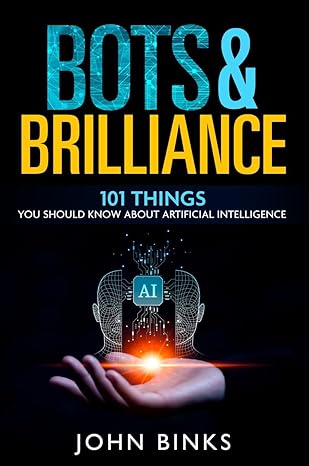
John Binks’ Bots & Brilliance is a crash course in artificial intelligence that reads like a lively conversation rather than a textbook. The book walks readers through 101 essential things to know about AI, from its history and daily applications to its ethical dilemmas and future possibilities. Whether you’re an AI newbie or someone with tech chops, Binks keeps things engaging with humor, real-world examples, and just enough technical depth to make you feel smarter without overwhelming you. It’s part explanation, part think-piece, and an enjoyable ride through the ever-evolving world of AI.
One of the standout features of this book is its knack for making AI accessible. The early chapters, like “AI, A Love Story” and “AI for the Complete Beginner,” strip away the intimidating layers of AI and present it as something we already interact with daily, such as smartphones, streaming services, and even online shopping. Binks compares AI to a “super-smart parrot” that mimics, learns, and sometimes surprises us, a metaphor that sticks. He also dispels common AI myths grounding the discussion in reality without killing the excitement. This approach makes the book perfect for readers who might be curious about AI but don’t want to wade through pages of technical jargon.
The book shines brightest when it explores how AI is already shaping our lives. The chapters “AI in Your Daily Life” and “AI at Work” are packed with examples of how AI is seamlessly integrated into everything from social media feeds to financial markets. Binks’ take on AI-powered streaming recommendations had me chuckling, he describes Spotify’s algorithm as a “magical music cauldron” that somehow knows you better than your best friend. The way he blends humor with insight keeps things engaging, and his examples make you realize just how deeply AI is embedded in everyday experiences.
Binks also doesn’t shy away from the darker side of AI. In The Dark Side of AI, he delves into bias, job displacement, privacy concerns, and the looming question of AI ethics. These are serious issues, but Binks presents them in a way that feels like a necessary reality check rather than fear-mongering. His discussion of AI bias, where AI can inherit and amplify human prejudices was especially eye-opening. He makes a strong case for why ethical oversight is crucial and why we can’t afford to let AI develop unchecked. This section adds depth to the book, making it more than just an AI enthusiast’s handbook, it’s also a call for responsible innovation.
In the end, Bots & Brilliance is a fantastic read for anyone curious about AI, whether you’re a beginner or someone who wants to connect the dots between tech and real life. It’s especially great for professionals trying to grasp AI’s impact on their industries without getting lost in tech-heavy explanations. If you want a book that makes AI feel less like a sci-fi concept and more like an everyday reality, while keeping you entertained, this one’s a solid pick.
Pages: 168 | ASIN : B0CVGP852J
100 Livestreaming & Digital Media Predictions, Volume 4
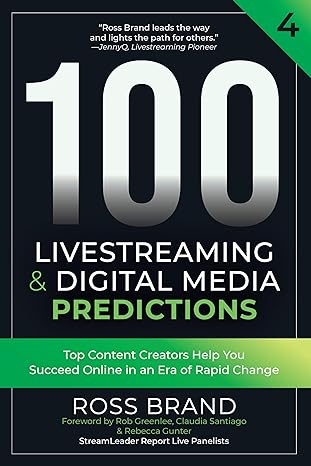

Ross Brand’s 100 Livestreaming & Digital Media Predictions brings together over 100 experts to provide a comprehensive guide for content creators navigating the rapidly evolving digital media landscape. This book is both timely and relevant, serving as a roadmap for the future of live streaming and digital media. It offers a wide range of predictions on emerging technologies, changing consumer behaviors, and innovative content strategies.
One of the book’s standout features is its authoritative stance on the controversial topic of AI. In an era where discussions about AI are highly divisive, the book’s balanced approach addresses both ethical and practical concerns, ensuring readers are well-informed about the benefits and potential pitfalls. This nuanced treatment of AI lends the book a credible and authoritative voice in the ongoing discourse.
The diversity of perspectives included in this book is another significant strength. Ross Brand has curated insights from across the digital media spectrum, from live streaming and podcasting to email marketing and community building. This comprehensive approach provides a well-rounded view of the industry’s collective opinion, enhancing the book’s credibility. The book features a variety of voices, each contributing unique insights. For example, Laura Clapp Davidson and Marisa Cali discuss the potential of micro-content, while Ross Quintana predicts a shift in advertising from traditional channels like TV to platforms like YouTube, alongside discussions on Web3 and VR/AR experiences. Bryan Kramer, on the other hand, highlights the enduring effectiveness of email marketing newsletters, particularly in an era of increasing privacy concerns and restrictive social media algorithms. While the book is rich in predictions, opinions, and discussions, its sheer variety offers a wealth of knowledge. I do feel that bit more thematic organization could enhance readers’ ability to digest the information seamlessly.
Ultimately, this book will open readers’ minds to a world of possibilities and re-energize their creativity. 100 Livestreaming & Digital Media Predictions reads like a captivating fairy tale rooted in reality, blurring the line between the two. It provokes thought and conversation about technology, its implications, and the opportunities the future holds.
Pages: 232 | ASIN : B0CSBCQSZR
Compiled by Ross Brand, an on-air personality and consultant for leading live video brands, this latest volume in our award-winning series (with 25 book awards to its name) is more than just a collection of predictions; it’s a roadmap to mastering the digital realm in 2024 and beyond.
Within these pages, 113 expert contributors, including Emmy winners, renowned YouTube influencers and Hall of Fame podcasters, share their foresight. They delve into how AI is redefining content creation, offering both foundational advice and groundbreaking strategies. From exploring AI’s role in enhancing productivity to addressing fears of losing authenticity, this book tackles the pressing questions every creator and entrepreneur faces:
What are the essential tools to integrate AI into your work?
How can AI be leveraged to maximize efficiency without sacrificing creativity?
What are the pitfalls of AI in digital media, and how can you navigate them?
How can you maintain a genuine connection with your audience in an AI-driven world?
“100 Livestreaming & Digital Media Predictions, Volume 4” isn’t just a window into the future; it’s a treasure trove of insights from industry leaders. You’ll find exclusive predictions that shed light on emerging trends and practical pathways to navigate the complex interplay of AI and human creativity. Whether you’re a seasoned creator or just starting, this book equips you with the knowledge to thrive in the dynamic digital media frontier.
Critics and peers alike praise the “100 Predictions” series for its depth, accuracy and utility. As the fourth installment, this volume continues the tradition of excellence, offering a unique blend of expert opinions and actionable advice.
Embark on a journey through the converging paths of AI and human ingenuity. Let the insights of seasoned experts arm you with the tools to not just anticipate the future but to shape it.
GET IT NOW and be part of the vanguard shaping the digital media landscape in 2024 and beyond.


