She’s Next


Sophie Sartain’s She’s Next is a memoir of memory, grooming, secrecy, and the long process of understanding what happened when a trusted teacher crossed a line with a teenage student. Sartain was sixteen when her thirty-two-year-old English teacher, Cissy Lewis, initiated sexual contact with her, beginning an entanglement that would shape years of her life. Three decades later, Sartain sets out to confront that history, not with a tidy explanation already in hand, but with questions. Was she the only one? What did the adults around them see? What did the schools know? And what happens when the person who once controlled the story no longer gets to define it? The book begins with two anonymous letters condemning Sartain for speaking up, then answers them with nearly two hundred pages of carefully reconstructed experience.
What makes the memoir so absorbing is Sartain’s ability to recreate the world in which the abuse took hold. Her Dallas childhood, the rituals and social codes of an elite girls’ school, the pressure to be accomplished and agreeable, and the peculiar intensity of adolescent teacher worship all become part of the story. She writes with a filmmaker’s eye for telling detail: penny loafers, school uniforms, blue Toyota Corollas, Christopher Cross on a Walkman, grand tours of Europe, long phone calls, handwritten letters, and the carefully maintained smiles of girls trained to be courteous. There’s humor here, too, often at Sartain’s own expense, and it keeps the book conversational even when the material turns harrowing. That tonal range matters. The teenage Sophie remains recognizable as a funny, ambitious, ordinary kid, which makes the gradual narrowing of her world around Cissy all the more disturbing.
The book grows into something larger when Sartain’s private reckoning becomes an investigation. She finds Miranda, the girl she remembers Cissy identifying years earlier with the chilling words that give the book its title, and discovers that their experiences follow the same pattern. Together they contact Cissy’s current school, setting off investigations, a resignation, renewed scrutiny of Sartain’s own alma mater, and difficult questions about how institutions respond when the harm is decades old but the consequences are still present. Sartain is especially good at showing how certainty arrives in pieces. An old letter establishes a date. Another survivor confirms a pattern. A former student remembers a boundary violation. A school responds well, then another response raises new questions. The memoir doesn’t reduce recovery to a single confrontation or revelation. It shows knowing as an accumulation, and it shows how speaking becomes possible when one person’s memory is finally met by another person saying, in effect, yes, me too.
By the end, She’s Next has become a book about reclaiming authorship in the broadest sense. Sartain examines the shame she carried, the family relationships that survived and changed, the institutional language that both acknowledges and obscures, and the strange permanence of a formative trauma that can lose its grip without disappearing. Even the book’s recurring images of handwriting become meaningful: once a sign of how completely Sartain had absorbed Cissy’s influence, later evidence that the past can be examined. The closing movement, including Miranda’s letter, gives the memoir a sense of connection. Sartain hasn’t written a story in which the past gets erased. She’s written one in which the person who lived through it finally gets to name it. She’s Next turns private memory into public reckoning, and gives the survivor the final word.
Pages: 201 | ADIN : B0H92DB5TZ

Hijacked
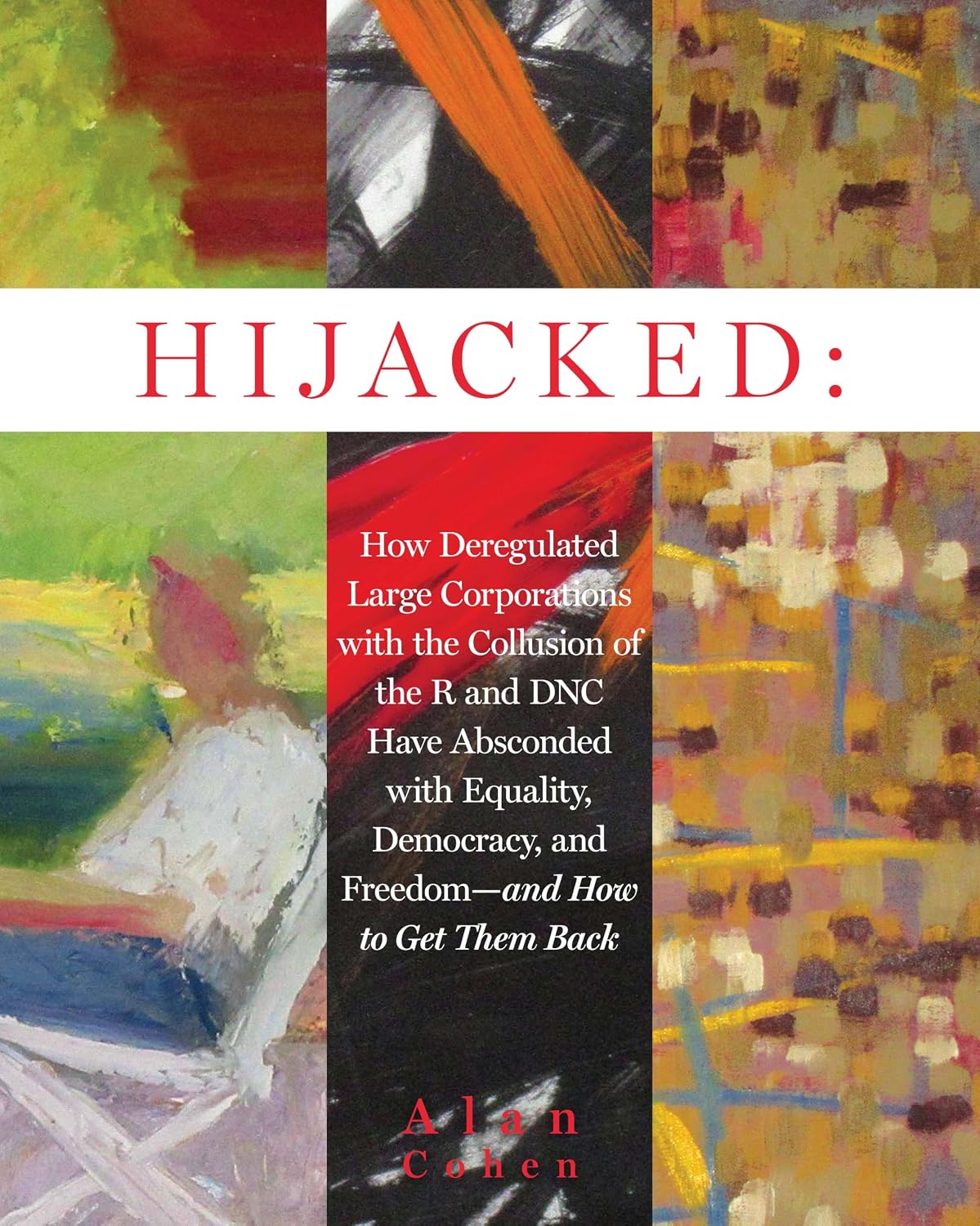

Alan Cohen’s Hijacked: How Deregulated Large Corporations with the Collusion of the R and DNC Have Absconded with Equality, Democracy, and Freedom, and How to Get Them Back is an ambitious work of political and economic criticism built around a straightforward concern: who actually exercises power in the United States, and who benefits from it? Cohen argues that over roughly the past fifty years, large corporations and wealthy interests have gained increasing influence over government while ordinary citizens have lost economic security, political influence, and equality of opportunity. He approaches this subject as someone who believes strongly in capitalism but also believes capitalism requires active government oversight to remain competitive and socially useful. The result is a book driven less by party loyalty than by Cohen’s conviction that concentrated economic power has distorted both major political parties. He describes the book as a selective introduction drawing together hundreds of sources on inequality and corporate behavior, and that description captures its character well. It’s essentially a very large argument assembled from history, economics, politics, journalism, and case studies.
One of the book’s most effective choices is to begin by asking what inequality actually means and how much of it a society should accept. Cohen acknowledges that differences in ability, responsibility, effort, and circumstance will naturally produce some inequality. His deeper concern is equality of rights, opportunity, treatment under the law, political influence, and access to economic security. From there, Hijacked builds its central case that markets don’t operate independently of government. Laws establish everything from minimum wages and bankruptcy procedures to union rights, taxation, corporate charters, environmental standards, and financial regulations, so political decisions inevitably shape economic outcomes. Cohen argues that decades of deregulation have steadily changed those rules in favor of large corporations and wealthy individuals. This historical framework is important because it keeps the book from treating present-day inequality as an isolated problem. Cohen places it in a much longer struggle between concentrated wealth and democratic power, moving through ancient societies, the American founding, the rise of corporations, the Gilded Age, the New Deal, postwar prosperity, and the turn toward deregulation beginning in the late twentieth century.
The middle of Hijacked is where its scale really becomes apparent. Cohen moves through pollution, climate change, corporate welfare, military contracting, privatization, food production, medicine, pharmaceuticals, finance, law, housing, education, the arts, retail, transportation, privacy, labor, media, science, and other parts of everyday life. His purpose is cumulative. He wants readers to see these subjects as connected expressions of the same underlying problem. The section on corporate welfare is especially revealing of his method. Cohen surveys tax advantages, subsidies, contracts, bailouts, bankruptcy protections, liability protections, failures of regulation, and other mechanisms that he believes transfer wealth and risk from the public to large corporations. From there he turns to what he calls the destruction of businesses, institutions, and professions, examining how corporate consolidation can alter the priorities of industries that once operated according to professional, civic, or local values. Reading these sections can feel like moving through an enormous case file. Cohen is interested in accumulation, patterns, and connections, and the sheer number of examples is part of his argument.
Cohen writes with urgency and with a strong personal point of view, so readers are rarely left wondering what conclusion he wants them to draw. At his best, he takes subjects that are usually discussed separately and makes their relationships easier to see. A discussion of deregulation leads naturally into corporate influence, which leads into campaign financing, regulatory capture, weakened professional independence, and growing inequality. He also spends considerable time challenging what he considers misleading cultural narratives about free markets, government, taxation, privatization, corporate efficiency, upward mobility, and the political identities of the two major parties. His style is closer to an extended civic argument than a detached academic study. That gives Hijacked energy, but it also means the reader is continually being asked to evaluate Cohen’s interpretation of a very large collection of evidence. The book rewards an engaged reader who’s willing to follow hundreds of examples and pause occasionally to consider where the evidence is strongest, where a conclusion is more interpretive, and how the pieces fit into the broader thesis.
I think Cohen wants Hijacked to produce political action. His proposed answer is an alternative party organized around what he repeatedly calls government “of, by, and for the people,” with reducing inequality and limiting concentrated corporate power as its central commitments. He argues that reform efforts in health care, environmental protection, labor rights, education, voting rights, and numerous other areas keep encountering the same political obstacles, so people working on separate causes would gain more by joining forces to change who controls government. Whether readers embrace that solution or reach a different conclusion, the book makes clear why Cohen believes structural political change has to accompany economic reform. I’d recommend Hijacked most strongly to politically engaged readers who are interested in economic inequality, corporate power, regulation, American political history, and the relationship between capitalism and democracy. It will especially appeal to readers who enjoy big-picture nonfiction that gathers material from many fields and tries to turn it into a single explanation of how contemporary America got where it is. Even when readers disagree with Cohen, there’s plenty here to argue with, think about, and investigate further.
Pages: 628 | ASIN : B0H8W5SMSX
The First Law of Survival (We Have a Few More)


Magnus Baikie’s The First Law Is Survival (We Have a Few More) is a sprawling historical fantasy novel that drops Roman-inspired military culture, Celtic kingdoms, Huns, dwarves, winged Anemoi, witches, assassins, and powerful wizards into one deliberately remixed ancient world. Baikie openly embraces the historical liberties, using the familiar framework to get straight to the people, politics, battles, and schemes. At the center is Marcus d’ Ostia, an orphanage-trained young officer whose talent for engineering and strategy keeps putting him in situations where the odds are terrible and somebody has to come up with a plan. Around him grows a large cast whose loyalties, promises, rivalries, and friendships eventually connect military campaigns, Imperial succession, organized crime, assassination, and the return of the Hun threat.
What gives this historical fantasy its personality is the rotating first-person narration. Baikie moves among soldiers, criminals, royalty, dwarves, Anemoi, Celts, Magyars, Huns, and others, sometimes changing narrators inside a chapter, so major events are often seen from several very different angles. That structure turns what could have been a straightforward military adventure into something much more character-driven, which was also the author’s stated intention. Marcus’s dry practicality plays especially well against Septimus’s criminal charm, Timolen’s unsettling competence, Mistral’s temper and loyalty, and the ruthless ambition of Krekka. The humor comes naturally from those personalities. Even when armies are being destroyed or someone is plotting a murder, there’s usually a sarcastic observation, an argument over rank, or a character quietly realizing that another supposedly brilliant plan is probably going to get everyone killed.
The novel is also very much military historical fantasy, with sieges, battlefield tactics, Legion politics, engineering, logistics, magic, and command decisions forming a huge part of the story. Fort Edge establishes that approach early, but the scale keeps increasing through the Celtic campaign, the struggle over the Imperial succession, the siege of Ynys, and the Hun invasion. By the later chapters, political intrigue and warfare are tightly intertwined, so victories on the battlefield matter just as much as what happens in the Senate, the Palace, or the back streets of Subura. The book’s strongest recurring idea is contained in those COB Laws introduced near the beginning: survival matters, but so do loyalty, family, promises, and protecting the people you’ve decided are yours. Those rules start as the rough code of abandoned boys and gradually become a moral framework for decisions that affect an entire empire.
The First Law Is Survival (We Have a Few More) has the scope of epic historical fantasy, but its voice stays informal and quick on its feet. Baikie favors conversation, tactical problem-solving, and character interaction over long scenic description, so the story keeps moving even as the cast and stakes expand. The ending pays off relationships and promises that have been developing since the early chapters, while the epilogue keeps the book’s mischievous streak alive and suggests that power, ambition, and trouble will continue in this world. Readers who enjoy historical fantasy novels with large casts, Roman-style Legions, military strategy, political maneuvering, magic, dark humor, and found-family bonds will find plenty to dig into here. It’s an ambitious, energetic story that treats empires and wars seriously while still letting its characters be funny, stubborn, dangerous, affectionate, and wonderfully human.
Pages: 474 | ASIN : B0HB5XT2VL

Blood of a St. Claire

Blood of a St. Claire starts with a wonderfully small warning sign: Evan St. Claire knows his father is lying because the family is eating off the good plates. From there, the story keeps widening. What begins as a teenager grieving his mother and wondering why his father is acting strangely turns into a supernatural crime thriller involving murder, organized crime, buried family history, possession, and a curse that has followed the St. Claire bloodline for generations. The book moves quickly, and it has an easy, conversational style that makes even its darker material surprisingly readable. Evan’s sarcasm, Mason’s relentless jokes, and Heather’s dry responses give the story personality without draining the danger out of it.
The heart of the book is Heather and Evan. The supernatural mythology gets increasingly elaborate, but their relationship gives all of it somewhere to land emotionally. Heather has spent years carrying guilt over what their father trained her to become, while Evan has to reckon with memories, violence, and family truths that were deliberately taken from him. Their father, Henry, works especially well as an antagonist because his idea of family is inseparable from ownership. He treats blood as destiny, while the siblings gradually learn to treat it as something they can interpret for themselves. That makes the book’s central question more interesting than simply whether a curse can be broken. It’s really asking how much power an inheritance should have over the person who receives it.
The blend of family horror, dark humor, and supernatural chaos reminded me most of Grady Hendrix, particularly How to Sell a Haunted House. Hendrix also likes putting messy, believable family relationships in the middle of increasingly outrageous paranormal situations, then using humor to keep the characters human when the horror gets intense. Blood of a St. Claire has a similar instinct. Mason can make a joke while half-dead, Heather and Evan can bicker in the middle of a crisis, and those moments help the characters feel like people who knew each other before the plot started. The St. Claire mythology is more crime-driven and sprawling than Hendrix’s usual setup, though, with mob connections, secret properties, old institutions, murder investigations, and generations of supernatural history all feeding into the same family story.
I enjoyed the way the ending brings the book back to ordinary life. After everything the St. Claire name has represented, Evan and Heather don’t need to destroy it or worship it. They get to decide what it means now. The final image gives the story a satisfying emotional resolution because it turns survival into something quieter than victory. Blood of a St. Claire is a fast, twist-heavy supernatural thriller, but its strongest idea is surprisingly intimate: family history can explain you, haunt you, and hurt you without getting the final say in who you become.
Pages: 547 | ASIN : B0BW7N6856
When Darkness Falls: The Trilogy

When Darkness Falls, by Alliie McCormack, is an expansive romantasy trilogy built around one irresistible idea: a young woman who has spent her life simply surviving arrives in a desert city determined to make a home for herself, only to discover that she’s connected to powers far older and stranger than she ever imagined. Alyssa’s arrival in Al Khair sets everything in motion, from her unlikely appointment as Royal Scribe to the Sultana to the awakening of Damien, the ancient vampire and demon known as the Dark Lord. What makes the story so inviting is that McCormack gives Alyssa time to fall in love with her new life before the larger supernatural story closes around her. We experience the markets, baths, palace, Library, oasis, and crowded streets through someone who’s genuinely delighted to have a room of her own, money in her pocket, meaningful work, good food, books to read, and people who care whether she comes home safely. That simple hunger for belonging gives the entire trilogy its emotional foundation.
Al Khair is wonderfully suited to this kind of story because it feels like a place where the ordinary and fantastic have learned to live next door to each other. Vampires inhabit the Catacombs beneath the mountains. Magi study and advise the Sultana. Demons, Djinn, shapeshifters, healers, gypsies, merchants, guards, craftspeople, servants, and courtiers all become part of an increasingly interconnected community. McCormack has fun with the practical side of that world, too. Supernatural beings have laws, rivalries, customs, prejudices, political responsibilities, and domestic routines. A Dark Lord who inspires terror can also find himself worrying about furniture, horses, libraries, shopping trips, and whether Alyssa is happy. Those contrasts give the trilogy much of its personality. There’s plenty of magic and danger here, but there are also friendships, teasing conversations, shared meals, palace gossip, books being shelved, carpets being coveted, and a memorably ill-tempered peacock named Alphonse.
At the center, though, is the evolving relationship between Alyssa and Damien. It begins in fear and misunderstanding, with Damien hunting for the mysterious power disturbing his domain and Alyssa having no idea that she’s the person he senses. Their relationship changes substantially over the three books as fascination becomes attachment, protectiveness, desire, trust, and eventually love. Damien is possessive, imperious, ancient, and frighteningly powerful, while Alyssa has a stubborn moral center that keeps her from being swallowed by the force of his personality. Some of their best moments come when she simply refuses to be intimidated by the Dark Lord everyone else fears, scolding him, teasing him, questioning his assumptions, and quietly forcing him to reconsider what he thinks he knows about humans and Others. Their romance works alongside Alyssa’s own awakening, because falling in love with Damien is only one part of her transformation. She’s also uncovering the truth about herself, her lost family, her unusual magic, and why fire has always held such a complicated place in her memories.
The trilogy grows naturally in scope as those personal mysteries become political ones. What begins with one impoverished traveler seeking employment eventually encompasses vampire law, human and Other relations, conspiracies, refugees, rogue vampires, a threatening army, an ancient prophecy, and the revelation of Alyssa’s Djinn heritage. The supporting cast gives that widening story real warmth. Zahira is a capable Sultana whose responsibility to her people feels personal. Nicholas becomes teacher, protector, investigator, and friend. Kayja brings sharp humor and a delightfully unsentimental demon perspective. Remi is chaotic, affectionate, and impossible to forget, while characters such as Aleksei, Kaylee, Azim, Melisande, Jamal, Malikai, Salima, and Aseel gradually make the world feel populated by relationships. By the time the Great Horde approaches Al Khair, the coming battle matters because the trilogy has spent so much time showing exactly what these characters are fighting to preserve.
What stayed with me most is the way When Darkness Falls keeps returning to the idea of chosen home. Alyssa comes to Al Khair believing that a job and a room might be enough to give her a life, then discovers something far larger: friendship, purpose, love, family, power, and a community broad enough to include humans and supernatural beings alike. Even the prophecy ultimately feels less like a mechanism of fate than a recognition of what Alyssa and Damien have already accomplished by bringing different worlds together. McCormack blends fantasy adventure, paranormal romance, court life, found family, humor, and supernatural politics into a trilogy with a generous heart and a heroine whose joy in discovering where she belongs is genuinely infectious. When Darkness Falls is a richly imagined fantasy romance trilogy where darkness has wings, fire has a lineage, and belonging becomes the most powerful magic of all.
Pages: 839 | ASIN : B092T3CFCR
Rhythm and Flow

Ceylon Moon is a reflective poetry collection exploring memory, dreams, aging, identity, nature, and the search for meaning in a finite life. You organize the collection into five sections exploring childhood, dreams, sanity, nature, and aging. How did you decide on that structure?
I approach organizing how my poems are presented once I reach ~ 30 publishable poems. The organization is based largely on how the poems were written: as part of a project based on my interests, or those arising spontaneously based on an impression or mood. For example, in Ceylon Moon, the poems of “With [In] Sanity” and “The Voices” were projects in which the poems were created after months of study or observation. In contrast, the poems in “What The Night Holds” were more spontaneous in nature: triggered by an image, an idea floating through my mind, or my infatuation with another poet’s work. For example, “The Owl in Our Dreams” was prompted by Philip Lamantia’s enigmatic poem “The Owl.” When enough poems are written, they often coalesce around a common theme. When poems don’t fit into a specific theme, I categorize them under a vague title (eg., “Moods and Musings”).
Dreams are a recurring theme throughout the collection. How do your dreams influence your writing and understanding of yourself?
It’s important to understand that dreams emanate from the emotional (“mammalian”) centers of our brain (ie., the Limbic system). Our animal nature models our world and lets loose neural phantoms inside our mind. These phantoms speak through our higher (cerebral) functions of symbolism, language, vision, and explicit event memories. This is what stirs our sleep with important shards of meaning, as well as insights that evade our waking life. Such insights are not pronouncements about who we are. Rather, they reflect our unfiltered feelings, concerns, and struggles. And sometimes, they provide lucid insights into others we evade through rationalizations. Ones created to maintain a tenuous relationship.
I’ve studied my dreams for 40 years, and have come to know myself with greater clarity by doing so. I believe dreams and poetry travel the same pathways in the mind: one by night and the other by day.
Music, paintings, landscapes, and memories often intersect in your poems. How do different art forms influence your poetry?
Rhythm and flow are dominant in how I write poetry because I’ve been a drummer since I was 10 years old, and rhythm pervades my daily life. Poetry and song have had an intimate relationship since antiquity, and as a lifelong musician, that’s where I belong as a poet.
In terms of the visual arts, I’ve loved paintings since I was a child, implicitly recognizing them as W.H. Auden’s Secondary Worlds (our enchanted, sacred world of imagination). I began to notice the relationship between poetry and painting after years of discussing art with my friend, the artist Martha Diaz (who created the artwork for Ceylon Moon: Martha Diaz Fine Art).
Both painting and poetry attempt to induce a sense of immediacy for the experiencer. Both forms draw us into their world without necessarily understanding why. Only that their immediacy exudes something that is deliciously enticing, finally, it’s important to spend time with an image as well as a poem. To look at an image is an activity, rather than seeing (a physiological perception) and walking by. Similarly, glancing through a poem is like walking past a painting. We (including myself) need to spend time with a poem. Coming back to it again and again. Often there are layered meanings to be discovered and coveted.
If you could have readers carry one idea from Ceylon Moon into their own lives, what would it be?
I would simply say take to heart D.H. Lawrence’s observation: An act of pure attention brings its own answer. That has been the foundation of every poem in this collection. It’s how I struggle to evade my chattering mind. To dwell for a moment or two or four on all the beauty and richness of life that surrounds us and sometimes passes by¾like the smiling toddler without his stroller who turned around my hollow day (the poem “Becoming”).
Author Links: GoodReads | Website | Amazon
What the Night Brings are a series of poems delving into the nature and vagaries of our dreams. The many unsettled aspects of dreaming is extended into the next section “With Insanity” (or “Within Sanity”) explores” the near thin edge” that separates our uncomfortable ideas about what actually constitutes sanity, insanity, and what lies in between.
The Voices are six Rilkean poems in which Gedaliah assumes the personas of non-sentient nature (eg. clouds, mountains, trees, etc.) to explore what it is that resonates within us that draws us to them. The collection closes with All That is Worn and Torn (from the last poem in Rilke’s The Sonnets to Orpheus) explores the inevitable decline and closing of our own life and what solace and wisdom we might take away at the end.
The series of poems rises above the fear and despair it describes to reach for a higher position or acceptance, gratitude and love for the journey we’ve taken. Even for those who believe (like the author himself) that there is nothing more than what we hold no longer. The poetry of Ceylon Moon is consistent with his previous books in that they confront the darkness and chaos but do not wallow in despair, but shines a light upon all that makes life worthwhile that is found in the closing poems Because My Time is Limited and What is Life?


