Blog Archives
The Chemist Whisperer


The Chemist Whisperer is George Kesic’s memoir of becoming an unlikely activist after the COVID years shook his trust in government, medicine, media, and public obedience. The book moves from the grief of losing his mother, Anka, into his work with Forest of the Fallen, then into the repeated pharmacy visits that give the book its title, where he delivers cease and desist notices, questions pharmacists about informed consent, and records thirty encounters that range from hostile to strangely tender. At its heart, this is a book about conscience under pressure, about one man deciding he’d rather risk being mocked, dismissed, or “banned for life” than live with the ache of having done nothing.
Kesic writes with a bruised sincerity that often feels less like political commentary and more like someone trying to make sense of a wound that never quite closed. The scenes with his mother give the whole book its pulse. Her “Keep going, son” becomes more than a family phrase; it becomes the engine of the memoir. I found the Forest of the Fallen chapter especially affecting, with those laminated pages on bamboo stakes fluttering on the beach like private grief made public. That image carries more force than some of the louder passages because it lets silence do the work. The book is at its strongest when Kesic slows down and lets people become human: the pharmacy worker who quietly admits she was injured after taking the shots to keep her job, the security guard who privately tells him he didn’t get them either, the rare pharmacist who actually listens and says they’ll stop giving COVID vaccines to children.
The writing has a raw, insistent rhythm, sometimes almost sermon-like, with short lines, repetition, and a steady drumbeat of moral urgency. The cadence gives the book momentum, and Kesic has a gift for turning a small exchange into a larger reflection on obedience, denial, or fear. The strongest ideas here are not necessarily the most sweeping claims, but the more intimate ones: that informed consent matters, that professionals shouldn’t hide behind “just following orders,” that grief dismissed becomes another injury, and that ordinary people can be changed by the act of standing up. Even when I wanted more restraint, I could feel the moral seriousness behind the anger.
By the end, I felt I’d read a memoir of resistance as much as a record of pharmacy encounters, one shaped by mourning, stubbornness, faith in personal courage, and a deep suspicion of institutions that failed to speak plainly. I found it personal, forceful, and often unexpectedly moving. The shift toward joy, gratitude, stillness, and living freely softens the book in a way I appreciated, as though Kesic knows outrage alone can’t sustain a life. I’d recommend The Chemist Whisperer to readers interested in pandemic-era dissent, personal conscience, medical freedom debates, and memoirs where private grief becomes public action.
Pages: 217 | ASIN : B0GG4M5BG4

Emotional Fabric

When the World Held Its Breath follows a family whose comfortable day-to-day lives are turned upside down when COVID rears its ugly head and threatens everything they hold dear. Did you begin with the idea of a pandemic novel, or with the emotional arc of a family under pressure?
I began with the emotional arc of a family under pressure rather than the idea of writing a pandemic novel. The pandemic was the circumstance — the crucible — but the heart of the story has always been about family. I have always believed deeply in the strength of family bonds. In my experience, when love within a family is genuine and resilient, it becomes a shield against even the harshest crises. That strength is not accidental; it is nurtured daily, often quietly, and very often by wives and mothers who hold the emotional fabric of the household together.
When my wife and I contracted COVID-19, we experienced firsthand how fragile life can suddenly feel. Those were frightening days. Yet what stands out most in my memory is not only the illness, but the way our family rallied around us — offering encouragement, support, and unwavering presence. Their strength carried us through. That lived experience shaped the novel. I used the pandemic as the backdrop, but the true focus of When the World Held Its Breath is what happens inside a family when external forces threaten to tear it apart — and how love, when it is strong enough, can hold everything together.
What was the most challenging part of writing Laura’s ICU storyline?
The most challenging part of writing Laura’s ICU storyline was balancing medical accuracy with emotional authenticity. I spent a great deal of time researching the progression of severe COVID cases — the stages of respiratory decline, the medical interventions, the terminology — because I wanted the portrayal to feel real without becoming clinical or detached.
But research was only one part of the challenge. The deeper difficulty lay in writing the scene where the doctor explains Laura’s worsening condition and prepares Harrison for the possibility of losing her. That conversation had to carry immense emotional weight. It needed to feel devastating, yet restrained. Honest, yet not melodramatic. David’s reaction in that moment was especially complex to write. I rewrote those passages many times because I did not want the medical explanation to interrupt the narrative flow or feel like an informational pause. It had to remain part of the story’s emotional current — not a break in it.
Ultimately, the challenge was ensuring that the ICU scenes did not simply describe illness but conveyed what it feels like when hope begins to slip and a family is forced to confront the unimaginable.
What conversations are you hoping to spark about misinformation and trust during trying times?
One of the conversations I hope to spark is about how fear alters the truth. During times of crisis, uncertainty creates a vacuum, which is often filled by speculation, misinformation, and narratives that promise simple answers to complex realities and sometimes, made-up narratives.
In 2020 and 2021, when fear was widespread and information was evolving daily, many people turned to social media not just for updates but for reassurance. Unfortunately, it was and is fertile ground for doubt, rumor, and conspiracy theories. What fascinated me — and concerned me — was how quickly these narratives spread and how deeply they influenced trust: trust in institutions, in science, and even within families.
The novel touches on these tensions because misinformation does not remain abstract. It enters homes. It shapes decisions. It strains relationships. I hope readers will reflect on how we determine what to believe in moments of uncertainty — and how we can protect both truth and human connection when they are under pressure. The book is not about judging anyone; it is about examining how fragile trust can become when fear dominates the atmosphere.
Can we look forward to more work from you soon? What are you currently working on?
Yes, I am currently working on my next novel, and I’m deeply excited about it. While it is still taking shape, it explores a timely and thought-provocative theme that reflects the complexities of the world we live in today. Much like When the World Held Its Breath, it will focus on human relationships, emotional resilience, and the choices people make under pressure.
Without revealing too much, I can say that it examines differences that divide us — and the deeper commonalities that ultimately bind us together. I believe it will spark meaningful conversation and, I hope, resonate strongly with readers across cultures and generations.
Author Links: GoodReads | Amazon

As COVID-19 transforms from distant news to deadly reality, the Harrisons retreat behind their doors, believing caution will keep them safe. The lockdown forces them into unprecedented proximity—four people confined together, stripped of their escape routes to work, school, and social life. Tensions simmer as David’s work pressure intensifies, and Laura must balance her work with the family’s well-being. The teens chafe against restrictions, and small irritations magnify into explosive conflicts. The question was not whether they could survive the virus. The question was whether they would survive each other.
But then Laura catches the virus, and within days, she’s fighting for her life on a ventilator, her family separated by a glass partition, helpless to reach her.
David faces immense pressure and impossible choices: saving his company versus his wife in the hospital, maintaining his ethics versus corruption that offers easy solutions, and being a father, taking care of the children, when he’s barely holding himself together. Ultimately, David broke down. Seventeen-year-old Ethan and fourteen-year-old Sophie watch their invincible parents crumble, growing up overnight as their world collapses around them.
But their ordeal has just begun. When Laura finally wakes up, she doesn’t recognize her family. Her memory is gone, scattered like puzzle pieces, and she must painstakingly reassemble it. In this crisis, it’s the family bond that keeps them together.
“When The World Held Its Breath” is an intimate portrait of one family’s journey through COVID-19, America’s darkest modern crisis. This story explores love tested by unimaginable circumstances, highlighting a nation discovering its capacity for indifference, selfishness, and extraordinary generosity. It also shows ordinary people learning that resilience isn’t about being unbreakable, it’s about helping each other in crises.
Rich with authentic detail and emotional depth, this novel captures not just what we endured during the pandemic, but why and also who we became because of it. For anyone who lived through those terrifying months, this is the story of how we found our way home—and how America, despite losing more than a million lives to initial missteps, ultimately rose to the occasion and helped the world control the pandemic.
When the World Held Its Breath
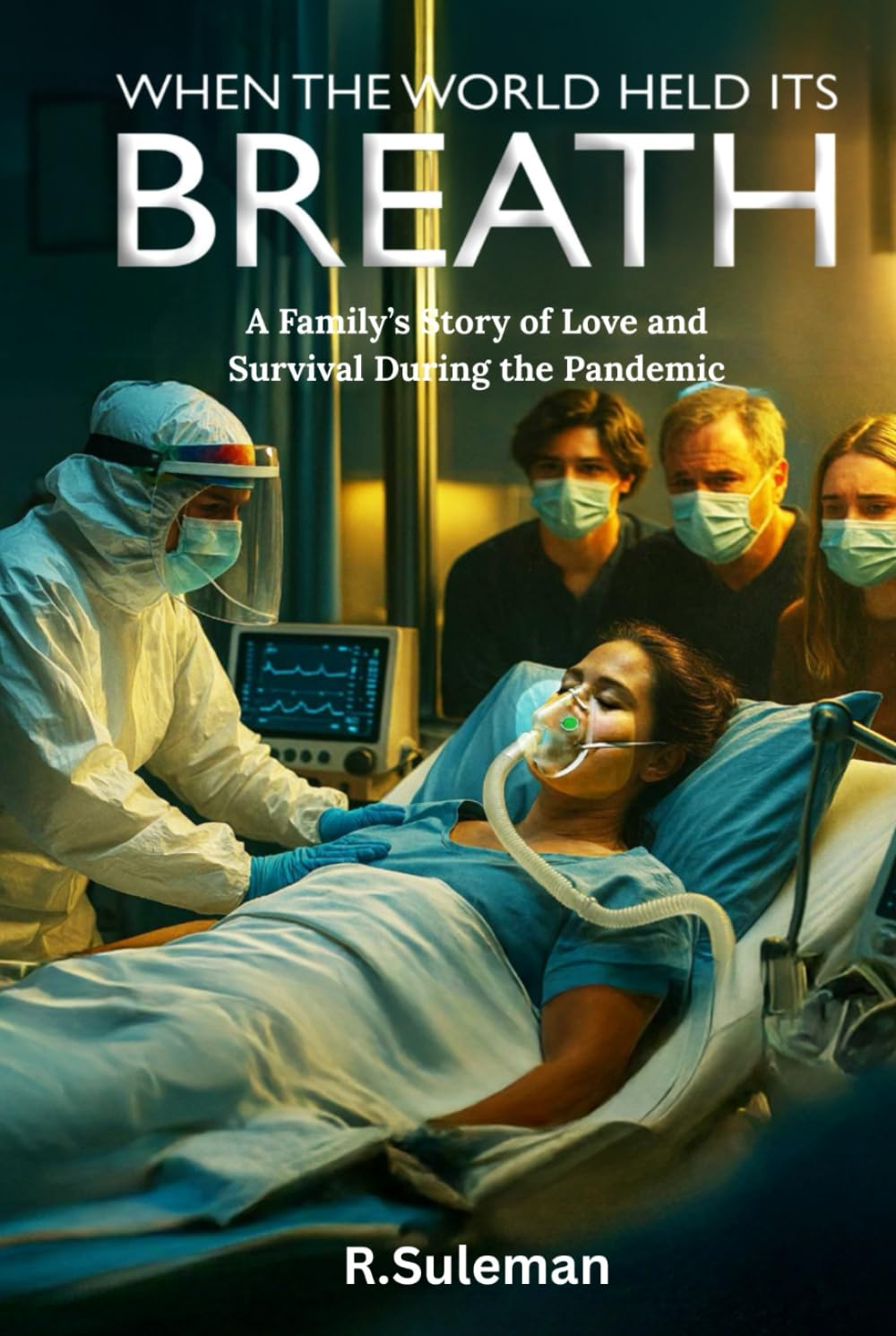
In When the World Held Its Breath, author R. Suleman tells a sweeping, close-to-home story about the Harrison family as COVID moves from distant headlines to a force that reshapes everything they thought was stable. We start with their comfortable suburban rhythm, work pressures, teenage drama, and the sense that life is busy but manageable, and then we watch that “manageable” feeling crack under lockdowns, fear, and the slow grind of uncertainty. The plot tightens around the family’s hardest stretch when Laura’s illness turns severe and she ends up in the ICU on a ventilator, leaving David and the kids in a kind of suspended, breath-held waiting room of dread and hope. By the end, the book moves toward recovery and aftermath, asking what “back to normal” even means when normal has been burned down and rebuilt. Genre-wise, this sits in contemporary family drama (pandemic fiction with a literary-leaning, emotionally driven core), and it will likely appeal to readers who liked the intimate, relationship-first approach of Wish You Were Here more than the big-society lens of Station Eleven.
I liked how committed the narration is to the day-to-day texture of a family under strain. It’s not chasing shock for shock’s sake. Instead, it keeps returning to small moments, arguments over school and responsibility, the way parents try to “be steady” even when they are scared, the way kids act tough until they don’t. There’s a steady, almost cinematic clarity in the opening domestic scenes, and that groundwork matters because later, when the world narrows to hospital glass and medical updates, you already know what’s at stake. The book sometimes leans into explanation, especially when it steps back to name what a moment “means” for society or history. That did not ruin it for me, but I did notice it. I found the story strongest when it trusted the characters to carry the emotion without summarizing it for me.
I also appreciated the author’s choices about what the book is and is not trying to do. It’s upfront that the Harrison family is fictional, and that the goal is the human response to crisis, not a clinical chronicle of the pandemic. That framing helps, because the novel keeps circling themes that feel painfully familiar: the illusion of control, the way privilege can soften the edges of life until something comes along that ignores status, and the way fear spreads faster than facts. I was especially struck by the recovery arc, not as a neat victory lap, but as a long, uneven rebuilding, with memory gaps, “brain fog,” and the strange tenderness of learning your own life again. And I liked that the book doesn’t dodge social fractures either, like vaccine distrust and misinformation, but it keeps those debates grounded in dinner-table conversations and personal consequences.
I felt the book had earned its quieter ending: a house full of people, a Thanksgiving gathering, a sense of gratitude that is not naive because it remembers exactly what it cost. I’d recommend this most to readers who want a family-centered, emotionally direct pandemic novel, especially anyone who lived through those years and is ready to look at them with clear eyes, or anyone who enjoys contemporary family dramas where the biggest battles are love, fear, and the effort it takes to keep showing up for each other. If you want a grounded story about how a crisis breaks a family open and then, slowly, helps stitch them back together, this one will land.
Pages: 380 | ISBN : 978-9699896361
Local Lives in a Global Pandemic

Local Lives in a Global Pandemic is a thought-provoking compilation of stories conveying the real-life experiences of the residents of North Central Florida. Readers get an honest look at what different residents of Florida experienced during the COVID-19 pandemic. The book includes interviews from an array of people, from a local inmate, to medical personnel, a retired resident and many more. Readers also see how these resident dealt with the loss of loved ones due to COVID-19, showing just how different our experiences were during the peak of the pandemic.
This illuminating memoir is a powerful read that took me on an emotional rollercoaster since we are all still recuperating from the pandemic. During the lockdown many of us felt alone, but reading this book showed me that we were all going through the isolation together. I enjoyed reading about the medical personnel and their thoughts and experiences since they were at the front line witnessing the affects of COVID-19 and putting their lives at risk. While some people finally found the time to take a break and reconnect with themselves, others were unfortunately separated from their friends and families and some even lost the lives of their loved ones. The constant state of isolation and agony was mutual and this book has preserved that struggle not only for the victims and survivors to read, but for future generations as well.
This is an evocative and relevant collection of true stories that will help readers work through the grief brought on by COVID-19 and sympathize with other individuals who suffered in different ways. Eloquent, emotional and elevating this is a collection of stories that must be told, should be heard, and opens your eyes to the kaleidoscope of pain that the pandemic brought to our lives. While this can be deeply emotional the stories also let us know that we are not alone, even when it feels like it.
Pages: 247 | ASIN: B09JYP7GWZ
You Find Out Who Your True Friends Are
The Covid Kid follows a young adult in his first year of college who has all his plans turned upside down with the emergence of COVID. What made you write a story about this topic?
The pandemic had such an overwhelming influence on us all. I simply could not ignore the impact on my upbeat protagonist, who always seems to come out okay in the end but never takes the straightforward path. Placing the most important person in his life at risk with COVID, under circumstances that might have been attributable to him, created suspense and concern for my readers.
Marshall’s plans for his first year of college change dramatically, and he has to adapt to many changes. What were some driving ideals behind your character’s development?
Boiled all the way down, it is a critical part of the maturation process from childhood to adult. Thankfully, most kids ease into adulthood without facing major trauma on the way, but they will have to deal with it at some point in their lives.
Marshall lived an admirable life with a sincere concern for others. I wanted to show that even the very best have problems, but his faith and perseverance won out in the end.
What were some themes that were important for you to explore in this book?
The pandemic was very serious business and should not be taken lightly, as it was by many young people. Marshall lost friends close to him and realized COVID must be dealt with seriously. Financial pressure can turn almost anyone to compromise their ideals and sworn allegiances, even a Hippocratic oath. When adversity rears its ugly head, you find out who your true friends really are.
What is the next book that you are working on and when will it be available?
My next book in the Marshall Morris series is “The Battle of Sam Jacinto”. (Yes, “Sam”) Marshall aligns himself with a group of old vets who rally with slingshots and baseball bats at the planned destruction of a Vietnam era local hero statue for a shopping center. In the process he forgets the proliferation of slavery advocated by many of the monuments and impact on his girlfriend African American Mallory. The one after that with a working title of “Hugs and Drugs” is about half written. Hopefully out in time for Christmas.
Author Links: GoodReads | Twitter | Facebook | Website
The devastating loss of senior citizen war veteran buddies who survived combat bullets, but not this bug, leads him to become grimly serious about the pandemic, and he rails against young people who refuse to take precautions. His worst fears are realized when his precious mother is struck down by the dread disease, which he is certain he gave to her.
Though she worsens in an ICU he is unable to visit. He tries to keep busy working at a struggling real estate company. The owner, desperate for cash, becomes the middleman. in a bizarre international scheme to inject a bogus miracle cure into COVID patients at a local hospital. Marshall is shocked to learn the surely fatal drug will be given to his mother. He must get to her ICU before it is too late. The hospital’s COVID ward is a fortress. Can he get to her in time?
The Covid Kid: Another Marshall Morris Adventure

Robert John DeLuca’s The Covid Kid follows the misadventures of Marshall Morris, who we encounter as a high school student embarking on his first year at college. Having won an enviable football scholarship, Marshall expects his college experience to be full of sport and socializing — yet the encroaching presence of an unfamiliar virus threatens everything. As fear and tensions surrounding the virus continue to build, Marshall must decide what sacrifices he is willing to make for the good of his friends and the wider community. In the face of worldwide tragedy and conflicting opinions, the value of friendship is made clearer than ever before — something that the carefree Marshall must learn the hard way.
With its warm and humorous cast of teenagers, alongside ambitious antagonist Tommy Kinder, The Covid Kid encourages its readers to laugh ruefully at the hijinks and efforts of its characters — efforts which frequently backfire. There is a vein of tragedy that runs alongside this comic adventure, however — set during the rise of Covid-19, this story does well at balancing fun action with thoughtful commentary.
While I enjoyed the story, I felt that there were moments when we’re given a lot of exposition, and are told things about characters rather than shown. Otherwise, Marshall is a likable character that readers will enjoy following and the plot is compelling. The dialogue is straightforward and and delivers facts in a reporter-style of speech that serves an educational purpose, as characters’ fearful discussion of the impact of the virus marks a particular point in human history.
The Covid Kid successfully explores the effects of Covid-19 on society, particularly the younger generation. This is a compelling medical thriller that is as enlightening as it is entertaining.
Pages: 284 | ASIN: B09XWFMPR3
There Will Be Another Pandemic

COVID-19 AFRICA, HAITI, AND THE U. S. VIRGIN ISLANDS helps separate the truth from myth and misinformation that has been rampant since the onset. What were your goals in writing this book?
The goal of writing this book was to start a conversation about the negative impact the denials and distortion of the COVID-19 deadly virus had on populations and countries at large. The COVID-19 outbreak will not be stopped for one fraction of a second by delusional denials, distortion, or ruse; instead, it will only be defeated by strictly unbiased measures that prevent its spread while at the same time allowing people to live productive lives.
China and some other more developed countries have been able to slow the spread of COVID-19 by acting objectively and enforcing proven effective measures such as lockdowns of homes and enforced closures of city and regional borders (known as cordon sanitaire). These measures, although stringent, are highly effective.
What are some takeaway you hope readers leave with after finishing this book?
The hard-core reality is that even if COVID-19 eventually goes dormant or the world’s populations reach protective herd immunity levels, there will be another pandemic, another epidemic that will rage out-of-control crosses borders, is spread by travelers, and becomes a pandemic. Epidemics and pandemics are part of our world. Travel and the transport and domestication of animals keep disease and vermin spreading throughout the world.
This means:
First, the only pragmatic solutions are to learn from past incidents, cull best practices from other countries, adopt them, and share knowledge, techniques, methodologies, and strategies.
Second, increase and guarantee funding (with accountability measures and enforcement processes) for PPE and medical equipment must be available.
Third, establish accountability measures to make sure data is gathered, reported, and corroborated honestly both within the country and with other nations.
Also, Africa, Haiti, and USVI must put aside false pride in reporting data that makes them look good. Such reporting is to the detriment of their people, as inaccurate reporting stymies any aid for which they may qualify from international sources.
Last but not least, if governments in African nations, Haiti, and the USVI will use the suggestions made herein along with others that are equally viable, the problems with delusional myths and denial of disease existence and transmission will be controlled and have less of an effect on population compliance with public health prevention measures.
They will be better prepared to respond to and survive the next pandemic; such as the omicron virus.
What is the next book that you are working on and when will it be available?
The books I am writing now are the responses to the urgent need to provide a comprehensive overview of cancer and contagious diseases impact within the African population.
The two books offer an analysis of the diseases, specifically cancer diseases in African countries, with the awareness that even though there may have many correlates, there are also discrepancies in the prevailing cancer disease conditions.
Africa is home to 54 recognized sovereign states and countries, 9 territories, and 2 de facto independent states with the second largest population in the world with 1.29 billion (after Asia), scattered over the vast Africa land, and presently, 60% more Africans die from cancer diseases than succumb to malaria, and the number of cancer deaths is widening at an awful pace.
The information laid down on those forthcoming books will be a step toward self-awareness and will also present a foundation for informed improvement in the current health sector systems along with an approach by which African countries may learn from more in reciprocal action to the need for proper knowledge of disease and improvement prevention process.
It’s hoped that these approaches will give the reader an attitude towards cancer and infectious diseases that will be relevant whatever the nature of an agent and the type of contagious disease could occur.
Author Links: GoodReads | Twitter | Facebook | Website | LinkedIn
My COVID Story

Camp Afterlife follows a teen who overdoses and ends up at a camp that gives him one last opportunity to find peace before moving on. How did you come up with the idea for the camp in this story?
Honestly, it was my Covid story. I had been hospitalized with Covid right when the pandemic happened. Everyone said I should write a Covid novel, but I didn’t want to. I liked the idea of when you die that you go to camp. It made me happy to believe that is what could happen. It gave me some comfort with the afterlife.
What were some emotional obstacles you felt were important for Gus to face in this story?
I think the biggest issue was that everyone isn’t out to get him. I felt like he felt so alone in the world and no one cared for him. I wanted Gus to figure out that he had people in his life that truly loved and cared for him.
What is a common misconception you feel people have about loss and grief?
I think that it goes away with time. I lost my brother twelve years ago to suicide, and those emotions never really go away. You just learn to deal with it. That was why I loved the dynamic of the brothers.
What is the next book that you are working on and when will it be available?
My next novel is called Missed Calls. It will be out in February. It’s about the rise and fall of a friendship over the years and how politics can ruin friendships sometimes.
Author Links: GoodReads | Twitter | Facebook
Meeting kindred souls like himself, Gus began to heal at Camp Afterlife. All thanks to his friends and blossoming relationship with Luis. This makes him pause, were Gus’s best days actually the ones after he took his final breath? Or will the guilt of his mistakes during his life going to cause him to self-destruct once more?


