Blog Archives
Home: A Memoir of Family, Forgiveness, and Healing from Complex PTSD


Amy Smyth Miller’s Home is a tender and unsparing account of a childhood shaped by instability, hunger, addiction, shame, and repeated uprooting, then revisited through the clearer lens of adult trauma therapy. The memoir begins with Miller’s terror after her husband Ron’s heart attack, when an ordinary marital crisis opens a trapdoor into old abandonment wounds. From there, she moves backward through a life of van rides, motels, Catholic school humiliations, vanished homes, family secrets, her mother’s despair, her father’s volatility, and the small mercies that kept her intact: Grandma’s pie crust lessons, warm bread at a friend’s house, a teacher’s faith in her, the fierce shelter of women she calls Las Madres, and finally the hard-won understanding that “home” is not merely a place but a repaired relationship with the self.
I enjoyed the way Miller writes childhood from the inside out. She doesn’t flatten young Amy into a symbol of suffering; she lets her be hungry, observant, funny, embarrassed, furious, loyal, and achingly hopeful all at once. The scenes have a lived-in texture that makes them difficult to shake. I could feel the dread in the old house with the locked room and water-filled storm cellar, the humiliation of being sent home because a dress was too short, the quiet heartbreak of a forgotten birthday, and the surreal horror of cleaning blood from the bathroom floor after her mother’s suicide attempt. Miller’s prose is strongest when it trusts sensory memory: bleach coiling through a room, a motel sign blinking in the desert night, homemade bread arriving like grace. The explanatory passages about trauma and research slow the narrative, but I also understood why they were there. It’s a memoir about what happened and also about learning how to name what happened after spending years surviving it without language.
I found the book’s ideas about forgiveness especially moving because Miller doesn’t make forgiveness feel soft or easy. She refuses the shallow version of it, the kind that asks a wounded person to tidy up the past for everyone else’s comfort. Instead, forgiveness here feels more like excavation: painful, dusty, uneven, and necessary only because carrying the old verdicts became its own kind of captivity. I appreciated that she can see her parents clearly, including their addictions, racism, neglect, and emotional damage, while still refusing to reduce them to monsters. That nuance gives the book its moral weight. The most powerful thread, for me, was the way Miller keeps finding evidence of resilience where she once saw only damage. Singing “Is That All There Is?” in class, protecting her siblings, finding belonging in books and music, working in the fields, returning to school credits when a teacher tells her she can still graduate – these moments don’t erase the pain, but they complicate it. They show a girl repeatedly trying to build a self from whatever scraps of safety she can find.
Home felt less like a straight path from trauma to healing and more like a house slowly being lit room by room. Miller’s final reflections, especially her recognition that the cycle has been broken and that her wounds did not become her children’s inheritance, give the memoir a quiet and deeply earned beauty. I’d recommend it to readers who appreciate reflective memoirs about family trauma, complex PTSD, addiction, resilience, and forgiveness, especially those who want a personal story that’s emotionally honest without being self-pitying. This is a book for anyone who understands that healing rarely arrives as a grand revelation; sometimes it comes as the courage to look back, take the child self by the hand, and finally lead her home.
Pages: 306 | ASIN : B0G736Q1LS

Rabbi, Your Cleavage is Showing

Rabbi, Your Cleavage Is Showing is a memoir about becoming whole while being told, again and again, to make yourself smaller. Michal Mendelsohn begins with a lonely childhood in New York, where family silence, emotional distance, books, and music shape her inner life. “Books nourished my soul, much as music did,” she writes, and that line captures one of the book’s steady currents: even when people fail her, language, learning, and song keep opening doors.
The book then widens into a vivid coming-of-age story in Israel. Mendelsohn’s arrival during wartime, her kibbutz life, her struggle to learn Hebrew, and her service as a lone soldier in the IDF all give the memoir an urgency that feels lived-in rather than polished for effect. She writes about fear, hunger, illness, homesickness, danger, and belonging with the same matter-of-fact candor, which makes those chapters some of the most absorbing in the book. Israel isn’t treated as a backdrop. It’s the place where she starts to recognize her own toughness.
At its center, though, this is the story of a woman entering the rabbinate when the room was still arranged for men. Mendelsohn doesn’t frame her path as symbolic from a distance. She brings us into interviews, classrooms, pulpits, hospital rooms, funerals, gossip-filled hallways, and board politics. The title moment, when someone tells her, “Rabbi, your cleavage is showing,” becomes more than an awkward comment. It stands in for the constant scrutiny placed on a woman whose body, voice, clothing, authority, and ambition are treated as public property.
What makes the memoir engaging is Mendelsohn’s voice. She can be blunt, funny, wounded, reflective, and argumentative, sometimes all on the same page. She’s especially strong when writing about the daily work of being a rabbi: the teaching, the rituals, the pastoral care, the strange requests, the emotional weight, and the unexpected comedy. The later chapters, especially those on Jewish women, feminism, and “firsts,” give the personal story a broader context without losing the conversational feel that runs through the book.
By the end, Rabbi, Your Cleavage Is Showing feels like a memoir of vocation as much as survival. Mendelsohn isn’t only recounting what happened to her. She’s asking what it means to build a life of service when the institutions you love don’t always know how to love you back. “This is my story, and mine alone,” she says early on, and the book honors that promise. It’s intimate, opinionated, searching, and deeply rooted in the belief that faith is most alive when it’s wrestled with honestly.
Pages: 312 | ASIN : B0GML87Y17
The King of Happy Valley (A Peacetime Recon Marine)


The King of Happy Valley is a wild, funny, and unusually vivid piece of creative nonfiction about a young man who carries late-seventies counterculture straight into the structured world of Marine Recon. Coda Blue frames the book as something looser than a traditional memoir, and that looseness is part of its identity. It’s a coming-of-age story, a military yarn, a travelogue, and a comedy about a guy who keeps testing the edge of every room he walks into. His line from the preface, “I was only there to have a good time, forgive me,” feels like the book’s unofficial mission statement.
The first stretch, before the Corps, is full of reckless youth, drugs, music, cars, and near-death experiences, but it doesn’t read like a confession. It reads like someone trying to recreate the weather system of his own adolescence. The prose is dense, sensory, and sometimes proudly unhinged, especially when Blue describes altered states and close calls. He’s not simply reporting what happened. He’s trying to make the reader feel the warped time, the bad decisions, the laughter, the fear, and the odd little moments of grace that survive inside chaos.
Once the book moves into the Marines, it becomes a sharply comic look at discipline, endurance, and absurdity. Boot camp, Okinawa, WESTPAC, Camp Talega, SCUBA school, field exercises, work parties, inspections, and barracks life all get filtered through the same restless voice. The book loves the technical texture of Recon life, from gear and training to navigation and unit rituals, but it’s just as interested in boredom, ego, friendship, intoxication, and the weird social physics of men trapped together in demanding places. Blue’s affection for the Marines is real, but it’s never polished into recruiting-poster language.
What makes the book stand out is its voice. Blue writes with speed and swagger, but also with a surprising amount of self-awareness. He can turn a field problem into slapstick, a hangover into philosophy, and a bad idea into a full ceremonial event. The repeated sense that survival is partly luck and partly attitude gives the book its rhythm. Early on, he writes, “There is always a way forward,” and that idea keeps surfacing, whether he’s recovering from injury, stumbling through training, leading a team, or trying to exit the Corps with one last scam intact.
The King of Happy Valley feels less like a straight military memoir and more like a long, rowdy oral history from someone who remembers the smell of the barracks, the sound of the music, and the exact stupidity of being young. It’s funny, profane, crowded, and full of motion. The book is about peacetime Recon, but it’s also about identity, performance, male friendship, and the strange ways a person can belong to an institution while never quite surrendering to it.
Pages: 471 | ASIN : B0GKVD1PS4
Shadows, Roads, & Redemption: A Memoir

In Shadows, Roads, & Redemption, Jac Winters opens the long-locked rooms of memory and traces a life shaped by childhood trauma, silence, trucking, emotional exile, and the difficult grace of survival. The memoir moves from early images of safety, like the jingle of a stepfather’s keys and the strange wonder of being lifted by Johnny Cash, into the devastating shadow cast by Jane, then onward through years on the road and the eventual healing presence of Joanna. It’s a book about harm, yes, but more deeply it’s about naming what happened, reclaiming the child who was silenced, and finding a way to keep driving toward the open air.
Winters doesn’t write about trauma as something tidy or easily converted into wisdom. He lets it remain jagged. The recurring images of roads, engines, perfume, hay, silence, and weathered memory give the memoir a visceral pull, and at its strongest, the prose has the rumbling cadence of a rig moving through the dark. I found the early scenes especially affecting because they understand how childhood can hold wonder and danger in the same hand. Dougie, the neighborhood outcast, becomes a gentle counterpoint to Jane, whose warmth slowly curdles into control. That contrast gives the book its ache. It reminded me that safety is not always where the world tells us to look for it, and danger is sometimes dressed in familiarity.
I also appreciated the book’s insistence that ideas matter as much as confession. Winters is not only recounting pain; he is trying to understand the machinery of it. His reflections on grooming, complicity, trauma bonding, and silence are blunt, sometimes raw, and often deeply clarifying. The meteor and asteroid metaphor lingers because it captures the cruel mismatch between what others may see and what the survivor is left to live with. The writing can become emphatic, especially when it circles the same language of fire, poison, and redemption, but even that repetition feels emotionally true to the subject. The mind returns to the site of impact until it can finally name the crater. The chapters about trucking bring needed breath and texture, giving the memoir muscle, grit, and a broader sense of identity beyond injury.
The book’s conclusion, with Joanna as an anchor and the final poem “Firestorm” as a kind of earned ascent, doesn’t erase the darkness, but it does offer a hard-won tenderness that feels sincere. Shadows, Roads, & Redemption is best suited for readers drawn to survivor memoirs, trauma recovery narratives, and personal stories rooted in working-class life, especially those who appreciate candid reflection, emotional intensity, and writing that wears its scars without apology.
Pages: 94 | ASIN : B0H31LPCHT
Living in the Long Shadow: Surviving a Legacy of Mental Illness
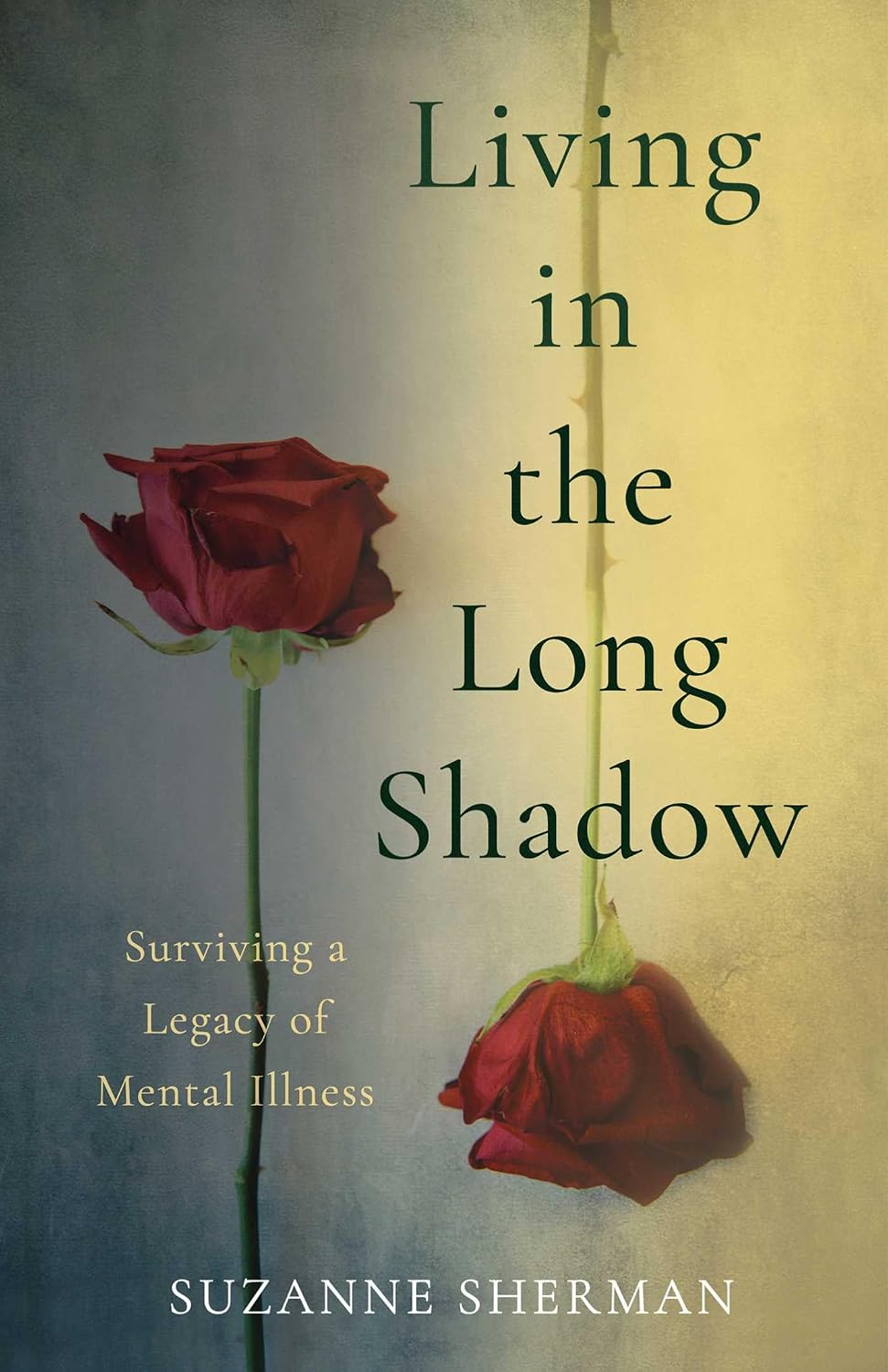
In Living in the Long Shadow, author Suzanne Sherman revisits her childhood as the daughter of Marilyn, a gifted, loving, musically alive woman whose schizophrenia slowly reshapes the family’s world, and then follows the aftermath of Marilyn’s suicide into Sherman’s adulthood. The memoir moves through West Los Angeles childhood scenes, divorce, sibling fracture, hospitals, medication, silence, and grief, but it’s never only a book about damage. It’s also about memory doing its careful work: a child in Sequoia learning to “listen” to the forest with her mother, a birthday cake left suspended in terror, a candlelight peace march led by Marilyn’s guitar and trembling hope, and, years later, roses drifting on the San Francisco Bay like an impossible answer.
I was taken by the book’s refusal to flatten Marilyn into her illness. Sherman writes about her mother’s frightening absences with clarity, but she also restores the radiance that illness couldn’t fully erase. I believed in Marilyn as the woman who made one-sleeved dresses for a daughter in a cast, who turned an environmental poem into a song, who planted lemon trees and noticed birds hatching under the trellis. That tenderness makes the pain sharper. The memoir understands that love and fear can live in the same room, sometimes in the same breath, and Sherman has a rare gift for letting those contradictions remain unsettled.
The writing is intimate, precise, and quietly devastating. Sherman’s structure, moving between childhood recollection and the approaching knowledge of her mother’s death, gives the book a haunted pulse. I found that approach emotionally true, because grief rarely arrives in a straight line. Some passages feel almost unbearably vivid, especially the small domestic humiliations and terrors: the father who insists on logic, the child learning to manage adults’ moods, the sister’s volatility, the stepmother’s cool judgments around food. The ideas beneath the story are equally strong. The book asks what children inherit when a family cannot name what’s happening, and what it costs when mental illness is met with denial, shame, or inadequate care. The density of pain is heavy, but I didn’t find it excessive. It felt earned, the way an old house creaks because every beam remembers.
I finished this memoir moved by its sorrow, but also by its steadiness. Living in the Long Shadow is not a simple recovery story, and that’s part of its grace. It’s a book about surviving what can’t be repaired, then finding language tender enough to hold it. I’d recommend it to readers of reflective memoirs, especially those interested in family trauma, mental illness, suicide loss, complicated mother-daughter love, and the long work of making peace with the past.
Pages: 312 | ASIN : B0GPJ4ZSDG
King of the Sky: Choosing to Listen to God as a Path to Sobriety, Happiness, and Purpose

King of the Sky is Gregory R. Gilmore’s candid account of addiction, identity, collapse, and spiritual recovery, tracing his path from a small-town Indiana childhood shaped by silence and conformity to a glittering but increasingly lonely life in Miami, then into the chaos of substance abuse and, finally, toward sobriety through faith, self-inquiry, and connection. The book moves through painful terrain with unusual openness: a hidden sexuality, a marriage that couldn’t survive the truth he was avoiding, professional success that never quite became peace, and the haunting image of a man living high above Miami while becoming more and more unreachable to himself. What begins in fog over Mobile Bay becomes a story about learning to listen, not only to God, but to the quieter, steadier voice beneath fear.
What stayed with me most was the book’s willingness to sit inside contradiction. Gilmore doesn’t present himself as neatly heroic, and that gives the memoir its pulse. He can be tender and self-protective, generous and enabling, spiritually hungry and still caught in the same destructive loops. I appreciated the way he lets certain images carry the emotional weight: the Rolex that has become less a symbol of achievement than a relic, the art room in high school that offers brief sanctuary, Sophie the dog as a small daily grace, the Miami condo that looks like success from the outside while becoming a kind of beautiful prison. The nickname “King of the Sky” is especially piercing because it sounds grand until you understand the loneliness beneath it. That tension gives the book its strongest emotional truth. It’s not only about addiction but about the ache of performing a life so convincingly that even you begin to confuse the costume for the self.
The writing is at its best when Gilmore trusts memory, scene, and vulnerability. His reflections on shame, belonging, and the hunger to be accepted feel deeply lived, and his voice has a plainspoken intimacy that makes the spiritual material feel personal rather than abstract. The book leans into explanation, especially when it turns toward teachings from A Course in Miracles, Abraham Hicks, Marisa Peer, and other sources of transformation. I found the ideas sincere and often moving. The central argument, that alignment with love and truth can become stronger than escape, could sound simple in another writer’s hands, but here it has been earned through humiliation, relapse, fear, and gradual repair. The book’s spirituality doesn’t erase the mess. It rises from it.
I came away from King of the Sky feeling that I had read the testimony of someone who had to lose nearly every false shelter before finding a real one. It’s reflective, emotionally naked, and sometimes raw in ways that made me pause before turning the page. The most convincing part of the book is not that Gilmore found answers, but that he kept learning how to ask better questions of his pain. This is a thoughtful and compassionate memoir for readers drawn to recovery stories, spiritual growth, LGBTQ+ self-acceptance, and books about rebuilding a life from the inside out.
Pages: 207 | ASIN : B0DM3FSZBY
Flying Without Instruments

Flying Without Instruments is part memoir, part practical guide, and part late-life reckoning with what it means to discover the name for your own mind after decades of simply surviving it. Rance Johnson writes about being diagnosed with ADHD at sixty-two, after a long career in IT, the Air Force, family life, crisis management, and the strange private shame of feeling both highly capable and constantly under-equipped. From there, the book becomes an argument for using AI, specifically his “Kemosabe,” as a thinking partner rather than a shortcut. Through stories of 5 am brain dumps, impulsive domain-name temptations, unread recipe folders, the steady love of his wife Kathy, and the hard loss of his “Fixer” identity, Johnson builds a case for self-knowledge as the real instrument panel.
What I liked most about this book is how lived-in it feels. Johnson doesn’t write about ADHD as a tidy diagnosis or AI as a gleaming productivity miracle. He writes from the kitchen table, with dogs snoring nearby, coffee cooling, and a whole life behind the sentence. That gives the book its best texture. The scenes that stayed with me weren’t the frameworks, useful as they are, but the human particulars: Ruckus snoring like a bear cub, the midnight urge to buy another domain name, the quiet image of Kathy organizing her garage on Easter Sunday, the old third-shift IT nights where he learned to sit with broken systems until they spoke. There’s real emotional intelligence in the way he connects those moments to the larger ideas. The writing can be plainspoken, but it often lands with surprising grace because Johnson trusts memory, and he understands that a life is made legible through details.
I also appreciated the book’s honesty about AI’s shadow side. It would’ve been easy for this to become a breathless pitch for a tool or a course, but the stronger idea here is more nuanced: AI can either become scaffolding or another beautifully lit rabbit hole. I found that distinction persuasive. The “Shadows” framework, with the Avoider, Restless, Pleaser, Controller, and Hyper-Achiever, gives the book a useful vocabulary without making it feel clinical. I didn’t mind the practical turns, but I did feel the memoir sections, especially “The Fixer” and “When the Ground Fell Out,” had a richer pulse than the more instructional passages. When Johnson writes about Lou, Alex, Nellie, Sparrow, and the grandchildren whose names become future trails, the book breathes more deeply.
I felt like Flying Without Instruments is less about AI than about finally refusing to mistake struggle for failure. That’s its quiet power. It’s a warm, reflective, sometimes bruised book about building supports without surrendering your own judgment, and about looking back at a hard-won life with more mercy than shame. I’d recommend it especially to adults with ADHD, late-diagnosed readers, partners of people with ADHD, and professionals who’ve spent years being “the capable one” while privately wondering why everything costs so much energy.
Pages: 57 | ASIN : B0GX3B5PFD
Sheltered

Sheltered, by Elisa Hertzan Schetrompf, is a memoir of grief, faith, family, and unexpected resilience, following the author after the sudden death of her husband, John, and into a trip to Israel that becomes something far more dangerous and transformative than the pilgrimage she imagined. What begins in Tennessee, with boat races, church, late-life love, and the raw shock of widowhood, opens into a journey through wartime Israel, where Schetrompf finds herself stranded amid sirens, shelters, cancelled flights, medical uncertainty, and the startling tenderness of relatives she barely knows. The book moves from loss to dislocation to a hard-won sense of purpose, tracing how grief can be held, not erased, by faith, memory, and human kindness.
I was moved by the way the memoir lets love remain ordinary and immense at the same time. John isn’t presented as an abstract saint, but as a vivid man of engines, boats, teasing confidence, and rough working hands. The scene of him racing on the Tennessee River gives the book its first pulse of danger and joy, while the later hospital scene, when Schetrompf kisses his cold hands and smooths his hair, lands with quiet devastation. I also appreciated how honestly she writes about spiritual identity. Her Jewish roots, her Christian church community, the breaking of the glass at her wedding, her prayers, and her complicated attachment to Israel all sit together in a way that feels lived rather than neatly resolved. The book’s strongest idea, to me, is that healing doesn’t always arrive gently. Sometimes it comes through exhaustion, sirens at 2 a.m., a crowded shelter, a stranger’s cookies on a plane, or a cousin saying, in effect, you belong to us now.
The writing is at its best when it trusts small, concrete moments. Uncle Isaac’s disciplined routines, the bus full of soldiers headed toward Eilat, Shorayna filling a kitchen with music and food, the musty bomb shelter with children’s toys, the beach glowing beneath the Red Mountains while war presses in from elsewhere, all of these details give the memoir its emotional texture. I did occasionally feel that the narration became more explanatory than evocative, especially when historical and political reflections somewhat overtook the intimacy of the personal story. Schetrompf writes as someone trying to make meaning while still shaken, and that urgency gives the memoir its particular human grain.
By the end, when the author returns through Rome and New York, rests on the Kavanah, and begins to speak of being “whole and healing,” the memoir has earned its title in a way I found unexpectedly affecting. Sheltered is not only about physical refuge from missiles, but about the shelters made by memory, kinship, prayer, and the stubborn will to keep living after love has been torn away. I would recommend it to readers who appreciate reflective memoirs about grief, interfaith identity, Israel, family inheritance, and the strange ways crisis can reveal both vulnerability and strength.
Pages: 189 | ASIN : B0H42WQ5CC


