Blog Archives
Power and Government Corruption

The Valhalla Project centers around a private investigator and attorney who become entangled in a case involving a teenager with autism who becomes an easy target in a murder investigation. Where did the idea behind this novel come from?
Regarding David, the 19 year old autistic man, it was really an exercise for me to delve into someone with a different personality, and express his emotions and fears. His character was born out of my attempt to create a character that would have an exceptionally deep relationship with a smart dog.
What drew you to write a mystery that expands from a local tragedy into a much broader examination of power and influence?
The broader examination of power and government corruption is often the basis of my novels.
One of the novel’s most unsettling moments is watching David become vulnerable during police questioning. What did you hope readers would take away from those scenes?
The takeaway is that our government and law enforcement is unfair to many members of our society, especially those with disabilities.
If readers remember one thing after finishing The Valhalla Project, what do you hope it is?
To not trust our government and elected officials at face value.
Author Links: GoodReads | Facebook | Website | Amazon
Nineteen-year-old David Jacobs discovers the body of a murdered woman while walking his dog through Pelham Bay Park. He does exactly what any innocent person would do—he calls the police.
Within days, he’s arrested.
Autistic, trusting, and unequipped to navigate a relentless interrogation, David accepts a plea deal for a murder he didn’t commit. His future disappears behind prison walls while the real killer walks free.
Former NYPD detective-turned-private investigator Dan Burnett knows the case doesn’t add up. His investigation leads to a controversial data center project, where corporate greed, political corruption, and billions of dollars collide. Someone has already killed to protect it—and they’ll kill again to keep the truth buried.
Witnesses stop talking. Evidence disappears. Every lead brings Dan closer to the truth—and closer to the people determined to silence him. Every day David spends behind bars is another day stolen from his life. To save him, Dan must expose the truth before the conspiracy claims another victim.
A gripping crime thriller packed with relentless suspense, plot twists, and unforgettable characters.
Trust, Deception, and Survival

Ghost Town follows a former intelligence operative who finds himself involved in a covert military experiment near the abandoned town of Ehrenberg, Arizona. What was the inspiration for the setup of your story?
I began writing Ghost Town while finishing graduate film school at UCLA in the late 1970s. Influenced by Robert Ludlum, Jason Bourne-style espionage, and the Cold War, I imagined a dissatisfied intelligence operative confronting something far beyond his training in an isolated ghost town. Originally titled Desert Dreams, the novel evolved through many rewrites into a story that alternates between the present-day mystery and the events that shaped the protagonist’s (Richard Hart) life, revealing how his past prepared him for the impossible. Maybe I was cramming in too many concepts, but I was also intrigued by the military running a time experiment and how they could still be doing that in the present day to influence events. If they could change one thing in the past, could they do it again on a small, isolated scale?
The novel explores how fear, violence, and manipulation can distort people’s judgment. What interested you about examining human behavior under those conditions?
Setting the story during the Cold War, I was fascinated by how intelligent, well-trained people could make terrible decisions under pressure. Espionage isn’t just about gadgets and secret missions—it’s about trust, deception, and survival. I wanted to see how ordinary people would respond when the rules they depended on suddenly disappeared.
Which scenes proved especially difficult—or especially rewarding—to write?
The most rewarding scenes were those in the ghost town, where mystery gradually gave way to discovery. The most difficult part was balancing two stories at once—the unfolding present-day mystery and the protagonist’s past—so they complemented each other and steadily built toward the conclusion. The relationship between Hart, Honey, and Boon was a unique balancing act because each had a different view of what was happening in those three days. It was a challenge to mix the paranormal with a sense of horror in this “literary fusion” of high-tech contrasting with life over 100 years ago, where the disenchanted agent did not have access to any of the customary tools he would have at his disposal in the present time.
If readers leave the novel debating one question, what do you hope it will be?
I hope they might ask themselves, “What would I have done?” It is a story about survival and illusion and giving in to the illusion or sticking with reality and trying to understand what is really happening. Every character is forced to make difficult choices with incomplete information. If readers find themselves debating those decisions long after they finish the book, then I feel the story has succeeded.
Author Links: GoodReads | X (Twitter) | Facebook | Website | Amazon
Finalist, Eric Hoffer Book Awards
Brilliant but burned-out CIA operative Richard Hart has a midlife crisis. He wants out of the intelligence game for good…
A CIA operative. A black-site time experiment. A ghost town that shouldn’t exist.
Three strangers. Three days. Trapped 100 years in the past — and hunted by the dead.
🏆 Winner, American Fiction Awards Finalist, Eric Hoffer Book Awards
Burned-out CIA operative Richard Hart wants out of the intelligence game for good. But a career-ending rendezvous goes wrong, and he’s thrown into a military time-travel experiment gone catastrophically sideways — trapped in a desert ghost town, hunted by ghost riders and desperadoes, with no way home…
Strong Female Protagonists

Broken Image centers around a woman grieving after tremendous personal loss, recovering from an accident, and healing after an abusive marriage, who finds herself in an area terrorized by a serial killer. Where did the idea behind this novel come from?
Broken Image is part of a four-book series, with each book centered on one of the four Bennett siblings. I needed a love interest for Jay, and a reason for her to be in Edmondsville, so I decided to bring back Joe Grimes, one of my favorite secondary characters from The Row Series. Making Sage, his great-niece, felt like the perfect way to root in the small town.
I also enjoy creating strong female protagonists who face real challenges, so I gave Sage the dual burden of grieving her daughter while escaping an abusive marriage. That enabled me to bring in Brooke O’Connor Matthews from my Victory Hill Series. Brooke runs a social network that helps women and children escape dangerous situations, and in this story, she’d been corresponding with Sage’s Uncle Joe. Writing is the fun part, but marketing matters too, and I’ve found that intermingling my series is a great way to introduce readers to worlds they might not have discovered otherwise.
As for the killer…he’s hiding in plain sight, living within the very community that trusts him. He will stay there, quietly keeping everyone on edge, until he finally makes one fatal mistake in book four, Final Image.
Sage’s healing feels just as important as solving the mystery. Was it always your intention for her emotional recovery to be the heart of the novel?
As a retired librarian and educator, I tried to weave in details that might genuinely help readers deal with their own grief or hardship. Jay dealt with the loss of a bullied high school classmate to suicide by keeping a journal of his thoughts and recovery, and that experience shapes how he connects with Sage. He buys her a journal and encourages her to do the same. I included excerpts from Sage’s journal throughout the book, and I’m hopeful that the idea resonates with readers. Journaling can be a simple and powerful tool for working through pain.
I wanted Sage to overcome her grief and abuse and come out the other side a strong, independent woman. She was never really weak. She was just a victim who got in over her head, desperate to do the right thing by her little girl. While editing the book, I took Donald Maass’ Advanced Fiction Methods course, an invaluable tool that helped me sharpen my focus on Sage’s recovery arc. I didn’t want her to simply survive her circumstances. I wanted readers to watch her grow. We see so much grief and abuse in today’s world, and I wanted Sage’s story to show that it’s possible not just to endure it, but to come out the other side stronger than before.
You occasionally let readers see events from the criminals’ perspectives, creating suspense by revealing dangers the other characters don’t yet recognize. What made you choose that narrative approach?
I am an avid Nora Roberts/JD Robb fan, and I’ve always admired how she lets readers into everyone’s head, not just the hero’s. There’s something powerful about that kind of access. It creates a sense of dramatic irony where the reader knows more than the characters do, which increases the suspense. When you see the danger coming before the characters, you’re not just wondering what will happen; you’re bracing for when it will happen.
I also love creating strong, distinct characters, even frightening ones, and letting readers see the world through their eyes. It’s a way of making the threat feel real and immediate, rather than abstract. Readers aren’t just told a killer is dangerous; they are inside his thoughts, seeing how close he already is.
Can readers look forward to more installments in the Bennett Auction Series?
Yes! I am currently working on book three, False Image, which follows Mary Kate Bennett and Sheriff Duane Peterson’s story. Book four, Final Image, will wrap up the series with GW Bennett and Miranda Dooley.
There’s still plenty left to resolve – a ghost who needs to cross over, symbols on a brass key that need to be located to solve a century-old town mystery, and a serial killer who still needs to be caught. I’m excited to bring the Bennett siblings’ stories full circle in 2027, and I hope readers will stick around to see how it all comes together.
Author Links: GoodReads | Facebook | Website | Pinterest | Amazon
When Sage Grimes returns to the small town of Edmondsville, she carries more than grief. The loss of her beloved great-uncle Joe and her four-year-old daughter Grace has left her shattered, her memories fractured, and her trust in the world destroyed. She came to Joe’s home to heal. Instead, she finds returned letters that hint at buried secrets, evidence that someone has been inside the house Joe left her, and terrifying gaps in her memory about the accident that changed everything.
She thought coming home would save her. She didn’t know someone was already waiting.
Jay Bennett has spent years trying to outrun his own painful past. When he meets Sage, he recognizes something in her eyes he’s seen before – the quiet devastation of someone standing at the edge. Determined to help her find her way back, he offers her something unexpected: a journal, a community blog, and a reason to believe her story isn’t over yet. But as Sage’s voice grows stronger, someone works anonymously in the shadows to destroy everything she’s building.
And Jay is keeping secrets of his own.
As fragments of memory begin to surface about the accident that killed Grace, a chilling possibility emerges that will change everything Sage thought she knew. Her dangerous ex-husband is circling. Anonymous threats are growing bolder. And Edmondsville, already gripped by fear as a serial killer terrorizes the community, offers fewer safe places than Sage had hoped.
The closer she gets to the truth, the more deadly the danger becomes.
When Sage discovers that the one person she’d begun to trust has been keeping things from her, her fragile recovery threatens to collapse entirely. Sage must find the strength to face the past before it destroys her future.
Because someone doesn’t want her to remember. And they’ll do anything to make sure she never does.
Broken Image is a gripping small-town romantic suspense perfect for readers who love emotionally complex heroines fighting to reclaim their lives, heroes with wounded hearts and protective instincts, small-town settings with secrets hiding in plain sight, slow burn romance woven through pulse-pounding suspense, and stories about grief, healing and the courage to trust again.
If you loved Mirror Image, don’t miss Sage and Jay’s story in Broken Image – the next chapter in the Bennett Auction Series.
This Case And My Life


This Case and My Life by Ana Braunstein is a fast-moving domestic drama about infidelity, deception, and the consequences that arrive when a carefully managed double life falls apart. Chris Roberts is a successful attorney who believes he can control every situation, including his marriage to Stacey and his relationship with Bridget. In the course of one turbulent day, Stacey files for divorce, Bridget reveals that she’s pregnant, and Chris is forced to confront how little control he actually has. The story follows the emotional fallout from several perspectives, which gives the reader a broader view of the damage his choices have caused.
The book has a strongly cinematic quality, which makes sense given that it’s based on a film. Scenes are built around phone calls, entrances, confrontations, revealing pauses, and memorable visual details. The red roses are especially effective. Chris buys them for Bridget, tries to offer them to Stacey, and accidentally proves how little attention he has paid to the woman he’s asking to forgive him. The short lines and quick shifts create the feeling of watching a screen drama unfold, and the chapters keep the pressure on Chris as each new development narrows his options.
What gives the story its emotional substance is the way it treats the women around Chris as people with paths of their own. Stacey’s journey from suspicion and heartbreak to independence becomes the book’s most satisfying arc. Her decision to close the door on Chris feels like both a literal action and a statement about the life she’s ready to leave behind. Kathy, Chris’s assistant, also begins setting boundaries after years of covering for him, while Bridget faces a future built on love, hope, and unresolved complications. Their experiences turn the story into more than an account of a cheating husband getting caught. It becomes a look at how people reclaim their voices after spending too long adjusting themselves to someone else’s behavior.
I’d recommend This Case and My Life most to readers who enjoy relationship dramas, emotionally direct storytelling, and stories about rebuilding after betrayal. It’ll also appeal to viewers who like film-style pacing and want a book they can move through quickly, with clear conflicts and dramatic turning points. Readers who have experienced divorce, major life changes, or the process of starting over may connect especially strongly with Stacey’s growing sense of peace. The book is about consequences, self-respect, and the fact that life continues even when the future looks completely different from the one a person had planned.
Pages: 64 | ASIN: B0GZ6DVDVB

English Upgrade: The Advanced Learner’s Guide to the Most Common English Language Errors (¡Para Hispanohablantes!)


English Upgrade is a practical English grammar workbook created specifically for Spanish-speaking learners. Rather than organizing the material around broad grammar categories alone, the book focuses on the mistakes that tend to follow learners into real conversations, emails, classrooms, and workplaces. Its sixty-one lessons cover false cognates, troublesome verb pairs, prepositions, phrasal verbs, pronouns, verb patterns, question forms, reported speech, pronunciation, and other details that often separate understandable English from natural-sounding English.
The most effective part of this ESL reference guide is its direct comparison of English and Spanish. Each section identifies the source of a common error, explains the English pattern in accessible language, and follows it with practical examples. The contrast makes rules easier to remember because readers can see why a sentence that feels logical in Spanish may need a different structure in English. The book’s tone is encouraging and teacherly, and it doesn’t bury useful guidance under academic terminology.
As a language-learning book, it’s designed for active use. Short explanations are paired with fill-in-the-blank exercises and answer keys, while idioms, phrasal verbs, footnotes, pronunciation guidance, and reference sections add value beyond the core lessons. Readers can move through it in order or treat it as an English usage guide when a particular question comes up. That flexibility makes it useful both for independent learners and for teachers who need focused material for lessons, tutoring sessions, or review.
What gives English Upgrade its personality is the author’s clear familiarity with the habits of Spanish-speaking students. The examples feel drawn from actual teaching experience, and the lessons repeatedly address the small choices that can make English sound more fluent and precise. Advanced learners will get the most from its detailed corrections, though the simple format also gives motivated intermediate students a comfortable entry point. It’s a practical, thoughtfully organized English grammar guide that readers can study, mark up, revisit, and keep nearby as their confidence grows.
Pages: 181 | ASIN: B0GGHQMLWZ
The Hunting of the Snark
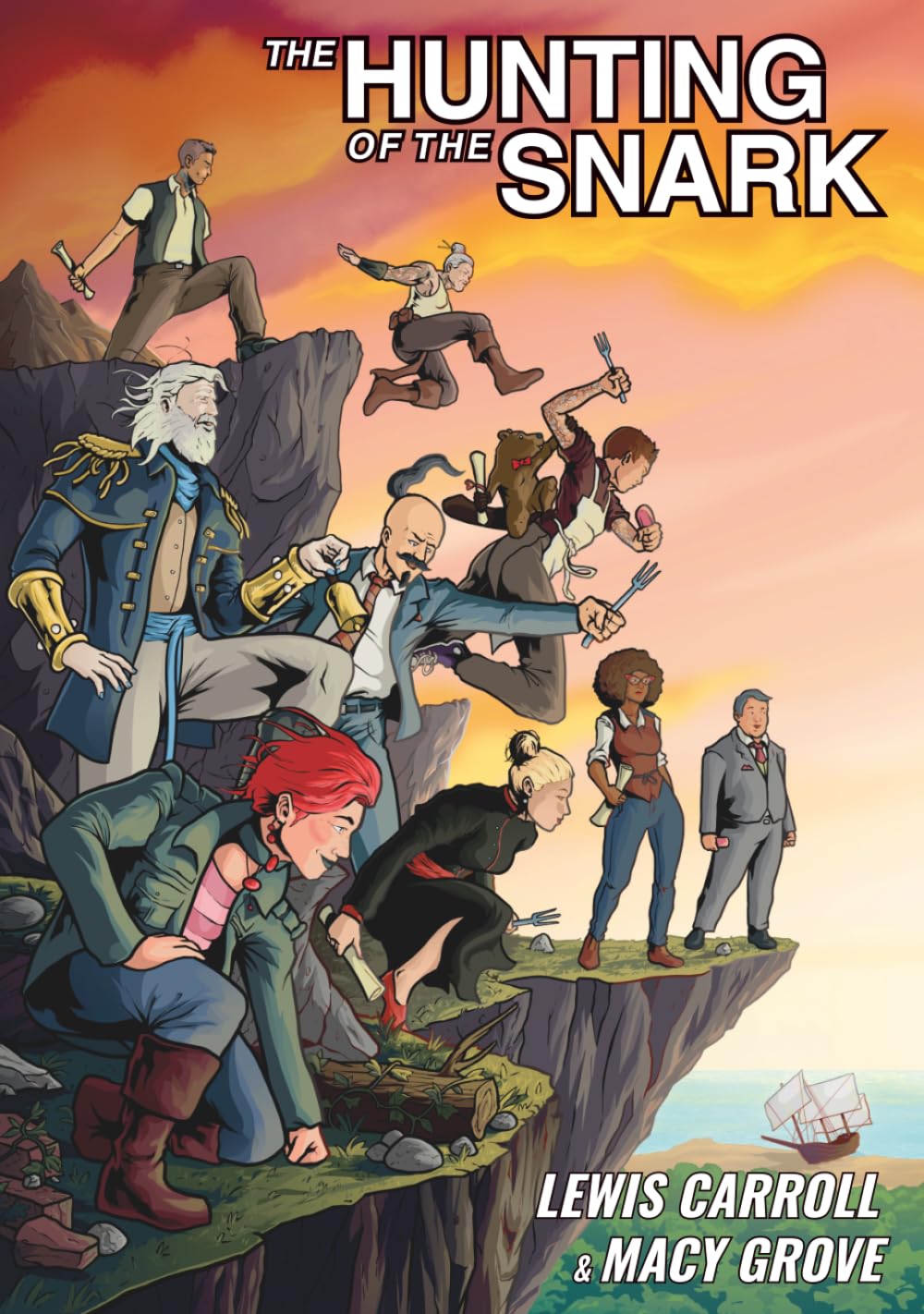
Macy Grove’s The Hunting of the Snark is a vibrant graphic novel adaptation and fantasy adventure built around Lewis Carroll’s famously strange 1876 poem. Grove preserves Carroll’s rhythmic language while giving the expedition a contemporary visual identity, with illustrations credited to Anonymous, Macy Grove, and Nyx Grove. The story follows the Bellman and a wonderfully mismatched crew as they cross an impossible sea, land in a landscape of chasms and crags, and begin searching for a creature they can barely describe. It’s playful from the start, but the silliness always carries a faint sense of danger.
The cast gives this illustrated fantasy poem much of its personality. The crew includes a Baker who has forgotten her name, a lace-making Beaver, a Butcher who can kill only beavers, a Barrister, a Banker, a Broker, and several other specialists whose talents are either oddly specific or completely useless. Grove updates the hunters into a broader, more varied group while making that choice part of the book’s own mischievous mythology. The character designs help turn Carroll’s list of occupations into an ensemble you can recognize, follow, and care about, especially as the Beaver and Butcher move from mutual fear to genuine friendship.
What makes the book especially enjoyable is the way its surreal comedy and comic book storytelling work together. Carroll’s absurd logic remains intact: the Bellman navigates with a blank map, treats repetition as proof, and instructs the crew to hunt with thimbles, forks, railway shares, smiles, and soap. The art gives those jokes physical shape, but it also deepens the mood when the Jubjub, Bandersnatch, and Boojum enter the story. Scenes that sound ridiculous on the page can suddenly feel lonely, eerie, or threatening when placed against dark valleys, jagged cliffs, and an approaching night.
The final part lands with more emotional force than the book’s comic setup might suggest. The Baker appears to find the Snark, calls out in triumph, and then vanishes when the creature proves to be a Boojum. That ending gives this dark fantasy graphic novel a haunting aftertaste, turning the hunt into a story about ambition, fear, friendship, and the things people chase without fully understanding them. Grove’s adaptation feels lively, affectionate, and visually generous, making it an inviting way to experience Carroll’s poem while also giving longtime readers plenty of new details to notice.
Pages: 99 | ASIN : B0FP54JXFZ
The Kabuki Book

Kohōpeh’s The Kabuki Book is an ambitious blend of historical fiction, Japanese folklore, philosophical adventure, and speculative fantasy. Its emotional center is the relationship between Okuni, a wandering shrine maiden and performer, and Niten, a disciplined swordsman shaped by war. Their journey toward Kyō unfolds through conversations about art, violence, faith, desire, social rank, and personal freedom. The novel also reaches far beyond their immediate story, moving among mythic beings, political institutions, future scholars, and centuries of cultural change. The result feels less like a conventional historical drama and more like a long meditation on how stories, names, and systems of power survive.
Okuni is the book’s most compelling presence. She’s observant, practical, sensual, spiritually complicated, and sharply aware of the ways religious authority can use sacred language to control women’s bodies. Her growing vision of performance as something communal and liberating gives the rise of kabuki both personal and political weight. Niten provides a strong counterbalance. His devotion to discipline and self-reliance gradually expands into an appreciation for art, intimacy, architecture, teaching, and legacy. Their bond works because it’s built through curiosity and argument as much as attraction. Even when the narrative separates them, each continues to shape the other’s understanding of what a meaningful life can contain.
The book’s structure is unusually broad. Historical scenes sit beside folktales, elemental vignettes, supernatural conflicts, and a science-fiction strand involving suspended life and ancient beings surviving into the modern world. That range lets Kohōpeh connect the birth of an art form to larger questions about gender, class, theology, memory, and historical interpretation. The shifts can be demanding, especially when the novel pauses for extended cultural explanation, but they’re part of its identity. The book wants the reader to see history not as a straight road but as a crowded stage where official records, private suffering, mythology, and later scholarship all compete to define what happened.
Readers familiar with James Clavell’s Shōgun will recognize the attention given to hierarchy, ritual, political calculation, and the social codes of early modern Japan. Kohōpeh’s approach, though, is closer and stranger. Where Clavell builds outward through political spectacle, The Kabuki Book often builds upward and downward, from intimate bodily experience to gods beneath the sea and scholars centuries later. It’s a thoughtful, eccentric novel with the confidence to treat swordsmanship, dance, folklore, sexuality, and institutional power as parts of the same cultural story. Its strongest achievement is turning Okuni’s performance into more than entertainment. In her hands, kabuki becomes a way of claiming space, gathering people together, and leaving a mark that authority can restrict but never fully erase.
Pages: 422 | ASIN : B0H8B3G3PR
Stormfront Rising

Stormfront Rising is a big, rowdy fantasy adventure built around danger, discovery, and the kind of companionship that’s forged when everyone is wet, wounded, outnumbered, and still cracking jokes. Jason N. Long opens with a ship caught in an unnatural storm, purple lightning crawling across the sky, and a kraken turning disaster into outright catastrophe. From there, the novel keeps widening its horizon, drawing readers into a world of rival empires, elemental dragons, dangerous magic, strange oceans, and cities with histories that feel much larger than the characters passing through them. The maps, faction guide, and detailed systems of measurement reinforce the sense that this is a fully imagined place.
The book’s real engine, though, is its band of survivors. Leo, Zoe, Thorn, Ben, Toby, and the wider cast have distinct voices, skills, and emotional burdens, and their relationships give the story its warmth. Leo’s practical instincts, Zoe’s dangerous confidence, Thorn’s enormous personality, and Ben’s anxious intelligence create a lively rhythm that carries through the quieter stretches as well as the fights. Their banter can be filthy, affectionate, cruel, and unexpectedly tender, often within the same conversation. That mix makes them feel less like a polished heroic fellowship and more like people who’ve learned to love one another while standing knee-deep in trouble.
Long approaches fantasy with a tinkerer’s enthusiasm. Weapons have mechanisms, magic has consequences, cultures have customs, and politics shape nearly every choice. The story blends seafaring adventure, military fantasy, dark comedy, cosmic speculation, and dragon mythology into something proudly excessive and deeply personal. Its action is physical and graphic, but the violence has weight because the characters carry their losses forward. Even the jokes often sit beside grief, fear, or loyalty, which gives the novel an emotional texture beneath all the blood, monsters, and spectacle. The author’s acknowledgement of his “three-body problem” and “quantum queries” hints at the scientific curiosity running beneath the fantasy framework.
By the time its many conflicts converge, Stormfront Rising feels like the opening movement of a saga that has been living in its author’s imagination for years. It’s ambitious, unruly, funny, violent, and sincere, with a world large enough to reward readers who enjoy learning names, factions, histories, and rules as they travel. Most importantly, it understands that epic fantasy works best when the fate of nations is tied to people we’d willingly follow into a storm.
Pages: 471 | ASIN : B0GXFGQ2BM


