Blog Archives
The Dance of Open Hearts


A.R. Larson’s The Dance of Open Hearts is a sprawling portal fantasy that mixes science fiction, fairy-tale creatures, political conflict, grief, and longing into one very earnest story. It begins with Elly, a farm girl stuck between duty and desire, and then takes a hard turn into the strange world of Meerland after a talking cat pulls her, Timothy, and Alice into something much bigger than any of them expected. What struck me most is how openly the book reaches for wonder. It wants magic, but it also wants machinery, prophecy, environmental collapse, class tension, and messy human feeling all in the same frame. That’s a lot to carry, and the novel carries it with real conviction.
What makes the book work best is Elly. She has the kind of inner life that gives the whole story weight, especially early on, when her frustration with ordinary life is so sharp you can feel it. One creative line comes when she describes the cows on her family farm and says, “They looked like they were swimming through the grass.” That image gets at something the book understands well: Elly doesn’t just want escape, she already has an imagination that keeps turning the world into something larger and stranger. That quality makes her a strong guide through a novel that gets increasingly wild.
The book is also packed with big emotional swings, and for the most part, that’s a strength. Relationships are intense, sometimes volatile, and often shaped by old hurt, guilt, and unmet longing. Timothy starts off almost hilariously insufferable, but the novel gives him room to become more than a rich boy with a space legacy. Alice brings warmth and motion to the group. Rajaa, Benson, Maria, and the rest help the story grow from an adventure into something more bruised and romantic. Larson clearly likes characters who are carrying damage and still trying to move toward tenderness anyway. That gives the book its pulse.
The writing is at its best when it slows down and lets an image or feeling land. The book has a taste for theatricality, and that fits a story so invested in dance, ritual, costume, and spectacle. Sometimes the scale of the story makes the pacing slow a little, especially as the mythology and politics deepen, but even then, there’s an appealing sincerity to it. The novel never feels detached from its own heart.
The Dance of Open Hearts is an ambitious and emotionally direct fantasy novel that cares deeply about hope, connection, and the choice to keep reaching for beauty when life gets ugly. It’s interesting in openheartedness not as softness, but as a risk people take when they’ve already been hurt. That gives the book a distinctive center. It’s romantic, strange, crowded, sometimes messy, and often surprisingly moving. More than anything, it feels written by someone who really believes stories can hold pain and wonder at the same time, and that belief gives the novel its charm.
Pages: 576 | ASIN : B0GHZHQJ12

Release & Be Free: An Enlightening Erotic Anthology

Release & Be Free is an erotic anthology, but it isn’t interested in eroticism as spectacle alone. I think what the author is really writing about, again and again, is liberation: sexual, emotional, spiritual, generational. The book moves through poems and stories that treat desire as revelation, whether that’s the surreal, shape-shifting mythology of “Mow Me Down,” where a supernatural sexual curse becomes a story about tenderness breaking inheritance, or the more intimate pieces that turn toward self-worth, patience, motherhood, and the ache of becoming someone freer than you were taught to be. Even when the book is at its most explicit, it keeps reaching for something deeper, and that tension gives the collection its identity.
Angelica Stevenson writes with almost no ironic shield at all, and I found that disarming. In “Mow Me Down,” the wildness of cursed women, levitating lawnmowers, and men who only prove worthy when they slow down long enough to ask, to listen, to please, could have tipped into pure camp, but there’s real feeling underneath it. The emotional logic is clear even when the plot is gloriously excessive. I felt that same pulse in the poems too. “Patience’s Patient” and “A Soul Kiss” shift the mood completely, but in a way that makes the anthology feel fuller rather than scattered. They bring in healing, motherhood, self-regard, and the painful work of learning how to receive love without losing yourself. That emotional openness gave the book its strongest moments for me.
Stevenson has a bold voice. She likes intensity, repetition, declaration, and heat. Sometimes, the prose can be rough or more direct than elegant. But there’s also a raw immediacy to that style that suits the material. The book’s best scenes aren’t polished into cool perfection. They’re vivid, impulsive, strange, and emotionally exposed. I especially liked how often the ideas beneath the sex were about agency rather than conquest. Rebel’s refusal to be pulled in too easily, the sisterly ache between Zaphena and Ragina, the self-recognition in “The Art of Roses,” even the charged chaos of stories like “Murderous Intimacy,” all of it suggests a writer trying to fuse body and spirit instead of pretending they live in separate rooms.
I found Release & Be Free: An Enlightening Erotic Anthology sincere, imaginative, and unexpectedly heartfelt. What it offers is emotional candor, erotic fantasy with a spiritual undertow, and a voice that feels genuinely personal. I’d recommend it to readers who enjoy erotica with mythic flair, emotional directness, and a strong interest in healing, transformation, and feminine power. It left me feeling that Stevenson’s real subject isn’t sex by itself, but what sex can uncover when a person is finally ready to be honest.
Pages: 235 | ISBN: 9798233384141
Let Me Go


Elaine Broun’s Let Me Go opens with a woman in flight and never really lets that first note of fear go slack. Isabella Hampton has slipped away from a controlling, violent marriage and taken refuge in a secluded cottage in Provincetown, where the practical business of repainting cabinets and checking window locks becomes part of a larger attempt to reclaim her own life. From there the novel braids present-day suspense with backstory: old-money damage, stolen inheritance, emotional manipulation, and the wary, slowly brightening connection between Isabella and Nate, the former Marine realtor who senses almost immediately that her nerves are not mere skittishness. It is a long, plot-forward romantic suspense novel, and it knows exactly which engines it wants running at once: danger, secrecy, desire, and eventual escape.
Let Me Go does not approach abuse as a decorative complication; it treats control as something incremental, intimate, and psychologically erosive. I found the early sections especially effective because Isabella’s vigilance is built into the furniture of the story. She is not merely “afraid”; she is counting doors, thinking about sightlines, testing locks, measuring safety in tiny domestic units. That gave the novel an authentic tension I appreciated. I also liked the cottage itself, which has a kind of weathered charisma. Broun is very good at making shelter feel double-edged: a sanctuary, yes, but also a place whose quiet can sharpen dread.
My reaction to the romance was a little more mixed, though still largely favorable. Nate is written with unabashed fantasy-novel generosity: capable, protective, broad-shouldered, emotionally available, and nearly mythic in his attentiveness. Sometimes that pushes the book toward melodrama, and the dialogue can tilt into soap-opera intensity. But the flip side is that the novel has pulse. It’s not coy, not bloodless, and not embarrassed by feeling. I admired that. Broun writes as someone unafraid of yearning, and even when the prose grows florid, there is real conviction under it. The book is at its strongest when that conviction is tethered to Isabella’s interior life, her shame, her hesitation, her gradual return to selfhood, because then the story acquires something more tensile than mere page-turning momentum.
I would hand this to readers who like romantic suspense, women’s fiction, domestic-abuse survival narratives, small-town romance, and contemporary drama with a strong emotional current. Readers who enjoy Colleen Hoover’s darker relationship plots, or fans of Sandra Brown’s blend of danger and desire, will probably recognize the territory, though Broun’s novel is more earnest than either. For the right audience, that earnestness will be part of the appeal: it gives the story an unvarnished immediacy. Let Me Go is deeply invested in its heroine’s escape, and that investment makes it a gripping story. This is a novel about what it costs to leave and what it takes to feel safe in your own life again.
Pages: 306 | ASIN : B0FTV3G2DX
Shadow Walkers

Shadow Walkers is a Christian supernatural fantasy thriller that follows Lisa and Jason, a married couple pulled into a hidden spiritual war where gifted women and their paladin partners hunt demons, confront possession, and answer to an old sacred order. This mission starts with a gathering at Fletcher Mansion, where the team learns that something in their usual pattern has gone wrong, their gifts have not gone dormant, and a far larger battle is coming. The story then opens out into a dangerous campaign involving demon law, possessed people, undead forces, and a mission in Haiti that feels bigger than a single assignment and more like the start of a wider storm.
The book’s tone is intense, but it also makes room for warmth, teasing, and domestic tenderness, especially in the way Lisa and Jason talk to each other. Their banter gives the novel a human center, and at its best, it keeps the story from becoming all lore and combat. I was drawn to Lisa as a lead because she isn’t written like a fearless action machine. She worries. She hesitates. She carries the strain of leadership in a way that feels personal rather than theatrical. That choice gave the book a grounded pulse. Some scenes land with real momentum, while others repeat emotional beats or overexplain. Even so, I kept feeling the author’s sincerity on the page, and that counts for a lot.
I was also interested in the author’s wider choices. Bob Leone builds the book around spiritual hierarchy, ritual, duty, and moral tension, not just around monsters, and that gives the fantasy elements a distinct identity. The friction between Lisa and Magdalana adds real texture because it turns leadership into more than a title. It becomes a live question. Who should lead, and what kind of person should lead when the rules are old but the danger keeps changing? I thought the Haiti mission, the bokor, and the undead raised the stakes in a way that pushes the story into darker and broader territory. Sometimes the book feels like it’s carrying a lot at once, romance, action, theology, team drama, military-style planning, supernatural lore, but there’s also something compelling about that ambition. It reads like a story that genuinely believes good and evil are not abstract ideas. They’re close enough to touch.
I would recommend Shadow Walkers to readers who enjoy faith-infused supernatural fiction, especially people who like demon-hunting stories with a strong relationship at the center and a clear moral framework. Readers who value heart, conviction, and a fast-moving spiritual warfare premise will likely find a lot to appreciate here. It feels best suited for fans of Christian speculative fiction, paranormal thrillers, and team-based fantasy adventures that care as much about calling and loyalty as they do about the next fight.
Pages: 340 | ASIN : B0GFY8MPYR

Obadiah and the Last 100 Prophets of Edom
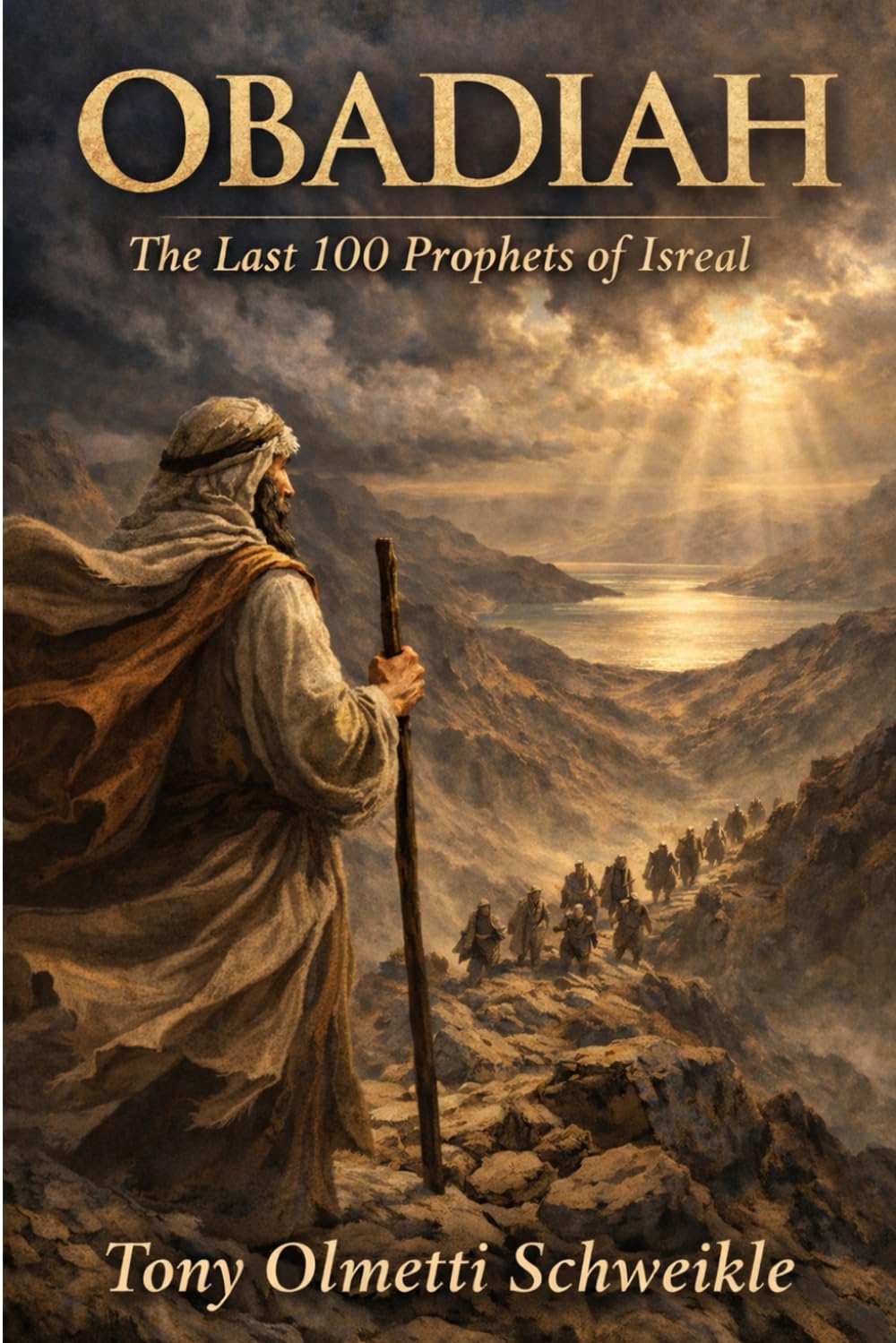
Obadiah and the Last 100 Prophets of Edom, by Tony Olmetti Schweikle, is a biblical historical novel that reads like a sustained act of witness. It takes the world around Ahab, Jezebel, Elijah, Naboth, and Obadiah and turns it into a landscape of drought, persecution, flight, and stubborn belief. From the opening battle scenes to the cave hideouts and tense village encounters, the book keeps returning to one central conviction, stated again and again in different emotional keys: “There is only One God.” That refrain gives the novel its spine and its sense of purpose.
What makes the book work is its seriousness. The author isn’t treating this material like a distant legend. He writes it as immediate, physical, and costly. Crosses line the road into Jezreel, Naboth’s vineyard becomes a site of both injustice and sacred memory, and Obadiah’s loyalty is measured in hunger, grief, and risk. The novel is full of kings, soldiers, priests, shepherds, traders, and villagers, so faith never feels abstract. It’s social, public, dangerous, and tied to land, bread, water, and survival.
I also liked how the book handles its characters in moral terms without flattening them into symbols. Ahab is brutal, but he’s also uneasy. Jezebel is cold and forceful, and the book gives her a real presence whenever she enters a scene. Obadiah, though, is the center of gravity. He isn’t drawn as flashy or invincible. He’s steady, grieving, practical, and quietly persuasive. That matters because it lets the novel become not just a story about defiance, but a story about endurance and teaching, about how belief gets handed from one frightened person to another.
The prose itself is direct and emphatic. It uses strong images, sharp confrontations, and declarative endings. Sometimes that gives the book the feel of oral storytelling, and sometimes it leans toward something almost cinematic, especially in the long middle stretch where action, dialogue, and visual staging take over. That hybrid energy turns out to be part of the book’s identity. It feels like a novel written by someone who can already see the scenes onscreen. Even when the language is simple, it’s aiming for momentum, clarity, and conviction rather than ambiguity.
What I liked most was that the book understands faith as something lived under pressure. It’s there in the markets, in whispered conversations, in stories told by lamplight, and in the refusal to surrender what is holy. A line like “The truth remained, unchallenged and eternal” captures the book’s posture. This is a novel of declaration, pursuit, and testimony, and it knows what story it wants to tell. If you’re open to a fervent, dramatic retelling of biblical conflict with a strong devotional core, this book has a clear voice, and it commits to it completely.
Pages: 142 | ASIN : B0GPLSLY4P
Finding Our Voice: A Story of Leadership in Crisis and the American Spirit Abroad

Finding Our Voice is part memoir, part leadership manifesto, part archive of speeches delivered while Adam Castillo led AMCHAM Myanmar through coup, sanctions, economic collapse, and disaster. What gives it shape is his “Three Acts of Leadership” model, moving from proving competence, to enduring pressure, to offering people a reason to believe, but what gives it pulse is the lived texture around that framework: the ex-Marine who washes up in Myanmar half-broken, builds a company from a couch he still keeps, stays when others evacuate, and tries to turn a frightened business community into something like a moral community. The book’s range is wider than its premise suggests. It moves from Marine Corps formation and post-service disillusionment to chamber politics, hotel ballroom speeches, a refugee’s testimony, and earthquake relief work, always circling the same core conviction that jobs, dignity, and belief matter most when history gets ugly.
What I admired most is that Castillo writes with the urgency of someone who feels he has earned the right to be emphatic. The book has a driving, spoken quality. You can hear the podium in it. But even when it swells toward rhetoric, it rarely feels bloodless. I kept thinking about the small, disarming details that save it from abstraction: that battered couch doubling as bed, desk, and command post, the local hires he treats not as placeholders but as future leaders, the image of him in the black Ford Ranger navigating Yangon during the coup, and later the surreal electricity of a July Fourth event where children wave little American flags, “Wild Thing” blasts, and the room tilts from ceremony into something like collective release. Those moments give the book warmth and grain. They make the ideas legible because they show what belief looked like on the ground.
I also found the book more interesting and more affecting when it let its certainty crack a little. Castillo is plainly a man of strong opinions, especially about sanctions, American power, the failures of institutions, and the obligations of leadership. At times, that forcefulness veers into self-mythologizing, and there are stretches where the prose presses so hard on its own importance that I wanted more room for complexity. Still, the book earns much of its moral intensity.
The inclusion of the Burmese refugee’s testimony deepens the narrative by shifting the lens away from Castillo’s own heroism and toward the human consequences of policy and abandonment. Likewise, the later sections on the earthquake and the Rebuild Fund, with their focus on water points, latrines, health workers, blocked transfers, and practical relief, pull the book back from grand theory into the stubborn world of actual need. I didn’t agree with every conclusion, but I never felt the ideas were merely posed. They’ve been lived in, argued through, and paid for.
I found Finding Our Voice uneven in the way many deeply personal books are, but never inert, never timid, and often genuinely stirring. Its best passages carry real heat, and its best insight is a simple one: leadership in crisis is less about charisma than stamina, witness, and the ability to make people feel they still count. I’d recommend it to readers interested in memoirs of service after military life, leadership under pressure, Myanmar, or the uneasy border where commerce, politics, and conscience meet. I finished it feeling that Castillo’s conviction gives the book its force.
Pages: 300 | ISBN : 978-1544551630
We Are Never Far From Wild Landscapes

The White Wolf follows a struggling young vet tech whose bond with a stolen white wolf pup drives her into a fierce pursuit through a world where cruelty, commerce, and survival are tightly entwined. What was the inspiration for the setup of your story?
Several experiences shaped the concept of the novel. First, all my life I’ve loved canines, both wild and domestic. Especially memorable was the time my high school teacher, internationally renouned wildlife artist Robert Bateman, took some of his students up to the wolf research station in Algonquin Park where they allowed us to go in and play with some wolf pups. I’m an ardent environmentalist alarmed by the loss of wildlife in our communities and the barbaric practice of trophy hunts. And I once stumbled upon a riveting Anishinaabe story about how the Creator out of all animals chose the wolf to be a brother to man. When it came time for them to be separated, the Creator said that although they would lead separate lives, what happened to one would aways happen to the other.
How did you approach writing from both human and animal points of view without losing emotional credibility?
Thank you for the compliment. I regarded the portrayal of the wolf as especially important and indeed, difficult to accomplish but I knew I did not want to mirror the device many authors use to express the animal’s viewpoint as though it were talking in first person. I think the distance of third person worked. And I tried to avoid anthropomorphizing the wolf’s experiences. Even though they are different species, having spent my life in the company of dogs one gets to understand their communications – vocally, through body language and actions. Also, lots of research and learning from people who worked with wolves. As to the humans, I felt on stronger ground having come from farming families. Even in cities, in my home country, we are never far from wild landscapes.
Jade and Niko are both displaced from home in different ways. How conscious were you of building the novel around that shared dispossession?
That didn’t start out to be a major theme but grew organically as I wrote the book. Again, the overarching concept of “what happens to one will also happen to the other” helped me to deepen the novel along the lines of losing one’s home.
The ranch is such an effective symbol of polished cruelty. What inspired that setting and its “family-friendly” facade?
Early on my research turned up the presence of many ranches that offered canned hunts and trophy hunts to wealthy individuals. The tourist or educational aspect of the ranch is made up but the operation of these places is very real indeed.
Author Links: Facebook | Website
The author’s earlier novels, historical thrillers, have been praised by international bestselling authors, Louise Penny, Alan Bradley and Katherine Neville.
Niko is a rare white eastern wolf. Snatched from his den by a hunter when barely a week old, he’s raised by Jade, a young woman. The hunter returns promising he’ll take the wolf to a sanctuary, instead, he sells Niko to a hunting preserve. Jade risks everything to rescue the wolf as trophy hunters track Niko through the shimmering beauty of the Adirondack mountains.
The deep attachment we all feel to home entwines the fates of three principal individuals: Jade, grieving the loss of her family farm, Conrad Lang, a hunting guide who could lose his ranch as it teeters on the edge of bankruptcy, and Niko raised in captivity, who finds the early trust he placed in humans threatens to become a curse. The young wolf too, longs for home – his birthplace high up on Mount Seymour. But to survive, he must learn how to be wild again.
This story is a testimony to the passion and courage of all three.
“Much of the novel is from the wolf’s point of view, but he is not anthromorphised in any way, and Westbrook has done a sterling job of representing him as he grows, determined to set his own fate. The human characters he encounters are fully realized, both the good and the bad, those wanting to help the wolf, those wanting to make money off him, and those fixated on hunting him. A thriller like no other, with a deep heart, compelling message, brilliant writing, and a deep seated love of nature in all its complications.”
Vicki Delany, National Bestselling Author
Rediscovering the Wisdom of Human Nature

Rediscovering the Wisdom of Human Nature blends social criticism, philosophy, and spiritual reflection. Author Chet Shupe argues that human beings were shaped for intimate, interdependent life, but civilization pulled us away from that design by teaching us to live for rules, institutions, and imagined futures instead of felt reality. Across chapters on emotional pain, language, law, marriage, war, and “spiritual home,” he keeps returning to one core claim: modern life has cut us off from our emotional intelligence and from one another, and that loss sits underneath much of our loneliness and distress.
Shupe does not tiptoe around his thesis. He states it, circles it, pushes it harder, then looks at it from another angle. At times, that gives the book a sermon-like intensity. I could not deny the force of his voice. He writes like someone who has been sitting with these ideas for a very long time and has reached the point where he needs to say them plainly. When he describes modern life as a place of compliance, emotional repression, and spiritual homelessness, the book can feel stark, even severe, but it doesn’t feel half-hearted.
I found myself both pulled in and pushing back. That was part of the value of reading it. Shupe’s contrast between “spiritual obligations” and legal ones, and his argument that language helped turn humans away from the present and toward anxious future-control, are bold ideas. They are also sweeping ones. I didn’t agree with every leap, but even then, I kept thinking. The book has that effect. It presses on sore spots most people already know are there: loneliness, numbness, strained relationships, the strange emptiness that can sit underneath a well-organized life. In that sense, this book works less like a tidy argument and more like a long, insistent conversation that wants to shake you awake.
I would recommend this book most to readers who enjoy reflective nonfiction that is willing to be provocative, speculative, and deeply personal in its philosophy. If you like books of social critique that overlap with psychology and spirituality, and you do not need every argument to arrive in a strictly academic package, there is a lot here to wrestle with. Readers who are open to a candid, searching, sometimes repetitive, often arresting meditation on what modern life has cost us will probably find it worth their time.
Pages: 275 | ASIN : B0FVPQJZCX


