Blog Archives
From the Back of a Donkey, Journey of a Lifetime – Second Edition


Nancy Elaine Hartman Minor’s From the Back of a Donkey: Journey of a Lifetime reimagines one of the most familiar stories in the Christian tradition, the birth of Jesus, through the eyes of Mary. The book blends biblical retelling, creative storytelling, and devotional reflection into a narrative that feels both ancient and deeply personal. Each chapter combines Mary’s imagined thoughts and prayers with scriptural passages and reflection questions for the reader, making it part story, part meditation, and part journal. The style is warm, vivid, and grounded in faith, giving life to moments that the Gospel of Luke only hints at.
Reading this book, I found myself unexpectedly moved. Minor doesn’t just recount events; she breathes humanity into them. Her Mary isn’t distant or saintly in the untouchable sense; she’s tender, curious, even a little scared, and wholly devoted to God. The writing feels like sitting down with someone who loves to tell stories by firelight, earnest and filled with wonder. There’s something beautiful in the author’s refusal to make Mary flawless. Instead, she lets her faith shimmer through her doubts and daily tasks, through her conversations with Joseph and her cousin Elizabeth. I loved that. It made the sacred story feel reachable, even intimate.
Stylistically, the book reads with a kind of musical rhythm, almost like a prayer. At times, I caught myself pausing just to let a sentence sink in. The writing is rich with sensory detail like the smell of baked bread, the roughness of wood, the brightness of stars, and yet it never drifts into heavy language. The author’s tone feels humble and heartfelt. Occasionally, the abundance of biblical references slows the pace, but it never feels forced; rather, it roots the story in the faith that inspires it. I could tell this book was written not only with literary care but also with devotion.
From the Back of a Donkey draws the reader into reflection, not just about Mary’s journey, but about their own. I would recommend this book to anyone looking to experience the Christmas story in a fresh, contemplative way. It’s perfect for believers who enjoy devotional reading, book clubs that center on faith, or anyone who wants to feel a deeper connection to the humanity behind the divine story.
Pages: 99 | ASIN : B0CP8WMQS4

A Commentary on Society-at-large

Where’s Jackson Pollock? follows a gallery owner in Richmond, VA, who is accused of stealing two valuable modern art paintings and needs the help of her brother and his girlfriend to clear her name and find the missing art. What was the inspiration for the setup of your story?
It was mostly about greed. So many people are self-absorbed in how they live life and never stop to see their own foibles. Everyone in the book, except the protagonists, had some sort of angle, some kind of scam going on, and they all thought it was business as usual. More or less, a commentary on society-at- large.
Sophia is a smart and engaging character who keeps the other characters and readers on their toes. What do you think makes her a valuable and worthy heroine?
Her unique abilities have allowed her to see the world as it is, not in a jaded way. She sees not just the good and the bad in people, but their endless variations. Having such a gift can be chaotic and overwhelming, but she has learned to cope with it.
What experience in your life has had the biggest impact on your writing?
Living on this planet for over sixty years. Nothing gives you a better experience than experience.
Can you tell us more about what’s in store for Chris and Sophia and the direction of the next book?
They are asked to use their unique skills and join a special branch of the FBI. They use their abilities to solve some of their most complicated cases. They next book has them in Boston, Montreal, Prague, and Antwerp.
Author Links: GoodReads | Amazon
Chris and his uniquely skilled girlfriend, Sophia Garcia, coax an old detective out of retirement to help solve the case and save Jackie. However, his once vaunted detective skills have deteriorated, and as the case becomes more complex, what evidence they do find incriminates her.
When the FBI becomes involved, and two people turn up dead, Chris and Sophia become desperate and must use their combined talents to find the stolen paintings and discover the identity of the real criminal and keep his sister from being convicted of the crimes.
The case is complex, the evidence convoluted, and the suspects are clever. Will anyone ever find out, “Where’s Jackson Pollock?”
Between Worlds: Between Worlds, A Life of Abduction, Addiction, and Awakening


Brian Martin’s Between Worlds is an unflinching memoir wrapped in the surreal. It’s part trauma confession, part spiritual reckoning, and part cosmic fever dream. Martin tells of a life marked by abuse, addiction, strange visitations, and an aching search for meaning. The book opens in darkness, both literal and emotional, moving through scenes of childhood pain, hallucination, and haunting encounters that blend the psychological and the supernatural. As the story unfolds, it shifts from terror to transcendence, revealing a man grappling with his own mind and his memories, questioning what’s real and what’s revelation.
Reading this felt like wading through someone’s nightmares while clutching a flickering flashlight. Martin’s writing hits hard, raw and poetic in turns, and sometimes so vivid that it left me uneasy. His prose can feel chaotic, but that chaos feels intentional, like the inside of a fractured mind trying to make sense of itself. I found myself fascinated. The honesty is brutal. There are no neat answers, no tidy lessons, just waves of memory and madness that force you to sit with discomfort. I respected that. It made the book feel alive, even when it hurt to read.
At the same time, there’s a strange beauty threaded through all that pain. Martin writes about horror with the eye of a poet, and about faith with the heart of a skeptic. I could feel the ache of someone who wants to believe in something, God, magic, UFOs, salvation, but can’t ever quite grasp it. That struggle hit close. The spiritual parts don’t feel preachy. They feel desperate and human. There were moments when I had to pause just to take in how he could write about trauma with such raw tenderness.
Between Worlds is for readers who can handle truth that’s ugly and luminous at once, who don’t mind getting lost in someone else’s storm if it means finding a little light of their own. If you like memoirs that bleed honesty, or stories that blur the line between real and unreal, you’ll remember this one.
Pages: 307 | ASIN : B0FWN2PGHM
Revolutionary Women a Little Left of Center
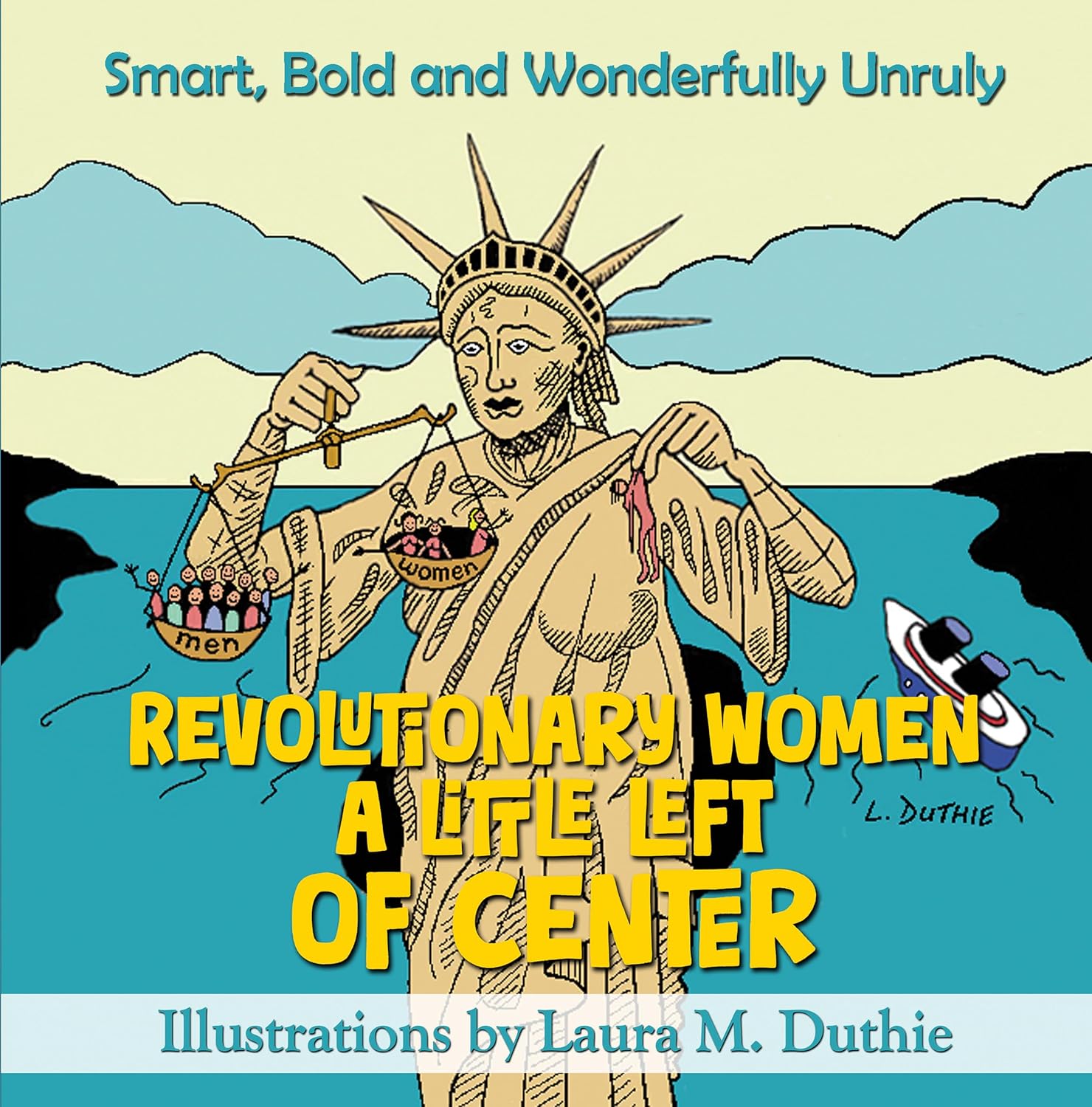
Laura M. Duthie’s Revolutionary Women: A Little Left of Center is part memoir, part feminist manifesto, and part visual commentary. The book weaves together Duthie’s personal history with her artistic and ideological journey. From her early life in Toronto to her awakening as a gay artist, Duthie recounts experiences that shaped her identity and worldview. Alongside her autobiographical reflections, she presents a series of feminist cartoons and essays that tackle themes like religion, patriarchy, sexuality, and society’s deeply ingrained biases. The work feels like both a confession and a call to action, a deeply personal yet universal exploration of what it means to claim one’s voice in a world that often silences women.
Reading this book felt like sitting down with someone who’s lived through several lifetimes of rebellion. Duthie’s tone is sharp and funny and sometimes achingly vulnerable. She doesn’t sugarcoat the pain of growing up under misogyny or the confusion of coming into her sexuality in an unwelcoming world. What struck me most was how her humor doesn’t dull her anger, it sharpens it.
The cartoon’s artwork is executed in a clear, traditional comic-strip style defined by bold outlines and a flat, simple color palette. This accessible visual style serves its purpose effectively, ensuring that the viewer’s attention is drawn immediately to the characters’ actions and the text in the speech bubbles. My favorite was the “Moon Walk.” The cartoon provides a sharp, satirical commentary on contemporary social polarization. It cleverly transports a modern “culture war” debate to a history-making moment, the first landing on another world, signified by the “APHRODITE I” lander. The humor stems from the juxtaposition of this grand achievement with petty ideological infighting.
There’s also something raw in how she talks about art and identity. When Duthie describes art school and the chaos of creative discovery, it’s electric. She paints the world of artists, the lost, the brilliant, the broken, with an honesty that’s both funny and sad. I felt her frustration with the hypocrisy of society, and I admired her courage to turn that frustration into something that challenges and provokes. Some parts run on, sure, but that’s part of the charm. It feels real. It feels like someone thinking out loud, refusing to polish herself for anyone’s comfort. Her take on Freud made me laugh. It’s the kind of commentary you wish you’d said yourself but never found the guts to.
This book left me thinking about what it really means to be revolutionary. Not in the sense of shouting the loudest, but in daring to be honest. Revolutionary Women is alive and full of heart and bite. I’d recommend it to anyone who loves art that has something to say, especially women and gay readers who’ve had to fight for their place in the world.
Pages: 67 | ASIN : B0FFZT3611
Dusty Roads: Meet the Hidden Figure Who Really Ignited the Women’s Movement

Elaine Rock’s Dusty Roads tells the story of Barbara “Dusty” Roads, a trailblazing flight attendant who dared to challenge the airline industry’s sexist standards in the 1950s and 60s. The book follows Dusty’s rise from a young stewardess bound by age limits, girdle checks, and marriage bans to a formidable advocate who reshaped labor rights and gender equality in aviation. Rock paints an intimate portrait that blends Dusty’s personal struggles with broader social change, showing how one woman’s determination rippled into the women’s movement itself.
Reading this biography felt like being on a flight through time. It’s turbulent, beautiful, and filled with purpose. Rock’s writing is crisp yet full of warmth. I could feel her admiration for Dusty in every page. What I enjoyed most was the balance she found between Dusty’s grit and her vulnerability. The author doesn’t just list victories. She lets us feel the cost of them, the isolation, the heartbreak, the stubborn hope that kept Dusty going when most people told her to sit down and be quiet. There’s a quiet defiance in the tone that made me cheer for Dusty, even when the odds were stacked sky-high.
The blatant discrimination, the absurd rules about weight and marriage, the humiliation of being judged for your age, it’s maddening. But Rock doesn’t preach. She lets the history speak for itself, and that makes it hit harder. I found myself reflecting on how many women still face subtler versions of the same nonsense today. The mix of historical detail and Dusty’s personal voice pulled me in completely. It didn’t feel like reading a textbook about feminism. It felt like sitting across from a brave, funny, no-nonsense woman telling me her life story.
By the time I reached the end, I felt a mix of admiration and gratitude. Dusty Roads is the kind of book that sneaks up on you. It educates, but it also stirs something deep inside. I’d recommend it to anyone who loves stories about ordinary people doing extraordinary things, especially readers who crave strong female voices that history almost forgot. It’s perfect for those who want to understand how real change begins, not with grand speeches, but with one person refusing to accept “that’s just how it is.”
Pages: 436 | ASIN : B0DL4F6B56
A Place for Memories
The Path to Heaven follows an aging Parisian tour driver haunted by grief and faith, who embarks on a cross-cultural journey to reconcile loss, belief, and the idea of heaven itself. What was the inspiration for the setup of your story?
The seed of this story came from watching drivers and guides in Paris—people who spend their days ushering others toward beauty while quietly carrying their own lives in the background. I wondered what it might feel like to witness so many reunions, honeymoons, and celebrations when your own heart is learning to live with absence. Lucas emerged from that question: a man who knows every street in a luminous city yet is still learning the road back to himself.
I was also inspired by conversations across cultures and faiths—how a simple ride can open a door to someone’s private world. The novel began as a quiet scene in a cemetery and unfolded into a journey where each encounter gently reshapes Lucas’s understanding of loss, devotion, and what “heaven” might mean on ordinary days.
The writing in your story is very artful and creative. Was it a conscious effort to create a story in this fashion, or is this style reflective of your writing in general?
The style is both intentional and natural to me. I’m drawn to concise sentences that carry a quiet rhythm—language that leaves room for breath, like a prayer spoken softly. I wanted the prose to mirror Lucas’s inner pace: deliberate, attentive, tender. While I do adapt my voice to each project, I tend to favor imagery, musical cadence, and moments where silence speaks as loudly as dialogue.
What were some themes that were important for you to explore in this book?
For many young people, faith, religion, and even the idea of life and death can feel distant—something abstract or far away from daily life. I wanted to explore that distance and quietly bridge it. I didn’t expect this story to open so many hearts, including my own. Through Lucas’s journey, readers begin to question what faith means beyond religion, and how love and loss can lead to a more personal kind of belief. What moved me most was realizing that a simple story could make people pause and reflect on something as vast as the soul.
Were you able to achieve everything you wanted with the characters in the novel?
Lucas and his daughter came into focus exactly as I hoped—quiet, resilient, imperfect, and brave. Some side characters, like the young Chinese artist and the Russian veteran, still linger with me; I can imagine returning to them in a companion novella or stories that follow the threads they began. But for this book, I’m content with the spaces I left for readers to inhabit—places where their own memories can meet the characters halfway.
Author Links: GoodReads
The Story That Wanted To Be Told

Morgan’s Landing follows a local police detective from a small Maryland town who is investigating the disappearance of a fourteen-year-old girl from the town’s wealthiest family and digging up buried secrets in the process. What was the inspiration for the setup of your story?
It began with the idea that even in a small town full of friendly neighbors, people would rush to judgment and start blaming each other if a young girl disappeared. I’ve always enjoyed police procedurals and had written one, Guilty Knowledge, with an urban setting, but I thought it might be interesting to trace the actions of a small town detective investigating within his own community.
It seemed like you took your time in building the characters and the story to great emotional effect. How did you manage the pacing of the story while keeping readers engaged?
I don’t think I managed the pacing so much as I let it flow naturally. I told the story that wanted to be told in the way the characters would let me tell it. I think being engaged in the story myself is the best way to encourage readers to stay with me on the journey.
What were some themes that were important for you to explore in this book?
I was more interested in how a small town detective would go about investigating a case than in what the solution would turn out to be. The dynamics of a family in which the members seem to be at odds and each has his or her own version of the story also intrigued me.
Is this the first book in the series? If so, when is the next book coming out, and what can your fans expect in the next story?
While it isn’t impossible for Detective Jim Brady to have another case in the future, Morgan’s Landing was never intended to be part of a series. I feel as if I’m done with these characters—or they’re done with me—but I never know when something may spark the next story, and if it turns out to fit into the world of Morgan’s Landing, so be it!
Author Links: GoodReads | X | Facebook | Website
Detective Jim Brady, married and the father of two, has been on the Morgan’s Landing police force for twelve years. He identifies a few suspects in the girl’s disappearance—Is it the fired school janitor, a paroled sex offender, Julie’s computer teacher…or his own teenage son? Jim can’t believe his son could be involved, but his wife is convinced the boy is hiding something.
He needs to find Julie before the worst happens—and keep the peace at home.
Thriving In The Modern Workplace: A Gen Z Guide to Success

Giselle Sandy-Phillips’s Thriving in the Modern Workplace is a guidebook written straight to and for Gen Z professionals trying to find their footing in a constantly shifting job market. It’s part handbook, part pep talk, and part mirror for a generation raised online but forced to work within systems built before them. The book mixes structured lessons on communication, adaptability, and self-assessment with moments of warmth, humor, and raw honesty. It moves fluidly between coaching and storytelling, showing how to navigate everything from hybrid work models to mental health struggles, while still pushing readers to define success on their own terms.
What I loved most was how personal and conversational the writing felt. It doesn’t preach, it talks to you like a friend who’s figured a few things out and wants you to avoid her mistakes. The tone is direct and modern, full of personality yet surprisingly practical. Sandy-Phillips knows how Gen Z thinks and what they value, and she meets them where they are. The self-assessments are smart additions, turning the book into an interactive experience rather than just something to read passively. I found myself nodding along, sometimes laughing, sometimes pausing to think about how deeply this generation is shaped by chaos and connection at the same time. The balance of empathy and blunt advice worked well, it felt relatable and grounded, never performative.
The book feels like it’s both a therapist and a career coach. There were sections that revisited ideas or leaned into slogans that read more like social media captions. The sincerity always shines through. What really works is how Sandy-Phillips captures the anxiety and ambition of being young in a world that never stops moving. She never blames or patronizes; instead, she guides you toward finding rhythm in the noise. That’s what makes this book feel alive. It reflects the messiness of real growth, not a polished version of it.
I’d recommend Thriving in the Modern Workplace to anyone in their late teens or twenties who’s unsure how to start, or restart, their career without losing themselves in the process. It’s especially good for students, new graduates, and even mid-level professionals who need a reset. It’s not just about jobs; it’s about identity, purpose, and peace of mind. If you’re the type of person who wants to build a life that works for you and not just through you, this book is worth your time. It won’t hand you answers, but it’ll help you ask better questions, and that’s what thriving really looks like.
Pages: 212 | ASIN : B0FSVXNXJ4




 LITERARY TITAN