Blog Archives
So You Want to Be A Candy Scientist
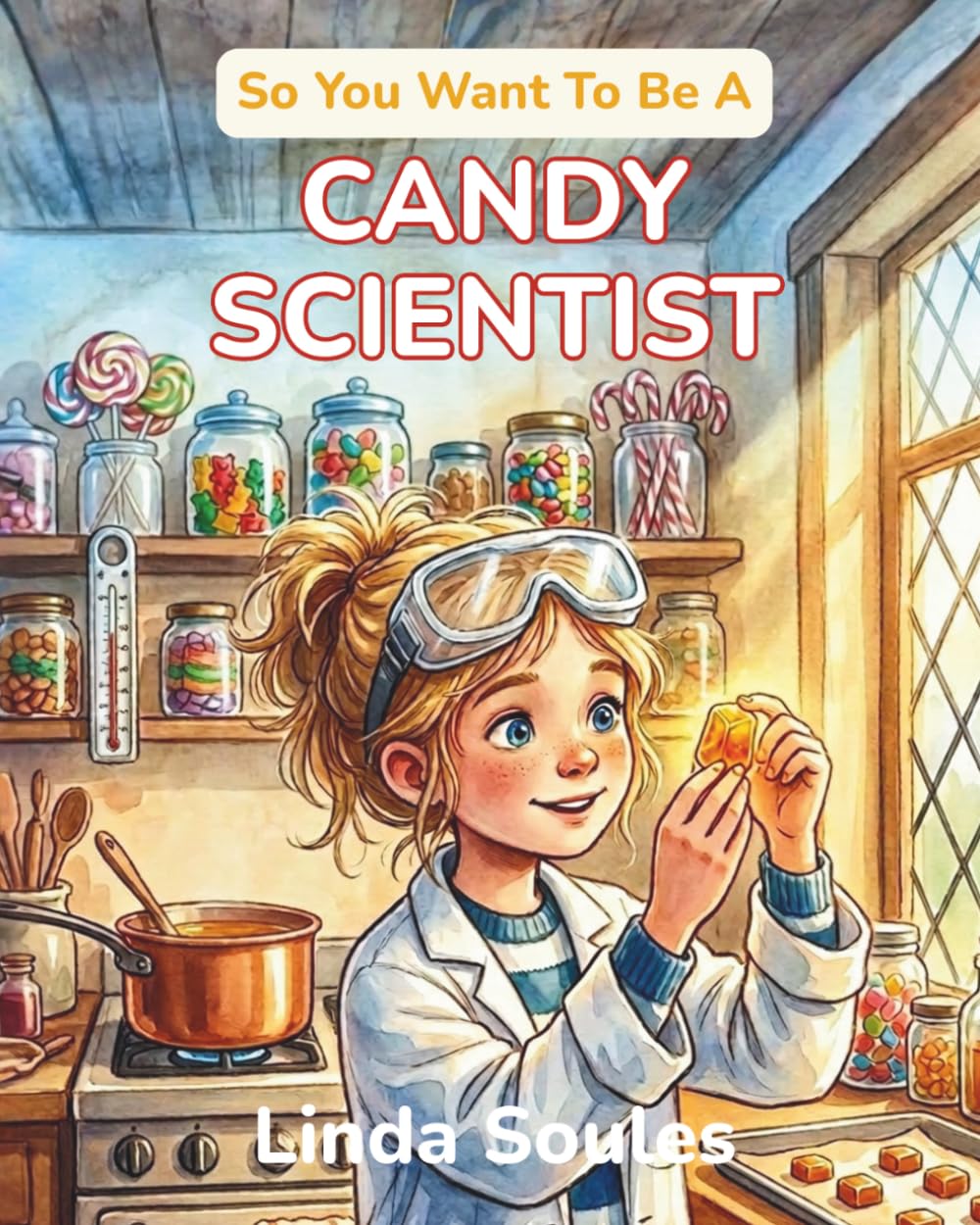

So You Want to Be A Candy Scientist is a delightful and informative children’s book that turns candy into a gateway for scientific discovery. Written for curious young readers, the book explores the fascinating work of candy scientists, showing how chemistry, creativity, and problem-solving come together to make the treats kids know and love. From gooey caramels and crunchy lollipops to chocolate that melts just right, Soules explains how small changes in temperature, texture, and ingredients can completely transform the final product.
One of the book’s greatest strengths is how accessible and engaging it makes STEM concepts feel. Rather than reading like a textbook, the book feels conversational and inviting, helping readers understand topics such as sugar stages, chocolate tempering, sour candy chemistry, and the science behind color and flavor. Young readers learn that a lollipop is technically glass, cotton candy is mostly air, and chocolate gets its satisfying snap from carefully formed crystals. These fun facts make the science memorable while encouraging children to keep asking “why.”
Author Linda Soules also does an excellent job introducing the real people and teamwork behind candy making. Readers meet pioneers such as Harvey Wiley, Milton Hershey, and Rebecca Robbins, whose discoveries helped shape candy safety, shelf-stable chocolate, and food coloring research. The book highlights that being a candy scientist is not just about tasting sweets all day; it takes patience, careful testing, communication, and the willingness to try again when experiments fail. This career-focused angle makes the book especially useful for classrooms, STEM lessons, and career exploration units.
The hands-on experiments and reference materials at the end make this book even more valuable. Activities such as growing rock candy, making edible sugar glass, and testing chocolate snap allow children to turn their own kitchens into mini laboratories. The colorful illustrations, clear explanations, glossary, and next-step resources all work together to inspire curiosity long after the final page. So You Want To Be A Candy Scientist is a fun, educational, and inspiring read for families, teachers, and young learners who want to discover how science helps make the world a little sweeter.
Pages: 38 | ISBN : 978-1972766590

So You Want To Be A Fashion Designer

So You Want To Be A Fashion Designer, by Linda Soules, is an inspiring and highly engaging introduction to the world of fashion design for young readers. Written for kids ages 10 to 14, this illustrated guide follows the creative journey of a garment from the first rough sketch to the runway. Soules presents fashion as far more than glamorous clothes; she shows it as a form of communication, identity, problem-solving, and wearable art.
I loved how the book balances the excitement of fashion with the realities of the profession. Readers learn that designers must think like artists, engineers, storytellers, material scientists, and problem-solvers. The book explores trend forecasting, fabric choices, sketching, sewing, garment production, and the teamwork involved in bringing a collection to life. It also doesn’t ignore the more difficult parts of the industry, including tight deadlines, copied designs, sustainability concerns, waste, and the importance of fair treatment for workers.
Soules fills the book with fascinating history, memorable facts, and stories of creative visionaries such as Coco Chanel, Virgil Abloh, and Issey Miyake. Young readers will be surprised to learn details such as the origins of high heels and the extraordinary amount of handwork that can go into a single haute couture gown. The hands-on activities are especially valuable, encouraging readers to start a sketchbook, drape fabric, redesign or repair garments, and begin thinking like designers right away. The glossary and “The Most Important Qualities of a Fashion Designer” sections make the book feel practical.
This is much more than a simple career guide. Linda Soules writes with warmth, encouragement, and respect for her young audience, never talking down to them while still making complex ideas easy to understand. The vibrant illustrations and lively descriptions make studios, fabrics, and runways feel vivid and exciting. So You Want To Be A Fashion Designer is an excellent choice for creative kids, aspiring artists, and anyone curious about how clothing can help people feel seen, confident, and valued. It is educational, realistic, and wonderfully inspiring.
Pages: 38 | ISBN : 978-1972766347
Faith and Nature Are Woven Together

God’s Plants centers around three children and their great-grandparents as they share the day discovering “biblical plant signs” placed among flowers, herbs, vegetables, and trees. What inspired you to write this book for young readers?
I’m a 75-year-old first-time published author. proud great-grandmother of 7 beautiful great-grandchildren, I was inspired to write this book for them and for all GOD’s young readers. My husband suggested I build on the biblical plant signs we made. I researched a list of 66 biblical plant signs for my graduation project to become a Certified Gardener. The list is included in the back of the book. I actually have a greenhouse and even the Crown of Thorns plant. The only way to write about biblical plant signs is to introduce the Bible, GOD, and Jesus. God’s Plants provides a unique way to see how faith and nature are woven together.
Why is it important for children to see connections between faith and the natural world?
Biblical plants are usually overlooked when reading the Bible. GOD’S PLANTS will give readers an awareness of how nature is intertwined with faith. Plus, the book is a great way to introduce the Bible, GOD, and Jesus.
What do you think children learn differently from grandparents than they do from parents or teachers?
As a great-grandmother, I wish I could have done many things differently when raising my son. But now I can reflect on my past experiences and share them with my great- grandchildren so they can learn from my mistakes. Today’s parents are busy living in the moment, while teachers are teaching what is needed to live a fruitful life. Grand and great-grandparents can provide real-life occurrences that will help shape a child’s behavior and values.
All my books will have messages I would communicate to my great-grandchildren, and they can pass on. By publishing my books, I hope to connect with other families and children.
What was the most rewarding part of creating GOD’s Plants?
Being able to bring to life, in GOD’S PLANTS, the awareness and beauty of biblical plants. And sharing where they are found in the Bible from my list of 66 biblical plants. (And there are more.) But most of all, introducing the Bible, GOD, and Jesus to the young readers, and making this a joyful family book reading opportunity.
Author Links: GoodReads | Facebook | Website | Amazon
Where the Kaleidoscopes Turn

Where the Kaleidoscopes Turn, by Joan Enockson, follows Cody, an eleven-year-old boy who’s carrying the quiet sting of a rough school year, as he visits his grandpa in Pocahontas County, Iowa. What begins as a family trip becomes a tour of giant kaleidoscopes scattered through small-town parks, each one opening into a memory, a lesson, or a new way of seeing the world. With Grandpa Russell, Cody’s new puppy Molly, and the legacy of Leonard Olson guiding the story, the book becomes less about sightseeing and more about learning how beauty, community, and perspective can change a person from the inside out.
I really appreciated the heart of this book. I felt drawn to the way it treats Cody’s unhappiness without making it too heavy for young readers. He’s not written as a dramatic problem to solve. He’s a child who is hurt, withdrawn, and a little stuck, which felt honest to me. The relationship between Cody and his grandpa is the emotional center, and it’s handled with a gentle patience I found moving. Grandpa doesn’t lecture so much as notice, wait, tell stories, and lets Cody arrive at understanding in his own time. That felt true to childhood, and also true to good parenting.
The writing has a homespun, reflective quality that fits the rural setting well. The lessons are stated clearly, but I can see why that directness would work for younger readers. The ideas are lovely, especially the way each kaleidoscope becomes a metaphor for change, memory, courage, family, community, and choosing what we put into the world. I also thought the artwork gave the book much of its charm. The illustrations have a soft sketchbook feel with bursts of watercolor-like color, and that splashy brightness mirrors the kaleidoscope theme beautifully. The images of the small towns, parks, farm scenes, and Cody with Molly add warmth and texture, making the book feel both personal and rooted in a real place.
I found Where the Kaleidoscopes Turn to be a tender, thoughtful book with a strong sense of place and a sincere belief in the value of looking at life differently. It’s earnest and full of affection for grandparents, small towns, old memories, and children who need a little help finding their footing again. I’d recommend it for elementary and early middle-grade readers, especially kids who enjoy family stories, gentle life lessons, dogs, road trips, or books that leave them feeling steadier and more hopeful by the end.
Pages: 98 | ISBN : 978-1958023648
Mystical Encounter

A Stargazer centers around a sick little girl who is convinced she has been healed by a star boy and his magical stardust. Where did the idea of Vesper, the “star boy,” come from?
Already early on, I borrowed all the space-themed nonfiction books from the small library in my home village and tried to observe the starry sky on dark winter nights. However, without a telescope, you couldn’t see much detail, although you could spot some constellations. For my story, A Stargazer, I drew inspiration and details primarily from this childhood fascination with the starry sky.
There is also a particular incident that closely resembles the meeting between my story’s little girl and the starboy. As a child, I built a snow lantern in windy weather so enthusiastically and for so long that I ended up with a very high fever. I had to stay in bed for days, and the illness wouldn’t let up. Finally, in my feverish delirium, I saw a translucent figure descend onto my blanket and smile kindly at me. When I told my mother about this angelic visitor, she quickly arranged for me to see a doctor.
I’ve slightly modified this mystical encounter with my clear angel figure to the beginning of my book. As a teenager, I fell in love with David Bowie’s song “Starman.” There was – and still is – something very captivating about its lyrics and melody. What do we really know? What if this isn’t all there is? What else could there be in the universe?
Do you believe wonder is a starting point for learning, especially in children?
Absolutely. Curiosity and a desire for knowledge are powerful forces. It’s good to satisfy them by reading, asking questions, and listening to those who are more experienced and knowledgeable than you.
I have personally gained a lot of knowledge from libraries. Of course, schools and later studies have continually added to those lessons. I hope that learning never stops, not even now that I am in my senior years. At least, I remain just as curious about everything around me—only the things that need explanation have changed.
I believe that curiosity and wonder keep people engaged and active at any age. Mental fitness influences us throughout life and can support overall well- being. It’s unfortunate when adults discourage a child’s enthusiasm for exploring the world. I always try to encourage young minds to make their own observations and think independently. I see my children’s books as a tool for this as well!
Life is such an interesting and valuable gift, regardless of your age, that it’s worth embracing it as the ultimate journey of discovery. We never know where the winds and currents will carry us. There’s plenty to wonder about along the way, and the destination itself invites reflection.
The artwork in your book is wonderful. Can you tell us about your collaboration with illustrator Nyamdorj Lkhaasuren?
I have had the pleasure of working with Mongolian illustrator Nyamdorj Lkhaasuren on several children’s books. Our collaboration started years ago through our mutual connection, Mongolian publisher Nepko Kids.
Initially, Nyamdorj Lkhaasuren illustrated my Axel and Ava Series. His interpretation added warmth, color, and humor to the everyday adventures of young children. When I started working on the Lyrics of Life Series for slightly older children, two stories immediately came to mind that would be perfect for Nyamdorj Lkhaasuren to illustrate. He was excited about the topics, so A Stargazer and The Hermit’s Hut were recently created and recently published in English and Finnish.
Lkhaasuren’s art is vibrant and detailed. In our two latest collaborations, his style creates enchanting and magical worlds with richer colors and more mystical details. He utilizes modern digital technology to its fullest, and the spreads he creates are a constant inspiration to me. He is exactly the kind of illustrator whose visual interpretations of my stories inspire me to write more and more.
I hope we can soon continue our collaboration on new books. I have already drafted some stories for this purpose. But first, I’m going to pitch A Stargazer and The Hermit’s Hut to the publishers I’ll meet at the Bologna Children’s Book Fair later this spring.
What do you hope children feel when they recognize themselves in Aylin?
Aylin, the main character, is both vulnerable and strong. I hope children find inspiration and encouragement in this story when they need to dig deep to build self-confidence and pursue their dreams.
Life is about standing your ground, even when others oppose you. Sometimes, obstacles are tough and require a lot of courage to overcome. Other times, they’re more subtle and involve just some headwinds. Aylin faces both types. It’s never easy to be the only one who believes in something, and enduring the laughter, teasing, and belittling from others makes it even harder.
Aylin’s behavior in the book also demonstrates a vital lesson: the value of seeking help and forming alliances with trustworthy, like-minded people. The young girl receives support from three different adults, each aiding her in a unique way. Her father shares her fascination with space and assists with the telescope, while the librarian respects her curiosity by guiding her toward the right books. Additionally, she finds a surprising kindred spirit in the old janitor of the observatory, who also has stardust in his eyes.
By featuring such a diverse cast of supporters, the story aims to encourage making friends across different ages and backgrounds and finding common ground with them. The best companions for life’s various journeys aren’t always found among peers—while those connections may feel more effortless, they don’t always challenge and refine our thoughts in the same way.
Growing up around people of all ages and generations simply taught me about humanity and the value of collaboration. These experiences gave me the courage to face life’s challenges together with others. I often say that age is a fluid concept. Some are born old, while others remain eternal children. These different starting points lead to fascinating encounters, where you might even find yourself talking about stardust, if the mood strikes you!
Author Links: GoodReads | Website | Warm Values | Facebook | LinkedIn | Amazon
But when Aylin’s class visits the city observatory, things don’t go the way she expects. Her most important questions are met with impatience-and laughter. Just when she’s about to give up, an unexpected friend appears: the observatory’s elderly janitor, who seems to understand stardust and the beauty of the universe better than anyone.
A luminous picture book about curiosity, resilience, and keeping your sense of wonder-even when others don’t understand.
So You Want To Be A Race Car Driver

So You Want To Be A Racecar Driver is an engaging installment in a career-focused series that introduces young readers to the exciting world of professional racing. The book explores what it takes to become a racecar driver while offering a realistic look at the responsibilities, training, and dedication required for this profession. It presents the information in an accessible, age-appropriate way and includes additional facts and resources for children who may want to learn more about this career path.
I appreciated the level of detail provided throughout the book. It is both informative and entertaining, giving readers a strong understanding of the career while also sharing interesting facts and trivia about racing. The book offers a look into a day in the life of a racecar driver and highlights the work involved in preparing for a race, both on and off the track. It makes clear that racing requires preparation, discipline, teamwork, and commitment. I especially enjoyed the inclusion of information about the pit crew, one of the most fascinating aspects of racing.
I would recommend So You Want To Be A Racecar Driver to young readers who are beginning to think about what they might want to be when they grow up. This book is a fun and informative introduction to a unique career path, filled with facts and trivia that will keep curious readers engaged from start to finish.
Pages: 38 | ISBN : 978-1972766156
Pari the Panda Learns About Patience: Patience Is a Fruit of the Spirit

Pari the Panda Learns about Patience, by J.M. Ashmore, follows a young panda who rushes from one thing to the next, first swimming too soon after breakfast, then wandering into a trap because she can’t resist the bamboo leaves inside. After a frightening escape, Pari finds a safer part of the forest and begins to understand what patience really means: not just waiting, but slowing down long enough to make wiser choices. The story gently ties that lesson to the Fruit of the Spirit, giving children a concrete way to think about patience through Pari’s mistakes, fear, relief, and growth.
What I appreciated most is that the book doesn’t treat patience like a tidy little rule children should memorize. Pari learns it the hard way, through discomfort and danger, and that makes the message feel more alive. As a parent, I found that useful. Children know what it feels like to want something right now, whether it’s a snack, an adventure, or a shiny mystery across the lake. Pari’s impulsiveness feels recognizable without making her seem “bad,” and I liked that the story gives her room to reflect. The writing is simple and direct, with a clear sense of cause and consequence. I also liked the added questions at the end, because they turn the story into a real conversation about safety, self-control, and learning from a scary moment.
The artwork is bright, soft, and inviting, with lush bamboo forests, stirring scenes, and an expressive little panda whose eyes carry a lot of the emotional weight. There’s a sweetness to the illustrations that balances the more intense parts of the plot, especially the trapping scene. The story takes a surprisingly dramatic turn. That tension gives the book more substance than a simple moral tale. The faith element is present and clear, particularly with the Galatians verse near the end, but the central idea also works on a practical level: pause, think, ask for help, and don’t let curiosity outrun wisdom.
I found Pari the Panda Learns About Patience to be a heartfelt picture book with a sincere moral center and a memorable little heroine. It’s best suited for young children, Sunday school settings, or parents looking for a story that opens up gentle conversations about patience, safety, and making thoughtful choices. I’d recommend it for young children who like animal stories with a little adventure, especially when read with an adult who can talk through Pari’s fear, her decisions, and the relief of finding a safer place to belong.
Pages: 33 | ASIN : B0FTRWHJ5F
Memories From Childhood Summers
The Ghost of the Deserted House follows two friends who sneak into an abandoned house on a summer night, where they encounter an unexpected visitor and wonder if the house is haunted. What was the inspiration for your story?
My Active Kids Series currently includes four books: The Ghost of the Deserted House, Luke’s Sailing Adventure, A Museum Robbery, and The Leading Role. Already, the series’ name and the books’ titles suggest that the heroes are a group of children who encounter surprising, interesting, and sometimes even exciting situations. These stories are based on my own childhood games and the friends and siblings who joined in.
This particular book takes place during the summer and tells the story of a visit to a friend’s family’s summer cottage. I had similar visits as a child, and they always felt like an adventure. Spending the night with a strange family can be tough for a kid. It might be an unfamiliar place to sleep, and the family might eat something different from what you’re used to at home.
And how well do your skills hold up in unfamiliar environments? A beach can feel strange and unsettling. Is it deep? Is the bottom muddy, or are there nasty, slimy aquatic plants growing in the water? What about those dark, enticing yet scary attics or abandoned houses? I still get chills thinking about how exciting a nature walk at dusk is!
What were some ideas that were important for you to share in this book?
The main focus of this book is actually summer nature. At least Finnish children have the chance to experience it in many ways. I want to take my readers to an environment filled with summer scents, trees, plants, and birdsong. It was also the rural environment of my childhood, by the beautiful lakes of Eastern Finland.
I’ve drawn many memories from childhood summers throughout my adult life. I can still close my eyes and return to those landscapes in my mind. Nature is the greatest teacher. It allows us to see and experience things from small to large, helping us reflect on life as a whole. And children feel connected to the vastness of nature, even when they’re just playing a simple game with stones and squatting on the ground.
I also remember how inspiring it was to constantly learn new things. I believe a child is a kind of explorer, whom we adults should give a rich environment to explore and challenges to face. Ideally, children should explore and learn early with their friends. In this story, two young friends share the same experience, and supporting each other becomes essential when things get too exciting. – They say shared joy is double the joy, and I believe that, too!
What scene in the book did you have the most fun writing?
The adult me was, of course, captivated while writing a nostalgic journey through my childhood and its experiences in nature. But the most fun and inspiring part was writing the sections where the children set out on their own adventure in the abandoned house.
After all, the attic scene is the most exciting part of the story. There, the children display independence and a bit of daring. Such activities are usually the most fascinating for young readers.
I wanted to take my readers on an experience they might not have in real life. It’s always fun when an adult in a story does something funny or even gets caught up in a prank or trick. I think the father snoring in a hammock is quite endearing, especially when the kids attack this “ghost” in the dark attic.
What is the next book that you are working on, and when will it be available?
In our small family business, I get involved in various parts of our publishing process. It’s rewarding to have direct contact with the people who create illustrations, edit, and lay out the work. As usual, I have numerous book projects at different stages. Some are still in the illustration phase on the artist’s desk, while others have just returned from editing.
I just published my 80th English children’s book in my writing career—there are even more in Finnish. The book The Hermit’s Hut is the fourth installment in my Lyrics of Life Series. This time, the story was inspired by John Lennon’s song Imagine. I believe the next sequel to this series will likely be published sometime next year.
Before that, I plan to publish two slightly longer novels for young readers. Those are really fun to write now and then. You get to create a longer adventure with a more complex plot, which allows more focus on the characters. These upcoming children’s novels include the exciting time travel adventure Professor Dreistein and the Captured Lightning and The Singing Ghost of Troll Village, which centers on a talent competition in a troll village. We can expect these new novels to be released later this year.
Until then, we at Wickwick need to focus on promoting our Bilingual Books Series—there are many titles featuring various language pairs! I hope these books help children worldwide master situations where they need to immerse themselves in two languages. It’s definitely more enjoyable with a good story and beautiful illustrations.
Creating new books is truly wonderful, but it’s also rewarding to share them with international publishers, such as at the Bologna Children’s Book Fair or the Frankfurt Book Fair. I was especially excited this spring when the Finnish version of one of my stories, “Carried by Wings,” was nominated for a prize in a Finnish competition. Wish me luck!
Author Links: GoodReads | Website | Warm Values | Facebook | LinkedIn | Amazon
Something strange happens when the boys decide to escape the heat and mosquitoes and go to the attic of the deserted house next door.
Do ghosts suffer from the heat too?


