Blog Archives
Where the Kaleidoscopes Turn


Where the Kaleidoscopes Turn, by Joan Enockson, follows Cody, an eleven-year-old boy who’s carrying the quiet sting of a rough school year, as he visits his grandpa in Pocahontas County, Iowa. What begins as a family trip becomes a tour of giant kaleidoscopes scattered through small-town parks, each one opening into a memory, a lesson, or a new way of seeing the world. With Grandpa Russell, Cody’s new puppy Molly, and the legacy of Leonard Olson guiding the story, the book becomes less about sightseeing and more about learning how beauty, community, and perspective can change a person from the inside out.
I really appreciated the heart of this book. I felt drawn to the way it treats Cody’s unhappiness without making it too heavy for young readers. He’s not written as a dramatic problem to solve. He’s a child who is hurt, withdrawn, and a little stuck, which felt honest to me. The relationship between Cody and his grandpa is the emotional center, and it’s handled with a gentle patience I found moving. Grandpa doesn’t lecture so much as notice, wait, tell stories, and lets Cody arrive at understanding in his own time. That felt true to childhood, and also true to good parenting.
The writing has a homespun, reflective quality that fits the rural setting well. The lessons are stated clearly, but I can see why that directness would work for younger readers. The ideas are lovely, especially the way each kaleidoscope becomes a metaphor for change, memory, courage, family, community, and choosing what we put into the world. I also thought the artwork gave the book much of its charm. The illustrations have a soft sketchbook feel with bursts of watercolor-like color, and that splashy brightness mirrors the kaleidoscope theme beautifully. The images of the small towns, parks, farm scenes, and Cody with Molly add warmth and texture, making the book feel both personal and rooted in a real place.
I found Where the Kaleidoscopes Turn to be a tender, thoughtful book with a strong sense of place and a sincere belief in the value of looking at life differently. It’s earnest and full of affection for grandparents, small towns, old memories, and children who need a little help finding their footing again. I’d recommend it for elementary and early middle-grade readers, especially kids who enjoy family stories, gentle life lessons, dogs, road trips, or books that leave them feeling steadier and more hopeful by the end.
Pages: 98 | ISBN : 978-1958023648

God’s Plants
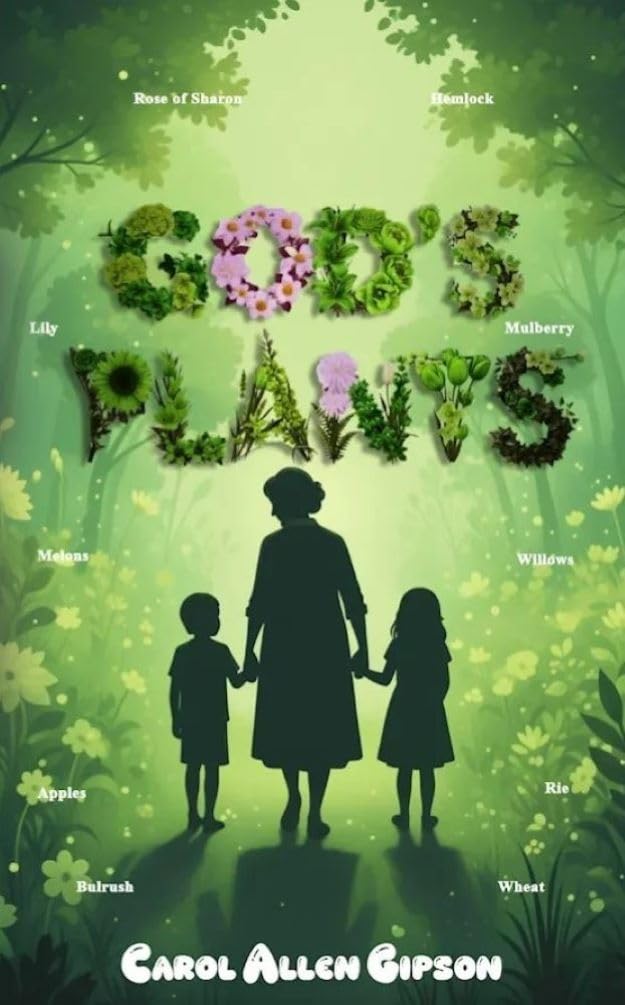
GOD’s Plants, by Carol Allen Gipson, follows three children, James, Marlene, and Robert, as they spend a sunny afternoon with their great-grandparents, Nana and Grandpa. What begins as a playful visit turns into a gentle backyard adventure when the children discover “biblical plant signs” placed among flowers, herbs, vegetables, and trees. Through their curiosity, Nana introduces them to the Bible, God, Jesus, prayer, and the meaning behind plants like mint, herbs, palm, and the Crown of Thorns.
There’s a sweetness in the way faith is presented through ordinary family time, not as a lecture but as a conversation that grows out of children noticing the world around them. I especially liked the garden setting because it gives the spiritual lessons something tangible to rest on. A child can smell mint, see a palm tree, touch a leaf, and then connect that sensory moment to a Bible verse. That idea feels thoughtful and memorable. The writing is warm and direct. The grandmotherly voice has a comforting quality, and I could feel the author’s desire to pass down faith, family memory, and a love of growing things.
The artwork gives the book a soft, welcoming atmosphere. The characters look kind and expressive, and the garden scenes have a glowing, storybook warmth that fits the tone beautifully. I was most drawn to the pages where the children explore among the herbs and signs, because those illustrations make the learning feel alive and playful. The Crown of Thorns section carries more emotional weight, and I appreciated that the book doesn’t avoid the seriousness of Jesus’ suffering, while still framing it gently for young readers. Some of the transitions can feel a little abrupt, especially when the story moves from plant hunting into deeper theology, but the tenderness of Nana’s explanations helps smooth that shift.
GOD’s Plants is a faith-centered picture book with a clear purpose and a deeply personal spirit. It’s best for Christian families, Sunday school settings, grandparents reading with grandchildren, or parents who want to introduce children to biblical ideas through nature and gardening. I’d recommend it especially for young readers who enjoy gentle family stories and hands-on connections between faith and the natural world.
Pages: 43 | ASIN : B0G5BQ1F9N
My Grandma Lives in Florida

My Grandma Lives in Florida, by Jeanne E. Rogers and Katharine A. Rogers, is a sweet picture book about a child visiting Grandma in Florida and all the things that make those visits special. She and her dog Stella go on sunny walks, spot birds and animals, and take in the flowers, trees, and warm air around them. The story moves through one gentle day and then opens up into extra pages with facts and photos about the animals and plants in the book, so it feels like both a story and a little nature tour.
This tale gave me that cozy, slow-morning vibe right away. The red hat, the leash, the walk, the pond, the backyard, the lemonade. It all felt warm and easy. I also appreciated that the book keeps its eyes on simple moments. Nothing huge happens, and that is part of the charm. It made me think of the kind of outing a kid would remember for years, just because it was with someone they adore.
The writing is direct and easy to follow, which works well for a picture book. It reads almost like someone talking to a child while pointing things out on a walk. The real standout for me, though, is the idea behind the book. It quietly mixes family love with curiosity about nature. I also loved that the back of the book adds glossaries with animal and plant facts and photos. The story ends, but the exploring continues.
I came away from My Grandma Lives in Florida feeling cheerful and a little nostalgic. I think it would be great for young kids who love animals, grandparents who want a cozy read-aloud, and families with ties to Florida or trips there. It is also a nice pick for children who enjoy learning little facts without it seeming like homework. I would recommend it to anyone looking for a gentle, affectionate picture book with a sunny heart.
Pages: 80 | ASIN : B0GHJ1PWGZ
Create a Memory

In Grandpa’s Christmas Gift, two children are granted a most amazing Christmas wish by an angel when they appeal to their late grandfather for a holiday miracle. Where did the idea for this story come from?
I was really close with my father and he passed away long before my daughter was born. I wanted to create a memory of him for my daughter and the idea was born!
Do you have a favorite scene in this story? One that was especially fun to write?
When the children dance in the snow and they ask for their grandfather’s help. That was my favourite because it shows how much they love him and also because they are not only asking for themselves – they’re also asking to make their parents happy!
The art in this book is fantastic. What was the art collaboration process like with Chloe Nyiri?
It was inspiring. It was great to work with her because she drew many ideas and I got to pick which ones I love!
What is the next book that you are working on, and when will it be available?
My next book is about my daughter as she loves playing with flashlights. The title is Emily and the Wonder Lamp.
Author Links: GoodReads | Website | Istvan Sanyi | Chloe Nyiri | Amazon
This lovely classic story is about a poor family who doesn’t have enough money to celebrate Christmas. The children ask grandpa from heaven but they don’t know if he can hear them or not.
You Can Have Your Cake and Grandparents Too!


You Can Have Your Cake and Grandparents Too! by C.L. Holliday-Firmin is truly a heartwarming story of a young boy that has a big misunderstanding. He thinks he must choose to invite only one of his six grandparents to his birthday party. How on earth could he possibly choose only one? Having to choose causes quite an upset for the young child because he has such a unique and special bond with each of them.
Those who are lucky enough to have had that special relationship with a grandparent can understand, if this was the case, the struggle this boy is going through. I connected with the story emotionally and felt, on a visceral level, the pain of having to make that difficult choice.
I feel this is such a great book for young readers to see the importance of family bonds. To show how the connections and relationships we build with our relatives are vital to our growth and overall happiness. This would be a great gift to a grandparent to show one’s love and affection and would undoubtedly leave a grandparent with a teary eye or two. The illustrations by Gull Zareen display the sweet nature of the moments the young child is reminiscing on about his grandparents. As the reader, I could feel the warmth of love radiating off each page and recalling my own cherished memories.
You Can Have Your Cake and Grandparents Too! is a creative picture book that shares a child’s fears and concerns and shows them working through things. It is a great lesson for children that many will be able to relate to.
Pages: 42 | ASIN : B0BB5L294C

My Grandpa – Book Trailer
When Grandpa visits, there is a whole world of possibilities that comes alive in the heart of one little girl who doesn’t only regard him as grandpa, but someone she can trust and depend on to be allowed to dream and explore, all in the realm of safety, because Grandpa’s love is just as special as her parents’ love.

Surprised and Amazed

Simon Perlsweig Author Interview
Front Porches to Front Lines uses the story of your great grandparents to tell a larger story about a small town affected by WWI. What was the inspiration that made you want to put this story into a book?
There were actually several inspirations which motivated me to turn my great-grandparents’ story into a book. Perhaps the most basic of these is simply the fact that I love history and thoroughly enjoy doing the research and writing about it. With that being said, the best way to cover all of the inspirations behind this book can probably best be told by talking about how the book began in the first place.
Front Porches to Front Lines is actually the expansion of a college essay with a similar title. I had always heard from my mother that there was letter somewhere in a box which talked about what took place on Armistice Day in 1918 in the small town of Springfield, Vermont where my great-grandparents were living at the time and I’d always hoped that I would find it someday. When I re-enrolled at the University of Connecticut in 2014 to finish my B.A. in American Studies I made up my mind that I wanted the remainder of my coursework to include an independent study project which would be completed under the guidance of a faculty advisor. Fortunately I found this letter and soon after found an advisor in Dr. Walter Woodward, a professor at UConn and the State Historian of Connecticut.
During the Fall 2014 semester, I researched World War One and the subsequent Influenza Epidemic of 1918 and in turned used the letter about Armistice Day and about 300 more family letters to tell the story of my great-grandparents’ experiences at this time as a microcosm of how the war and epidemic impacted people on the local, regional, national and international levels.
While, one of my biggest inspirations to write this book was to record my family’s story, I chose to tell this story in particular because of the wealth of primary resource material available to me and also to help expand the knowledge and scholarship of a chapter in the history of the United States which in some ways has gone largely overlooked until recently.
Lastly, I chose to turn this story into a book because it simply kept me busy with something I enjoyed doing. Since finishing my degree in the spring of 2016, my job hunt has been largely unsuccessful and expanding the essay which was my “senior thesis” of sorts into a book had given me a project to focus on amidst my bad job prospects. Plus, I was also of the belief that it would make my resume stand out in the future in a way that not many recent undergraduates’ resumes do. However, these last reasons are all somewhat secondary to those mentioned above.
I enjoyed the historical information provided in the book. What kind of research did you undertake for this book?
The scope of my research for this book was very broad and in fact I learned a lot of doing research and research methods on the fly while compiling the materials for Front Porches to Front Lines. The bulk of my research, about 60% of it, involved the careful analysis of the letters between my great-grandparents as well as those written between other family members and a few of their friends as well. I feel very fortunate to have had such an archive at my disposal while writing my book because it’s those letters which make up the majority of the family story which is at the center of the book.
Aside from the analysis of the letters, I conducted a handful of interviews, one with my great aunt, who is my only living relative at this time who knew all of the family members referenced in the book; I also interviewed the couple who run the historical society in Springfield, Vermont on two occasions to get a sense of what materials the town had left from the World War One era; and lastly, I interviewed a number people who had lived in Springfield during the first half of the 20th century and had some recollections of stories their parents and relatives had told them about Springfield during the 1910s.
I spent many hours in the public library in Springfield going through the microfilm they had copies of their local newspaper going back to World War One and was an excellent source of soldier letters as well as advertisements relating to both the war effort as well as the many remedies people were trying to cure themselves of the Spanish Flu. I spent time combing the objects and other materials at the Springfield Art and Historical Society and lastly, I used any primary source material related to war that I could get hands on along with a handful of pictures and other items from my family’s records.
What were some things that you found surprising about your grandparents lives?
To be honest, the majority of the information about my great-grandparents’ lives which I included in the book was all new to me. Since the location of their letters had been somewhat unknown for such a long period of time and since my family didn’t talk about many of the aspects of their lives that were detailed in these letters, much of what I learned from them was both new and surprising. For instance many of the down to earth details about daily living during this tough chapter in our nation’s history left me both surprised and amazed, especially given the circumstances of the world in which I grew up in the 1990s and 2000s. I was repeatedly left in awe of my great-grandparents’ ability to press on from one day to the next, when under the constant threat of a potential German invasion, the rapid spread of an infectious disease or both.
One particular episode during the 1910s which I found particularly curious actually was referenced in a letter between my great-grandmother and her sister. In this letter, my great-grandmother’s sister talks about hearing former president Theodore Roosevelt speak at a rally to raise awareness of the Armenian Genocide. Given, my family’s rather apolitical stances on things, it was surprising to find out that any of them participated in any event that was about an issue which didn’t directly threaten their lives or the nation’s security.
What is the next book that you are working on and when will it be available?
I have just begun the research for my next book, which at the moment is going to be a more comprehensive look at Armistice Day and how that day was celebrated around the world. However, since I am also in the process of getting ready to go back to graduate school, I do not have a good idea as of yet as to when that book will be completed and made available. I know that some of it will depend on my graduate school commitments as well as my ability to amass the resources I need to complete this project and do the topic justice.
Author Links: Facebook
 World War One and the 1918 Influenza Epidemic. Two events which will alwaysdefine the 1910s, a decade which saw great political and social change; a long list ofdisasters and a realignment of the global stage, something which would help define manyof the subsequent events of the twentieth century. When the United States declared war onGermany on April 2, 1917, it was just the first of two major calamities which would in someway impact just about every American man, woman and child during the latter half of the1910s.The second of these wars, the Spanish Influenza of 1918, came right on the heels of theGreat War’s conclusion on November 11, 1918 as many of the returning soldiers camehome with the influenza virus, having caught it either in Europe or sometime during thejourney home from France. Front Porches to Front Lines tells the story of how the citizensof one small New England town, came together to confront these two wars and in doing sobecame one of the most generous towns when it came to contributing to the war effort inthe form of Liberty Loans, war gardens and war supplies as well as dozens of soldiers, RedCross nurses and civilian workers, such as machinists.
Given To Me By Spirit

Jon de Graaff Author Interview
Friends of the Tsar is inspired by your personal experiences and your family history. Why was this an important book for you to write?
The diversity of my knowledge, which was given to me by spirit, was something too important to have lay dormant. The knowledge I accrued from many camping and four wheel driving trips was gained through life and death situations I encountered. If, by getting this information out to the world could save just one life, then I will have had good reason to write it.
The many miracles that kept my family and I safe on these learning adventures were so profound in that they were logic-defying, and I thought what better way to tell of my miracles than through an Australian character who entertained the Zuckschwerdts, my grandparents, with the narratives while snowed in.
What were some things that you felt had to stay true to real life and what were some things you took liberties with?
I felt that the horrific conditions in which my grandparents were successful in decamping from Russia had to stay true to life, also their personality.
I took liberties with the negative aspects of their plight because it would have been too depressing for a reader to continue reading. Too many family members were murdered by the Bolsheviks.
I also wanted to honour them with an acknowledgement of their plight after which they were positive in the rebuilding of their future together.
I felt like faith and family were important in the book. What were some themes you wanted to capture in this book?
The pivotal themes I wanted to capture were miracles, spiritual awareness, hope, danger awareness in nature, remembering ones heritage, and faith and family.
What is the next book that you are writing and when will it be available?
My mother, on the other side, wants me to write children’s books. My previous vocation as artist allows me to illustrate the books myself, and my eagerness to encourage young people to speak up when put in danger, especially when dad’s driving is too scary, strengthens my resolve.
It won’t be until this time next year that a book would be ready for publication, should I decide to do so.
Author Links: Facebook | GoodReads | Website

1917–The Russian Revolution. Danger and chaos abound, and the aristocratic Zuckschwerdt and Orloff families are desperate to escape to safety. Enter Blue, an Australian cattle-breeder with a big heart. Blessed by a heap of miracles from the Outback and beyond, he shares his gripping adventures with the snowed-in families. Blue has survived everything from bushfires to crocodile attacks.
With wolves and winter nipping at their heels, the Zuckschwerdts prepare to depart for the lucky country. Plunged into hostilities and espionage in Petrograd, they make a break for the high seas, only to find themselves in a deadly game of bluff with a German U-boat skipper.
Blue is in a predicament of his own when three of the Orloff daughters fall for his red earth charms. Will he find true love with one of them? And will his Aussie anecdotes help the family understand that awareness and preparation can spell the difference between life and death? As miracles begin to unfold, the Russian refugees discover the power of faith.
Inspired by Jon de Graaff’s personal experiences and his grandparents’ family history, ‘Friends of the Tsar’ is a thrilling tale. Spiked with humorous twists, tragic turns, perilous encounters, and life-saving lessons of survival. It offers spiritual insights into forgiveness and unconventional love.


