Blog Archives
The Fragility of Nature

The Falcon and the Songbird follows a girl coming of age in Texas whose private world is overtaken by the aftermath of Kennedy’s assassination, racial injustice, land greed, and the fight to protect a fragile natural habitat. What was the inspiration for the setup of your story?
I was fifteen and going to school in a small Texas town the day JFK was assassinated. It was the most devastating, shocking, unthinkable thing that had ever happened to me. Like April, I grew up loving nature and animals. At the time, I was not very sensitive to the fragility of nature, and I was also rather indifferent about racial injustice. It was only gradually, and later in life, that these subjects became important to me.
April feels both innocent and perceptive. How did you develop her voice?
I wanted to capture how a girl sees things and people around her as she is growing up. I started writing this novel several decades ago (!) and so I was able to put down my own feelings and memories.
How did you approach writing about the social and political tensions of the early 1960s?
Surprisingly, many people born after around 1970 are unaware, or even ignorant of the social and political upheavals of the 60’s. I wanted to weave this into the story in a way that people could relate to.
What is the next book you are working on, and when will it be available?
I am too busy at present getting this book “out there” to be thinking about my next book.
Author Links: GoodReads | Facebook | Website
A rare bird nests exclusively in the Texas Hill Country, and Clay, a sensitive young biologist, is determined to save it from extinction. He gets assistance from April, who finds herself increasingly drawn to him, even though she has long determined that she will never end up like the other adult women around her.
Back to the Beach


Back to the Beach by Alistair Sutton is a queer historical coming-of-age novel about Tim, a young gay man who leaves Queensland’s Sunshine Coast for Sydney in 1981, while the story also looks back at the childhood, family tensions, friendships, and betrayals that shaped him. The book moves between Lorikeet Beach in the 1970s and Sydney’s gay scene in the early 1980s, building a portrait of someone trying to understand desire, shame, freedom, and belonging. It is as much about place as it is about people, with the beach, the city, and the body all becoming parts of Tim’s search for himself.
What I liked most was the way Sutton lets the past and present talk to each other. Tim’s adult life in Sydney feels brighter, louder, and more open, but the childhood chapters give that freedom weight. We see the bullying, the awkward friendships, the longing for Saxon, and the complicated pull of family before we see Tim trying to make a life on Oxford Street. That structure works. It reminds us that becoming yourself is rarely clean. You do not just arrive in a new city and shed the old skin in one piece. Some of it sticks. Some of it has to be scraped off slowly.
The writing is rich in period detail, sometimes almost crowded with it, but I found that part of the book’s charm. The restaurants, bars, surf clubs, clothes, music, and social rituals make the world feel lived in rather than staged. Sutton is also candid about sex, and that frankness will not suit every reader, but it does fit the novel’s larger interest in bodies, power, discovery, and risk. I was especially drawn to the author’s choice to give space to characters beyond Tim, including Olivia and Sylvia. Their chapters widen the story and keep it from becoming a simple escape narrative. Still, I did feel the novel occasionally lingers longer than it needs to, especially when a scene has already made its emotional point. Even then, the excess often feels tied to the book’s appetite for life.
I would recommend Back to the Beach to readers who enjoy LGBTQ+ historical fiction, character-driven coming-of-age stories, and novels that explore gay identity with warmth, humor, and a clear sense of social context. It will especially appeal to readers interested in Australia in the 1970s and 1980s, the pull of chosen family, and the messy courage it takes to leave home without fully knowing what waits on the other side.
Pages: 339 | ASIN: B0GR8PC61J

The Best of Young Athletes

The Sweet Season centers around a group of overlooked girls who are shaped into a softball team led by an aging coach with a stubborn belief in effort. Where did the idea for this novel come from?
As a high school football player who had the great fortune to play on a very successful team, the book began as an ode to all the coaches who spend countless hours coaxing the best out of young athletes. However, early on I realized that while Coach’s character was a critical component, the story needed to be told from the point of view of the players and I elected to go with teenage girls since they often must confront life’s many challenges, both on and off the field, much earlier than teenage boys. Similarly, I decided to build the story around a softball team, not only because girls are more commonly engaged in this sport but also because it’s a very strategic game that requires its players to make many critical decisions on an inning-by-inning, game-by-game, basis. So, I crafted a disparate group of overlooked girls who, with the aid of their aged coach, find not only themselves and each other but also something none of them ever expected—they become a team, an entity separate and apart from their individual selves, an entity that accomplishes more than any of them ever dreamed possible.
How does sports fiction allow you to explore character in ways that other genres might not?
When you show up for a team sport, you’re immediately confronted with issues and problems that can often be ignored in everyday life. Suddenly, your effort and dedication matter. If you don’t give it your best, then it’s not just you that suffers—all of your teammates will suffer as well. Each member of any team needs to put in considerable time and effort, not only to improve their own skills but also to find the best way to help their teammates improve their skills. In the Sweet Season, I explore this dynamic through characters like Jessee, an exceptional athlete who learns that helping her teammates is far more productive than criticizing them; and Fee, an exceptional student who learns that despite her lack of athleticism, there are ways she can help the team succeed; and Bebe, a dedicated member of a very conservative church who learns that leading by example is far more productive than imploring others to see the world through the same religious lens that she does.
Cat becomes the emotional center of the story. When did you realize how important she would be to the novel?
I live in a town with a large immigrant community from Somalia and I once attended a lecture from a member of that community who described his incredible overland march from his burned-out village to a refugee camp and ultimately to America. Although I had initially conceived the Cat character as an outsider, casting her as an immigrant who practices a religion utterly foreign to most girls who have grown up in a small midwestern town allowed me to delve even deeper into prejudices built around race, religion and culture, all of which evaporate when the evil you don’t know becomes the person you do know. Cat’s courageous ability to overcome the crippling adversities that her family endured, as well as her own fears, becomes the lodestar that ultimately unites her teammates.
What is the next book you are working on, and when will it be available?
My first book, Morocco, A Remembrance of Childhood, Colonialism and the Cold War, is a memoir covering my early childhood years growing up as the son of a U.S. Navy officer and airplane pilot in a very foreign country, while The Sweet Season is centered on adolescence. Logically, my next book should focus on my adult years working as a corporate lawyer. However, I’m not John Grisham and I apparently lack the creativity to extract an interesting story from that time of my life. Instead, I’m currently crafting a novel centered on a widowed writer living alone in a small town in Northern Michigan who bumps into a middle-aged woman who shows far more interest in him than would appear warranted. Following this chance encounter, their budding relationship is disrupted by a murder that jeopardizes both of their futures. On the way to its surprising conclusion, the book will delve deeply into the small town’s historical past and the many ways in which this past has colored the lives of the man and woman at the narrative’s center. Just your average historical novel, mystery story, and court room drama, focused on an unlikely relationship that may or may not blossom. My target date for publishing is sometime during the summer of 2027.
Author Links: Amazon | Website
A chance meeting between a crabby old man, rehabbing a dilapidated Victorian mansion in an impoverished midwestern town, and five disparate teen girls pessimistically seeking contributions to support the summer softball team they have, for various reasons, been “sentenced” to join, ultimately alters the course of all their lives.
More than a sports story, more than a coming-of-age story, The Sweet Season is an inspirational exploration of the journey we all take from childhood to adulthood; as well as a thought-provoking exploration of the critical pathways we either choose or reject along the way.
Inspired the Same Love of Reading

Journey to Nirisia follows a quiet fourteen-year-old girl whose summer job quickly turns into a journey to a magical world. What was the inspiration for the setup of your story?
My passion and drive comes from the desire to place compelling books in the hands of an Upper Middle-Grade audience. I write stories that challenge and engage young readers while honoring their intelligence and curiosity. My aim is to inspire the same love of reading that shaped my own childhood.
Many readers will recognize Emma’s anxiety and uncertainty. How did you approach writing those aspects of her character?
Everyone experiences anxiety and uncertainty at some point in life, especially during the teenage years. My stories feature characters who are imperfect—and who are not expected to be anything else. Through their journeys, I hope readers recognize just how awkward, challenging, and complicated life can be. More importantly, I want them to understand that it is perfectly fine to be different, to have fears, and to experience emotions that take time and courage to navigate.
Were there scenes or characters that surprised you while writing the book?
Great question. Truthfully, my answer is no. I knew exactly who I wanted each character to be from the start. Emma, the introvert, is wonderfully flawed, and I wanted her journey to begin that way—filled with doubt, insecurity, and moments of indecision. After all, regardless of age, we all experience these feelings from time to time.
If my writing can make readers think, ‘that’s exactly how I feel,’ then I’ve accomplished my goal. My hope is that my audience sees themselves in these characters and realize they are not alone in their struggles, fears, or uncertainties.
Can you give us a glimpse inside the next installment of this series? Where will it take readers?
I would love to tell you about The Library Between Worlds: The House That Lies. If you love mysteries, this one is for you.
The story summary is: Dunhallow is cursed. Its residents are vanishing without a trace, and though all believe that Ashford House is the cause, none have lived to prove it.
But when Emma, Faylen, and Cedar find themselves in this spooky town, they set out to be the first ones to return with answers. And when someone close to them goes missing, waiting is no longer an option. They must uncover the dark secret hiding behind Ashford House’s walls—or sealed away in its basement.
Can the trio solve the mystery that an entire town cannot, before Ashford House claims them too?
Author Links: Amazon | Website
5 Star review / Emily-Jane Hills Orford for Reader’s Favorite*
Emma has always preferred the company of books over people. She believed in the magic within their pages, never suspecting the worlds they held truly existed. Now she is about to discover just how real those worlds are.
A dark force known as Eraser is ravaging countless realms, destroying their stories one by one. With each tale he consumes, he moves closer to unraveling reality itself.
To stop him, Emma must find the Wizard’s Crystal, a magical prison powerful enough to contain him. If she fails, every world ever written could vanish, leaving no stories left to save.
A Beautiful Sunrise

A Beautiful Sunrise by Bernadette Gage is a historical coming-of-age novel about Abi, a girl from Ipole whose hunger for education pushes against a culture that expects girls to marry, bear children, and stay quiet. The story follows her from childhood through schooling, marriage, motherhood, teaching, and later study abroad, tracing how one girl’s chance at education becomes a wider argument for dignity, independence, and opportunity for women.
I found the book most moving when it stayed close to the everyday texture of Abi’s world: the farms, schoolrooms, family compounds, village meetings, boarding school routines, food, chores, and the constant weighing of duty against desire. Gage writes with a steady, patient style. She isn’t in a hurry. Sometimes that makes the novel feel almost oral in its pacing, like someone is sitting beside you and telling a family history piece by piece. At times, I wanted a little more sharpness or compression, because some scenes explain what the reader already understands. But there is also something generous about that fullness. The book wants us to see the whole village, not just Abi.
What stayed with me most was the author’s choice to make education feel both personal and political. Abi’s story isn’t only about school certificates or ambition. It’s about permission. Who gets it. Who withholds it. Who has to fight twice as hard for it. I appreciated that the novel doesn’t make Abi perfect. She is stubborn, sometimes impatient, and often forced to carry more than she should. That made her feel real to me. The strongest idea in the book is simple but powerful: when a girl is given room to grow, the effect does not stop with her. It moves through her children, her students, and her community.
As a work of historical fiction and inspirational women’s fiction, A Beautiful Sunrise will appeal most to readers who like character-driven stories about resilience, family, education, and social change. I would especially recommend it to readers who enjoy reflective, culturally grounded novels with a hopeful arc. The story is like a slow sunrise, fittingly, and its warmth builds over time.
Pages: 178 | ASIN: B0GWB2ZL8Z
The Falcon and the Songbird


The Falcon and the Songbird, by Susan Kay Harris, follows April Winford, a perceptive girl coming of age in the Texas Hill Country during the early 1960s, as her private world of horses, family tensions, first love, and friendship is overtaken by the public tremors of Kennedy’s presidency, his assassination, racial injustice, land greed, and the fight to protect a fragile natural habitat. What begins as a young girl’s intimate remembrance widens into a story about conscience, how it wakes, how it wounds, and how it asks ordinary people to become braver than they planned.
I was drawn first to the novel’s strong sense of place. The Hill Country is not merely scenery here; it breathes, with its rain-starved grass, limestone ridges, ranch roads, birdsong, and the half-wild freedom of Moona, April’s horse. Harris writes April’s girlhood with a vivid inwardness, catching the awkwardness of adolescence without making it small. April is romantic, stubborn, naïve, observant, and sometimes painfully wrong, which makes her feel alive. The book is at its best when it lets innocence brush against danger before April fully understands what she has encountered.
I loved the way the novel braids personal awakening with historical disillusionment. Kennedy’s assassination does not sit in the background as decoration; it alters the moral weather of the book. The story can be sprawling, and at times its political conversations become more explicit than subtle, but I appreciated its ambition. It wants to connect a girl’s first difficult loyalties, to her mother, to Clay, to Ronnie, to the land itself, with the larger betrayals of a country entering a darker age. That gives the novel a raw, earnest charge, a kind of flint-struck sincerity.
I think this book is best suited for readers who enjoy reflective historical fiction, coming-of-age novels, Southern fiction, and stories about moral courage. Readers who admire the ethical awakening and regional atmosphere of To Kill a Mockingbird may find a familiar gravity here, though Harris’s novel is more openly political and more meditative in its treatment of land, memory, and loss. The Falcon and the Songbird is a heartfelt and searching novel about the hour when childhood ends, and conscience begins to sing.
Pages: 320 | ISBN : 978-2839949330
Outbreak (The Dark Days Series Book 1)

Outbreak: The Dark Days Book One follows Sonny, a young boy whose ordinary summer collapses into terror when a mysterious infection spreads across the world. What begins with family breakfasts, mall trips, and nervous rumors soon becomes a brutal fight for survival through quarantine zones, military violence, zombies, refugee camps, and fractured communities. The story is less about the outbreak itself than about what it steals: childhood, certainty, safety, and the simple belief that adults know how to fix things.
I was most affected by the novel’s insistence on filtering catastrophe through Sonny’s young perspective. His voice gives the horror a raw immediacy; he notices the strange details children notice, from favorite cartoons to birthday memories, even as the world around him is turning feral. That contrast gives the book its sting. The violence is often harsh, but the emotional damage lingers longer than the bloodshed. Sonny’s grief, fear, guilt, and stubborn loyalty become the real pulse of the story.
What really affected me, though, was the book’s bleak but persistent attention to human connection. Families are broken apart, friends are lost, and safe places keep proving temporary, yet the characters keep reaching for one another. The novel is at its strongest when it pauses amid chaos to let people comfort, argue, protect, or mourn. Some scenes are rough-edged and direct, but that bluntness suits the world author Christopher Cole is building: a place where tenderness has to fight for oxygen.
I think this book is best suited for readers who enjoy young adult dystopian fiction, zombie apocalypse horror, survival thriller, post-apocalyptic adventure, pandemic fiction, and coming-of-age horror. Fans of The Walking Dead will recognize the same grim question underneath the carnage: when civilization dies, what kind of person survives in its place? Outbreak is a fierce and grief-marked survival story about a boy forced to grow up while the world burns around him.
Pages: 245 | ASIN : B0G4GQ9J5N
The Summer of ’71
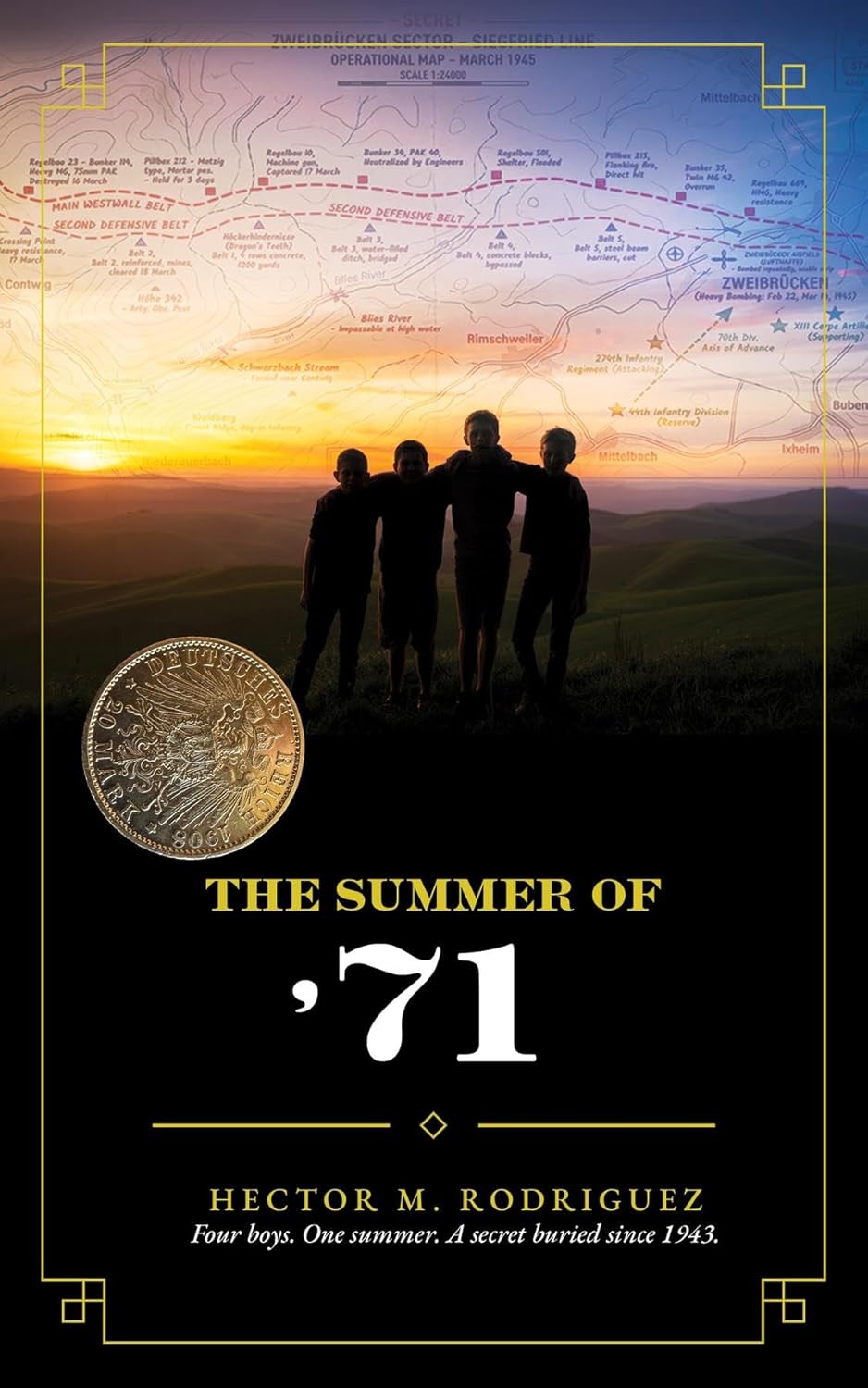
Hector M. Rodriguez’s The Summer of ’71 is a boyhood adventure told through the steady, reflective voice of a man who has spent most of his life trying to understand one summer in West Germany. Four military kids slip away from base, chase a rumor about a sealed World War II bunker, and find themselves carrying more than gold coins by the time they come home. It’s a story about friendship, military-brat life, old war wounds, and the strange way childhood can turn serious before anyone’s ready for it.
The book works because the boys feel specific. Galen watches and records, Bobby carries grief with quiet dignity, Rusty talks big but keeps going on a bad ankle, and Pascal moves through history like someone who already knows it has a pulse. Their banter feels natural, and their loyalty builds in small gestures rather than speeches. Bobby, especially, gives the story its emotional center. He’s the kind of kid who doesn’t announce that he cares. He just moves closer so he can catch someone if they fall.
Rodriguez gives the bunker scenes a strong, almost tactile atmosphere. The cold concrete, old tobacco smell, stopped clock, scratched walls, and buried ammo can make the past feel close enough to touch. The inscription “I was here. I loved her.” becomes one of the book’s quiet anchors, turning a wartime relic into something human and intimate. The gold coins matter, but the deeper treasure is the way the boys begin to understand that history is made of people who were scared, loyal, lonely, brave, and unfinished.
The novel also has a tender understanding of military families. It captures the odd mix of freedom and instability that comes with growing up on bases, where friendships form quickly because everyone knows time is limited. The boys’ secret becomes a bond they carry into adulthood, and the later chapters give that bond real weight. When the narrator looks back and says, “I wouldn’t change a single step,” it works because the story has earned that feeling.
The Summer of ’71 is warm, suspenseful, and deeply personal. It reads like a memory that’s been protected for decades before finally being set down on the page. Rodriguez turns a childhood expedition into a meditation on grief, duty, friendship, and the things people leave behind for others to find. It’s a heartfelt book with a strong sense of place and a sincere respect for the past.
Pages: 130 | ASIN: B0GX2X8NNZ


