Blog Archives
Inferno


Inferno, by Alan Cohen, is an ambitious piece of literary fiction that follows Nancey Reese, a young nurse in 1980s Holyoke, as she stumbles from innocence into something like self-awareness, all while a chatty, self-conscious narrator and his “Doctor” creator keep stepping in to talk about genes, consciousness, and what stories are for. We move between Nancey’s cramped apartment and chaotic hospital shifts, her friendships and near-relationships, and long reflective chapters on genetics and the mind that frame her life as one experiment among many. By the end, Nancey is left standing in an open future rather than wrapped up neatly, the “inferno” of experience still burning but no longer completely opaque.
On one level, there is this very grounded, almost stubbornly ordinary story of a plain young woman who smokes too much, works nights, and learns how to pay rent, navigate a toxic head nurse, cling to a glamorous friend like Susan, and decide what kind of intimacy she can stand. Those scenes feel relatable and authentic. On the other level, the narrator piques interest with intriguing ideas, talking about DNA as “snakes” inside us and consciousness as a new “light” that lets us see our own thoughts. Instead of feeling like a gimmick, it worked for me as a kind of echo chamber. Nancey’s small choices and the essayistic chapters keep reflecting each other, so her drifting, timid, half-woken life sits next to these big questions about how much freedom any of us really have.
What surprised me most was how much the book leans into self-awareness. The narrator reminds readers that he is a construct, trying to tell Nancey’s story under the Doctor’s rules. Then the Doctor himself appears as a character. It sounds clever, but I read it as someone worrying, out loud, about responsibility: to a character, to real patients, to family, to a life you could have lived but didn’t. There were times when the philosophical chapters stretched on, and I wanted to get back to Nancey and Susan or the drama at Mercy Hospital. But even there, I felt the pull of the ideas. The book keeps asking, in different ways, whether we are more than our genes, our conditioning, our old stories. It is curious, sometimes grand, and then suddenly very tender, like when the narrator pauses to wonder what kind of future Nancey should be allowed to have and admits he is still just curious, still compassionate, still vigorous, and cannot walk away from her fate.
By the time I reached the end, with Nancey facing the consequences of her choices and then offered back to the reader as a full-length portrait rather than a closed case, I felt oddly protective of her. It did not feel like a neat moral tale. It felt more like watching someone you know muddle through their twenties in slow motion. The genre is literary fiction, with a strong philosophical streak and a taste for metafiction, so it asks for patience and attention instead of dishing out quick thrills. I would recommend Inferno to readers who enjoy long, idea-driven novels, who are happy to sit with a flawed, sometimes frustrating protagonist, and who like their stories spliced with essays on science and consciousness. If you like the thought of George Eliot arguing with Oliver Sacks inside a hospital drama, you are the right audience.
Pages: 624 | ASIN : B0FTRPQ7NQ

Wooden Dolls Game


Wooden Dolls Game, written by Ivonne Hoyos, follows Mary Jane Crowell through a life shaped by family tension, a volatile sister, and a strange set of wooden dolls that lets her rewind time. The story begins with two little girls picking paint colors for their new bedrooms and unfolds into a tale about resentment, trauma, fate, and the high cost of trying to fix what cannot stay fixed. What starts as a simple childhood conflict grows into a sweeping journey through teenhood and adulthood, where Mary Jane desperately tries to undo tragic events using the dolls, and where every attempt triggers new ripples of chaos. It is a story about family wounds that never quite heal and the limits of love when time itself becomes a battleground.
The writing is direct and emotional in a way that sneaks up on you, and I found myself caring a lot about what happened. Scenes between the sisters made my chest tighten. Some moments felt painfully real, like the time Antonia destroys Mary Jane’s room in a wild burst of envy or the school fight that spirals into tragedy. The author captures the feeling of walking on eggshells around someone you love yet fear. I felt myself bracing every time Antonia entered a scene. The pacing moves fast, and sometimes the dialogue feels raw, but honestly, that worked for me because the characters live in a constant state of imbalance. Their world is never calm.
As the story leaned more into the supernatural element of rewinding time, I felt a mix of fascination and frustration, which I think is exactly what the book wanted me to feel. Every attempt to rewrite the past leads Mary Jane deeper into emotional exhaustion. I kept rooting for her and kept dreading what might go wrong next. The idea that fixing one tragedy only opens the door to another stayed with me. It made me think about how people carry their pain and how trying to rearrange life into something perfect can end up breaking everything. Even when the plot went dark, I stayed hooked because the emotional truth behind the events felt honest.
Wooden Dolls Game is a story for readers who enjoy family drama with sharp edges and for anyone who can handle a bit of heartbreak mixed with hope. If you like stories about sisters, trauma, time loops, and choices that echo forever, you’ll enjoy this book. For readers who enjoy a tense and emotional journey, Wooden Dolls Game is more than worth your time.
Pages: 353 | ASIN : B0CDJ8T2NX
The Queen’s Dark Ambition
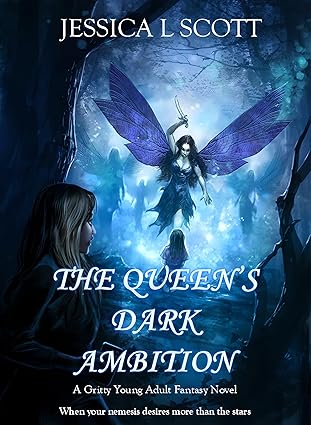
The Queen’s Dark Ambition follows fourteen-year-old Stacy, newly uprooted from her old life and friends, as she struggles to adapt to an unfamiliar town and strained family relationships. Drawn into the nearby Whispering Woods, first by curiosity, then by strange dreams, she discovers a hidden and dangerous world of fairies, rituals, and missing children. Caught between her fear, her longing to belong, and the peril of the Queen’s power, Stacy must navigate deception, captivity, and the blurred lines between friend and foe in a fight for survival. The story blends contemporary teen angst with a dark, magical undercurrent, shifting from domestic drama to eerie fantasy with ease.
I was struck by how raw and unfiltered Stacy’s voice felt. The writing doesn’t shy away from messy emotions like resentment, loneliness, and embarrassment that so many coming-of-age stories tend to polish smooth. The family tension is sharply drawn, and it hit me harder than I expected. It’s not just background noise; it shapes Stacy’s every decision. That made the jump into the fantasy elements more jarring, in a good way. The sudden emergence of the fairies and the sinister Queen felt like stumbling into a nightmare while you’re still mad about a real-world fight, which gave the whole story an uneasy energy I couldn’t shake.
There were moments where I wanted the plot to push forward, especially in the early chapters when the family drama circled. But when the fantasy plot took center stage, the imagery was vivid and unsettling, fairies with ghostly skirts, glowing globes in the trees, and a captive’s cell full of terrified kids. These scenes stuck in my mind. The writing has a blunt honesty in its emotional beats but a dreamlike quality in its supernatural ones, which makes for an unusual and memorable mix.
I’d recommend The Queen’s Dark Ambition to readers who like their fantasy tinged with real-life grit, and who aren’t afraid of a story that lingers on discomfort before offering resolution. It’s a good fit for teens and adults who enjoy moody, character-driven tales with a sharp edge of menace. If you like your magic beautiful but dangerous, and your heroines flawed but determined, this book will keep you turning the pages.
Pages: 342 | ASIN : B0F324QLFL
The Cost of Remembering

The Symbol: Awakening follows a fierce prosecutor dedicated to combating violence against women who, along with her allies, fights to dismantle systemic oppression and bring justice to survivors. What was the inspiration for the setup of your story?
The Symbol: Awakening was born from real-life pain. As a Brazilian attorney, I worked for years supporting women who survived gender-based violence. I carried their stories with me, their silenced voices, their broken systems, and their quiet resilience. Eventually, those truths demanded a fictional home. The futuristic Council is a metaphor for the institutions that failed them. Louise is a mirror: she’s a prosecutor trying to do the right thing in a world that punishes those who dare to speak.
It’s not just a dystopia. It’s a cry for justice.
What were some of the trials that you felt were important to highlight Louise’s development and shape her into the woman she is now?
Louise’s development is rooted in trauma and contradiction. I wanted to show a woman who fights for justice but is also broken by the system she serves.
She loses her mother to domestic violence. She carries a symbol of resistance (the button) since childhood. She trusts the law, then watches it collapse under silence and control. Her most important trials are emotional: learning to trust again, to remember who she is, and to embrace her voice even if it puts her in danger.
Her strength is not in being fearless. It’s in being terrified and still choosing to act.
What were some themes that were important for you to explore in this book?
There are many layers, but five themes are central:
• Systemic violence against women
• Institutional silence and complicity
• The cost of remembering (trauma)
• The complexity of justice
• Hope as resistance
The book also explores power through language, memory, and surveillance. Who gets to tell the truth? Who gets believed? What happens when silence becomes law?
I wanted to write about pain, but more than that, about transformation through pain.
Where does the story go in the next book, and where do you see it going in the future?
In Book II, Louise will no longer work within the system; she will rise against it. She becomes the public voice of a growing rebellion, but that comes with consequences. Enemies will rise from both sides. The movement she inspired begins to fracture.
The second book is about navigating power without becoming what you fought against.
Author Links: GoodReads | Website | Instagram | Amazon
Since childhood, Louise has carried a button inherited from her mother, a silent symbol of resistance against tyranny and violence against women. The book follows her journey through pain, discovery, and courage as she investigates crimes, exposes the Council’s lies, and confronts deep human dilemmas. Alongside allies like Emma, Joe, and Sam — the latter a mysterious man torn between his past and a chance for redemption — Louise finds herself at the center of a plot involving conspiracies, assassinations, and the darkest secrets of power.
Always Bet on Death: The Griffin Knight Rises

Always Bet on Death: The Griffin Knight Rises kicks off with a bloody murder in a half-renovated casino and doesn’t slow down from there. The book follows Griffin Knight, a sharp new detective transferred from Chicago to Long Island, as he’s thrown into a tangled web of casino politics, shady business deals, and buried secrets. With his grizzled partner, Trenton Barnes, by his side, Griffin unravels a death that’s anything but accidental. The deeper they dig, the more corruption bubbles to the surface, and nobody, not even the casino’s power players, nor Griffin himself, is safe from suspicion.
What immediately stood out to me was the tone of the writing. It is sharp, cinematic, and highly effective, particularly in the prologue. The opening scene, depicting a woman fleeing barefoot through an unfinished construction floor, wounded and pursued by a masked assailant, is gripping and visceral. It evokes the urgency and tension of a Bond film, though with a darker, more grounded edge. The atmosphere is palpable; the blood on the concrete and the fear driving the woman’s flight are rendered with striking clarity. Miguel Angel Hernandez Jr. wastes no time establishing momentum, and his ability to craft intense, visually charged moments speaks to a strong command of narrative pacing and mood.
Where the book shines brightest is in the banter between Griffin and Trenton. Their chemistry is hilarious and tense in equal parts. Take the early scene at the crime scene, where Trenton disarms the smug casino head of security with sarcastic wit and a fake Pop-Tart emergency. It’s ridiculous and perfect. These moments give the book heart, making it more than just a gritty mystery. It’s not all laughs, though. Trenton shares a heartbreaking story about a former partner ruined by a corrupt elite. It gave weight to the whole investigation. The book’s got teeth, and it bites when you least expect it.
That said, the plot is rich with twists and turns, offering a complex web of intrigue that rewards close attention. Particularly in the middle chapters, the narrative demands an engaged reader, as layers of deception unfold and motivations shift. While some of the secondary characters serve more as moving parts within the broader mystery, they contribute to the sense of a larger, bustling world surrounding the central investigation. Jennifer Grimwald, the shady executive, is a standout, though cold, clever, and clearly hiding something from the moment she dumps a suspicious trash bag into the Long Island Sound. Her scenes added a delicious layer of villainy that kept me turning pages, but I wish a few of the others were drawn with the same flair.
If you appreciate crime fiction that blends the sharp wit of Knives Out, the gritty energy of Lethal Weapon, and the atmospheric depth of L.A. Confidential, Always Bet on Death: The Griffin Knight Rises will likely resonate with you. It offers a compelling mix of suspense, moral ambiguity, dark humor, and emotional weight. This novel is particularly well-suited for readers who enjoy noir-inflected detective stories with brisk pacing and vividly drawn characters. The setting, an opulent casino shadowed by violence, adds an irresistible layer of intrigue. Be advised, however: once you begin, it becomes remarkably difficult to put down.
Pages: 105 | ASIN : B0DMJQB746
Creating My Own Fantasy World
The Tydareus Kingdom, Alliance of Nations follows twin princes in a tale of epic proportions as they navigate the wreckage of a long lineage of family secrets and power struggles. What was the inspiration for the setup of your story?
The Inspiration for the story was the ending of the Game of Thrones TV Series. I have always loved the fantasy world of Kings and Queens and decided to create my own fantasy world. As I sat down to write the Alliance of Nations, the plot seemed to drive itself from one kingdom to the next.
What intrigues you about this time period enough to write such a thrilling period piece?
As I stated, I love the fantasy world of royalty with Kings and Queens and wizardry. From King Author and Sir Lancelot to Game of Thrones and the many different kings portrayed in the books, I think the fantasy worlds offer a break from reality with dragons, stonemen, etc. Although, I chose not to add mythical creatures and other type animalistic avatars, I do find them interesting. However, I sometimes have a more difficult time relating to books with such characters, which is why I chose to maintain humanlike characters with emotional conflicts on a more personal level relatable to common people. Also, I’m not such a big fan of The House of Dragon Prequel. I haven’t read the books, but I think the series feels rushed and lacks the time development of the plot and characters. That is why I took the time to create realistic plots and focus on character development so that readers could relate to the characters on a more personal level and connect with their personalities whether good, bad or indifferent. It was important to maintain in-depth situations that followed each character’s persona. Of course that made for a much longer read, but I hope that the intrigue and thrill of both plot and characters made the book feel less cumbersome in length.
Were you able to achieve everything you wanted with the characters in the novel?
Yes, as each character came to life, so to speak, each person’s persona felt natural and unforced. From Stavros and his twin to the different kings, it was important that their persona was relatable and realistic. Although I didn’t particularly like each character’s persona, I think it made for a more intriguing plot with relatable twists and emotional conflict. It was important that readers form an emotional attachment to the characters as the story progressed, whether perceived as an antagonistic protagonist, a villain, or a heartfelt protagonist that drives the story forward while overcoming challenges.
Can we look forward to seeing the follow-up to this novel? What are you currently working on?
Yes, the follow-up sequel is The Tydareus Kingdom, A Nation of Slaves which delves more into the lives of the slaves as these 3 kingdoms continue on the path to war. The final book is entitled The Tydareus Kingdom, A War of Three Nations, which of course will follow the lives of the kings as they progress through the war. I’m currently working on the sequel to The Women’s Meeting entitled, Saga of My Scars, The Aftermath of Life’s Wounds which follows Dr. Angela Morrison through her quest for answers to her life as presented by the 3 different personalities. The Women’s Meeting revealed her Renee Lindsey personality to Dr. Morrison forcing her to confront the truths of her childhood, adoption, abuse, etc. Unknown by Dr. Morrison, she finds herself entangled in conflict with a newly emerging personality, Erin Philips. Unlike Renee, Erin has her own ideas about taking over Dr. Angela Morrison’s life—determined to eliminate all other personas and assert herself entirely. Erin is determined to avenge the people responsible for the abuse and degradation of Angela, Renee and herself even if that means destroying Angela in the process.
Author Website
The imminent invasion by Kadir, the brother exiled to the Western Island, forces Arius and Acuitius to seek an alliance with the Eastern Shore Kings—Matteo, Obasi, and Basili—to safeguard their western borders and train their soldiers in an Army that has not experienced combat in centuries. However, these three Eastern Shore Kings, notorious tyrants of their lands, harbor their own ambitions and agenda. They aim to overthrow the Tydareus Kingdom, destroy the brothers, and seize control, regardless of the cost.
Ultimately, this may escalate into a war between the three nations. “Alliance of Nations” delves into the lives of these six kings as they navigate the complexities of forming alliances through marriages and conflicts that threaten to derail their strategies for a successful union.
No Sugarcoating

Real Aussies: John’s Heartbreak follows a man struggling with family drama and his identity, who finds himself questioning his life choices and their impact on who he is now. What was the inspiration for the setup of your story?
There are plenty of brilliant authors out there, each exploring their own genre, offering their own lens. But something’s always struck me: as readers, we usually watch a story unfold. Whether it’s first or third person, there’s still a barrier — you’re seeing the world through someone else.
My work shifts that. I don’t want you watching. I want you inside it. I want you experiencing everything as if it were your life. No inner monologue distractions. No cinematic distance. Just you, immersed. That’s the goal — that the life unfolding on the page feels indistinguishable from your own.
Where many authors focus on plot, I focus on consequence. Cause and effect. The way people stay stuck in self-inflicted nightmares because it’s all they know. My job is to make it real. That’s why it hits hard. It’s confronting. And yes, it’s designed to be. Not for shock — but to surface what’s buried. I write to draw out the emotional junk most people never look at.
Call me a literary exorcist, if you like. My job isn’t to write pretty metaphors that need decoding — that’s useless to someone having a breakdown at 3 AM. My job is to make a reader feel, viscerally, so they process. It’s therapy without the label. Even Beatrice — when she speaks to John, she’s really speaking to the reader. “Good to see you.” That’s intentional.
The inspiration wasn’t John. It was the reader. My intention was always to unearth something in them — to bring them face-to-face with the parts of themselves they’ve ignored. That’s why the novel has a warning up front, why the blurb literally tells you to have tissues ready. It’s not a story about you… until it is.
That’s also why the novel ends with a poem. By the final page, I shift focus directly back onto the reader. Verse-by-verse, I hold up the mirror. You realise it was never about John. It was always about you. The choices you’ve made. The patterns you repeat. But there’s solace in that. You get to use John’s story as a scaffold — a safe space — to unravel what’s unresolved in your own story.
So far, every review echoes the same thing: “It lingers.” “It hit me harder than I expected.” It’s not a light read, by design. If you’re lying to yourself, this book won’t let you. It’ll show you — cracked mirror and all.
I didn’t write this to win awards. I wrote it for the people who didn’t know they needed it. And the most unexpected part? The reviews don’t reflect me or the book. They reflect the readers themselves. You can watch the healing (or resistance) play out in the reviews. One star, five stars — it’s not about John at all. That’s the art.
Is there anything about John that came from you or your life experiences?
Absolutely — but it’s not about facts, it’s about feeling. Every emotion in the novel is real. I don’t want readers to witness John’s feelings or mine — I want them to sit inside their own. That’s the point. I’ve spent years deconstructing emotion — peeling away the polite language and self-protective narratives we use — until I could write it raw, in its unfiltered form. That rawness is what bleeds through John.
Love, hate, despair, anxiety, disbelief, torture, horror, hope, humour — it’s all there. These aren’t just themes. They’re mine. I’ve lived them in one form or another, and instead of dressing them up in literary robes, I hand them to the reader as they are: messy, confusing, overwhelming. That’s what makes the novel so confronting.
My writing isn’t about literary awards or clever turns of phrase. It’s about impact. I write for people who don’t usually read. People who’ve been through real pain. People who are emotionally constipated and don’t even know it. That’s my audience. That’s who I care about reaching. My job is to make sure the work remains readable in 20 years — 50 years. That means: no sugarcoating. Just as I’ve never had the luxury of a sugarcoated life, as someone who grew up autistic, dyslexic, and an outcast — this work had to be just as honest.
Setting the novel in the past wasn’t just for the killer music (although — quote me — it is the best). I wanted to lull the reader into a false sense of nostalgia. That dream-state safety net. Then — rip — pull them deep into emotional terrain they weren’t expecting. That’s how real healing begins. When you’re least prepared.
The Real Aussies series isn’t fiction in the traditional sense. These are my emotional truths, fictionalised just enough to get under your skin. I make them yours. That’s the goal.
What were some themes that were important for you to explore in this book?
If you’re Australian, you’ll know the complexity of Australian men. From the outside, we’re seen as fun-loving, relaxed, and some of the friendliest people in the world. But scratch the surface, and you’ll find men are often expected to fit one of two emotional lanes: the hard-working provider, or the larrikin who cracks jokes over beers to mask the pain.
That’s the irony of Australia. Real emotional depth is often hidden. Having any feelings outside the intimacy of your bedroom — with your wife, your child, or your closest mate — is quietly forbidden. For me, it was time to show who the Australian man really is. Setting the story in the past allowed me to amplify that unspoken, strictly enforced social code: once you’re boxed in, you’re rarely reclassified. This limits potential — and creates internal chaos when your truth no longer fits the label.
Another core theme is beauty in pain. We don’t always reflect on the quiet glimmers in our darkest moments — the friend who helped, the stranger who saw us. Life can feel like one storm after another, but if we slow down and look closely, we’ll often find there was always a guardrail. Even in disaster, there’s something beautiful — that’s what carries us forward. This was true for John. For Chris. For Stew. For all of them, their “Refuge” was a club full of misfits — a symbol of chosen family in a world that rejected them.
I also wanted to preserve and spotlight community. Specifically, the LGBTQ+ community in Sydney during the 70s and 80s. It really was as intense as I depicted. The violence, the tension, the desperate need for a safe space — it was all real. Today, as society becomes more tolerant, we risk forgetting what community used to mean. I wanted this novel to capture that moment in time, so we remember how people found belonging through pain.
Finally, I wanted to confront the reader with the consequences of accumulated choice. The novel stretches through John’s twenties, showing how each decision either aligns him — or derails him. Life doesn’t punish. It doesn’t reward. It just stacks up your choices until the result is undeniable. You get what you build. If you live for others, lie to yourself, or compromise your truth — that stack eventually collapses. The novel reminds us: we’re born alone, we die alone. Everything in the middle is experience — but how we carry it determines who we become.
Is this the first book in the series? If so, when is the next book coming out, and what can your fans expect in the next story?
Yes, this is the first novel in the Real Aussies series — and also the first novel I’ve ever written. Quite the mountain, especially when you’re someone who reads words wrong, flips similar-sounding ones in your head and constantly fights to stay on the line. It’s exhausting. But I persisted. Because I had to.
The next novel is Peter’s Nightmare. If John’s Heartbreak was about how our choices align or unravel over time, then Peter’s Nightmare is about when you never had a choice at all. When your identity isn’t something you built — but something constructed for you through trauma, projection, and other people’s pain.
It explores what happens when the lessons you’re forced to carry don’t belong to you — childhood burdens, family shame, expectations you never agreed to. It’s a story about how we unconsciously repeat what we hated. How we become the bully, even when all we ever wanted was kindness. Peter’s story doesn’t hold back. It goes into territory most people avoid.
The schoolyard bully who wrecked you? He was likely wrecked too. This novel digs into that truth — that intergenerational cycles of pain can be broken, but not if we stay in victimhood. Not if we keep pretending we’re not part of the problem.
You’ll finally understand who Peter really was in John’s story. What shaped him. Why he was the way he was. And by the end of it, just like with John, you’ll be holding a mirror — not to Peter, but to yourself.
This is a novel about the parts of life we don’t speak of. The moments society can’t language properly. Peter’s Nightmare will give readers that language. And with that, maybe the power to finally change.
I’m aiming to release Peter’s Nightmare in early 2026. I’ve got a few other projects on the go that need to clear first — it’s a bit of a juggling act (especially when you’re navigating it all with disability compensation!) — but hey, that’s life. 🙂
Author Links: GoodReads | X (Twitter) | Website | Amazon
Sydney is thrown back to the late 70s and early 80s in this Aussie epic that sees John navigate the explosive consequences of his ill-thought actions, his wife’s destructive wake, and the unexpected feelings he has for his nurse; his male nurse… oh crap!
Amid drag queens, nightclubs, drugs, and iconic decade-defining music, John struggles with his identity, whilst trying to secure the custody of his two sons. With a batshit crazy family and a chaotic trip to Kiama, John’s life spirals out of control.
This rich multi-decade LGBT quasi-hetero romantic drama, written by an Aussie nomad, is layered with deep emotion and complex relationships. Profound, soul-touching, and reflective, this novel opens questioning the impact of all life’s choices.
Perfect for that weekend curled up in bed with a box of tissues, chocolates, and ice cream.
Real Aussies: John’s Heartbreak

At its heart, Real Aussies: John’s Heartbreak is a raw and emotionally intense dive into the life of John, a 24-year-old car salesman hustling through Sydney’s sun-soaked grit of the late ’70s. The story kicks off with John chasing the Australian dream—buying out the dealership he works for and giving his family a better future. But things unravel fast. There’s infidelity, identity struggles, explosive family drama, a deeply repressed past, and an unexpected romantic connection that challenges everything John thought he knew about himself. It’s set against a vivid Aussie backdrop of drag queens, classic Holdens, meat pies, and church pews. It’s heavy, hilarious, heartbreaking, and, at times, unhinged.
The dialogue snaps with authenticity, the slang hits just right, and the pacing is mad. One minute you’re laughing at a wild Monaro test drive, and the next you’re cringing through John’s brutal Sunday family lunch, dripping with micro-aggressions, classism, and suppressed rage. The scenes with his mum and Beergut Barry was spot on. Horribly accurate. You can feel the suffocation. That kitchen table tension isn’t just writing, it’s lived experience on the page.
But the emotional gut-punches land hard. The twist about John’s biological son genuinely winded me. And then, Jezbon goes further. That deeply disturbing assault scene with Peter was unexpected and so painfully real. It’s handled with unflinching honesty. It doesn’t glorify or overexplain, it just lets you sit in the horror of it. It messed me up a little. That’s powerful storytelling. Still, it’s not for the faint of heart. You have to be ready for it. But it shines a light on the complexity of male trauma, especially in a world that doesn’t give men like John the language or space to process it.
John is messy. He lashes out. He hits. He breaks. But Jezbon doesn’t romanticize it. He forces you to reckon with the choices people make when their lives implode. There’s nuance. There’s shame. There’s that desperate grasping for control when everything’s slipping. And then there’s hope, like a tiny stubborn weed growing through concrete. John’s care for his sons—especially Jason, his “little champ”—grounds all the chaos. The emotional rollercoaster is real, and I didn’t wanna get off.
If you like your stories emotionally charged, a little chaotic, and rough around the edges—this one’s for you. Especially if you’re into queer themes wrapped in raw masculinity, generational trauma, and the realest kind of love—the kind that’s flawed but refuses to give up. It’s not tidy. It’s not polished. It’s real. And that’s exactly what makes John’s Heartbreak stick. Jezbon wrote something that lingers.
Pages: 398 | ASIN : B0F3KDHH9R



 LITERARY TITAN