Blog Archives
Field of Memories


Field of Memories is a memoir told through a long chain of short, self-contained stories. Childhood in 1950s California. The family moves to Idaho. A parade of neighbors, pets, cousins, choir trips, candy trucks, and church mornings. Later, marriage, grief, travel, Auschwitz, dementia, and the slow ache of saying goodbye to parents and friends. Each vignette is small in scope but big on feeling. Together they form a life story that leans hard into gratitude, faith, and the power of remembering.
I found the story to be very smooth and polished. The tone stays warm and steady even when the subject is painful. The language is plain, almost conversational, and that gives the stories a kind of kitchen-table honesty. I liked how often a scene hangs on one concrete detail. A blue Studebaker. The smell of Toni home perm solution. A chipped tablecloth chewed by the neighbor’s dog. Those small bits made the memories feel lived in, not staged. I appreciated how confidently the prose leans into sentiment, and how many of the endings clearly spell out the lesson, almost like the comforting moral at the end of a fable.
The ideas underneath the stories resonated with me in a gentler, slower way. The book circles again and again around kindness, the cost of cruelty, and how ordinary people carry each other through time. The chapter about Matthew and the teacher who says, “stay with your own kind,” made my stomach knot, because the racism is so casual and so early. The Auschwitz visit in “Never Forget” pulled the lens wide and dropped the whole earlier world of penny candy and Levi’s into a much darker frame. I appreciated that shift. It kept the book from drifting into pure nostalgia. I also felt a strong spiritual thread. It shows up in quiet moments, like the customer-service call that turns into a mini sermon about grief, or the way the author talks about her mother “changing addresses” instead of simply dying. I responded to that mix of tenderness and steadiness, even if now and then it brushed close to sentimentality for my taste.
I would recommend Field of Memories to readers who enjoy reflective, faith-tinged life writing, especially anyone who grew up in mid-century America or loves stories about close families and small towns. If you like to sit with a cup of coffee and dip in and out of short, heartfelt pieces that celebrate parents, grandparents, neighbors, and the strange beauty of getting older, this collection fits that mood very well.
Pages: 188 | ASIN : B0G72F556R

Waves of Light and Darkness


Waves of Light and Darkness is a short story collection that circles big, tender questions, then keeps circling them from different angles: grief, desire, family duty, fear, and the stubborn need to make meaning even when life feels random or unfair. The book moves between intimate relationship dramas and more metaphysical turns, story by story. One early piece, “The Yellow Butterfly,” sets the tone: a widowed astrophysicist is knocked off balance by loss and then pulled into an uncanny encounter that feels half therapy, half dream, half cosmic riddle.
What I kept noticing, in a good way, is how Danenbarger writes feelings as physical states. A room gets too quiet. A routine becomes a trap. A conversation turns into a tight knot you can feel in your chest. Even when the stories lean surreal, the emotional footing is very human, like when that grieving scientist can’t decide if he’s being helped or manipulated, and either possibility hurts. The prose likes to linger on atmosphere, the smell of a place, the small habits people use to stay upright. Sometimes it’s almost cinematic. You can hear the café, feel the late-night glow, and then, suddenly, you’re somewhere stranger.
I also got the sense that the author is deliberately mixing “real life” tension with the itch of bigger ideas. One moment you’re watching people play social games at a fancy event, the next you’re hearing characters talk like reality itself might be bending. That blend can be compelling. It can also be a little blunt at times to make sure you do not miss the point. I respected the ambition. The stories keep asking: what do we cling to when certainty falls apart? In “Fragments of Existence,” a father’s sense of purpose snaps into focus while his kids are literally suspended above him on a ride, and it’s simple and sharp, like a truth you did not realize you were avoiding.
If you like literary short fiction with existential, occasionally speculative edges, this will probably land for you. It sits in the neighborhood of writers like George Saunders or Ted Chiang in the sense that the stories use unusual premises to press on ordinary human nerves, though Danenbarger’s voice is more earnest and romantic than wry. And it makes sense that he describes his own lane as “existential literary fiction.” Read this if you enjoy character-driven stories that are willing to get philosophical without turning cold.
Pages: 308 | ASIN : B0GFXPT5KM
Surviving Life: The Art of Resilience

Surviving Life: The Art of Resilience is a memoir by surgeon and Vietnam combat pilot Tom Schneider, who walks through an abusive childhood, the heartbreak and love around his profoundly disabled brother Mark, the terror of being shot down over a rice paddy in Vietnam, and a later life filled with medicine, illness, near-death moments, and hard-won forgiveness. The book moves from a chaotic home with parents Russ and Ellen, to the flight deck of a carrier, to exam rooms and operating rooms, and finally into living rooms and Zoom calls with old friends as he ages and rethinks what really matters. Through all of it, he circles one core idea. Life will hurt, and it will not be fair, and yet you can choose how to respond; you can choose kindness, and you can learn to carry both anger and gratitude without letting either one run your life.
The memoir hooked me fast. The opening scene in the Vietnamese rice paddy feels cinematic, but the voice stays very plainspoken and almost chatty, which I liked a lot. Schneider leans on short, punchy lines, then drops in dark humor that made me wince and smile at the same time. When he talks about “Agent Orange Country Club” or calls himself a “sugar monster” as a kid, the jokes soften the blow while still letting the horror land.
I also appreciated how often he circles back to specific phrases, like his grandmother’s charge to “take care of yourself,” and the mantra that even cruel people were doing “the best they could do.” That repetition gave the book a spine. Sometimes the structure feels a bit loose, like a long conversation that wanders. He digresses, he backs up, he jumps ahead. For me, though, the voice stayed strong enough that I did not mind the meandering feel. It actually made it sound like an older doctor talking late at night, telling the stories he never had time to tell before.
Emotionally, the book hit me hardest in the family sections and in the late-in-life medical chapters. The scenes with Mark are full of small, concrete details that stay in my head, like pushing his wheelchair to the TV and yelling “Heal” at Oral Roberts, or calling him “Umpy” in private and learning love and patience from a brother who never spoke a word. The abuse from Russ and Ellen is described in the same straightforward tone, and that contrast made it even more disturbing. There is no self-pity, just this steady drip of information. I felt his anger, and I also felt the weight of carrying that anger for fifty years. The epilogue gives the book a useful, almost guide-like layer without losing the personal voice.
I walked away from Surviving Life feeling like I sat with someone who truly “survived life” in every sense, not just survived war or disease. The book is honest, rough around the edges, and that texture matches the story he tells. I would recommend it most strongly to readers who like candid medical or military memoirs, to veterans and their families, to adult children from chaotic homes, and to anyone staring down serious illness who wants company from someone who has been on both sides of the hospital bed. If you prefer straight talk, gallows humor, and a lot of heart wrapped around some pretty brutal memories, this book will speak to you.
Pages: 240 | ISBN : 978-1966786566
Emotional Fabric

When the World Held Its Breath follows a family whose comfortable day-to-day lives are turned upside down when COVID rears its ugly head and threatens everything they hold dear. Did you begin with the idea of a pandemic novel, or with the emotional arc of a family under pressure?
I began with the emotional arc of a family under pressure rather than the idea of writing a pandemic novel. The pandemic was the circumstance — the crucible — but the heart of the story has always been about family. I have always believed deeply in the strength of family bonds. In my experience, when love within a family is genuine and resilient, it becomes a shield against even the harshest crises. That strength is not accidental; it is nurtured daily, often quietly, and very often by wives and mothers who hold the emotional fabric of the household together.
When my wife and I contracted COVID-19, we experienced firsthand how fragile life can suddenly feel. Those were frightening days. Yet what stands out most in my memory is not only the illness, but the way our family rallied around us — offering encouragement, support, and unwavering presence. Their strength carried us through. That lived experience shaped the novel. I used the pandemic as the backdrop, but the true focus of When the World Held Its Breath is what happens inside a family when external forces threaten to tear it apart — and how love, when it is strong enough, can hold everything together.
What was the most challenging part of writing Laura’s ICU storyline?
The most challenging part of writing Laura’s ICU storyline was balancing medical accuracy with emotional authenticity. I spent a great deal of time researching the progression of severe COVID cases — the stages of respiratory decline, the medical interventions, the terminology — because I wanted the portrayal to feel real without becoming clinical or detached.
But research was only one part of the challenge. The deeper difficulty lay in writing the scene where the doctor explains Laura’s worsening condition and prepares Harrison for the possibility of losing her. That conversation had to carry immense emotional weight. It needed to feel devastating, yet restrained. Honest, yet not melodramatic. David’s reaction in that moment was especially complex to write. I rewrote those passages many times because I did not want the medical explanation to interrupt the narrative flow or feel like an informational pause. It had to remain part of the story’s emotional current — not a break in it.
Ultimately, the challenge was ensuring that the ICU scenes did not simply describe illness but conveyed what it feels like when hope begins to slip and a family is forced to confront the unimaginable.
What conversations are you hoping to spark about misinformation and trust during trying times?
One of the conversations I hope to spark is about how fear alters the truth. During times of crisis, uncertainty creates a vacuum, which is often filled by speculation, misinformation, and narratives that promise simple answers to complex realities and sometimes, made-up narratives.
In 2020 and 2021, when fear was widespread and information was evolving daily, many people turned to social media not just for updates but for reassurance. Unfortunately, it was and is fertile ground for doubt, rumor, and conspiracy theories. What fascinated me — and concerned me — was how quickly these narratives spread and how deeply they influenced trust: trust in institutions, in science, and even within families.
The novel touches on these tensions because misinformation does not remain abstract. It enters homes. It shapes decisions. It strains relationships. I hope readers will reflect on how we determine what to believe in moments of uncertainty — and how we can protect both truth and human connection when they are under pressure. The book is not about judging anyone; it is about examining how fragile trust can become when fear dominates the atmosphere.
Can we look forward to more work from you soon? What are you currently working on?
Yes, I am currently working on my next novel, and I’m deeply excited about it. While it is still taking shape, it explores a timely and thought-provocative theme that reflects the complexities of the world we live in today. Much like When the World Held Its Breath, it will focus on human relationships, emotional resilience, and the choices people make under pressure.
Without revealing too much, I can say that it examines differences that divide us — and the deeper commonalities that ultimately bind us together. I believe it will spark meaningful conversation and, I hope, resonate strongly with readers across cultures and generations.
Author Links: GoodReads | Amazon

As COVID-19 transforms from distant news to deadly reality, the Harrisons retreat behind their doors, believing caution will keep them safe. The lockdown forces them into unprecedented proximity—four people confined together, stripped of their escape routes to work, school, and social life. Tensions simmer as David’s work pressure intensifies, and Laura must balance her work with the family’s well-being. The teens chafe against restrictions, and small irritations magnify into explosive conflicts. The question was not whether they could survive the virus. The question was whether they would survive each other.
But then Laura catches the virus, and within days, she’s fighting for her life on a ventilator, her family separated by a glass partition, helpless to reach her.
David faces immense pressure and impossible choices: saving his company versus his wife in the hospital, maintaining his ethics versus corruption that offers easy solutions, and being a father, taking care of the children, when he’s barely holding himself together. Ultimately, David broke down. Seventeen-year-old Ethan and fourteen-year-old Sophie watch their invincible parents crumble, growing up overnight as their world collapses around them.
But their ordeal has just begun. When Laura finally wakes up, she doesn’t recognize her family. Her memory is gone, scattered like puzzle pieces, and she must painstakingly reassemble it. In this crisis, it’s the family bond that keeps them together.
“When The World Held Its Breath” is an intimate portrait of one family’s journey through COVID-19, America’s darkest modern crisis. This story explores love tested by unimaginable circumstances, highlighting a nation discovering its capacity for indifference, selfishness, and extraordinary generosity. It also shows ordinary people learning that resilience isn’t about being unbreakable, it’s about helping each other in crises.
Rich with authentic detail and emotional depth, this novel captures not just what we endured during the pandemic, but why and also who we became because of it. For anyone who lived through those terrifying months, this is the story of how we found our way home—and how America, despite losing more than a million lives to initial missteps, ultimately rose to the occasion and helped the world control the pandemic.
When the World Held Its Breath
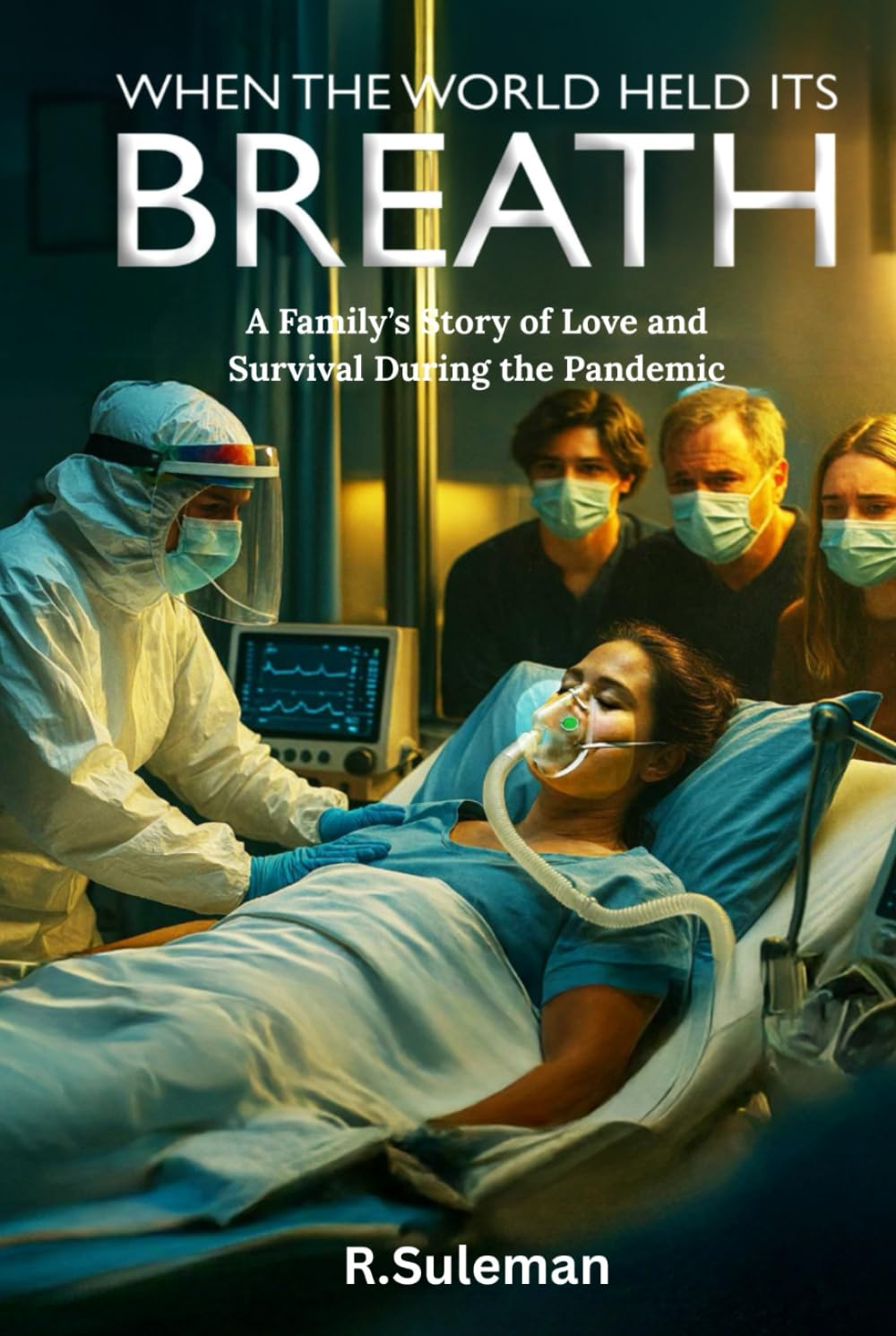
In When the World Held Its Breath, author R. Suleman tells a sweeping, close-to-home story about the Harrison family as COVID moves from distant headlines to a force that reshapes everything they thought was stable. We start with their comfortable suburban rhythm, work pressures, teenage drama, and the sense that life is busy but manageable, and then we watch that “manageable” feeling crack under lockdowns, fear, and the slow grind of uncertainty. The plot tightens around the family’s hardest stretch when Laura’s illness turns severe and she ends up in the ICU on a ventilator, leaving David and the kids in a kind of suspended, breath-held waiting room of dread and hope. By the end, the book moves toward recovery and aftermath, asking what “back to normal” even means when normal has been burned down and rebuilt. Genre-wise, this sits in contemporary family drama (pandemic fiction with a literary-leaning, emotionally driven core), and it will likely appeal to readers who liked the intimate, relationship-first approach of Wish You Were Here more than the big-society lens of Station Eleven.
I liked how committed the narration is to the day-to-day texture of a family under strain. It’s not chasing shock for shock’s sake. Instead, it keeps returning to small moments, arguments over school and responsibility, the way parents try to “be steady” even when they are scared, the way kids act tough until they don’t. There’s a steady, almost cinematic clarity in the opening domestic scenes, and that groundwork matters because later, when the world narrows to hospital glass and medical updates, you already know what’s at stake. The book sometimes leans into explanation, especially when it steps back to name what a moment “means” for society or history. That did not ruin it for me, but I did notice it. I found the story strongest when it trusted the characters to carry the emotion without summarizing it for me.
I also appreciated the author’s choices about what the book is and is not trying to do. It’s upfront that the Harrison family is fictional, and that the goal is the human response to crisis, not a clinical chronicle of the pandemic. That framing helps, because the novel keeps circling themes that feel painfully familiar: the illusion of control, the way privilege can soften the edges of life until something comes along that ignores status, and the way fear spreads faster than facts. I was especially struck by the recovery arc, not as a neat victory lap, but as a long, uneven rebuilding, with memory gaps, “brain fog,” and the strange tenderness of learning your own life again. And I liked that the book doesn’t dodge social fractures either, like vaccine distrust and misinformation, but it keeps those debates grounded in dinner-table conversations and personal consequences.
I felt the book had earned its quieter ending: a house full of people, a Thanksgiving gathering, a sense of gratitude that is not naive because it remembers exactly what it cost. I’d recommend this most to readers who want a family-centered, emotionally direct pandemic novel, especially anyone who lived through those years and is ready to look at them with clear eyes, or anyone who enjoys contemporary family dramas where the biggest battles are love, fear, and the effort it takes to keep showing up for each other. If you want a grounded story about how a crisis breaks a family open and then, slowly, helps stitch them back together, this one will land.
Pages: 380 | ISBN : 978-9699896361
Tests of Character

A Second Chance follows a faith-filled teen whose prophetic dreams, fractured family, and fierce love for her best friend collide with online grooming, violence at home, and the cost of believing God can still redeem what’s been broken. What was the inspiration for the setup of your story?
I was listening to “Running up That Hill” by Kate Bush, and I thought, what would it take a teen to make a deal with God? And I expanded upon that because not everyone has a perfect life, and that makes youth vulnerable. Vulnerable youth are key targets for predators, in person and online. I wanted to show that through it all, faith can get you through it, and so can supportive, responsible friends and family.
Mikaila’s dreams play a major spiritual role. How did you balance portraying divine guidance without removing her agency as a character?
Many times, in life, we’re given tests–tests of character and even tests of faith that require us to use our own strengths and character to get through them. I wanted to focus on the internal and external struggles of passing those tests.
What were some themes that were important for you to explore in this book?
Friendship, because that is foremost important when you’re a teen. Secondly, I wanted to tell the truth about manipulation, loyalty, and faith under pressure.
How did you approach writing faith conversations so directly while still keeping the voice authentic to teens?
I thought about my nephews, who are faith-driven teens now, and what the conversation would look like from their perspective.
Author Links: GoodReads | Website | Instagram | Amazon
For Mikaila, faith is simple. When her best friend Chara is in a horrific car accident, Mikaila makes a promise to God: Chara’s life for her devotion. She is determined to guide her friend back to the light.
But an old friend from her past has other plans. He’s charming, intelligent, and seems to understand Mikaila better than anyone. Until charm becomes pressure. Until flattery becomes control. Mikaila finds herself trapped in a game she doesn’t understand.
Chara tries to warn Mikaila before the game turns deadly. But in a world of doctored emails and masterful lies, they discover that the most dangerous predator is the one everyone trusts. A Second Chance is a faith-lit YA suspense about the dangers we don’t see until they’re too close, and the courage it takes to run toward the light.
Lost in Bone Cave

The Adventures of Syd: Lost in Bone Cave tells the story of a girl named Syd who joins her scientist father on a real caving expedition in West Virginia. What starts as a planned research trip to observe bat colonies turns into a long, muddy, sometimes frightening journey through Bone Cave, complete with tight crawls, glowing rock walls, wildlife encounters, and a moment where things go genuinely wrong. The book follows Syd as she moves from curiosity and doubt into courage, responsibility, and trust in herself during an underground adventure that tests both her nerves and her judgment.
What struck me first was how grounded the writing feels. Author Danielle Simone clearly knows this world, and she takes her time letting readers learn it alongside Syd. The explanations about caves, bats, and equipment are woven into conversations instead of dropped like lessons, which makes them easier to absorb. I liked that Syd does not magically become brave overnight. She complains. She gets scared. She makes mistakes. The fear in the Devil’s Pinch crawl is especially well done. You can almost feel the dust in your throat and the panic tightening your chest, and it never tips into melodrama. It feels honest, like the kind of fear kids actually experience when something goes beyond what they expected.
I also appreciated the author’s choice to center the story on a parent and child working together. Syd’s dad is capable but not perfect, and that matters. Adults in this book do not have all the answers, and sometimes they get hurt too. That balance gives Syd room to grow without turning her into an unrealistic hero. The science elements, especially the focus on bats and White Nose Syndrome, add weight to the adventure. This is not danger for fun. There is a purpose, and that purpose keeps pulling the story forward.
Lost in Bone Cave fits squarely in the children’s adventure genre, with a strong thread of nature and science exploration running through it. I would recommend it to middle-grade readers who like outdoor stories, animals, and realistic challenges rather than fantasy quests. It would also be a great pick for kids who enjoy learning how things work while following a character their own age. If you have a reader who loves hikes, caves, or asking big questions but still feels nervous about new experiences, this book will likely feel like a steady hand on their shoulder, saying you can be scared and keep going anyway.
Pages: 104 | ASIN : B0FQDCNFDX
You Are Not Broken

The Split gives voice to women who have faced pain, loss, the dissolution of their marriages, and challenges of long-held beliefs. Why was this an important book for you to write?
This book wanted to be written. Another collaborative book was not in my plans and yet, the idea came to me in a moment of frustration as I heard yet another person reference families of divorce as ‘broken’. I pushed it off and the idea wouldn’t let go, so I knew it needed to be shared. The women I know that have gone through divorce are not ‘broken’ and neither are their families. As we discuss in the book, something is arguable broken before divorce happens. Divorce is the and the answer to a problem where no other solution has worked. Letting women know that the end of a marriage or relationship is not the end of the story, simply the end of a chapter is extremely empowering. Having gone through divorce mostly alone, I know the power of having a group of women guide you in the process is priceless.
With so many authors involved in the making of The Split, I would imagine the collaboration process was complex. Can you share with us a little about the writing process?
Surprisingly, it was more difficult getting women to join the book than it was to have them write! So many women that were interested in writing self selected out before the process really began. To choose to share a story, especially one as raw as divorce, one has to be ready to share. You want to share what you’ve learned along the way and if you’re not quite there yet, the story simply won’t come. Being ready was the most challenging part. Once the women said they were in, the writing happened and the deadlines were (mostly) met without much fuss. The Split is now a beacon in the dark for those that need it.
Did you learn anything about yourself while putting this book together?
I learned the seeds of my divorce (and so many others) were planted long before marriage was even a consideration. From a young age, our families of origin and society share a particular message of happiness, without providing a lot of room for curiosity. I realized that when I began to become seriously curious about my life and the future I wanted, I found out the story I had been told I wanted isn’t what I actually wanted.
What is one thing you hope readers take away from The Split?
I hope the readers understand that the idea of divorce is not one they need to explore alone. It can be a tough journey and I hope this book provides a guiding light and the authors in it become a part of the readers’ support system. I hope they connect with the authors that resonate with them the most and continue their healing journey.
Did you hear? They’re getting divorced.
We have a broken family.
We’ve all heard these phrases whispered in hushed tones—words laced with judgment, pity, or shame. But what if they’re wrong?
The Split: Tales of Family Renewal and Female Resiliencechallenges the narrative that divorce equals failure. These powerful, deeply personal stories reveal that splitting isn’t the breaking point—it’s the breakthrough. In these pages, women share how they reclaimed their voices, rebuilt their lives, and redefined what family, love, and strength can look like after endings that became beginnings.
This anthology dismantles generations of stigma around divorce and womanhood, replacing it with a message of renewal, courage, and collective healing. These are not broken women. They are bold, audacious, and resilient—choosing themselves, their peace, and a new path forward. Splitting isn’t the end; it’s a rebirth.
Contributors: Brandee Melcher, Dr. Katherine Humphreys, Carol Britton, Lesley Goth, PsyD, Carolina Cifuentes, Sierra Melcher, Christen E. Bryce, MS RN, Allison Banegas, Dr. Erica Anne Love, Summer Jean, LaToya Burdiss, and Jen Kennedy, MPA


