Blog Archives
Blending Dark Humor With High Stakes
33 Frivolous Pricks is a genre-bending satire that follows an adjunct professor in dystopian L.A. on a surreal journey involving time machines, social decay, and a cast of eccentric misfits. What was the inspiration for the setup of your story?
I wanted to squeeze more juice out of the time machine story I did a few years back in “Hollyweird Needs” using the two locations I know and like to make trouble in the most—Los Angeles, CA., and Kyoto, Japan.
I connected the two cities this time by placing the unhappy daughter, half Japanese, of one of the time travelers into Kyoto and coming up with one powerful sub-plot that has the girl on a reckless mission to burn down the renowned temples of the city.
How did you balance the dark social commentary with the whimsical and surreal elements of the story?
Blending dark humor with high stakes is what I like to do, weaving together elements of horror, comedy, and philosophical inquiry to create a narrative that questions the nature of time itself and humanity’s place within its flow.
I did this by depicting many catastrophes of US twentieth century life and placing the distressed time travelers within them, hopefully giving these historical periods more emotional weight, making readers feel that they’re living everything alongside the cast.
What were some themes that were important for you to explore in this book?
I think the exploration of human nature brings huge amounts of depth to the adventure as we follow characters grappling with consequences both personal and universal. The philosophical elements emerge naturally from the story, examining time, choice, and mortality in ways that linger in my mind.
Which character or subplot was the most enjoyable for you to write, and why?
New characters are always the most challenging and inevitably rewarding. Charlie, the girl with the power of pyrokenises, sets out to destroy what she sees as the beautiful things in her life and surroundings—which happen to be the magnificent structures of Kyoto.
And tracing Pinky Bell’s development is always fun, as she comes to terms with the inscrutable power that has been given to her by that little bird from the Sarawak jungle, the cuckoo shrike, that interconnects almost all of my stories.
Author Links: GoodReads | Facebook | Website
They are now unable to discern the frivolous, or harmless, pricks of time from the non-frivolous and are sent spinning through history amid a spontaneous parade of perilous events and dangerous locations. They come face-to-face with some of the goriest disasters and most odious crimes of the twentieth century, and the longer they stay trapped in the past the deadlier the pricks become.
How to get back home? It’s up to a girl with astonishing powers of the mind to help the survivors find a portal homeward—a girl currently lying comatose in a hospital bed.
33 Frivolous Pricks
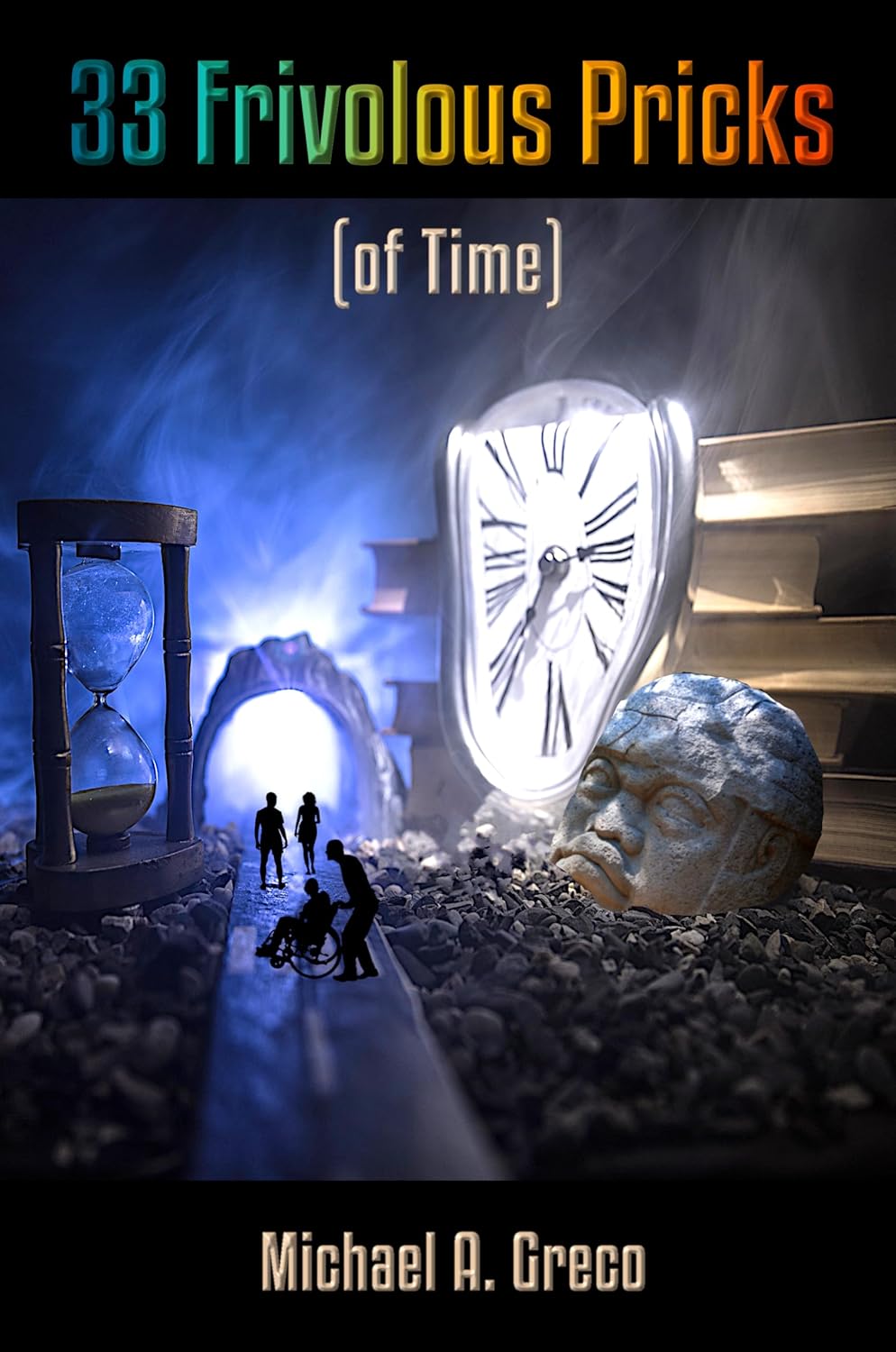

Michael A. Greco’s 33 Frivolous Pricks takes readers on an unexpected journey, blending sardonic wit, bleak satire, and surreal scenarios in a story that defies convention. At its core, the book follows the misadventures of a motley group of characters across a dystopian Los Angeles and a quirky, time-warped Japan. The tale opens with Reggie Gallo, an adjunct economics professor navigating the chaos of a decaying city, and soon spirals into a story involving time machines, peculiar institutions, and an ensemble of oddball characters. The novel’s eccentricity is its hallmark, weaving tales of social decline and personal desperation with humor and moments of introspection.
Greco’s writing shines in its vivid descriptions of Los Angeles. Early in the book, Reggie’s nightly commute through the “Miracle Mile” becomes a grimly poetic portrait of urban decay. From the “stench of human excrement” to the “mountains of trash releasing sweet rottenness,” the city is depicted as a dystopian wasteland. The gritty atmosphere perfectly underscores Reggie’s existential malaise. The book’s tonal shifts are both its strength and its challenge.
Rocket’s brash commentary on the logistical perils of time travel showcases Greco’s talent for mixing the fantastical with the mundane. This whimsical subplot sometimes feels disconnected from the grimmer narrative threads, such as Reggie’s struggles or the social commentary on homelessness and inequality.
The book’s structure, while inventive, occasionally borders on chaotic. From Pinky Bell, a Japanese teenager grappling with self-discovery and cultural expectations, to the enigmatic “Needs,” a time machine imbued with cryptic messages, each character and element is steeped in individuality. These vignettes highlight the novel’s underlying themes of resilience and self-reinvention amidst chaos.
Greco’s novel is a daring experiment in storytelling, blending genres and tones with unapologetic boldness. It’s an ideal read for those who enjoy dark humor, speculative fiction, and character-driven narratives. Fans of Kurt Vonnegut or Douglas Adams will likely find its quirky, sardonic voice compelling. 33 Frivolous Pricks is an experience that invites readers to laugh, wince, and ponder the absurdities of modern existence.
Pages: 251 | ASIN: B0DR6KZRFB

Cuckoo Heartfully

Michael Greco’s Cuckoo Heartfully is a mystical and beautiful book. It tells the story of Pinky Bell, Windy, Moonch, Puso, and Nini after they leave a colloquium in a Malaysian rain forest. After their encounter with supernatural entities in the forest, they hope that they can get back to their usual lives. However, this proves difficult, especially since Pinky Bell carries something from the forest with her back to her home in Kyoto, Japan.
This triggers a multitude of strange events that affect everyone in the town. Eventually, Pinky Bell has to find a way to return what she stole and deal with the consequences of what happened in the Malaysian rainforest. On the other hand, Moonch tries to find stability in her chaotic life while Windy tries to explore a love interest. Ultimately, all the characters in this book are struggling with handling the changes in their lives, some of which are being caused by mystical forces.
If there’s one thing that makes this book unique it’s the writing style the author employs. It’s witty, fun, and playful. This makes the book a joy to read, especially since doing so makes you feel like you are solving a puzzle. Clearly, the author is adept at leaving readers yearning for more and generally wondering where the story is headed. However, this can sometimes make a reader feel like the different storylines are unrelated, but don’t be fooled. In fact, the first chapters of the book can lead you to believe that you’re reading a compilation of different short stories. Eventually everything is woven together into an intriguing story.
The different supernatural beings and occurrences in this book are fascinating and I wish we could have been given more explanations about them because I thought they were intriguing. As a reviewer I was wondering whether to categorize this book as science fiction or fantasy, but I put that aside and decided it is a wonderful blend of both genres.
It’s undeniable that the plot of this book was fully conceptualized and expertly executed. Also, it’s clear that the author has done a lot of research into Asian culture, which is a central focus of the book. Cuckoo Heartfully is an imaginative and fun adventure book that I heartily enjoyed.
Pages: 217 | ASIN: B09YNMLDT9
Trying To Hide A Dead Body

A Labyrinth for Loons follows a man who’s stuck in Malaysia during a COVID lockdown and begins to question his own identity. What was the initial idea behind this story and how did that transform as you were writing the novel?
This story was unique in that I really had no idea where it was headed. At first, I was simply going to chronicle daily life, as I was genuinely stuck in KL (from February to September of 2020) and couldn’t return to Japan—as I had to babysit the cat. The daily diary turned stale, though, and since I do write fiction, I began running ideas through my head on how to turn this predicament into something more adventurous than it actually was.
The set-up for the story, the characters, the location—it’s all true, as that’s where I was living. The cadaver that comes along, of course, is fiction. I’m not sure if this qualifies as an “idea” but I’d simply always wanted to write about a protagonist trying to hide a dead body—one that would not cooperate. I mean, what writers, don’t, right?
The chaos with the travel visa was inspired by a novel I read in May of 2020 called Transit by Anna Seghers. The issue of identity that plagues the lead, Leonard Smith, may have developed some from another novel I read that summer, The Talented Mr. Ripley by Patricia Highsmith. And all the nihilism that permeates the story—well, that’s just me. But I’d be grossly misleading if I also don’t mention the impact of House of Leaves by Mark Daneilewski. (Hence, the minotaur.)
Leonard Smith goes on a transformative journey. Is this intentional or incidental to the story you wanted to tell?
I’d say that Smith’s journey is the story and everything else is incidental. As he struggles with the act of assuming the identity of someone who has died, he slips into a kind of psychosis, exacerbated by his isolation. He begins to see the cadaver that he’s agreed to store in his living room cupboard as not dead at all. What’s really happening is that he’s questioning his own reason for living, and this question must be answered by his metaphorical minotaur. His understanding of the influences of religion impacts his journey, too—the Islam of his host country and of the other characters; the Buddhist ideas within the Donovan song There is a Mountain, and his attempt to understand why the mountain disappears and then returns—a realization that comes from an understanding of oneself.
I find that authors sometimes ask themselves questions and let their characters answer them. Do you think this is true for your character?
Yes, definitely. Leonard Smith’s questions are mine. He’s on a journey, and his inner struggles with identity and core beliefs lead to a kind of psychotic crash. He survives it and comes away with a more contemplative outlook on his world.
What is the next book that you are working on and when will it be available?
The next book is a sequel to my first novel called The Cuckoo Colloquium. I’m not sure what we’re going to call it, but it’ll be out on Amazon in January of 2022.
Author Links: Website | Facebook | Twitter | GoodReads
![A Labyrinth for Loons by [Michael Greco]](https://m.media-amazon.com/images/I/51cWaFEBBFL.jpg)
Writer Leonard Smith wants to go home, but he’s stuck in Malaysia’s Kuala Lumpur during Covid lockdown, and the airlines seem haphazardly selective about who flies and who doesn’t, based on the type of travel visa one holds.
While waiting for the opportunity to get out, Leonard agrees to look after the belongings of another tourist—the Kiwi—who’s committed suicide. The dead man, also a writer, has written a bizarre manuscript concerning real-life accounts of a brutal minotaur housed within a labyrinth. Before he realizes it, Leonard finds himself in custody of the embalmed corpse, storing the dead man until he can be transferred for burial in another city.
Through a bureaucratic screw-up, Malaysian authorities confuse Leonard with that of the deceased Kiwi—who possesses just the right kind of visa. Is Leonard capable of assuming the false identity of the dead man for a chance to go home?
Getting desperate while holed-up with a wily cat, a 13-year-old house guest who could possibly be homicidal, and a dead man in the closet—that at times doesn’t seem all that dead—Leonard slips into profound questions of his own identity.
The only way to find answers is in the labyrinth—where the minotaur waits.

A Labyrinth for Loons
Michael A. Greco’s novel A Labyrinth for Loons first appears as a retelling of 2020 and the Covid-19 pandemic; however, something much more sinister is happening below the surface.
Trapped on the 22nd floor of his condo in Malaysia, Leonard Smith deals with the global Covid-19 pandemic on his own. With brief facetime calls from his wife and daughter, who are hundreds of miles away, an ill-tempered teenager Chuckie and various neighbours, Leonard is isolated and desperate to leave. When two individuals show up with a manuscript and insist he help return the deceased Leonard Smith’s belongings, the mind starts to play tricks on itself, and he begins to question his sanity.
While the story is based around the Covid-19 pandemic, the story still felt fresh while remaining relevant. The more I read, the more intrigued and entranced I felt. The main character is isolated in urban Malaysia, first appearing as an arrogant and stereotypical American, despite his insistence he is not, but then he morphs into other personas. While his narration and point of view are not trustworthy, I found myself enraptured by his inner monologue and the world of the Tomato Frog Building above the mall.
One would think you are reading about a dystopian world, but for those who experienced quarantine, the events of the book are undeniably plausible. As Leonard (aka Leon or Leoni) gets drawn into chaos, the readers find themselves falling deeper into the madness, as if following the white rabbit down its hole. This book captures every critical moment of the world’s time in quarantine, from Tik Tok to the troubles with face masks. It will serve as an important literary marker for society, most notably for its remark on the human mind in a state of psychological stress. Comparable to Stephen King’s The Shining.
“Monsters are real. Ghosts are too. They live inside of us, and sometimes, they win.”
Pages: 193 | ASIN: B09BKL3XLJ
Vexing Stages of Culture Shock

Michael Greco Author Interview
Plum Rains on Happy House follows an American who is trying to turn an Inn into a school but is thwarted by the house’s strange creatures. What was the inspiration behind this unique story?
I live in Japan, and it’s a place I know well. The book’s dedication probably says it all:
This book is for Japan. It’s the place I call home—though it may not want me to. For over 25 years I have grappled with the dos and don’t’s of my host country, destroying the language in conversation, giving up, resuming more study, eventually resigning myself to the boundless plateaus of almost-speech.
And Japan abides. Like a patient steward, it absorbs the frolics and the ribbing, while providing a solacing habitat in which to write and teach and parent and grow.
I came over to Japan in the 80’s and I’ve lived in some pretty seedy guesthouses—what we call gaijin houses. In creating the residents of Happy House, I just mingled the characteristics of a few of the unique people I’ve met over the decades in Tokyo and in Los Angeles. In some cases, I didn’t need to exaggerate at all.
On one level Plum Rains on Happy House is a detective story. A fellow named Harry Ballse invites the protagonist, nicknamed the Ichiban, to Japan. But the residents of Happy House all deny any knowledge of this mysterious Harry Ballse.
Some readers may pick up on the references to the 1973 film The Wicker Man, about a policeman who is lured to a Scottish island to investigate the report of a missing child. It’s a game of deception. The islanders are playing with him. The paganism and the sexual activity the sanctimonious policeman finds so objectionable are simply part of the selection process—to see if he possesses the characteristics to burn in their wicker effigy so that the village will have subsequent successful harvests.
In Plum Rains on Happy House, the Ichiban must undergo his own horrific sacrifice to appease the house. My novel is in many ways a tribute to that remarkable film, and it has the same foundational plot lines, but I’ve laid down a hearty layer of satire and lots of cross-cultural lunacy.
There are some weird and fascinating things happening in this story. Was this an easy outlet for your creativity or was there some effort put into creating these things?
Nothing is easy. If women will forgive me the metaphor, creating Plum Rains on Happy House was like giving birth—it hurt a lot. There were points when I considered giving up because it was just too hard. I’m not a funny person, but I have little trouble dreaming up wacky stories and characters. The residents of Happy House had to be distinctively quirky. I didn’t know how bawdy things were going to become, or how much depravity would creep its way into the story. But once I had the characters they took charge, and I relegated myself to being, more or less, their stenographer.
Dialog was also something I paid close attention to. Of course, sharp dialog is vital in any story, but for this kind of back-and-forth humor to succeed, I felt it really had to have zip. Just like a comedian practices his delivery line, the dialog exchanges had to have real punch. As with most writing, dialog should say a lot , with very little. The communication isn’t in the words being said but in the subtext. Good dialog says it without saying it. One quick example from Chapter One has the resident of Room 3 (nicknamed The Goat) explaining to the new resident about his missing foot:
“I saw you looking at the bottom of my leg.”
“Your foot?”
The Goat scowled. “Obviously, you can see that no longer exists.”
“It’s in Cambodia.”
The Goat went into a cross-eyed fluster. “What is?”
Sometimes readers need to work a bit to understand the exchange, and I think they appreciate that. Dialog is an organic process. It’s the way characters talk in my head, and I think I know how to write them because they are all a part of me. It all works toward satisfying the element of what a good scene often comes down to: one person trying to get something from another.
Mix that in with the baffling idiosyncrasies of Japan and its language, and the vexing stages of culture shock, which frame the Ichiban’s adventure in Happy House, and readers have a lot to juggle, especially those uninitiated to living in other countries. I’m hoping this confusion is a part of the magnetism of the story. On top of that, one should remember the old guesthouse is haunted:
“Happy House is an amoeba everlasting, a floating world—capturing and sealing the self-indulgence of the red-light districts, the bordellos and the fleeting, delightful vulgarity of ancient Japan, an eternal time capsule of the flamboyant and the boorish.”
What do you find is a surprising reaction people have when they read your book?
The book has received mixed reviews. Of the five books I have up on Amazon, Plum Rains on Happy House was the first to receive a customer review of one star—perhaps rightfully so: the reader was “disgusted” by some of the more explicit scenes, and I think that was my fault; the earlier cover gave no indication of the sexual content within, and this poor woman was clearly ambushed. With the one star, I know I’m finally an author, and wear it as a badge of honor.
There are, however, cultural elements in the story that some will not understand: the usage of the various slipper customs inside a house, the daily beating of the futon, the laundry poles, the shockingly steep stairwells, the neighborhood garbage trucks that play cute tunes to let you know they’re coming, the confusion between the colors of blue and green.
The dichotomy of substance versus form also plays an important part in underscoring the tension—in the way one swings a tennis racket, or walks in a swimming pool, or plays baseball, or eats particular dishes: What should predominate—what you are doing or how you are doing it?
On another level, the story examines language acquisition and the role of structure within the learning process. The residents all have their various opinions: As teachers, should English be taught through some kind of lock-step formula, or would one be better off approaching it in a more hands off manner, rather like painting? Everyone seems to have an opinion.
The idea of structure comes to the forefront again when discussing what one character, Sensei, calls the hidden structure of the house, which, like the neighborhood (or any cityscape in Japan) appears as an amorphous sprawl. But look underneath this sprawl and one sees the organism. Sensei says that the randomness, or chaos, embraces a flexible, orderly structure, and he likens the house to an amoeba that has the ability to alter its shape. Similarly, this amoeba can be seen as a microcosm of Japan as a whole.
What are you currently working on and when will it be available?
I’ve finished the first few drafts of a story about Special Needs teens who discover time travel. But the adult teachers at the school find out what’s going on and abuse this ability to travel back into time for their own selfish needs. It turns out the ones with the Special Needs are not the teenagers—who are all somewhere on the Autism spectrum—but the supposed grownups, and it’s up to the teens to save the day. It should be out in autumn.
Thanks for having me!
Author Links: GoodReads | Twitter | Facebook | Website
![Plum Rains on Happy House by [Greco, Michael]](https://i0.wp.com/images-na.ssl-images-amazon.com/images/I/51Q1wl7Un%2BL.jpg?resize=285%2C428&ssl=1) In Japan, the little inn called Happy House welcomes its guests … unless it’s rainy season. When the “plum rains” arrive, trying times of volatility and decadence begin for everyone.
In Japan, the little inn called Happy House welcomes its guests … unless it’s rainy season. When the “plum rains” arrive, trying times of volatility and decadence begin for everyone.
The American in Room 1, however, is dead-set on turning the derelict Happy House into a burgeoning English school.
The house has other plans, and Room 1’s attempts are thwarted by a freakish creature that lives under the floorboards called “the Crat”.
Moon Dogg
![Moon Dogg by [Greco, Michael]](https://i0.wp.com/images-na.ssl-images-amazon.com/images/I/51KYaG3C--L.jpg?resize=277%2C420&ssl=1) It’s easy to judge a situation from the outside looking in. Jerome Doggman has an opinion about religion and is looking into a specific sect for his next project. Jerome is a semi famous Arizona filmmaker working to expose the practices of a particular fundamentalist religious group. As luck, or lack thereof, would have it. He gets too close to something he shouldn’t and is murdered. You would think that this is the end of it but alas! It is actually the beginning of things.
It’s easy to judge a situation from the outside looking in. Jerome Doggman has an opinion about religion and is looking into a specific sect for his next project. Jerome is a semi famous Arizona filmmaker working to expose the practices of a particular fundamentalist religious group. As luck, or lack thereof, would have it. He gets too close to something he shouldn’t and is murdered. You would think that this is the end of it but alas! It is actually the beginning of things.
The subject of Jerome’s expose would have been a teenage boy, Abraham, who’s been in a coma for eight years. When Jerome dies, he reincarnates in the body of Abraham. As if that is not strange and complicated enough he has the hots for the boys sister, Florence. Jerome’s journey is long and enlightening, all the while fighting the fact that his previous killers want to kill him, again.
Michael Greco puts together a hilarious tale of life through the eyes of different people. This book is beautifully written. The story flows smoothly, almost like the characters and story took on a life of its own without control from the author. It is exquisite. I felt that the prose was simple and easy to digest. For such a wild plot, it is pretty easy to wade through and find the lessons in the story.
One of the biggest takeaways from this story is the importance of putting oneself in another persons shoes. Jerome would have remained judgmental of Abraham’s sect for life if he got to live his own life. Another beautiful thing is the realization at the end of what the true purpose of reincarnation had been. It was never about uncovering truths and secrets. Not to mention the happy, maybe a little sad, ending. It is nice to see the characters wrap up so nicely.
The author weaves in some old folk tales into the narrative that help to deliver some complex ideas. All in all, it is a book that is thought provoking and engaging.
Pages: 373 | ASIN: B07B7H3NMV
Plum Rains on Happy House
![Plum Rains on Happy House by [Greco, Michael]](https://i0.wp.com/images-na.ssl-images-amazon.com/images/I/51Q1wl7Un%2BL._SY346_.jpg?w=604&ssl=1)
Lawrence Thornberry thinks he is ready for his year in Japan. However, nothing could have ever prepared him for the experience he is about to have. An experience he can never truly understand but astonishingly accepts. He discovers new elements everyday. Some of these strange things would deter anyone but not the Ichiban. A nickname he got because of the room he was assigned, room number one. This American English teacher teaches at the Slop Bucket. When he is not there he encounters strange things at the Happy House. Strange things that are brought on by the rain. Just a good old Japanese experience.
One of the strange but weirdly comfortable things is that this story is told by crow. A tale that slides seamlessly from first to third person and back. The crow has strange characteristics of its own. Note the overuse of the word strange. It is a recurring theme in Plum Rains on Happy House. The crow though not exactly living in Happy House is one of the many eclectic characters in the book. Michael Greco has done a good job of building otherworldly characters but still maintain a light touch. Another grumpy but delightfully humorous character is the Goat.
Oh the words. The author has a special gift. He weaves words into a beautifully crocheted poncho. A poncho that envelopes the reader in pure literary induced ecstasy. An example is that bit where Titty is introduced. It is so funny and accurate, I imagine. The reader cannot help but picture it. Speaking of which, the character development in this book is quite good. Not in a way that one can relate to them but in a way that makes the reader comfortable. The reader feels at home in a house that requires a symbiotic relationship between it and the resident. It is uncanny how that can be possible.
It is truly wonderful that despite the Ichiban noticing some peculiarity as he was trekking up to the house. He kept going. He continued to see the crooked house but it was like he saw something completely different. Like all the strange things were supposed to be part of the experience. It is good to take things in stride like that.
There are two issues with this book. While the language is well utilized, it still requires a bit of polishing. The plot is unique, but the story is confusing at times. Bits that arise abruptly and disrupt the flow of everything. Some people may like this as it brings a little unpredictability to the story.
This is an entertaining book with interesting characters and an imaginative creative plot. All of that and a whole lot of quirk.
Pages: 248 | ASIN: B07DWQ3R68


