Blog Archives
The Importance of Our Self-Discovery

The Philosopher and The Theologian, Through Asceticism, Seekers of God provides readers with an in-depth look at asceticism, its resurgence, and the relevance of its practices. Why was this an important book for you to write?
As a man passionate about philosophy and religion, I was somehow irritated by the way the philosopher was viewed by the theologian, and the theologian by the philosopher.
I realized that in fact, the differences are not that big even if, superficially, the positions seem to be irreconcilable. The ascetic aspect of life has always intrigued me, especially through the character of “self-imposed sacrifice,” and I wondered what intimate springs make certain people seek to desire such a way of life. Studying the lives of the ascetics from early Christianity (Egyptian Patericul, Sinait Patericul, Mount Athos Patericul) as well as the asceticism performed by the Buddhist masters from the East, I realized that the differences are not so great. In fact, I noticed that the similarities are much more numerous. But in fact, the biggest surprise was to find that both the philosophers (starting with those from Greco-Roman antiquity) and the believers sought through asceticism to reach a deep knowledge of their own person.
Through this book, I tried to show and try to demonstrate the importance of an ascetic life (somehow adapted) even today in the somewhat impossible conditions of contemporary society. The existence of contemporary social currents that stimulate an ascetic life correlated with the protection of the environment and a life lived with moderation proves that such a book is necessary not so much by the application today of the ascetic practices of 1500 years ago but by the mental preparation of the members of society for another way of life much more responsible towards nature and towards us.
Today, people feel like they have lost their compass; they can’t find themselves, and they can’t be happy anymore. However, being happy does not necessarily mean having a mountain of money. Being happy means finding yourself, getting to know yourself, and loving yourself and those around you. Man is born with a purpose in life. Man gives meaning to his life as he “becomes” a person.
The common element found in Christian and Oriental asceticism, as well as in atheistic philosophers, was man’s obsessive desire to know himself. There is the key to the discovery of happiness and immortality: self-knowledge, the discovery of the God within us, deep within our Self. And asceticism can help us achieve this.
Can you share a little about the research process involved in putting this book together?
Writing the book involved a huge amount of research. In addition to the normal documentation activity that involved the research of philosophical currents starting from Greco-Roman antiquity to contemporary currents, an important role was also played by the study of the lives of the Ascetic Fathers from the beginning of Christianity. I tried to extract the common element of these thousands of Christians who dedicated their whole lives to an ascetic way of living in order to unite with their God. Studying Pateric was essential. Also, to realize the parallelism with the asceticism practiced by Buddhist monastics, I studied Buddhist asceticism. To properly understand the ascetic essences of Buddhism, I sought to go to the source, and the visit to Japan to the great Buddhist and Shinto Temples in Tokyo, Kyoto, and Osaka was of great help to me.
What is one thing you hope readers can take away from The Philosopher and The Theologian?
I hope that by reading my book, the readers will understand only one thing: the importance of knowledge and self-discovery. This book is not about religion; it neither supports nor criticizes religion. It is an attempt to emphasize the importance of our self-discovery. We live in delicate times in which people have lost hope and resort more and more to different external stimuli in an attempt to “feel good about themselves.” This book wants to tell people that there is no need for anything external to be satisfied with yourself. Through the examples I gave, starting with those from antiquity, I wanted to show that man has always been preoccupied with discovering himself. We don’t need external stimuli not to be depressed. We will find – inside us – everything we need to be happy and discover our path in life.
Can readers look forward to more from you in the near future? What are you currently working on?
I want to start writing as soon as possible on my future book in which I want to treat the problem of “time.” However, I will have to finish the analysis and research phase of the “time” phenomenon. I’m not interested in “physical time,” but especially in the philosophical interpretation of time and how societies relate to “time.” I am interested in the transcendental aspect of “time.” I will start with a brief history of how philosophers have interpreted “time.” Then, I will present my vision of “time” in detail. I will also deal with the transcendental aspect, so there will be theological interpretations of “time and eternity.” I will try to discover if there is a connection between society, religion, and time. For that, I will have to deepen my analysis.
Author Links: GoodReads | Facebook | Website | Amazon
Man has always sought to discover himself and his soul’s “depth” and understand how to relate to divinity.
Man has been looking for methods and means to “improve” himself since ancient times. Asceticism, as a way of life, has existed in secular or religious forms since the beginning of human existence, depending on the areas of manifestation.
In this book, I showed that ascetic practices were not specific only to Christian monks or Buddhist ascetics. It was also practiced by ordinary people through which they tried to get closer to their inner self and God. Asceticism was practiced both by theologians and philosophers who, being atheists, were not looking for God but were looking for “the depth of themselves.” We could name this “deep within us” as God or otherwise; it does not matter.
In this book, I tried to deal with two themes.
The first was that asceticism, in different degrees, can be practiced by both the faithful and the less faithful. Both seek the same thing that they call different. I dealt with the subject of the Holy Fathers of the Desert from the Egyptian Pateric. I have tried to present the variety of ways of manifesting asceticism, from a “harsh” form made by these hermits of the desert to a more “diluted” form that manifests itself today.
The second theme that I tried to discuss was the “attempt to revitalize” the asceticism that can be seen in Western society today dressed in an environmental form.
In this book, I explained how I see the issue of asceticism and the connection with God without turning the content into a religious one. The book is a philosophical book that deals with religious themes, a combination of philosophy and theology in approaching doctrinal themes related to asceticism.
I hope that the reader will discover in the pages of this book an unsuspected universe, a man’s search for the discovery of his own person. Each of us must find himself so that we become responsible individuals in front of history and ourselves.
Each of us was born with a purpose. Let us be an active part in building our destiny to fulfill that purpose.
Be Your Own Boss


In Be Your Own Boss, Bill McGowan distills five decades of business acumen into a compelling guide for the aspiring entrepreneur. With an evocative recount of his own journey—from his roots to his love for business—McGowan captivates readers, illustrating his path to success with vivid personal narratives. His unfiltered insights into the multifaceted business world reveal lesser-known aspects, making this book an invaluable resource for emerging entrepreneurs and those envisioning future leadership roles.
The content of this book is remarkably accessible. Despite its brevity, each chapter delivers profound insights. The book is meticulously structured to engage readers effortlessly, featuring reader-friendly fonts, logical organization, and eloquent diction. McGowan’s passion for business is palpable throughout the text, and his encouraging tone offers solace and inspiration, even when navigating the complexities and challenges inherent in entrepreneurship. McGowan covers a wide array of topics, including business planning, marketing, franchising, goal setting, and structure creation. He skillfully intertwines each subject with relatable anecdotes, making complex concepts understandable. This book addresses the myriad challenges entrepreneurs face, from marketing dilemmas to client acquisition and beyond, providing comprehensive solutions to the most pressing questions. McGowan employs bullet points for clarity and includes periodic illustrations to enhance understanding and engagement.
Be Your Own Boss is a tool offering a blend of entrepreneurial wisdom and practical skills. This book is an indispensable mentor and guide for anyone with aspirations of steering a successful business.
Pages: 190 | ISBN : 1398420336

Communication is More Than Verbal Language

Communicating: The Multiple Modes of Human Communication 3rd Edition is a thorough and insightful examination of human communication, transcending the conventional focus on verbal language. Why was this an important book for you to write?
I’ve been interested in, and writing about, communication in its various senses from my early days: storytelling for example, the beautiful wit and words of Ulster communicating, linguistic anthropology, body language, music (that’s communication too). Through this I’d been becoming more and more convinced that communication did not consist only, or even predominantly, of verbal language, spoken or written, but a whole wealth of other things as well. That isn’t at all a widely accepted view among communication experts, so I felt that I HAD to write a book to show the evidence and argument for my position – almost a duty.
It turned out a bigger journey of investigation than I’d expected (and I loved it – hope you’ll come along it with me and enjoy it too: about these amazing, clever, enterprising animals, and I don’t mean just the human ones).
What changes did you make in this edition of your book from prior editions? Was there any area where your research has led you to a new or different conclusion from prior published results?
A lot. Besides some updating throughout and more and better illustrations, there’s a new introduction linking to recent perspectives in social science (much has changed in the 20 years since the first edition); reordering of the five chapters on the senses to make the argument run more smoothly; a rewritten chapter on extrasensory communication in the light of recent developments and of the revolutionary findings of “new science”; and a totally new concluding chapter.
That final chapter: I found to my consternation that what I had found During my investigations almost totally reversed the usual assumptions about communication in early human history (cave paintings are in too), INCLUDING KEY ASSUMPTIONS IN MY OWN BOOKS, earlier editions of this book among them.
It was startling. But I had to be honest and tell it as I’d found it.
And that was – ? Ah, complicated! You’ll have to read it.
Did you find anything in your research of this story that surprised you?
Yes very much so, not just in research for that final chapter, but also the fascinating range of ways humans and other animals use their differing but overlapping resources to interact (WHAT a lot is now known). I was particularly surprised and impressed by the explosion of radically new research about the gesticulation systems of the great apes: amazing and surprisingly relevant for human communicating.
What is the next book that you are writing, and when will that be published?
Am I allowed two? The thing is that now that I’m retired and have more time I find it relaxing to have several contrasting books on the go and don’t always know which is going to come out first.
Two books that I’ve been tinkering with for some time are, first, an updated version of a collection of prose, verse and images from many cultures, now to be called “The Search for Peace: Voices of Despair and Hope through the Centuries”. That’s only too heartbreakingly topical just now, isn’t it, but inspiring too – what insights there have been through the world and the ages. With luck it’ll very soon be chuntering its way onto Amazon.
And, second, a small book now nearing completion: a fun – but perhaps also a bit useful – silly little book with cartoon pics, to be called something like “Kate’s Bad Cook Guide for morons”. I’m enjoying that immensely. Maybe in time for Christmas, no promises.
After that? Back to a couple academic ones, and maybe a new Kate-Pearl novel…, let’s see.
Author Links: LinkedIn | Twitter | Facebook | Website
In an authoritative and readable account, Ruth Finnegan brings together research from linguistic and sensory anthropology, material culture, non-verbal communication, computer-mediated communication, and, strikingly, research on animal communication, such as the remarkable gesture systems of great apes. She draws on her background in classical studies and her long anthropological experience to present illuminating examples from throughout the world, past and present.
The result is to uncover an amazing array of sounds, sights, smells, gestures, looks, movements, touches, and material objects used by humans and other animals to interconnect both nearby and across space and time
She goes on to first explore the extra-sensory modes of communication now being revealed in the extraordinary “new science” research and then, in an incendiary conclusion, to deny the long-prevailing story of human history by questioning whether orality really came before literacy; whether it was really through “the acquisition of language” that our prehistoric cave painting ancestors made a sudden leap into being “true humans”; and finally, astonishingly, to ask whether human communicating had its first roots not, after all, in verbal language but something else.
Not to be missed, this highly original book brings a fresh perspective on, among other things, that central topic of interest today – the dawn of human history – and on what being homo sapiens really means. This revised and updated edition has additional illustrations, updated chapters, and a new concluding chapter.
A provocative and controversial account that will stir worldwide debate, this book is an essential transdisciplinary overview for researchers and advanced students in language and communication, anthropology, and cultural studies.
Communicating: The Multiple Modes of Human Communication 3rd Edition


Communicating: The Multiple Modes of Human Communication 3rd Edition by Ruth Finnegan presents a thorough and insightful examination of human communication, transcending the conventional focus on verbal language. Finnegan adeptly delves into the multifaceted aspects of communication, encompassing not only spoken words but also the nuanced realms of gestures, body language, material objects, and the contexts in which these interactions occur. Her approach highlights the intricate and layered nature of human interactions, with a particular emphasis on the significance of non-verbal elements such as facial expressions and sensory experiences. This perspective offers readers a comprehensive and dynamic understanding of communication.
Finnegan’s writing style is both clear and inviting, effectively demystifying complex concepts for a broad audience. Her narrative is enriched by anecdotes and vivid descriptions, making the book as engaging as it is informative. From beginning to end, the text is infused with a depth of material and a keen analytical perspective, showcasing Finnegan’s scholarly acumen and intellectual diligence. Her reflective and inquisitive tone invites readers into a deep exploration of communication’s diverse dimensions. The book’s use of diverse examples, ranging from 20th-century England to 1960s Sierra Leone, underscores Finnegan’s commitment to examining communication across various cultural contexts. This approach, coupled with references to semiotic and structuralist theories, adds theoretical depth to her exploration.
Rather than diving into complex definitions from the outset, Finnegan opts for an experiential approach to communication. This strategy enhances the book’s accessibility and appeal, making it a compelling read for a wide audience. Communicating serves as a foundational text for those deeply interested in the expansive study of human communication. It caters to readers seeking a nuanced and reflective understanding of the term ‘communication’ and its multifaceted nature, especially in relation to broader social and cultural contexts.
Ruth Finnegan’s Communicating stands out as a comprehensive guide to understanding the diverse and complex facets of human communication. Her skillful blending of high-quality writing with in-depth discussion captures the functional value of communication in society, stimulating intellectual curiosity and providing valuable insights into the intricate interactions that define our social fabric.
Pages: 338 | ASIN : B0CKFNP7S1
Triumph Over Trauma
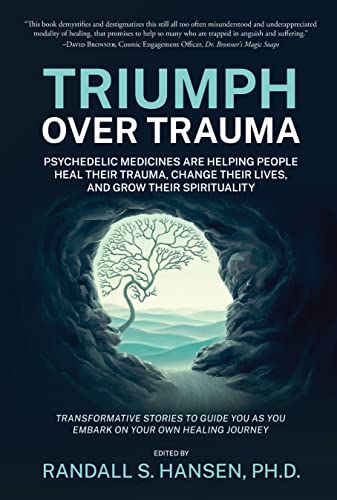
In Triumph Over Trauma: Psychedelic Medicines Are Helping People Heal Their Trauma, Change Their Lives, and Grow Their Spirituality, the reader is educated about psychedelics, shown how to use them, and taught about facts that are not shared in schools and on the media. Randall S. Hansen uses 23 stories to demonstrate to readers the positive impact psychedelics have on humans and why more people need to be open-minded about them.
Psychedelics are recognized to be hallucinogenic drugs that sometimes alter one’s perception and cognitive processes. In this book, Randall S. Hansen, throws light on the basics of psychedelics, answering frequently asked questions, and stating unknown facts. One of the things I love about how Randall S. Hansen started his book is the Matt Zemon quote he shared. The quote reads, ‘I am convinced that psychedelics are not a panacea, but they can play a role in healing and connection, both for the people that choose to use them and for those that do not.’ This quote is inspiring, and it acknowledges the healing elements of psychedelics.
Triumph Over Trauma is an eye-opening read. The author starts from the basics, discussing the best psychedelic medicines for newbies, how to source them, positive effects, the different kinds of psychedelics, and even the dangers. Randall S. Hansen is candid in his writing and does not write about fantasies or unproven theories. This book is a great read and incredibly excellent for anyone dealing with trauma. Whether it is trauma from work, home, childhood, or any mental condition, Randall S. Hansen, in detail, writes about how psychedelics can help you.
This book is divided into four parts. Part one of the book is an introduction for those unfamiliar with psychedelics. The second part of the book is my favorite. In this part, the author writes about experiences with 23 people. These are real stories told, and one can feel the healing the people in the stories share. The positivity radiated through these stories is marvelous. I appreciate that their stories were not too long but short enough to inspire and radiate the positivity readers that are hurt and those that have been dealing with past traumas need. I mostly enjoyed the stories and transformation journeys of Ryan, Todd, Charles, Hunt, Alexandra, and Jessica. Part three is on microdosing while the last part has the author summarize, and mention other vital information not discussed in the book.
Randall S. Hansen’s book is the ideal for your healing, wellness and positive transformation. After reading this book, you get a new perspective of psychedelics and feel refreshed. I recommend this book to readers that are struggling with traumas, those seeking treatment, and readers that are curious about psychedelics.
Pages: 290 | ASIN : B0BNLWHSHL
100 Livestreaming & Digital Media Predictions Vol 2
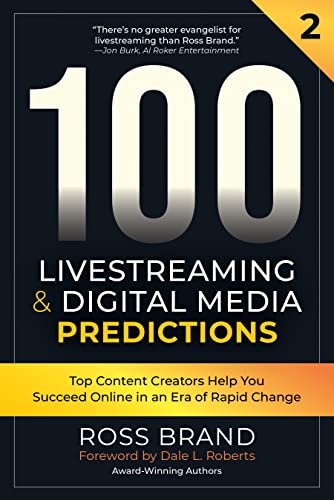
In 100 Livestreaming & Digital Media Predictions Volume 2, Ross Brand shares his thoughts with other experts in marketing, influencing, social media, and new tech trends. The reader is treated to a wealth of knowledge that will get any entrepreneur or marketer to move to the next step. As an expert, Ross Brand extensively writes about digital media, trends, and the future. He shares his experience in various capacities and writes on how to build a digital empire using the tips in the book. As a reader, you not only grasp the topics being discussed but also feel like you are part of the significant movement that is bringing global changes. The internet has made the world a global village, and Ross Brand is here to tell you how to use that to your advantage.
How do you keep your audience engaged? How do you use live streaming and digital media to connect with your targeted market? Is social media difficult to use, or are you just uninterested? Do you put your talent to use? Finally, how do you strategize when online? The author answers these and related questions and explains why everyone must keep up with the trends. Understanding social media icons and the art of influencing authors, digital strategists, online celebrities, and many other personalities is refreshing. I loved reading the professional takes and predictions from Marisa Cali, Gord Isman, Chris Stone, Ash Borland, Will Slaise Jr., Tim Sohn, Lottie Hearn, Brad Friedman, and the rest of the experts. I like that the author took this approach, giving the reader different perspectives.
I like that the author does not generalize when discussing social media platforms. Ross Band writes about every forum individually and later concludes with how each is connected. For instance, users that love using Twitter are given tips relevant to the platform, while users are more inclined to use Instagram to get different tips. I have learned from the author that despite these online platforms appearing similar, they each need a different approach to marketing and promoting products. One of the most valuable lessons I learned was about shopping platforms like Amazon. Few people are keen on using videos or live streaming on e-commerce sites. Tips on how to be different from the author and predictions make this book a gem.
By the end of the reading, the reader completely comprehends the art of live streaming and building a brand online. The author‘s dedication to this subject is admirable and encouraging. The world is moving fast, and every ambitious person needs to adapt. With books like 100 Livestreaming & Digital Media Predictions, readers are assured of being in the know and moving with current trends without struggle.
Pages: 219 | ASIN : B09Y8C7NMX
120 Seats in a Boiler Room
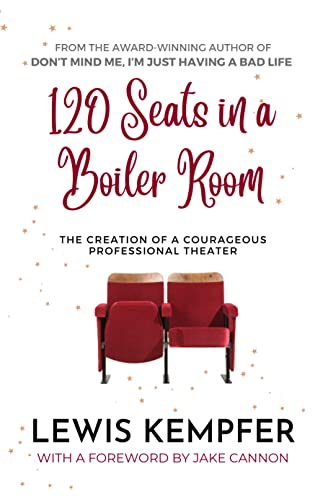
Lewis Kempfer’s storytelling is incredible. How the author chronicles his early days, relations with friends, the family encounters as an adult, and everything in between is thrilling. In 120 Seats in a Boiler Room: The Creation of a Courageous Professional Theater, Lewis Kempfer narrates his and others’ stories about this beautiful theater in Nashville, how it came to be, and the impact it had on the community.
The author’s storytelling aside, this book is an exciting read because of how descriptive Lewis Kempfer is when recounting events, locations, objects and even people. You get the real picture just by reading the text and get the appeal of being part of the story. This exciting book will inspire individuals in the arts and those who dream of owning a theater or something similar.
In the book, the reader is transported to Nashville. There is a rundown boiler room filled with waste and unpleasantness. What to do with this boiler room? Enter four ambitious friends who could use the boiler room for something else. Lewis Kempfer and his buddies have a theater company looking into making this boiler room a theater. Converting this old, unused boiler room into something locals would treasure was beautiful. I enjoyed reading about the strategies the friends took, the brainstorming process, completing the whole thing, and how it served the people.
This fascinating book reads like a memoir, except it is not your typical memoir, as the author shares vital tips and also has guest authors chip in to tell the story. One moves from enjoying Lewis Kempfer’s personal stories to reading the how-to guides he shares to engaging with the letters to the editor. I appreciate having other individuals tell tales from their perspective, as it balances the author’s narration.
120 Seats in a Boiler Room is unique, the storytelling and narration are remarkable, but the lessons readers will take from this book are invaluable. Sharing lessons on subjects like learning audience demographics, casting, licensing, production, media and public relations, staffing, and other crucial matters are all included. This is an entertaining book for readers that love semi-autobiographies fused with how-to guides.
Pages: 418 | ASIN : B0BDKPG6JX
Freeman Explains!
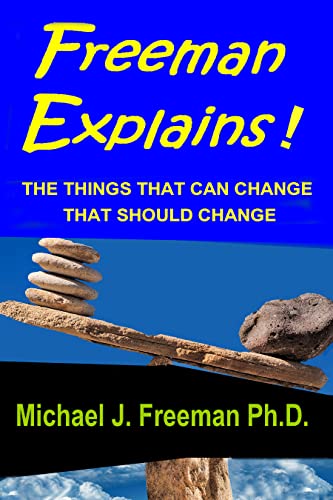
The title of this fascinating book instantly grabs readers, Freeman Explains: The Things That Can Change, That Should Change. This is because the content in the book is literally what the title states. The author Dr. Michael J. Freeman is direct and gives readers exactly what the title promises. This book summarizes what happens in society and what is wrong with people’s approach regarding pertinent issues. Freeman is intentional and weighs on issues before offering a solution. The author examines the problem, digs down to the root, and analyzes every aspect of the issue before giving his final take.
There are multiple issues discussed in the book, but there is one particular topic that I am grateful for the most; Kids and pornography. This is a sensitive subject to some and is even outlawed in certain cultures. In Freeman’s book, however, the reader is given a clear perspective on the harm pornography causes to young minds. Freeman writes about the harm of pornography and how the internet, despite making life easier, is causing tremendous damage as anyone can access whichever content they please. The author hopes that internet pornography can be regulated. He even offers strategic solutions to this problem, giving rational answers to anyone with questions.
Other than pornography, Freeman also tackles more than a dozen other topics. Like the title suggests, Freeman explains things you need to know as a human being and a citizen of the world. Contemporary issues need modern solutions, and the author is here to do just that, offer sensible and logical solutions. I also enjoyed reading about drug problems, healthcare, politics and policymaking, medicine, religion, marriage, sex, education, voting rights, and civic education. Readers will get a discussion on almost all topics law-makers debate about.
What I like most about the author is his passion for children and young people. One can see the genuine concern he has through his text. He will share with you why children need to be protected and how every responsible adult can do it. Two of my favorite texts in the book are ‘Without perspective, you know nothing’ and ‘you don’t know what you don’t know.’ Both phases are in reference to children or young minds. On issues like pornography, children may not be able to know what is good for them and what is not because they are yet to see or experience what adults already have. Simply put, they lack perspective and thus don’t know anything.
Dr. Michael J. Freeman and his work are the true definition of ‘with age comes wisdom.’ The author, having experienced an eventful life, understands what ails society and knows what should be encouraged. Reading his thoughts was refreshing, as one can tell that the author is not influenced by modern trends. Freeman openly shared his takes and explained in detail his views. This thought-provoking book is perfect for those interested in how the modern world is shaping children and their futures.
Pages: 213 | ASIN : B0BLXW5PMH



 LITERARY TITAN