Blog Archives
Imagination and Inspiration

The Grand Adventures: A Secret Unveiled follows a group of cousins who stumble into a magical sleigh that kind of works like a time machine, taking them to witness important moments in Biblical history. What was the inspiration for your story?
When covid locked down the country, I bought a Santa outfit for my husband and made a Mrs. Claus dress for me. Our volunteer fire department got a list of all the kids and addresses, raised funds, bought and wrapped presents, and devised a plan to distribute throughout town. On our little trailer behind the command truck with the 2 big fire engines behind it all began. Social distancing went out the window with the first little boy and his sister about knocking Santa off the trailer, and us getting the best hugs ever. Ever since we give to whoever asks for Santa and Mrs. Claus. When we shared with our grandkids they loved it and they wanted to share with the world that their grandparents were in fact the real Santa and Mrs. Mary Claus. So, grandma’s storytelling and the imagination of the 10 grandkids, the story emerged. It inspired our oldest grandson, who is now working as the lead writer on the 2nd story for the series.
How did you decide which biblical moments to include?
It was rather easy for us as we were at Thanksgiving but Christmas was just a month away. We gathered together and talked, I just listened. There are so many to choose from, but most decided on these 2.
How did you approach writing emotional faith moments for kids?
The grandkids were the inspiration. Asking what would you say, think, do, or feel in these situations?
Do you plan to continue the cousins’ adventures?
Yes, very much so, the adventure is continuing with our 16-year-old grandson, William, who has taken the lead in writing book 2. I am so very proud of him and each of my grandkids. The hardest is trying to get all 10 grandkids together to decide what to do, where to go, and how to fulfill the adventure.
Author links: GoodReads | Facebook | Instagram | Website
Arboreal Destiny: The Trees that Shaped the History and Culture of People
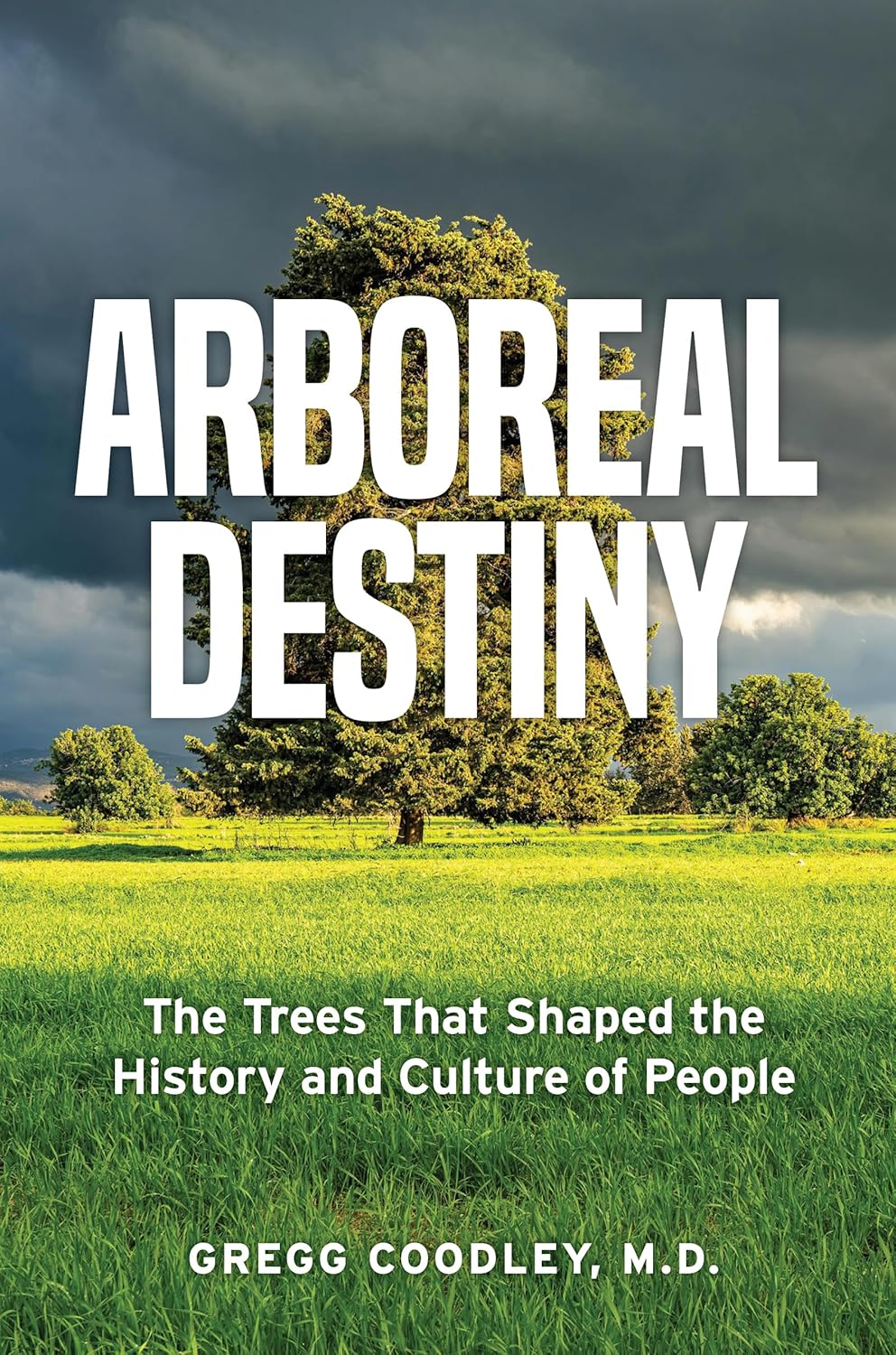

Arboreal Destiny: The Trees That Shaped the History and Culture of People takes twenty kinds of trees, from figs and olives to oaks, chestnuts, and rubber, and shows how they have steered human history, belief, trade, and even medicine. Each chapter starts with clear biology, then moves through myths, sacred stories, everyday uses, and modern science, before the final section widens out into a case for trees as key allies in facing climate change and ecological breakdown. The book argues that we literally grew up with trees, built our homes and ships from them, wrapped our gods and our empires around them, and that our future still rises or falls with their fate.
The writing is careful, researched, and very steady. The author piles up stories, laws, quotes, and footnotes, and the effect is that each tree feels huge and crowded with people. I loved the way the fig chapter moves from wasp pollinators to Egyptian coffins to Buddhist pilgrims under the Bodhi tree. The olive chapter does something similar with lamps, temple rituals, and long-lived groves tied to families. Those shifts kept my curiosity awake. The tone can sometimes feel textbook-like, and the book is very detailed. Still, the overall voice is calm, patient, and respectful of readers who want substance.
The book quietly insists that trees are not scenery. They are the main cast. When I read about chestnuts feeding mountain villages, or white pines driving imperial navies and colonial anger, I felt a little jolt of grief at how casually we cut these living systems down. The closing material, where trees become tools for restoring ruined land and drawing carbon out of the air, hit a different nerve. It felt hopeful, but also a bit desperate, like we are turning back to old companions after years of neglect and asking them to save us one more time. I appreciated that the author does not romanticize everything. Rubber and palm chapters, for example, face the violence and exploitation tied to those trees. I would have liked a stronger personal voice from the author, a short scene on the ground, a human face among the facts, because the subject is so alive that it almost begs for that touch.
This is not a quick nature coffee table read. It’s closer to a serious but accessible course in how trees and people grew into each other, with a side of quiet moral urgency about where we go next. I would recommend it to readers who enjoy narrative history, people who like to see religion, trade, science, and culture in one frame, and anyone involved in conservation, policy, or environmental education who wants stronger stories to tell. If you are ready to see forests and street trees as long-time partners with a real stake in our future, this book will be well worth your time and attention.
Pages: 414 | ASIN : B0GNNVSG69

The Ripple Effect

The Ripple Effect is a memoir that follows Teresa Baglietto from a golden childhood in Aspen through the shattering loss of her father, a steep financial fall, sexual assault, three marriages, motherhood, multiple cancers, aneurysms, strokes, and a brutal round of money crises. It is structured as a series of storms and partial calms, each chapter moving from vivid scenes to “Core Lessons” and reflective “Breakout Questions” that spell out what she took from each season of her life. The through line is her belief that we can meet even the worst moments with a mix of radical honesty, small practical steps, and a stubborn inner voice that says, “Not today, life.”
This is an emotionally stirring book, in a good way. Baglietto writes in plain, straight-talking language, and she leans on concrete details, like the feel of the swimming pool at the country club, the smell of the barn blankets, and the exact sound of the walker with tennis balls scraping along the hospital floor. Those moments pulled me in and made the medical scenes, in particular, feel painfully real. The structure of the story, followed by “Core Lessons” and “Breakout Questions,” gives the book a coaching flavor, which I mostly liked because it kept nudging me to think about my own life instead of just watching hers. The lessons felt like a keynote talk captured on the page, but the scenes before them are so specific and emotionally charged that the summaries usually landed as earned rather than preachy.
Emotionally, the book hit me hardest when it dealt with compounded trauma and how it lands on family. The way she describes rape, then silence, then the armor she builds over years, is blunt and unvarnished, and I felt my stomach drop reading it. Later, when she writes about her sons watching her cycle through diagnoses, treatments, relapses, and new crises, I could feel how much she carries in her body and in her mind at the same time. Her central idea is that resilience is not magic, it’s a series of small, strategic choices: pushing for a mammogram when the system drags its feet, speaking up when something feels wrong in the hospital, sitting down with the numbers when the money is gone, letting people bring food when pride wants to say no. I appreciated that mix of emotion and practicality. The constant framing around strength and comeback felt relentless, leaving little room for simply being wrecked, but she does show those cracked, exhausted moments, and that kept the message from sliding into toxic positivity for me.
I would recommend The Ripple Effect to readers who are living through serious illness, caregiving, grief, divorce, or financial upheaval, and to people who walk alongside them, including clinicians who want a grounded sense of what this kind of life actually feels like from the inside. It’s not a light read, and there are passages that may be triggering for survivors of assault or those in the middle of cancer treatment. For readers who are ready to sit with hard stories and still look for something sturdy to hold onto, this book offers both a personal testimony and a set of simple, workable anchors for getting through the next wave.
Pages: 159 | ASIN : B0G2Q4WCVB
Badge on Fire


In Badge on Fire, we follow Jack, a Berkeley fire captain who is both a local hero and a deeply compromised man caught up with the Sangre cartel and a corrupt mayor, using “equipment donations” to Mexico as cover for arson jobs that clear the cartel. The book opens with a brutal villa fire on a cliff in Ensenada, then shifts back to Jack’s life at Station 5, his grief over his wife’s death, and his fragile relationship with his teenage daughter, all while he tries to keep his double life hidden from his tight-knit crew. In parallel, Mexican detective Sofía Valderón pieces together a pattern of fires linked to American fire units, eventually tracing them back to Jack and coming to Berkeley under cover as a journalist. The story builds toward a confrontation where Jack has to choose between protecting his daughter and his firehouse family, and finally facing the damage he has been helping to cause on both sides of the border.
The crime thriller frame is very clear, with cartel bosses, dirty politics, and an investigation that tightens like a noose, but what hooked me most was the everyday detail of station life and Jack’s small routines, like pancakes for his daughter or banter over terrible coffee at the firehouse table. Those pieces made the bigger twists land harder, because I never forgot that the guy doing these awful things is also the one who shows up when someone’s house is on fire. The cross-border angle feels textured rather than touristy, especially once we are in Sofía’s head and watching her sift through files, maps, and late-night hunches. Every time she connects another fire to one of those “goodwill” equipment trips, the book nudges that uncomfortable question of how easily good intentions can be bent for ugly purposes.
The prose is straightforward and visual, very much in line with a modern crime thriller, and the author has a good ear for how coworkers tease, comfort, and cover for each other in high-stress jobs. The fire scenes are vivid without being gore-heavy, and the quieter passages with Jack’s grief and guilt feel honest enough that I winced on his behalf. A few moments feel a little pointed, and some side characters come across more as embodiments of certain roles or ideas. There are also a couple of spots where you can see the plot doing its work, with key information arriving just when it’s needed to keep the investigation moving.
For a crime thriller, Badge on Fire spends a lot of time on moral gray zones, on what happens when a “protector” becomes a threat, and on how systems of corruption use ordinary people’s desire to help as cover. Jack’s inner conflict, especially around fatherhood and the badge he has turned into a weapon, gives the book a weight that will keep you thinking about this story afterwards. Sofía’s side of the story adds a needed counterbalance, grounding the consequences in the lives of those on the receiving end of the fires, not just the man starting them.
I would recommend this book to readers who enjoy character-driven crime thrillers set in realistic worlds, with firefighters, detectives, and cartel politics all colliding. If you like stories that mix action with emotional fallout, and you are willing to sit with a flawed protagonist who makes some very bad choices before reaching for any kind of redemption, Badge on Fire is worth your time. For anyone curious about the shadow side of heroism and the cost of looking away, this is a satisfying read.
Pages: 199 | ASIN : B0F2SZFBXP
Shooting Up: A Memoir of Love, Loss, and Addiction

Shooting Up is Jonathan Tepper’s memoir of growing up as a blond American missionary kid in San Blas, a rough working class neighborhood in Madrid that became one of Europe’s main heroin markets during the AIDS crisis. He moves from childhood scenes of handing out tracts to yonkis in the park to the birth and growth of Betel, his parents’ faith based rehab community, and then into the years when AIDS, overdoses, jail, and sheer bad luck tear through the people they love. The book blends family story, street life, and spiritual struggle and it slowly tracks how those experiences shape Tepper’s own sense of faith, vocation, and home.
On the surface, the voice is very calm and clear, almost plain, yet underneath I could feel grief and shock moving like a current. Tepper writes about heroin, dirty syringes, and AIDS wards with a reporter’s eye and a son’s heart, and that mix hit me hard. The early chapters, where the kids fold pamphlets at the coffee table and then walk out among needles on the ground, feel almost playful until you realize what you are actually seeing. I liked how he lets small details carry the weight, like the sound of the lifts rattling in a housing block or a junkie’s burnt fingers from falling asleep with a cigarette. The style stays very readable, but it is not simple; it keeps coming back to the same people, the same corners of San Blas, and each return adds another layer of history and hurt. I thought of them long after a chapter ended, as if they were people I knew and might meet again.
I also liked the way the book handles faith and power. Missionary stories often slide into self-congratulation; this one does not. Tepper shows the costs of his parents’ calling on everyone in the family, and he lets the contradictions sit in the open. I admired his father’s courage and stubborn love, and at the same time, I felt uneasy at how the boys had so little say in the life they were given. The book lets me feel both things at once and does not tidy it up with easy lessons. I appreciated that the addicts are never just “souls to save” or cautionary tales; they are friends, tormentors, stand in uncles, people with awful choices and a strange kind of honor. The scenes in the rehabs and hospitals, and the constant roll call of who relapses, who disappears, who dies, left me tired in a good way, like I had walked a long road with them. When the narrative jumps forward, and we see what became of Betel and of Tepper himself, it felt earned.
I came away thinking of this book as both a love letter and a lament. It is a love letter to a very broken neighborhood, to parents who were flawed and brave, and to the addicts who trusted them enough to risk change. It is a lament for the lives that burned out in the years when heroin and AIDS cut through Spain and the state and the church were slow to respond. I would recommend Shooting Up to readers who care about memoir, about addiction and recovery, about faith lived in messy real life rather than in slogans. It will suit anyone who wants a story that is gripping and easy to read but not easy to shake off, and who is willing to sit with pain, compassion, and complicated gratitude all at once.
Pages: 311 | ASIN : B0G1FFWSL9
Exoskeleton

Exoskeleton is a military techno-thriller with strong sci-fi elements, and it reads like a prequel that’s eager to light the fuse. The story follows Alec Byrnes, a former Air Force special operations lieutenant who’s now a bitter paraplegic drinking himself into a corner, pushed hard by his powerful senator father to “play the cards” he’s been dealt. When a secret program offers him a shot at walking again through an experimental exoskeleton suit, Alec throws himself into the work, joins a tight, high-risk unit, and ends up in a widening conspiracy tied to LEGION and a ruthless inner-circle betrayal that turns the mission personal.
The book opens in an emotional place, with Alec’s anger and humiliation sitting right on the surface, and the writing leans into that heat. There’s a lot of close-in sensory detail, the kind that makes you feel the stale breath of last night’s booze and the claustrophobia of being “trapped inside” your own life. It’s not subtle, but it is effective. The author makes a clear choice to keep Alec prickly, sarcastic, and sometimes simply hard to like early on, and I appreciated that commitment. You don’t get a polished hero. You get a guy who’s bleeding on the page and daring you to look away.
Once the story pivots into the program itself, the book becomes more about systems and stakes. There are big chunks where the author explains how the suit works and why it fails, and it’s surprisingly readable because it’s framed as problem-solving and ego, not a lecture. And when the action comes, it does so with zeal. The Alaska sequence, the hostage trap, the close-quarters fight with Amy, it’s nasty and fast and has that cold feel of a nightmare you cannot wake up from. I also liked the underlying idea that “power” is never just hardware. The suit can make a body move, sure, but it doesn’t automatically fix the damage inside the person wearing it. The book keeps exploring that truth even while it’s throwing punches.
By the end, I felt like I’d finished the first part of a bigger story, not a neat standalone novel. The closing pages push the threat outward and set up the next stage of the conflict in a way that’s pretty blunt about what’s coming. I’d recommend this book to readers who like high-energy military thrillers, special-ops team dynamics, and near-future tech that feels just plausible enough to be unsettling. If you enjoy the Tom Clancy energy but you also want exosuits, AI, and conspiracy creep, this will hit the spot. For everyone else, especially fans of action-forward sci-fi thrillers that don’t pretend trauma is tidy, it’s a compelling ride.
Pages: 329 | ASIN : B0GFXXZW3G
Tiny Backyard Discoveries

Tiny Backyard Discoveries is a fun, educational book for young readers that highlights the fascinating world living just beyond their front door. As part of a nature-focused encyclopedia series, it introduces a range of tiny creatures children might spot outdoors. The book explains where these animals live, what they eat, and how they connect to the larger animal kingdom. Curiosity comes naturally as each page invites readers to notice more and wonder more.
What makes it especially engaging is the balance between solid information and an inviting, exploratory tone. It never feels like a textbook. It feels like a field guide for young nature detectives. The message is clear: small creatures matter. Learning about them can build respect for them. That respect can grow into real care for the natural world.
The visuals also play a major role in the book’s success. Each creature appears in a clear, in-habitat photo paired with quick details on size, diet, activity, and a handful of fun facts. That format keeps the learning light, fast, and genuinely enjoyable. One detail that stuck with me was that pill bugs cannot survive underwater even though they use gills to breathe. Facts like that are surprising in the best way. Better yet, the book delivers similar memorable tidbits throughout, giving readers plenty to talk about and plenty to investigate further.
Tiny Backyard Discoveries is a great pick for readers who enjoy animals, science, or outdoor exploring. It would also fit nicely in classrooms. It works well as a companion for nature walks, too. Most of all, it encourages children to slow down and look closely. This book proves how much there is to discover in even the smallest corners of nature.
Pages: 44 | ASIN : B0FPZGBX7H


