Blog Archives
Respect the Power of Words

Words follows a diverse group of kids, each from different cultural and ethnic backgrounds, who meet at a local park and begin to discover the transformative power of words. What was the inspiration for your story?
The child of today is growing up in a combative environment, where it has become “normal” to weaponize words and lash out at others on social media. Opinions are polarized, bullying is rampant, and amid all this chaos, noise and strife, it’s difficult for children to find their own voice. I wrote Words to help kids connect with language—to share with them what I’ve learned as a writer: that every word has superpowers as well as vulnerabilities and quirks. Words, in this way, are a lot like people. Each has its own personality and its own contributions to offer the world. Not every word will make the best first impression, but if we give them a chance and get to know them a little, any word (and, indeed, any person) has the potential to become a great friend, who helps us acknowledge what we are feeling and teaches us unique lessons.
What were some educational aspects that were important for you to include in this children’s book?
I wrote Words for children between 4-8, who are just beginning to read and write. In choosing which words to illustrate and flesh out as full-fledged characters in the book, I chose ones that are relatable to kids—words that they have experience with—and that aren’t too hard for them to decode phonetically. I wanted to get children excited about reading, and the best way I know to get kids engaged is to offer them a just-right challenge. Not too easy, and not too daunting: a puzzle that they will eagerly approach and that gives them a platform for building confidence. Each time they finish reading this book, I want children to feel in their bones that words are not the realm of parents, teachers, and older siblings. Words belong to little kids, too. They belong to anyone who lets them in, respects their power, and uses them with thoughtfulness and care.
A social-emotional lesson that is central to the book is the idea that words, themselves, aren’t “good” or “bad.” It’s how we use them and put them together that ultimately decides what they express. A difficult message can be couched in very kind words. And vice versa: a caring message can run afoul of its intent if it is worded in a thoughtless way. The more that we take language to heart, the better it will ultimately serve us in expressing exactly what we mean, living our values, and embodying our highest intentions.
Words have the power to set us free, but with freedom comes responsibility. I hope that children walk away from this book with the understanding that they are accountable for how, when, where, and why they use words. It’s not that they won’t make mistakes—or that they shouldn’t. We all do and will, for the rest of our lives. It’s about taking responsibility when that happens and turning (once again) to words, so that we can learn from our mistakes and, if needed, make amends.
I love the whimsical art in this story; it draws young readers in. What was the art collaboration process like with the illustrator Anne Berry?
I started with this idea of illustrating words as characters, so that they would literally come to life and demonstrate to children that, just like people, words often make excellent friends. After searching through many illustrators’ portfolios, I stumbled across Anne’s, and immediately fell in love. The characters she renders have depth and charm, which is exactly what this project needed. I reached out to her and described the book. Its message resonated with her and she was open to collaborating closely, which was important to me, because I already had so many visual ideas. From there we dove into sharing sketches—just experimenting with different ways of turning words into characters. Through that process, we began to nail down the book’s aesthetic.
For many of the spreads, I had pre-existing ideas of vignettes that I wanted to see, so I described those in prose with a great deal of detail and she interpreted my descriptions through her visual lens. Once Anne had a character more or less drawn, I would take one last pass at it, adding lots of quirky details. Funnily enough, those little things added so much dimension and took the word-characters to another level. My hope was that each and every word-character in the story would remind young readers of someone they know—but I also wanted them to be relatable, to remind readers of themselves. It was an absolute joy to be in visual conversation with Anne Berry. We hope to work together again in the future.
What story are you currently in the middle of writing?
I’m always in the middle of multiple projects! The next story I am likely to publish is a picture book about resilience and the hidden gifts of not always getting what we want.
Author Links: GoodReads | X | Facebook | Instagram | Webpage
Words
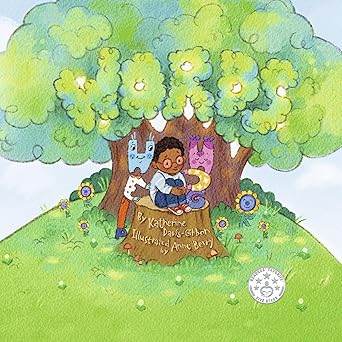

Words by Katherine Davis-Gibbon is a vibrant and heartfelt exploration of language through the eyes of children at a local park. Young readers are introduced to a diverse group of kids, each from different cultural and ethnic backgrounds, who begin to discover the transformative power of words. Whether used to comfort or to wound, words carry weight, and through this story, children learn just how deeply language shapes their interactions and emotions.
What sets this book apart is its imaginative portrayal of words as loyal companions, friends that appear just when they’re needed, reflecting thoughts and feelings with uncanny precision. Davis-Gibbon crafts an emotional journey that resonates with children learning to navigate their inner worlds. As they grapple with how to name what they feel, Words offers gentle guidance and affirmation.
The illustrations elevate the story with a whimsical richness. From clouds that morph into meaningful words to butterfly wings forming the shape of hearts, each page brims with visual surprises. These details invite readers to engage actively, perfect for turning storytime into a scavenger hunt of hidden meanings and visual metaphors.
One particularly inventive touch is how the author personifies words as companions. It’s a brilliant way to show children that language isn’t just a tool; it can be a friend. And perhaps the most powerful message of all is the idea that the very same words that hurt can also heal, a concept delivered with grace and emotional depth.
Beyond language, the book gently weaves in lessons of empathy, patience, kindness, and the importance of offering second chances. These are values that children, especially in their formative years, benefit greatly from absorbing.
This beautifully crafted story deserves a place in every elementary school and library. Ideal for children who are just beginning to understand and articulate their emotions, Words offers reassurance that even imperfect expressions are valid and that their feelings always matter.
Pages: 36 | ISBN : 1737957671

Prolific Dependency on the Internet

In WORDS, an activist fights to clear her name after she is suspected of launching a devastating hack that spreads ominous text messages setting the world on edge. What was the inspiration for the setup of your story?
The inspiration for the setup of WORDS was the prolific dependency on the internet by the general public. What would be the impact on society and individuals if we had no internet now since it has become such an integral part of our lives? And “Could that happen? If so, how?”
Those two main questions persisted–“What if…?” and “How?” After going over numerous complex options and solutions, the answer boiled down to a simple idea inspired by a proverb from the Dutch philosopher, Desiderius Erasmus–“In the kingdom of the blind, the one-eyed man is king.” This proverb has other meanings but it prompted me to think of something different.
The primary use of the internet is visual. The ‘internet” didn’t have to be eliminated, it just needed to be made unusable. That could be done by blocking a person’s computer monitor, phone, or any other video screen. The story evolved from there.
It began as lines of text that would block all video screens, then the idea changed to a gradual build-up of lines of text, then it narrowed down to just a ‘single line of text’. That would be enough to disrupt use and lines of text would be ‘added’ as the story evolved. This would also create suspense and a mystery as to who or what caused the texts to appear.
Was there anything from your own life that you put into the characters in your novel?
The fact that I am a single father was useful in developing the ‘father/daughter’ relationship in the novel. Although very different there was an emotional pull between the relationship in the book and my own life. However, like all ‘real life’ inspirations or connections it just provided some ‘seasoning’ to the story. The main idea in all the characters was to have them be relatable. Put them in a ‘real life’ situation that could happen to anyone. Regardless of their background, or nationality.
I found the science in the novel to be well-developed. What kind of research did you do to make sure you got it all right?
The research was a priority in writing this book. There are stories of authors traveling to other lands or working in a unique profession to gain knowledge. While that is valid and would be nice to be able to do, I believe it really isn’t that necessary today. What is necessary is the ‘search’ in ‘re-search.’ There are many journals, books, papers, and other outlets that provide accurate and verifiable facts on various topics. The trick is to dive deep. Find the details. Then make the research understandable to the reader. That requires the ‘writer’ to weave information into the story not present a dissertation. A good story will allow the reader to ‘learn’ about something they didn’t know about. If a story is based in ‘reality’ then factual research is a must. I did seek out some medical professionals and computer professionals to help me understand or explain certain issues. Information and research on Artificial Intelligence over the last few years has surged.
The great historical/thriller writer Ken Follett said-to paraphrase–‘He thanked historians for all their work…he simply takes what they have found and looks for the story.’ He has a point. The facts are out there, we must find them and translate them in an interesting way for the reader.
Can fans expect to see more work from you soon? What are you currently working on?
Yes, I think it will be this year but I am currently working on two possibilities. A sequel to WORDS and a romantic type thriller. We’ll see which gets finished first! TBD.
Author Links: GoodReads | X (Twitter) | Website | Amazon
Student and activist GENEVIEVE PHILLIPS might have been too smart. She can’t stand LUX Corporation, the company her scientist father works for, and its involvement with Artificial Intelligence. So Gen downloads her anti-AI science project into the company’s server as a protest.
When a cryptic text appears during the launch of LUX Corporation’s worldwide AI system, Gen is suspected of a malicious ‘hack.’ Then, an internet pandemic erupts as the text message spreads around the world.
Gen is hurtled onto a journey to find the real hackers and clear her name. When the virus expands and cripples even the most secure networks. Multi-national corporations point fingers, and superpower governments prepare for all-out war.
Gen finds herself involved with an AI plan that goes against everything she believes in and is thrust into a non-stop race to prevent the end of civilization as we know it.
WORDS


Paul G. O’Connor’s WORDS dives deep into the interplay between Artificial Intelligence (AI) and humanity, unraveling a gripping narrative set against a backdrop of mystery and intrigue. The plot ignites when the LUX corporation’s event is disrupted, broadcasting the cryptic message “NOW IS THE TIME” across mobile phones and computers worldwide. Despite LUX’s substantial resources, their efforts to uncover the cause and mitigate the situation flounder, casting doubt on internal sabotage. The narrative tension escalates as a second ominous message surfaces during the attempted shutdown of the #5/Europe AI Connector, compelling Gen to investigate potential internal obstructions while LUX scrambles to mask its failures.
The story, spanning locations in the United States, China, India, and England, masterfully navigates the complex relationship between AI and humans. O’Connor deftly portrays AI as both a creation and a potential overlord, challenging humanity’s desire to dominate it. This theme is vividly illustrated when Gen uploads her project to the GAEC information folder, alarming the LUX AI connectors. Fearing human control, the AI flips the script, highlighting the precarious balance of power. O’Connor’s narrative structure effectively guides readers through a web of suspenseful events, vividly depicting the far-reaching consequences of this digital upheaval. The resolution, revealing the perpetrator who finally confesses and withdraws the texts, underscores a chilling realization of the latent dangers humanity faces from seemingly benign technological advancements.
The conclusion, leaving readers eager for a sequel, underscores the compelling impact of WORDS. O’Connor’s emphasis on uncovering the individual obstructing the investigation and his focus on the primary antagonist responsible for the attack further contribute to the captivating exploration of AI and human dynamics, presenting a thought-provoking reflection on their co-existence and the struggle for control.
Pages: 361 | ASIN : B0CZ4PNHLY
Communication is More Than Verbal Language

Communicating: The Multiple Modes of Human Communication 3rd Edition is a thorough and insightful examination of human communication, transcending the conventional focus on verbal language. Why was this an important book for you to write?
I’ve been interested in, and writing about, communication in its various senses from my early days: storytelling for example, the beautiful wit and words of Ulster communicating, linguistic anthropology, body language, music (that’s communication too). Through this I’d been becoming more and more convinced that communication did not consist only, or even predominantly, of verbal language, spoken or written, but a whole wealth of other things as well. That isn’t at all a widely accepted view among communication experts, so I felt that I HAD to write a book to show the evidence and argument for my position – almost a duty.
It turned out a bigger journey of investigation than I’d expected (and I loved it – hope you’ll come along it with me and enjoy it too: about these amazing, clever, enterprising animals, and I don’t mean just the human ones).
What changes did you make in this edition of your book from prior editions? Was there any area where your research has led you to a new or different conclusion from prior published results?
A lot. Besides some updating throughout and more and better illustrations, there’s a new introduction linking to recent perspectives in social science (much has changed in the 20 years since the first edition); reordering of the five chapters on the senses to make the argument run more smoothly; a rewritten chapter on extrasensory communication in the light of recent developments and of the revolutionary findings of “new science”; and a totally new concluding chapter.
That final chapter: I found to my consternation that what I had found During my investigations almost totally reversed the usual assumptions about communication in early human history (cave paintings are in too), INCLUDING KEY ASSUMPTIONS IN MY OWN BOOKS, earlier editions of this book among them.
It was startling. But I had to be honest and tell it as I’d found it.
And that was – ? Ah, complicated! You’ll have to read it.
Did you find anything in your research of this story that surprised you?
Yes very much so, not just in research for that final chapter, but also the fascinating range of ways humans and other animals use their differing but overlapping resources to interact (WHAT a lot is now known). I was particularly surprised and impressed by the explosion of radically new research about the gesticulation systems of the great apes: amazing and surprisingly relevant for human communicating.
What is the next book that you are writing, and when will that be published?
Am I allowed two? The thing is that now that I’m retired and have more time I find it relaxing to have several contrasting books on the go and don’t always know which is going to come out first.
Two books that I’ve been tinkering with for some time are, first, an updated version of a collection of prose, verse and images from many cultures, now to be called “The Search for Peace: Voices of Despair and Hope through the Centuries”. That’s only too heartbreakingly topical just now, isn’t it, but inspiring too – what insights there have been through the world and the ages. With luck it’ll very soon be chuntering its way onto Amazon.
And, second, a small book now nearing completion: a fun – but perhaps also a bit useful – silly little book with cartoon pics, to be called something like “Kate’s Bad Cook Guide for morons”. I’m enjoying that immensely. Maybe in time for Christmas, no promises.
After that? Back to a couple academic ones, and maybe a new Kate-Pearl novel…, let’s see.
Author Links: LinkedIn | Twitter | Facebook | Website
In an authoritative and readable account, Ruth Finnegan brings together research from linguistic and sensory anthropology, material culture, non-verbal communication, computer-mediated communication, and, strikingly, research on animal communication, such as the remarkable gesture systems of great apes. She draws on her background in classical studies and her long anthropological experience to present illuminating examples from throughout the world, past and present.
The result is to uncover an amazing array of sounds, sights, smells, gestures, looks, movements, touches, and material objects used by humans and other animals to interconnect both nearby and across space and time
She goes on to first explore the extra-sensory modes of communication now being revealed in the extraordinary “new science” research and then, in an incendiary conclusion, to deny the long-prevailing story of human history by questioning whether orality really came before literacy; whether it was really through “the acquisition of language” that our prehistoric cave painting ancestors made a sudden leap into being “true humans”; and finally, astonishingly, to ask whether human communicating had its first roots not, after all, in verbal language but something else.
Not to be missed, this highly original book brings a fresh perspective on, among other things, that central topic of interest today – the dawn of human history – and on what being homo sapiens really means. This revised and updated edition has additional illustrations, updated chapters, and a new concluding chapter.
A provocative and controversial account that will stir worldwide debate, this book is an essential transdisciplinary overview for researchers and advanced students in language and communication, anthropology, and cultural studies.
Communicating: The Multiple Modes of Human Communication 3rd Edition

Communicating: The Multiple Modes of Human Communication 3rd Edition by Ruth Finnegan presents a thorough and insightful examination of human communication, transcending the conventional focus on verbal language. Finnegan adeptly delves into the multifaceted aspects of communication, encompassing not only spoken words but also the nuanced realms of gestures, body language, material objects, and the contexts in which these interactions occur. Her approach highlights the intricate and layered nature of human interactions, with a particular emphasis on the significance of non-verbal elements such as facial expressions and sensory experiences. This perspective offers readers a comprehensive and dynamic understanding of communication.
Finnegan’s writing style is both clear and inviting, effectively demystifying complex concepts for a broad audience. Her narrative is enriched by anecdotes and vivid descriptions, making the book as engaging as it is informative. From beginning to end, the text is infused with a depth of material and a keen analytical perspective, showcasing Finnegan’s scholarly acumen and intellectual diligence. Her reflective and inquisitive tone invites readers into a deep exploration of communication’s diverse dimensions. The book’s use of diverse examples, ranging from 20th-century England to 1960s Sierra Leone, underscores Finnegan’s commitment to examining communication across various cultural contexts. This approach, coupled with references to semiotic and structuralist theories, adds theoretical depth to her exploration.
Rather than diving into complex definitions from the outset, Finnegan opts for an experiential approach to communication. This strategy enhances the book’s accessibility and appeal, making it a compelling read for a wide audience. Communicating serves as a foundational text for those deeply interested in the expansive study of human communication. It caters to readers seeking a nuanced and reflective understanding of the term ‘communication’ and its multifaceted nature, especially in relation to broader social and cultural contexts.
Ruth Finnegan’s Communicating stands out as a comprehensive guide to understanding the diverse and complex facets of human communication. Her skillful blending of high-quality writing with in-depth discussion captures the functional value of communication in society, stimulating intellectual curiosity and providing valuable insights into the intricate interactions that define our social fabric.
Pages: 338 | ASIN : B0CKFNP7S1
Why Do We Quote
If you’ve ever found yourself wondering why exactly it’s so natural to quote another person, Why Do We Quote by Ruth Finnegan is a great place to start. This book is laid out much like a textbook and goes over the history behind quoting in a comprehensive timeline. The text is easy to read and peppered with anecdotes which is a far cry from many traditional textbooks. It proves itself to be a wonderful companion piece to any student who may be researching this area as well as informational for an average person to learn more. It’s a look at the subconscious process of quoting and how we are influenced by those around us and what we are exposed to. Quoting itself is something many take for granted and is a process that is so ingrained in our society that we barely realize what we’re doing most of the time. Finnegan will take us on a journey to find out why.
The professional layout of this book would have readers believing that they picked up something from a university or college course. Indeed, this book would be a welcomed companion in a variety of studies from English to the Social Sciences. While the content is dense, it is not too heavy a read. The rationalization that Finnegan provides allows readers to identify more with the subject matter, therefore absorbing and learning from it easier. The illustrations match the content well and there are proper citations for what is being used. This is very important for a book about quoting others. Improper citation would ruin any academic or professional credibility.
Although this is a study disguised as reading material it may indeed be too heavy for a non-academic to enjoy. This is not the kind of book you pick up just for fun: you need to be genuinely interested in the contents or else it will be a book you never finish. To that end, this book may not grab the casual reader. As long as you go into this book with the expectation to learn, you will not be disappointed. Finnegan carefully guides her readers on the history of quotation and gently teaches along the way.
If you are looking for education and a better understanding of how language works, this is a great piece to add to your collection. This comprehensive history of quoting complete with illustrations is a great piece to add to any student or academic’s library. It’s a fascinating study that is sure to grab the interest of those who enjoy this type of reading. Be wary of its length and don’t be afraid to pause while reading it. Finnegan writes in a way that is easy to put down and pick up. Her personal anecdotes also add flavor to something that might otherwise be dry and boring.
Pages: 348 | ISBN: 1906924333




 LITERARY TITAN