Blog Archives
Global History and Politics

Jigsaw: Sonora follows a group of ideological extremists who travel back in time to WWI to alter history, and a group of temporal guardians must stop them before their plan unfolds. What was the inspiration for the setup of your story?
Excellent question. Most of the attention given to World War I seems to center on what happened on the Western and Eastern Fronts in Europe. Outside of the Zimmerman Telegram, little attention is given to the efforts to keep the United States out of the war or keep many of their military assets occupied on the Southern Border. This book touches on that as well as the origins of the Influenza virus in that period and the attack on Wall Street, where a real one did take place in 1920.
What intrigues you about this time period enough to write such a thrilling novel in this era?
This time period influenced global history and politics for the next century, from World War II to the Cold War, to the growth of the United States’ influence, to the advance of the modern welfare state and labor movement, to the creation of modern nations and nationalist movements that are still with us today.
What was your favorite scene in this story?
The climax on the Zepplein Sonora. I do not want to spoil the climax for readers, so I will leave it there.
Can you tell us where the book goes and where we’ll see the characters in the next book?
Yes. The next book, Jigsaw: Shadow Ball is already out where our Time Traveling heroes have to save the creation of the Negro Leagues in the 1920’s and the integration of Major League Baseball in the 1940’s with Larry Doby and the Cleveland Indians. That adventure will be followed in 2026 with Jigsaw: Temporal Apocalypse, where our heroes have to stop the ultimate attempt to change reality in the post-World War I Era by disrupting events in Italy/Yugoslavia over Fiume and the Russian/Polish War.
Author Links: GoodReads | X (Twitter) | Facebook | Instagram | Website | Amazon
Renegade Novus Ordo operatives have formed Global Harmony and have launched Project Sonora, a plan to draw the United States out of World War One, start a continental war in the Americas, and unleash a genetically coded pathogen that would cause population segments to fall to the Influenza Virus.
The Temporal Guardians, led by Francesca and Noah must stop Global Harmony before the Forces of Evil can change history and destroy reality.
Augusta


Augusta is a beautiful mix of fiction and nonfiction anecdotes about a tenacious woman working to keep her family afloat in the early 1900s. Based on the author’s grandmother and family stories, Augusta tells the tale of a young farm girl married off at thirteen, abandoned, and then remarried to another abusive man. Her second husband, Ottis, is fired, leaving Augusta to be their family’s sole provider. While the storm of calamity continues to affect her family, Augusta must make the hardest decision of her life: whether to keep her youngest, Lottie, or allow her to be adopted by a wealthy family.
Augusta is a heart-wrenching novel centering on the unique circumstances of a woman in a time period where dependency on marriage to a man for survival was commonplace. Augusta represents a silent yet resilient generation of women who frugally kept their families fed and clothed throughout poverty-stricken years. Many of these women turned to each other and created pockets of communities and villages to ensure mutual aid. The writing captured this well. Augusta’s pain is clear, but so is her love for those around her. She was forced into a marriage and motherhood at an extremely young age and thus relied on her community to guide her through adulthood. Her sacrifices became an important parable for those of us who live in the present.
I enjoyed how the author filled in some gaps to complete Augusta’s story. The story of Al and Angie was particularly touching. They served as a silver lining and restored optimism back into the story. I also liked the historically accurate descriptions of appliances, money, and the like. Augusta’s wide-eyed incredulity towards appliances is interesting to witness. While modern readers will be interested in the simplicity of it, Augusta is impressed by what it can do. In a lot of ways, readers can still feel a connection to Augusta amidst the decades of distance.
Augusta is an essential story for all readers and will continue to be important for years to come.
Pages: 199 | ASIN : B0BQ9KLK2K

Front Porches to Front Lines
![Front Porches to Front Lines: One Small Townâs Mobilization of Men, Women, Manufacturing and Money during World War One by [Perlsweig, Simon]](https://images-na.ssl-images-amazon.com/images/I/51VZYXahyZL.jpg)
Simon I. Perlsweig’s historical account of the lives of the author’s great grandparents and the communication between them shows a great deal of what life in Springfield, VT was like in the 1910’s. It is very possible that without this work, much of what Perlsweig writes about in Front Porches to Front Lines: One Small Town’s Mobilization of Men, Women, Manufacturing, and Money During World War One, would never have been pieced together. It is a real pleasure to be able to experience this slice of history. Simon Perlsweig does this astoundingly and it is clearly evident that he put his heart and soul into his work.
Perlsweig’s book takes readers to Springfield, and more importantly, into the lives of a couple whose lives were greatly affected by WWI. There was, of course, the impact on the couple in question, Lawrence and Gladys, but readers are shown how everything else in the small Vermont town was changed forever, as well, and to make matters worse, war wouldn’t be the only problem faced by this couple.
Historically speaking, this work is a gem. There is a wealth of information on virtually every aspect of life in the United States in the early 20th Century, and even when the familial part of the work is not considered, Front Porches to Front Lines holds its own as a historical text due to the attention given to the social, economic, and political issues, among many more.
The research is thorough, and the writing style employed by the author is academic, while at the same time being accessible to a diverse audience. With such a breadth of information contained within the pages of this book, it’s definitely a plus using language that is not too complicated.
Another aspect of the book that many readers should enjoy is the fact that there is a large amount of authentic memorabilia from the period, including recruiting posters, family photos, government documents, and much more.
Simon I. Perlsweig’s Front Porches to Front Lines, published by Husky Trail Press LLC, is certainly a work that should not be ignored. It is not everyday that we are invited into the human experience of those who lived through one of America’s most trying times, and it’s even rarer that we get such a personal touch as the one here.
Pages: 221 | ASIN: B07MY6GLD5

Personal Side of the Great War
 The Family that Went to War is both a family memoir and a history of the people of the state of New South Wales. Are you writing about your own family? What inspired you to write a story about your family’s life?
After starting to research my family tree I discovered for the first time that I had a great Uncle killed at the battle of Fromelles. Then to my amazement I gradually discovered the stories of the other 5 mentioned in the book. While I was discussing this with some of my cousins, I decided to see if I could write a book on their exploits.
This book is about World War 1. What research did you do to prepare to tell this story?
We had a guest speaker at a men’s dinner and he mentioned that he found a lot of information from public available war records. I applied for the service records of all six members and from there I researched the events shown in their records. Every time I came across a location that I was not familiar with I Googled the location to check on its spelling. Unfortunately army diaries were notorious for the inaccuracy of foreign names. The Google research also allowed me to see the relationship between the various locations. I also searched newspapers particularly after reading Georgina’s letters to the army. I realized that there was a lot more to learn. From the old newspapers I was able to put together the later histories of the Wright brothers (both of whom gained the rank of Inspector in the NSW police force).
This story gives a personal look into the lives of WWI veterans. Did you find anything in your research of this story that surprised you?
Everything surprised me as I (like so many of my generation) knew so little of the personal side of the Great War.
How do you think the return of these veterans from WWI helped to shape modern culture?
From those I have talked to, it seems that they were all effected long term. I got the feeling that the distance made it even harder on the families at home because it would be months after the event that their families would have any news. I think that many went to do their duty for the “Mother Country” only to be disappointed by the attitudes of the British Generals toward the Australians. From that time in history Australians ceased to feel they were British. They now were proud to be Australians.
Author Links: GoodReads | Website | Twitter
In1914 Australia joined England and declared war on Germany and it’s allies. In the small New South Wales town of Cootamundra 6 young Australians, all from the same family, individually joined the fight. This saga follows their journeys through Gallipoli and the Western Front. The saga also covers time in Egypt, England and France away from the fighting. This is a story of a family and how it was affected by a on the other side of the world. It tells of the battles, the wounding and sickness endured by these young men as well as the lighter moments. A readable history that shows some insights into what it was like during those dark times.
The Family That Went to War
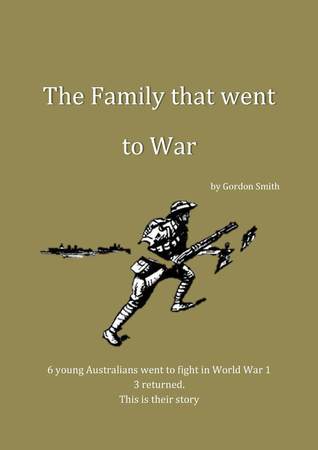
 The Family that Went to War is both a family memoir and a history of the people of the state of New South Wales, Australia. The author, Gordon Smith, gives a well-documented account of six members of a family from Cootamundra, NSW, who enlisted into the First Australian Imperial Force (1st AIF) at the onset of World War I. His research in historical archives, newspapers, and memorial societies is well done. The accounts of war and details of each man’s deployment presumes that he also had their war diaries and letters from home to draw on for detail.
The Commonwealth of Australia was still a young country, having formed a federation just over a decade previous. Australians still regarded Britain as their mother country, and when war broke out, Australia’s Prime Minister declared support for Great Britain and formally entered the Great War. Six members of the author’s family enlisted to fight the German army. He tells each man’s story with informative passages about the region they are in, the larger picture of the war that raged around them, and then brings it back down to the trenches where the soldiers fought. Smith’s details regarding ships, armaments, shortages and hardships, and other details of the soldiers’ experiences in Egypt and France will be of great interest to readers fascinated by World War I or the contribution of Australia to the Great War.
One such detail is in the account of Austin Schofield’s experience at Gallipoli. A water shortage, bad weather, and devastating losses motivated the British combined forces to evacuate. In order to safely evacuate, they used subterfuge to trick the Turkish forces into thinking they were still there.
Periscopes were to be propped up, and every effort was to be made to create the impression that the trenches were still fully occupied. … When it was time to finally abandon the trenches, Austin was to help set up some remote firing devices to fire some rifles to keep the illusion that the trenches were occupied. Some rifles had string tired to the trigger and a candle burning until it reached the string. The rifle would then fire.
Though the author writes with detachment, the stories of these soldiers in the midst of historic battles give a glimpse into the life, and death, of Australian soldiers. I was particularly interested in the account of William Power, fighting on the Western Front at Fromelles France. The losses to the Australian forces were described as, “the worst 24 hours in Australia’s entire history”. Though the account is given in a very matter-of-fact manner, it’s hard not to sympathize with the Australian soldiers.
The biggest drawback of this book was a simple case of bad editing. In one case, the name of an Egyptian city is spelled three different ways on the same page. Punctuation is inconsistent and made some passages difficult to understand and hard to follow.
Overall, I think the author has done a fine job documenting both his family history and military history. Despite the dry, academic tone of the account, there are moments of humor and humanity that shine through.
Pages: 92 | ISBN: 9781310378010



 LITERARY TITAN