Blog Archives
A Journey Toward Independence

The Girl with Free Feet is a moving multigenerational narrative that celebrates the women whose courage, sacrifices, and difficult choices helped create new possibilities for their families. What was most important to you about preserving these experiences for future generations?
I was born during the Great Chinese Famine and grew up during the Cultural Revolution. I witnessed how quickly political upheaval could destroy families, separate loved ones, and take away freedoms we often take for granted.
But my mother’s life began in a very different China. She grew up in a privileged Shanghai family, surrounded by traditions that shaped women’s lives for generations. Her mother had bound feet, while my mother was fortunate enough to grow up with free feet. To me, that difference symbolizes much more than a physical change. It represents the beginning of a journey toward independence.
I wanted to preserve not only the suffering and sacrifices of these women, but also their love, courage, humor, and determination. History books record political events, but family stories reveal how ordinary people lived through them.
Most importantly, I wanted my grandchildren and future generations to understand where they came from and how much courage it took for their ancestors to give them the opportunities they enjoy today.
What did you discover about the relationship between mothers and daughters while exploring these generations?
I came to understand that mothers and daughters are connected by both love and expectations, and that love is not always expressed in ways we recognize at the time.
Each generation of women in my family wanted something better for the next. My grandmother lived within the restrictions of traditional Chinese society. My mother sought education, love, and greater independence. I eventually found opportunities in America that neither of them could have imagined.
As a daughter, I did not always understand my mother’s decisions. Writing her story helped me see her not simply as my mother, but as a young woman with dreams, disappointments, and difficult choices of her own.
I discovered that understanding our mothers requires looking beyond the roles they played in our lives and recognizing the women they were before we were born.
What parallels do you see between the struggles for independence experienced by the women in your story and the challenges women face today?
The circumstances have changed dramatically, but the desire for independence remains the same.
My grandmother’s generation struggled against traditions that literally bound women’s feet. My mother’s generation fought for education, the freedom to love, and the right to make personal choices amid political turmoil.
Today, women have far greater opportunities, yet many still struggle to balance family expectations, careers, relationships, and their own ambitions.
Freedom is not simply the absence of restrictions. It is the ability to make meaningful choices about one’s own life.
One lesson from my family’s history is that progress is never guaranteed. The freedoms women enjoy today were made possible by the sacrifices of earlier generations, and they must continue to be valued and protected.
What do you hope younger generations, particularly daughters and granddaughters, learn from Rita’s life and the experiences of the women in your family?
I hope they learn to be courageous, independent, and compassionate.
Rita’s life reminds us that we cannot always control history or circumstances, but we can choose how we respond to them. She experienced love, heartbreak, political persecution, and extraordinary changes, yet she never lost her independent spirit.
I especially hope my granddaughter Zoey understands that the freedom she enjoys today is a precious inheritance. Her great-grandmother had free feet, but she still faced many invisible restrictions. My generation crossed oceans to find greater opportunities. Zoey’s generation can walk even further.
That is the meaning behind my book’s title. Free feet are only the beginning. True freedom is having the courage to choose your own path.
Author Links: GoodReads | Facebook | X |
Born into a changing Shanghai, Rita grows up in a world suspended between old traditions and a new China. Her mother, Rong, walks on feet bound in childhood—a painful inheritance from a culture in which obedience was expected and freedom, especially for women, was limited.
Rita is different.
She wants an education. She wants independence. And she wants the freedom to choose whom she loves and what her life will become.
But history has other plans.
As political upheaval transforms China, Rita’s family is swept into forces far beyond their control. Love is separated by distance. Family security disappears. The Cultural Revolution brings fear, persecution, and loss. Yet through marriage, motherhood, heartbreak, and extraordinary change, Rita refuses to surrender the independent spirit that has always defined her.
Eventually, that journey carries the family across an ocean to America—and toward freedoms earlier generations could scarcely have imagined.
Inspired by family history and personal memory, The Girl with Free Feet is an intimate multigenerational story of women, family, resilience, sacrifice, and the complicated choices people make in order to survive.
Above all, it is a story about what one generation endures so the next can walk more freely.
The Girl with Free Feet
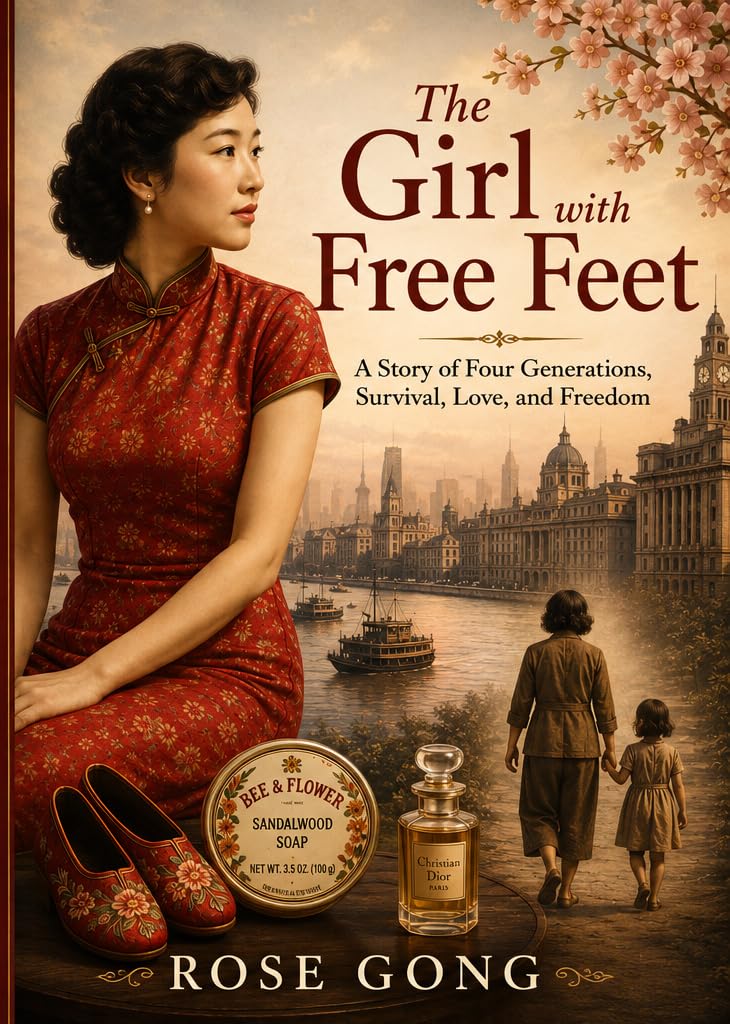

Rose Gong’s The Girl with Free Feet is an intimate family narrative about women’s freedom and the complicated work of claiming it. Drawing on family history and personal memories, Gong tells the story through reconstructed scenes and dialogue, with her mother, Rita, at its center. We meet Rita as a curious, quick-witted teenager in Shanghai, growing up in a household where education, elegance, and obedience carry considerable weight. Her mother Rong’s bound feet give the title its immediate meaning, while Rita’s questions introduce a wider concern: how much say does a woman have over her own life? That question connects the book’s treatment of love, motherhood, political upheaval, and immigration. Its emotional pull comes from seeing those concerns take shape within one family, through everyday conversations and competing expectations.
The book’s strongest feature is its feel for domestic life. Steaming breakfast buns, the scent of sandalwood soap, a carefully fitted qipao, and music drifting through a house give these memories texture. Objects carry associations that deepen as the story progresses, making the family’s past feel tangible. Rita herself brings plenty of energy to the page. She’s funny, impatient, proud, and eager to learn, and her teasing exchanges with relatives keep the early chapters lively. I especially appreciated the attention Gong gives to the women around her, including her sister and the people whose care sustains the household. Affection often appears through practical gestures: preparing food, adjusting clothing, sitting beside someone, or making room for a difficult conversation. Those details make the relationships feel close enough to recognize.
As the story moves through periods of fear and upheaval, Gong keeps her attention on how people experience them at home. History affects what families can say, which possessions they value, and what parents hope to preserve for their children. Education becomes particularly moving in this context, both as an opportunity and as a habit of questioning. The book also gives personal choice a complicated emotional life. Desire, loyalty, guilt, and gratitude can occupy the same relationship, and Gong acknowledges the responsibilities that accompany independence. Her prose is accessible and strongly shaped by dialogue, short paragraphs, and recurring images. At times, repeated reflections on feet, wings, movement, and freedom explain a scene’s meaning so fully that they soften its impact. Some conversations also have a polished, almost proverbial quality. The sensory details and family tensions are where the writing feels most convincing.
I’d recommend The Girl with Free Feet to readers who enjoy family memoirs, stories centered on women across generations, and accounts of Chinese immigrant experience. People interested in how political change enters private life will find plenty to consider, especially in the book’s attention to parenting, education, and the ways fear alters ordinary routines. It would also make a thoughtful book-club choice, with room to discuss the relationship between freedom and responsibility, the expectations daughters inherit, and the difficulty of understanding our parents as people with desires of their own. Its openly emotional style will appeal to readers who like warmth, humor, and reflection alongside painful material. What stayed with me was the care behind the telling: a daughter trying to understand her mother’s life and preserve the experiences that shaped her family.
Pages: 329 | ASIN : B0HGB5XQJ1

Fig Trees – A Childhood Lived in the Shadow of Murder


Marnie Ross’s Fig Trees is a memoir about childhood, memory, and the long reach of losing a parent violently. Ross was nearly eleven when her mother was murdered in the family’s Phoenix home in 1979, and that night becomes the dividing line of the book. But Fig Trees is interested in much more than the murder itself. Ross reconstructs the world around it: her sisters, her mother’s habits, school, birthdays, television shows, food, church, games, friendships, and the frightening instability that followed her mother’s death. Early in the memoir, Ross writes, “Memory isn’t a calendar.” That line becomes a useful way to understand the whole book. She’s telling the story as a person remembering childhood decades later, where certain details remain startlingly vivid while dates and sequences sometimes blur.
One of the book’s strongest qualities is the way Ross lets ordinary objects carry emotional weight. Bullet holes remain in curtains her mother made. A jigsaw puzzle becomes a memory of patience and tenderness. A piano becomes a way of trying to make her mother proud. The fig trees themselves grow into the book’s central image because they connect Ross to the everyday version of her mother, the woman who gardened, cooked, sewed, hummed, and cared for her children. These details give Jill, Ross’s mother, a presence beyond the fact of her death. Ross also includes excerpts from her mother’s letters home to Australia, which let readers encounter Jill’s humour, homesickness, curiosity, and growing unease in her own words. That choice adds another layer to the memoir because Ross isn’t simply remembering her mother as a child once knew her. She’s also meeting her again as an adult.
The chapters about life after the murder are especially affecting because Ross remembers childhood survival in such practical terms. Grief exists beside hunger, school lunches, Christmas presents, bruises, chores, television, and the constant effort to protect her younger sister Ayrlie. Some of the hardest passages describe Ross finding ways to get food for the two of them, whether through babysitting money or the quiet help of a friend who brought an extra lunch. Reflecting on that kindness, Ross describes love as “The kind with paper bags and silence.” It’s a small line, but it captures something the memoir returns to again and again. Care often appears through modest acts. The relationship among Ross and her sisters is especially important in this way. Their games, arguments, private worlds, and shared memories show children improvising their own forms of comfort when the adults around them can’t reliably provide it.
Ross’s style is direct, emotionally open, and strongly rooted in sensory memory. She remembers wallpaper patterns, the smell of food, television programs, pool water, songs, toys, the texture of objects, and the strange thoughts that occur to children during terrifying situations. Those childlike observations are often what make the darkest scenes feel convincing. The memoir also moves frequently between the child Ross was and the adult Ross interpreting what happened, so the reader sees both immediate experience and decades of reflection layered together. Its short, episodic chapters suit that approach. Ross accumulates memories until a fuller childhood emerges. Moments such as the imaginary “Club” she created with Ayrlie or the sisters’ stuffed-animal battles matter because they restore playfulness and personality to a story that could otherwise be defined entirely by trauma.
By the end, Fig Trees feels like an act of reconstruction. Ross is piecing together her mother, her sisters, and herself from memories, letters, objects, and stories that survived. The closing sections become more reflective, particularly as Ross considers the adult lives of the three sisters and writes directly to her mother. What stayed with me most was the memoir’s attention to the coexistence of grief and affection. Ross can remember fear and still remember laughter; she can describe cruelty while holding tightly to the people who offered kindness; she can mourn the childhood that ended while taking pleasure in the childhood moments that survived in memory. The fig trees are a fitting title because they come to represent exactly that mixture. They keep growing after Jill is gone, carrying both the ache of her absence and the evidence that she was there. That makes Fig Trees an intimate and deeply personal account of how a child remembers a mother and how those memories continue to change as the child grows older.
Pages: 245 | ASIN : B0GX2XFZWJ
Through Her Eyes: A Memoir of Purpose and Courage
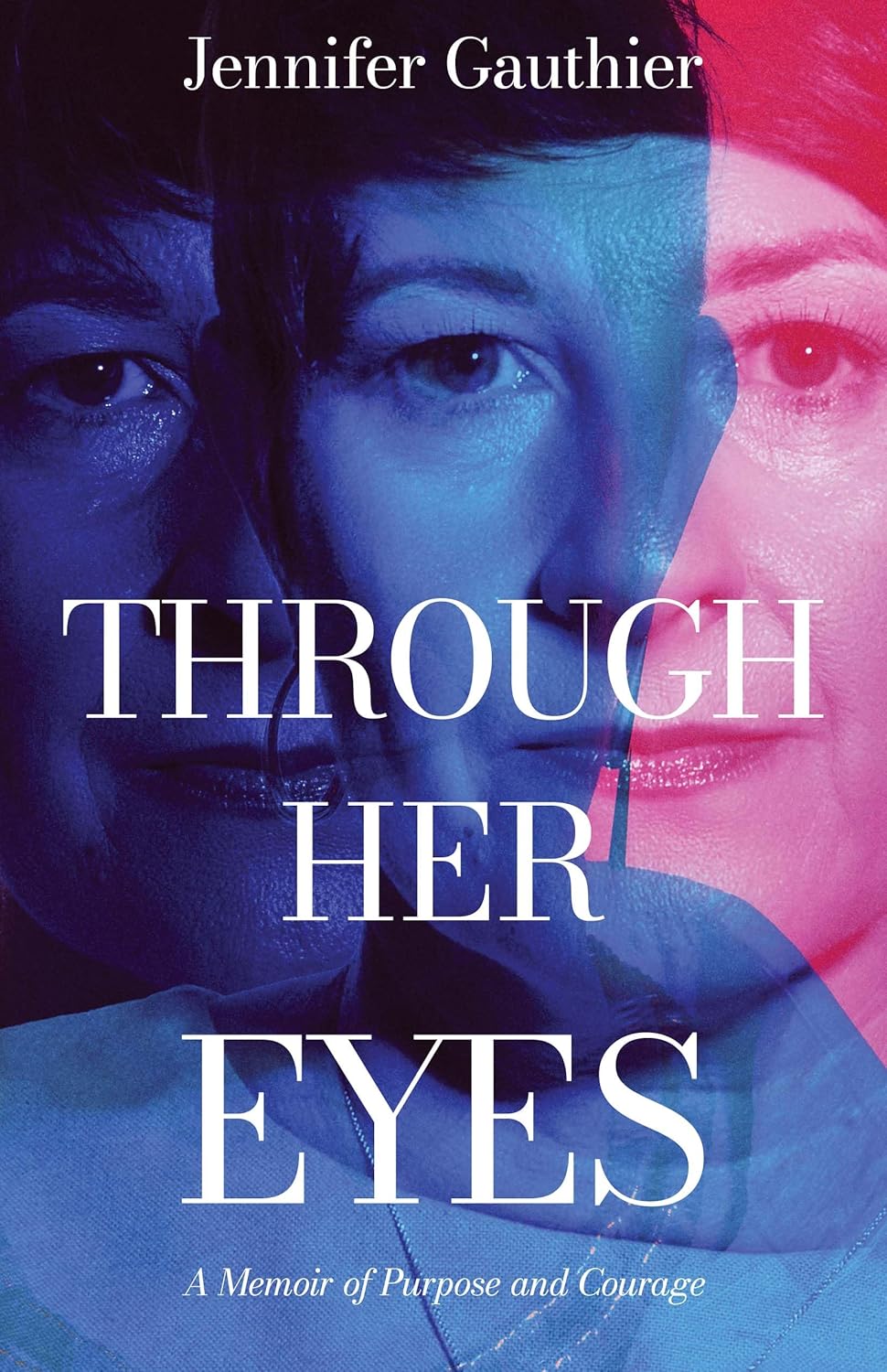
Through Her Eyes follows Jennifer Gauthier as she grows from a noisy, painful childhood into the role of founder and CEO of a nonprofit that centers healing, youth, and community. The book moves through her early years in a home shaped by addiction, her teenage pregnancy, homelessness, and single motherhood, then into her spiritual searching, discovery of Sufism, and her work as a mentor and leader. Along the way, she keeps circling one core message. Your story is yours to claim, even if the first chapters were written by other people.
I felt her voice first, more than any single scene. The writing is direct and chatty, like a friend talking with no filter. She warns you early that she is “that person” who talks to strangers in line and laughs too loud, and the prose matches that energy. I liked that she keeps the language simple and straight. She uses a lot of short, punchy lines, and she often drops into story mode with “Throwback” sections that read like spoken-word pieces. That style pulled me in. I could almost hear her accent, see her hands moving while she talked. She jumps from memory to lesson to side story in quick turns, and sometimes I wanted a bit more shape or pause, a little more space to sit with one scene before we moved on to the next.
Emotionally, the book hit me hardest when she wrote about addiction, codependency, and the way a child tries to manage a house that feels unstable. Her honesty about wanting her father to die, then shifting into years of praying for him to live sober, landed with real weight. There is no polish on those parts, and I appreciated that. I also liked her insistence on personal responsibility without erasing systems and trauma. She talks about racism, privilege, generational patterns, and spiritual harm, and still looks straight at herself and asks, “What can I control today.” I would have liked more direct talk about structural barriers, especially given her work with underserved communities. Even so, the through-line of “I will not stay stuck” felt honest to her story and background.
I walked away feeling like I had spent time with a real person, not a polished brand. The book would be a strong fit for readers who grew up around addiction, teen parents, people who have experienced trauma and are now ready to look at it, and anyone in social work, education, or youth programs who wants a reminder of what their clients might be carrying. It will also speak to women building something from scratch in midlife, especially those who feel “too loud” or “too much.” If you want a raw, talky, spiritually curious, no-nonsense story from someone who has actually had to claw her way forward, I recommend Through Her Eyes.
Pages: 228 | ASIN : B0GCFCTHLL

Home: A Memoir of Family, Forgiveness, and Healing from Complex PTSD

Home follows Amy Smyth Miller from a present-day crisis in a Bellingham ICU back through a childhood marked by poverty, neglect, and intergenerational trauma in the Midwest. The book opens with her husband’s heart attack and her spiraling panic, then moves into three arcs, “Roots,” “Rootless,” and “Transplanted,” tracing a line from her great-grandmother’s steady care, through her parents’ addictions and constant moves, to her later work as a teacher and her search for effective trauma therapy. Along the way, she threads in clear explanations of complex PTSD, especially the idea of it as a problem of how memory is stored, and she shows how lifespan integration and other somatic approaches help her piece her life into a coherent timeline and finally feel at home in herself.
The writing is gripping. The scenes are built with simple images that stuck with me. The plastic seat covers in the Buick, the smell of Pond’s cold cream and peppermints in Granny War Bonnet’s room, the dragonflies over the pond, the housekeeper ironing a floral dress on the night of a suicide. These details felt precise, not decorative, and they kept pulling me back to the emotional core of each chapter. The structure works well, too. The prologue sets a very tense, contemporary problem, and then the book steps backward into childhood and returns again to the present with more context. Sometimes the metaphors pile up, and the prose becomes lush. Overall, though, the voice is steady, kind, and unflinching, and I trusted it.
I appreciated that Miller does not turn her parents into simple villains, even when she describes clear neglect, hunger, and frightening behavior. She sits in the mess of loving them and being hurt by them at the same time, and she lets that tension stand. I liked how she shows what grounding or timeline work actually feels like in the room, and how she owns her missteps, including the painful texting episode with her husband. There were moments when the interplay of narrative and research slowed the pace, but I felt grateful for the educational layer. It made the book feel useful as well as moving.
Miller is very clear on the notion of complex PTSD as a long shadow cast by many smaller and larger wounds, and she keeps returning to the question of meaning. Not in a tidy, everything-happens-for-a-reason way, more in a “I refuse to let this be pointless” way. Her focus on protective figures and small stabilizing rituals, especially her great-grandmother’s stories and “angel crowns,” pushes back against the common narrative that survival is purely individual grit. I also liked her insistence that healing is not erasing the past but putting it in order so it stops crashing into the present. As someone reading this as a memoir rather than a clinical text, I appreciated how accessible the psychological parts felt. She explains concepts in plain language and grounds them in specific episodes from her life, so I never felt lectured at.
I would recommend Home to readers who come from chaotic or painful families, to people living with complex trauma, and to therapists, teachers, and caregivers who want a lived-in portrait of what CPTSD can look like from the inside. It is not a light read, and there are frank depictions of suicide, emotional abuse, and neglect, so I would be cautious recommending it to someone in a very raw place without support. For readers who can hold that weight and are looking for a story that blends honest hurt with genuine hope, this memoir feels like a companion, not just a case study.
Pages: 301 | ASIN : B0G5TCG9KJ
Watery Eyes: Reflections of a Muslim Woman

Watery Eyes: Reflections of a Muslim Woman, by Yerusalem Work, is a wide-ranging collection of poems that moves through faith, womanhood, identity, memory, grief, and tenderness. It blends personal history with spiritual reflection and cultural pride. The book shifts from intimate whispers to big declarations, sometimes soft as prayer and sometimes sharp as truth. The themes that repeat across its many pages feel like a heartbeat. Love. Loss. Devotion. A soul trying to stay steady in a world that keeps testing it.
As I read, I felt pulled into the author’s inner world. Her writing is warm and direct, and I found myself pausing often just to sit with an image or a line. She talks about faith in a way that feels lived rather than taught, and that honesty hit me hard. I kept feeling this mix of ache and comfort. Some poems feel like opening a window after a long night. Others feel like stepping into a memory that isn’t mine, yet somehow rings familiar. Her voice rises and sinks, and I liked that the rhythm never stays still. It mirrors real emotion. Messy, surprising, sometimes contradictory. The work feels confident and vulnerable at the same time.
There were moments when the ideas felt bigger than the poem holding them, but I didn’t mind. I actually liked the looseness. It gave the book a raw edge. I loved how she writes about Ethiopia and womanhood and faith as if they’re woven into the same cloth, each thread tugging on the next until the whole thing glows. Some pieces felt playful, some mournful, and others almost like confessions. The writing invited me to consider my own ideas of belonging and purpose.
I would recommend Watery Eyes to readers who enjoy poetry that comes straight from the heart. It’s a good fit for people who like reflective writing, spiritual searching, and stories rooted in identity and culture. It would also speak to anyone who has ever carried love and loss in the same breath. This is a book for readers who want to feel close to another person’s inner life and who appreciate writing that is sincere, emotional, and alive.
Pages: 167 | ASIN : B0G6WHMTZ8
Passion and Commitment

Creciendo Juntas: Narrativas de Empoderamiento de las Mujeres is an anthology of stories by women sharing their struggles, losses, revelations, and how they have rebuilt their world after significant challenges and changes in their lives. What was the process you used to collect the stories for this collection, and how did you decide which ones to include?
We came into this anthology with a spirit of openness. We were looking for diversity and honesty—to portray women in the rawness of their lives, with no intention other than to state that they are here and that their lives are valuable and rich. In that sense, we allowed the manuscripts we received to shape what the anthology would become. We did not want to preassign any boundaries that might prevent writers from crafting their work from the truth of their own experiences.
In most of the anthologies we’ve produced over our twenty years as publishers, there are specific criteria that must be met for a story to be included. This project was different. Here, it was the writers who shaped the anthology, not us. We deliberately gave up control and entrusted it to those who have lived the experience of being a woman in Latin America, as it should be. The guiding questions were simple: Are you a woman? Are you a writer? Do you understand that literature carries an ethical responsibility not to harm the reader? If so, you were in.
Have you received any feedback from readers that surprised or moved you?
Not directly, but the authors themselves have surprised us with the passion and commitment with which they have embraced, endorsed, and promoted the anthology. I think this speaks volumes about what the project has meant to them and, in turn, to their readers. It has been deeply moving to see how this book has differed from our other publications—it feels like a must-read for everyone.
The promotion of the anthology has not been directed toward a single type of reader, as is often the case with most books. Instead, it has reached across audiences, reinforcing the sense that this is an important work—one readers recognize as necessary. Seeing that response has been incredibly rewarding.
Will you be compiling a second collection of inspirational and motivational stories sharing the enduring spirit of women?
If the context allows for it, and if it once again feels like a necessity—as it did this time, when the first woman president in Mexico was about to assume office, and it felt essential for women to speak about the experience of being women—then it would be both lovely and exciting to do so.
At the same time, we are also interested in pursuing other projects. Women are always present in our work—talented women, talented writers—and that talent extends far beyond inspiration or motivation expressed only through stories explicitly about womanhood. The enduring spirit of women, like any enduring human spirit, is also revealed through creation, through writing, whether fiction or nonfiction, whether the work is about womanhood or about any other aspect of the vast human experience.
So in that sense, yes—we are planning to compile many collections that share the enduring spirit of women. They may not always be explicitly about the experience of being a woman, but they will be a testament to it nonetheless.
Author Links: GoodReads | X (Twitter) | Facebook | Website | Amazon
Estas son las historias de las mujeres que sustentan el cambio en cada palabra, en cada acción. La revolución también se hace en chiquito, en la cotidianidad, en las victorias y en los errores. En esta antología está escrita la historia del cambio, de cómo nuestras vidas, juntas, se convierten en una epopeya moderna.
Estas escritoras tejen una lucha en el tapiz de la libertad. Escribiendo juntas crecen con sus lectoras, quienes encontrarán en estas páginas una razón, aunque sea sólo una, para seguir adelante, pues todas compartimos, cada quien a su manera, el mismo arduo camino.
The Courage to Begin Again: Resilience, Courage, and Reinvention
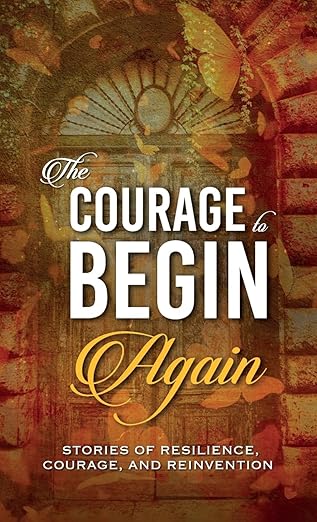
The Courage to Begin Again: Stories of Resilience, Courage, and Reinvention is an anthology of deeply personal stories from women who moved to Mexico and rebuilt their lives in unexpected ways. Each chapter explores a different perspective on starting over: the shock of cultural change, the struggle of loneliness, the bittersweet weight of leaving old lives behind, and the surprising joy of discovering new strengths. The voices range from lighthearted accounts of food and music to raw admissions of fear, loss, and self-doubt. What holds it all together is a theme of reinvention and resilience, showing that change, while often painful, can also be liberating.
Reading it, I found myself caught between admiration and empathy. The writing isn’t flowery or overly polished, which actually works in its favor. It feels honest. The women share their failures and embarrassments with as much detail as their triumphs, and that kind of vulnerability is hard to look away from. At times, I felt like I was eavesdropping on a conversation, with all the warmth and awkward pauses included. Some stories hit me hard, especially the parts about loneliness and feeling invisible in a crowd. I could almost feel the ache in my own chest. Other sections lifted me, like the small wins like finding a supportive friend, learning enough Spanish to laugh at a joke, or sitting at a long lunch surrounded by a new community.
What surprised me most was how much energy these women poured into reshaping themselves. Some leaned into self-care and spirituality, while others threw themselves into work, art, or friendship. At times, I thought the pacing of certain stories slowed as it circled the same lessons. But then again, maybe that’s the point. Starting over is messy. It’s not a neat arc, and this book doesn’t try to make it one. I respected that choice. By the time I reached the final pages, I felt a mix of exhaustion and inspiration, like I had traveled alongside them through the highs and lows.
I’d recommend The Courage to Begin Again: Stories of Resilience, Courage, and Reinvention to anyone standing at a crossroads, whether they’re moving countries or just moving into a new stage of life. It’s especially powerful for women who’ve had to leave something behind, be it a career, a home, or even a version of themselves.
Pages: 144 | ASIN : B0F7YM8QPL


