Blog Archives
50 Forgotten Cardinals: The short story of 50 lesser known and sometimes forgotten St. Louis Cardinals


Will Saulsbery’s 50 Forgotten Cardinals is a lively and deeply researched tour through St. Louis Cardinals history, built around 50 players whose contributions have been overshadowed by the franchise’s more celebrated stars. Saulsbery organizes the book largely by era, beginning with nineteenth-century figures such as Ice Box Chamberlain and Bob Caruthers and moving through championship teams, the difficult 1950s, later decades, and more familiar recent players such as Ryan Ludwick, Pat Neshek, and Aledmys Díaz. His selection criteria are intentionally personal and flexible, allowing statistical standouts, memorable characters, childhood favorites, and players with irresistible names to share the same pages. That approach gives the book the character of a knowledgeable fan opening an unusually deep baseball scrapbook. Saulsbery captures his purpose early when he describes his research as uncovering “So many great players, so many amazing names, and so much fun.”
I think the book’s strongest feature is the way Saulsbery combines statistics with compact, memorable stories. Each profile begins with basic biographical information and a Cardinals stat line, but the numbers usually serve as an entry point into something more revealing. Readers encounter Chamberlain pitching with both arms, Austin McHenry’s tragically shortened career, Tom Alston’s place as the first Black player to wear a Cardinals uniform, Max Lanier’s jump to the Mexican League, and Tom Henke finishing his career in St. Louis because playing for the Cardinals had been a personal dream. The result is a broader history of baseball itself, touching on war, segregation, labor disputes, changing salaries, medical limitations, evolving player usage, and the enormous differences between eras. Even when the careers are brief, Saulsbery finds a reason each player belongs in the larger Cardinals story.
Saulsbery’s voice gives the book much of its identity. He writes as an informed fan, moving easily between Baseball-Reference statistics, historical research, jokes, comparisons to modern players, personal recollections, and enthusiastic judgments. That conversational style makes unusual numbers especially accessible. A nineteenth-century workload becomes understandable when measured against modern innings totals, while forgotten seasons are compared with performances by players such as Bob Gibson, Stan Musial, or Albert Pujols. The humor is frequent, but the book also knows when a player’s story calls for restraint. The sections on McHenry and Alston, for example, carry genuine weight, while profiles of figures such as Bugs Raymond, Ripper Collins, Gerónimo Peña, and Ozzie Canseco embrace baseball’s capacity for eccentricity. The many photographs and vintage baseball-card images reinforce the book’s archival, keepsake quality.
By the end, 50 Forgotten Cardinals has become more than a collection of statistical curiosities. Its cumulative effect is to show how a franchise’s history is built not only by Hall of Famers but also by excellent players on unsuccessful clubs, short-term stars, relievers who caught fire for a season, role players, pioneers, and men whose careers were interrupted by circumstances beyond baseball. Saulsbery finishes the main list by calling them “Fifty St. Louis Cardinals we should all remember,” then extends the fun with his all-forgotten lineup, pitching staff, and all-name team. That closing material suits the book perfectly. 50 Forgotten Cardinals is an affectionate and statistics-rich work of baseball history that treats remembering as part of being a fan, and it gives dozens of overlooked Cardinals a fresh place in the franchise’s long story. This is the ideal read for anyone who enjoys baseball history, statistical deep dives, and colorful player stories.
Pages: 139 | ASIN : B0GXJNMKN3

The Risk Was Simply Mind-boggling

Game Changer is a vivid account of the 1968 Formula One season, tracing how Jim Clark’s loss, Graham Hill’s resolve, new technology, commercial sponsorship, and mounting danger transformed F1 into the modern sport we recognize today. What inspired you to write this book?
The basic bottom line, the core inspiration was the introduction of modern commercial involvement. The Gold Leaf Team Lotus to me was the “Game Changer” from which everything sprang moving forward. That was the core inspiration for the book.
How did your experience as a sixteen-year-old spectator at Brands Hatch shape the emotional perspective of the book?
In a word, context. I attended my first Grand Prix at Brands Hatch, a total neophyte to motorsports. I was completely mesmerized by the excitement and spectacle of the event, yet totally unaware of the tragedies that had preceded it. After Graham Hill retired from the race, I recall watching him watch the race by standing along pit row leaning against the pit wall. He looked disappointed, relaxed, and watching the race in much the same way everyone did. I was unaware that two weeks prior to this race, a driver had been horrifically killed in a fiery crash. Yet Hill and all the drivers had the capacity to cast aside the growing dangers and willingly climb back into the cockpit of a race car. The scale of the risk was simply mind-boggling. At the time, I had no idea of the level of risk involved, only two weeks removed from one of the most horrific accidents in F1 history.
Jim Clark’s death is presented as a profound rupture in the season. How difficult was it to write about that moment without sensationalizing it?
As I became more and more of a race fan, I quickly learned and became familiar with Jim Clark’s tragic accident. In doing research for the book I learned much more, but I had been familiar with the basics of what happened. Nearly every F1 race fan is familiar with it. What I found far more difficult was writing about the three other fatal accidents of the 1968 season that I was not as familiar, particularly, the accident that claimed the life of Mike Spence. He was killed barely one month after Jim Clark at the Indianapolis Speedway. He was just emerging from the background and was positioned to become a lead driver in the F1 series before his Indianapolis accident. His death as well as the other two drivers killed in a short period was very challenging writing.
What surprised you most while researching the rise of sponsorship, especially Lotus’s move from British racing green to Gold Leaf colors?
Basically, the scale of the change. Gold Leaf and Imperial Tobacco, along with Gunston brand of cigarettes from South America were the opening salvo. Over the course of the next several years, the tobacco industry as a whole spent $4.5 billion sponsoring Formula One as well as other motorsport platforms.
Author Links: Amazon | GoodReads
This is the story of a turning point.
Through vivid storytelling and deep insight, Game Changer reveals how a single season reshaped Formula One forever—sparking a revolution in safety, technology, and the very culture of racing. It’s a gripping account of courage, ambition, and the price of progress, told by someone who understands the sport from the inside.
Whether you’re a lifelong Formula One fan or new to the drama of the grid, this book delivers:
A behind-the-scenes look at a defining moment in racing history
The human stories behind the helmets—risk, rivalry, and resilience
The origins of the safety standards that protect drivers today
A powerful narrative that reads like a thriller—but is all true
Some seasons are remembered.
1968 redefined the sport.
Game Changer isn’t just a history of Formula One—it’s the story of how the sport survived itself.
The Whole Picture

So You Want To Be A Professional Athlete offers young readers insight into becoming a professional athlete, focusing on talent, discipline, and handling the inevitable pressure. Why was this an important book for you to write?
Because the dominant story kids are handed about professional athletes is almost all highlight reel — the game-winning shot, the gold medal, the 10 seconds that make the broadcast — and almost none of the 10 years behind those 10 seconds. I wanted to write the book that lives behind the camera. The 5 AM alarms. The ice baths. The thousand quiet repetitions a coach asks for to get one motion automatic. The work nobody films.
I also wanted to push back, gently, on a phrase I think hurts a lot of young athletes: “natural talent.” The book makes the argument as plainly as I could that the athletes who last aren’t necessarily the most naturally gifted. They’re the ones who take the whole job seriously — recovery, sleep, nutrition, mental preparation, the parts no one applauds. Talent gets you to the starting line. Discipline gets you to the finish. That’s a truer story, and I think it’s a kinder one, because it tells a kid that what they can control is what actually matters.
One of the book’s strengths is its honesty about injuries, routine, and the short length of many sports careers. Why was it important to show those realities?
Because a children’s book that hides those things isn’t really written for the kids; it’s written for the adults who don’t want to disappoint them. I think kids can hold the whole picture, and I think they’re better served when we trust them with it.
So the book tells them the average NFL career is about three and a third years. It tells them careers can end in a single moment of a single race — and then it tells them the Derek Redmond story, where a hamstring tears at the Olympic semifinal and the runner finishes the race anyway, on one leg, with his father’s arm around his shoulders. It tells them Simone Biles withdrew from a final she was expected to win because something inside her body was wrong, and that this was the most professional choice she could have made.
What I want the young reader to take from this is not a warning. It’s an inheritance. Sports give a person something rare: a daily relationship with honest feedback. The clock, the score, the tape from yesterday’s practice — none of them flatter you, and none of them lie. A child who grows up inside that kind of feedback learns early what most adults spend decades trying to learn: how to see themselves clearly, how to take in hard information without falling apart, how to separate effort from outcome and keep showing up to both. That self-knowledge is the real gift of the work, and it travels with the athlete long after the uniform comes off. I wanted kids to see that whole, because the trophy is the smallest part of what they would actually be earning.
The book also has a page about retirement that I’m proud of. Almost every career book ends at the peak; this one walks a few steps further, to the empty stadium and the question of what comes next. I wanted children to understand that an athletic career ending in your 30s is not life-ending. It is the beginning of a second act that the first act has been quietly preparing you for the whole time. The discipline, the resilience under pressure, the ability to be coached, the habit of showing up before dawn when nobody is watching — none of that disappears when the career does. It becomes the foundation for whatever comes next, whether that is coaching, building a business, raising a family, returning to school, or something nobody, including the athlete, can yet imagine.
How did you approach explaining sports psychology, pressure, and mental preparation in a way that younger readers could connect with?
I tried to give them the actual vocabulary. Flow state. The prefrontal cortex going quiet so trained instinct can take over. Visualization. Pre-performance routines. Body intelligence — the ability to tell the difference between productive soreness and the early signal of injury. Once a child has those words, they can describe experiences they’ve already been having on the soccer field or at the piano bench but didn’t have language for.
I also leaned hard on the idea that the mental side isn’t separate from the physical side. It is the physical side, at the level where competitors are most evenly matched. In the 100-meter dash, gold and fourth place can be one one-hundredth of a second apart. Less than a blink. Everything an athlete does — every nutrition decision, every recovery session, every breathing protocol — exists to find that one one-hundredth of a second. Once a kid sees that, they understand why the mental work matters, and why a sports psychologist isn’t a luxury or a sign something is wrong. It’s part of the job.
What is one thing you hope young readers take away from So You Want To Be A Professional Athlete?
That athlete is not a job they have to wait to be given. The book ends with this line, and I mean it as plainly as I can: professional is a destination, but athlete is an identity. A kid lacing up shoes on a front porch, about to go outside and find out what their body can do — that kid is already an athlete. Nobody has to certify it.
Most professional athletes will tell you the same thing in their own words: the love of moving, of testing yourself, of getting measurably better at one specific thing through focused work — that’s what carried them. The contract came later. If a reader closes this book and goes outside, that’s the whole thing. The rest of the work, they can begin tomorrow morning.
And the deeper takeaway, whether or not sport ever becomes their chosen profession, is that the way a serious athlete learns to live is the way any serious person learns to live. Showing up before dawn when no one is watching. Doing the boring repetitions because that’s where mastery actually resides. Losing, looking honestly at why, and trying again. Trusting a coach. Trusting a team. Being patient with a body, or a skill, or a goal that is improving on a timeline you cannot rush. Those habits not only build athletes. They build doctors, engineers, teachers, parents, and citizens. A child who learns them through sport carries them into every room they will ever enter. The trophy on the shelf is a small thing. The person formed in the pursuit of it is the whole point.
Author Links: GoodReads | Website | Amazon
This illustrated nonfiction guide takes young readers ages 10 to 14 inside the real world of elite sports — not the highlight reels and trophy ceremonies, but the thousands of hours of training, discipline, and sacrifice that happen long before the arena lights come on. From pre-season conditioning and sports science to in-season competition and recovery, this book shows kids what professional athletes actually do every single day to perform at the absolute edge of human capability.
You will discover how athletes build their bodies through periodized training programs, nutrition science, biomechanics, and carefully planned sleep and recovery. You will learn how they develop the mental toughness and psychological resilience to handle pressure, failure, and the relentless scrutiny that comes with competing at the highest level. And you will see why mindset and discipline matter just as much as speed, strength, or natural ability — because at the professional level, the margin between winning and losing is smaller than most people can imagine.
This is also a book about what a sports career really costs and what it gives back. It covers the full arc of an athletic life — its intensity, its brevity, and how the best athletes build confidence and prepare for what comes after the final game. It explores the team behind every athlete: the coaches, trainers, nutritionists, and sports psychologists who work in careful coordination so that one person, in one moment, can do something extraordinary.
Packed with vivid illustrations and real stories of what elite training looks like from the inside, this guide treats young athletes as equals. It does not talk down. It does not oversimplify. It brings kids all the way into a world most children only see from the stands — and gives them honest, specific answers about whether this demanding path might be their calling.
Whether your young reader dreams of competing in baseball, soccer, basketball, swimming, or any sport that demands everything they have, this book was written for the boy or girl who is never just playing. The one who is always competing, always measuring, always reaching for something just beyond their current best.
Somewhere right now, in a gym or on a field or in a pool, the next great athlete is doing the work that no one sees yet. This book is for the kid who wants to know exactly what that work looks like.
The Sweet Season


The Sweet Season, by James B. Farmer, follows a group of overlooked girls in a struggling Midwestern town who become the Sweets, a softball team built from “leftovers” and shaped by an aging coach with grief, regrets, and a stubborn belief in effort. At the center are Jessee, a gifted but emotionally bruised athlete, and Cat, a Somali refugee whose quiet courage changes not only the team but the town around them. What begins as a sports story gradually becomes a novel about friendship, discipline, community repair, and the long echo of one incandescent life.
I was most drawn to the way Farmer treats softball not as decoration but as a moral language. Practice matters here. Repetition matters. Failure isn’t glamorous, but it’s useful. The games have tension, yet the deeper victories happen in the smaller moments: a girl learning to trust a teammate, an old coach learning he still has something to give, a neglected town beginning to remember its young people. The novel has an old-fashioned largeness of heart, but it’s not soft. It keeps returning to hard subjects, poverty, prejudice, violence, grief, civic neglect, and asks what people owe one another when the scoreboard is not enough.
Cat is the book’s emotional lodestar, and Jessee’s arc gives the story much of its ache. Their friendship feels unlikely at first, then necessary, then almost mythic in its power to reorder lives. I appreciated that the novel lets love show itself through action rather than sentiment alone: tutoring, training, showing up, refusing to quit. At times, the book’s earnestness is big enough to fill a stadium, but I found that part of its charm. It wants readers to believe that character can be coached, that broken towns can be mended, and that a team can become a kind of chosen family.
This book will appeal to readers who enjoy coming-of-age fiction, sports fiction, inspirational fiction, and character-driven literary fiction with strong themes of resilience and community. Fans of A League of Their Own may recognize the fierce joy of women proving themselves on the field, while readers who admire Fredrik Backman’s blend of humor, heartbreak, and communal healing may feel at home in Farmer’s Centerville. The Sweet Season is a warm, bruising, deeply earnest novel about the people who teach us how to win without letting winning become the point.
Pages: 401 | ASIN : B0GWRXSHF4
So You Want To Be A Professional Athlete
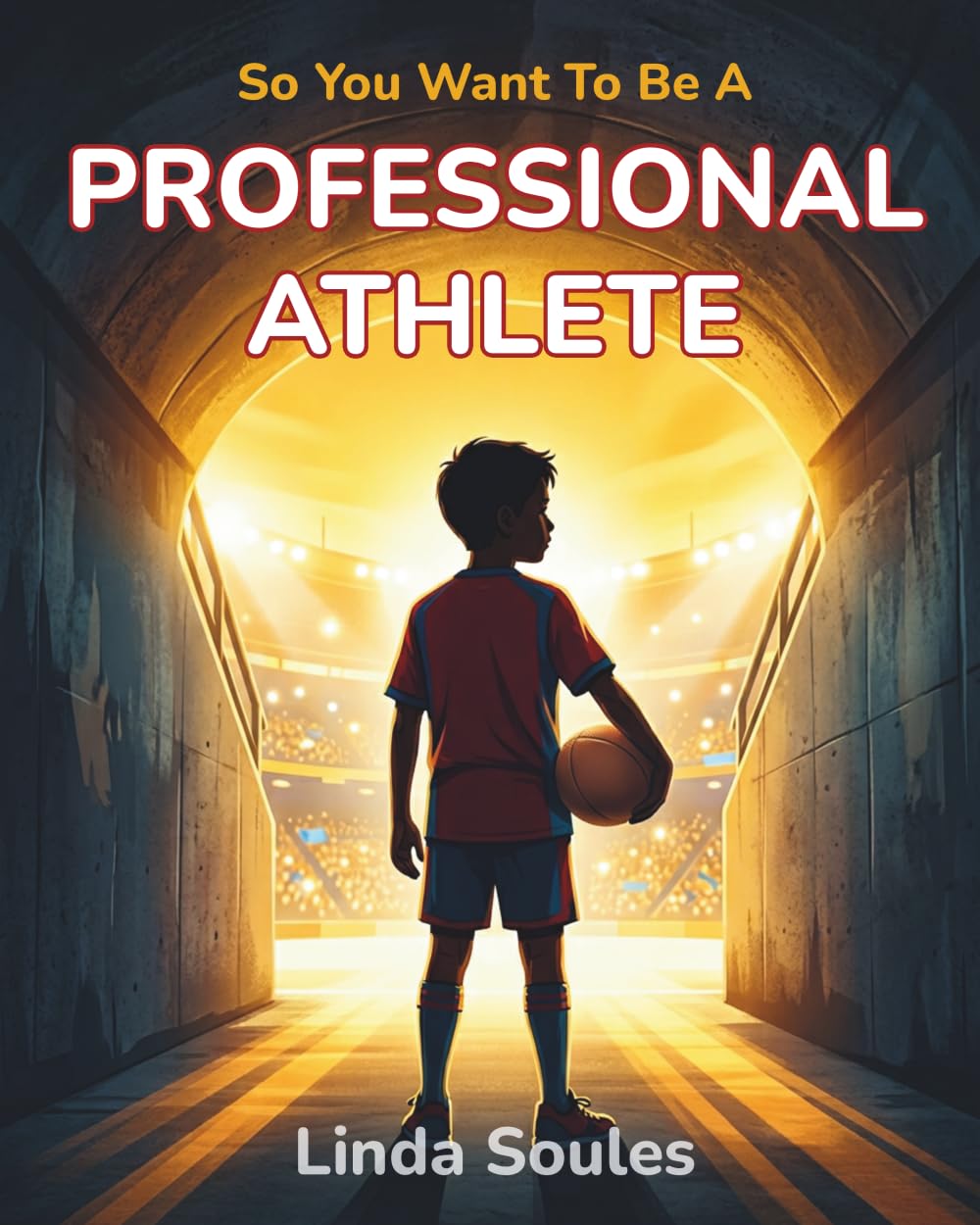
So You Want To Be A Professional Athlete, by Linda Soules, is a smart and encouraging nonfiction guide for kids who dream about playing sports at the highest level. Instead of focusing only on fame, trophies, and big game moments, this book shows what being a professional athlete really looks like behind the scenes. Soules makes it clear that talent matters, but it is only the beginning. The real work comes through practice, discipline, training, recovery, and learning how to handle pressure.
One of the best parts of this children’s book is how honest it is without being discouraging. Young readers learn about strength training, nutrition, sleep, film study, mental toughness, and the team of coaches, trainers, nutritionists, and sports psychologists who help athletes perform their best. The book also explains the less glamorous parts of the job, like injuries, early mornings, strict routines, public failure, and the fact that an athletic career does not last forever. That honesty makes the book feel useful, especially for kids who may think professional athletes mostly just show up and play.
The writing is clear, casual, and easy for kids to follow, while still treating them like serious readers. Soules doesn’t talk down to her audience, and she gives enough detail to make the world of elite sports feel real. The colorful illustrations, fun facts, real athlete stories, glossary, and “day in the life” sections help keep the book engaging. Some parts are packed with information, so it may appeal most to curious readers who enjoy learning how things work, but sports-loving kids will find plenty here to keep their attention. I also liked how it mentions that “The mental dimension is as demanding as the physical.” I don’t think many children’s book go into this aspect enough, and I was happy to see this book tackle that side of sports.
So You Want To Be A Professional Athlete is a great choice for young athletes, sports fans, families, teachers, and coaches. It gives kids a realistic look at the hard work behind greatness while still encouraging them to dream big. More than anything, it shows that being “professional” starts long before the crowd cheers your name, it starts with the choices you make when no one is watching.
Pages: 38 | ISBN : 978-1972766200
Practice Makes Perfect


Practice Makes Perfect: Draw Facial Expression is a fresh and creative take on the traditional colouring book. Instead of only giving readers finished outlines to color, this book introduces a new concept: drawing faces and facial expressions within a larger scene. That makes it feel more interactive, imaginative, and skill-building than the usual colouring activity.
The sports theme gives the book energy and movement. The pages show athletes in various sports and in a variety of situations. This kind of subject matter makes the colouring experience more exciting because the reader is not just filling in shapes; they are thinking about the character, the setting, and the emotion of the moment.
What makes this colouring book different from the norm is its focus on expression. This one encourages the reader to add personality by drawing faces. That small creative challenge can help build observation skills and storytelling ability. A happy, nervous, focused, or surprised expression can completely change the mood of the picture.
This is a thoughtful and original colouring book for young artists, sports fans, and anyone who enjoys drawing characters with emotion. It combines colouring, drawing practice, facial expression study, and sports storytelling in one book. It’s different, engaging, and a great choice for children who want something more creative than an ordinary colouring book.
Hard Times: The Extraordinary Life and Times of Nathan ‘The King Cobra’ Washington

Hard Times: The Extraordinary Life and Times of Nathan “The King Cobra” Washington, by M. Anthony Phillips, opens as a search story and widens into something far larger: a young magazine writer tracks down a vanished heavyweight champion, only to uncover a life marked by sharecropping poverty in Georgia, racist terror, war service, boxing glory, mob pressure, flight, reinvention, and old grief that never quite cooled. What begins as a sports mystery becomes a multigenerational saga about what a man loses when history corners him and what, against reason, he still manages to keep.
I appreciated the way Phillips portrayed Nathan’s emotional depth, instead of just listing things that happened to him. The early scenes of his family, the long shadow of Jim Crow, and the bruising detours of his adulthood give the novel a rough-hewn earnestness that suits its subject. I felt the book reaching not for polish so much as amplitude. It wants to tell the whole thing: ambition, lust, fear, tenderness, humiliation, pride. Nathan isn’t presented as an emblem or a sermon. He’s a battered, desirous, stubborn human being, and the book is strongest when it trusts that plain, unsanitized fact.
The prose can swing from vivid to blunt. Yet even when it can be melodramatic, I rarely felt indifferent. There’s a kind of unvarnished conviction here that kept me reading. I was especially struck by the book’s sense of aftermath: Nathan doesn’t simply vanish into legend; he survives into obscurity, sorrow, compromised second chances, and a late-life reckoning that is more melancholy than triumphant. That choice gave the novel a mournful aftertaste I found compelling. It refuses the easy coronation. It is more interested in the cost of surviving than in the glamour of winning.
I would recommend Hard Times to readers of sports fiction, historical fiction, and Black historical drama who want a big, old-fashioned story told with bruised sincerity rather than minimalist cool. Readers who respond to sagas of struggle, war, race, boxing, family, and redemption will likely find a great deal to hold onto here. In spirit, it sometimes feels closer to the broad emotional sweep of Walter Dean Myers or the combative American mythmaking around boxing narratives than to sleek contemporary literary fiction. Hard Times is not a delicate novel, but it is a heartfelt one, and its best blows land with the weight of a life fully lived.
Pages: 384 | ASIN : B00AA3PGRE
Strategy, Focus, and Concentration

Readora From BookTropolis is an engaging alphabet book for young readers that presents each sports-related letter through haiku-style verses framed by the tale of Readora, a reading superhero. What drew you to using haiku-style verses for each sport?
I have been writing poetry since childhood. Haiku is a style of written communication that allows a person to say a lot with few words. Kids have short attention spans, so telling a story or teaching lesson plans in short rhythmic form is an easier and more fun approach to reaching them rather than straight conversation. Plus, an impactful or sensible haiku statement (poetry/rap) is easy to remember. Also, my voice is Readora’s voice in the readings.
Do you have a personal favorite sport featured in the book?
My favorite sport in the book is chess because it requires critical thinking, strategy, focus, and concentration. These are life-long skills that children can learn as youngsters and apply to everything they do in the future.
The artwork in your book is wonderful. Can you share a little about your collaboration with illustrators Heyjuly and Kesab Karmakar?
I found both illustrators on a design platform and posted an RFP of my requirements. More than 20 artists sent designs. The first request was for the Readora from BookTropolis character. Among other specifications, I provided a younger photo of myself so the character can be created in my image. Intellectual property rights are critical, so I wanted to ensure that my face is the only one the designers would reference. All other designs were created based on the content of each sport in the book, with the use of AI prompts, with Kesab Karmakar contributing several sports illustrations as well.
How do you hope parents, teachers, or librarians will use this book with children?
This book is the first in a series of books called the Readora from BookTropolis Learning Series. The intent is for parents, teachers, and librarians to use this book and all others to come as a method of teaching younger readers their alphabet, introducing them to various sports, both traditional and those not as well known, and through the haiku style of writing, teaching children to read and comprehend while viewing the vibrant illustrations.
Author Links: GoodReads | YouTube | Facebook | Website | Amazon


