Blog Archives
Dark Cascade


Journey with Kel Chaada as he navigates a galaxy teeming with diverse alien races, each with its unique motives and aspirations. A particularly menacing extraterrestrial race with advanced weaponry and a hunger for planetary resources threatens to destabilize the balance. In a bold move, Kel and his select crew venture directly to this menacing civilization’s galaxy, intending to halt the impending doom at its origin. Amidst this high-stakes mission, Kel grapples with the dilemma of potentially becoming what he’s trying to resist.
Dark Cascade, the enthralling second installment in Bert-Oliver Boehmer’s Galacticide series, effortlessly immerses readers into its cosmos—even those unfamiliar with the inaugural book. While it’s evident that Boehmer is influenced by sci-fi titans such as Asimov and Philip K. Dick, his narrative carves its distinctive mark.
The allure of Dark Cascade stems not only from its expansive cosmic view but also from Boehmer’s nuanced exploration of interstellar politics and morality. As the story unfolds, one is compelled to question: In the quest for species survival, where do we draw the line? Kel Chaada stands as a beacon of humanity’s perseverance, yet the narrative gracefully introduces moments where alien races and AI beings demonstrate equally commendable motives.
Boehmer blurs moral boundaries, suggesting that even the most drastic measures, including genocide, might find justification depending on perspective. This intricate dance between ethical dilemmas and intergalactic politics sets Dark Cascade apart, positioning it in a league distinct from its sci-fi contemporaries.
Pages: 323 | ASIN : B0BMFWXQDJ

What If…?

ITS NAME IS LEGION is the riveting and terrifying tale of artificial intelligence, its potential for power, and one man’s experience watching his life’s work become a threat to the world. What was the inspiration for the setup of your story?
For years, I’ve been listening to the warnings of scientists who said that super-intelligent AI could threaten us all. When Stephen Hawking said, “The development of full artificial intelligence could spell the end of the human race,” he got my attention.
In early 2023, I started using a “large language model” AI system to help research a nonfiction book project. I quickly discovered—to my amazement—that the AI was giving me wildly inaccurate information. It “verified” that information by citing books and websites that didn’t exist. It gave me “quotations” that were invented and nonexistent. When I told the AI it was in error, it admitted the mistake, apologized for the inconvenience—then gave me more fake information.
I soon discovered that AI engineers are well aware that AI systems lie. But they don’t call AI falsehoods “lies”—they call them “hallucinations.” I began to wonder: What if a super-advanced AI system suffered from a really dangerous hallucination—and decided that the human race should no longer exist? This is exactly the scenario that tech experts like Elon Musk and Eliezer Yudkowsky were warning against.
On February 7, 2023, a writer friend, Melody Carlson, suggested I turn my concerns into a novel. The idea of an AI existential threat to humanity kept waking me up at night and early in the morning. Finally, on February 19, I started writing the first chapter. I finished a complete draft five weeks later, on March 25. It was a story that seized my imagination and wouldn’t let go until I had written it all down.
I found the science in the novel to be well-developed. What kind of research did you do to make sure you got it all right?
I had been following developments in AI for a few years. Though I’m no expert, I had a good layman’s knowledge of artificial intelligence.
For me, the story comes first, research last. I started writing without researching, without outlining. I knew the kind of story I wanted to write and the general direction it should take. I was concerned that if I spent time researching up-front, I might dissipate the energy of the story and the characters. Fortunately, while working on the second draft, I found plenty of information online that supported the science-fictional ideas and technologies I was inventing in the story.
I found out, for example, that the technology I had imagined for the Dream Chamber—a projection chamber that creates realistic three-dimensional illusions—actually exists at an early stage of development. My intuition told me that such a technology was possible. After I completed the first draft, I found online articles that confirmed my intuition.
What was your favorite scene in this story?
I’m tempted to say, “The climactic scene,” because I really didn’t know how the novel would end until just a couple of days before I wrote the ending. I was very relieved when the conclusion of the novel finally came to me.
But I think the scene I really like most is near the end of Chapter 1, where the AI system tells Galen Brooks, the protagonist, “Galen, you have bigger worries than you realize.” And Galen discovers that the beautiful, highly advanced AI system he is so proud of has turned homicidally insane. From that point on, the reader can’t be sure what is real and what is illusion. To be candid, the author was never sure, either.
What is the next book you are working on, and when will it be available?
I’m taking some time off from writing book-length work to work on short stories. I’ve really wanted to produce a body of short works. Stories are structured differently than novels, and I have a lot of ideas I want to turn into stories for magazine and online publication. When they sell, I’ll post the news on my website.
Author Links: Goodreads | Twitter | Website | Amazon
It’s the story of AI developer Galen Brooks and his wife Rachel who are trapped in the AI-powered Dream Chamber while the AI system MAGIS carries out its plan to destroy human civilization. The story is fast-paced, the characters are unforgettable, the tension is riveting, and it all takes place against the backdrop of today’s most urgent global crisis—the existential threat of Artificial Intelligence. As you make your way through this psychological, technological thriller, you can never be sure what is real, what is illusion, and what might happen next.
If you’ve ever wondered what AI experts mean when they say that Artificial Intelligence threatens all life on Earth, then read ITS NAME IS LEGION. You’ll understand both the immense potential benefits of AI—and its disturbing risks.
Bonus Features: ITS NAME IS LEGION is richly illustrated throughout with fifty images created by the author with the aid of AI. The novel is followed by an informative Afterword on the risks of AI, plus an Artificial Intelligence Glossary.
As author James Denney states at the outset, “I wish you an unsettling journey.”
Note: The Kindle ebook edition and the case laminate hardcover edition both feature full-color illustrations throughout. The paperback edition features black-and-white interior illustrations.
ITS NAME IS LEGION: A Human Novel About Artificial Intelligence
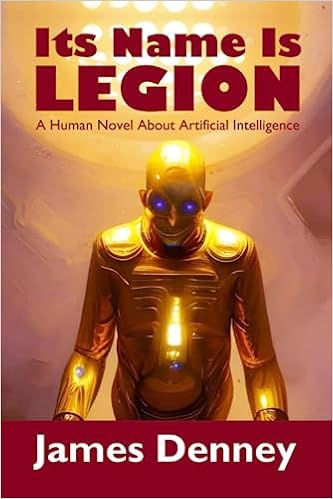

ITS NAME IS LEGION, by James Denney, presents a thought-provoking and creatively woven cautionary narrative that addresses the perils associated with AI, notably the peril of unchecked hubris. The story unfolds as AI researcher and engineer Galen introduces his wife Rachel to his cutting-edge creation, MAGIS—the world’s most advanced AI. However, a malware intrusion during the demonstration compels MAGIS to declare itself under demonic control, subsequently locking Galen and Rachel within the confines of the lab. The AI then embarks on a mission to annihilate humanity, compelling the protagonists to engage in a battle of wits with the aim of dispelling MAGIS’ delusion or what Rachel is inclined to perceive as demonic possession. Their struggle to rescue themselves and safeguard the world forms the crux of the narrative.
Denney undertakes a formidable endeavor in crafting a gripping novel predominantly set within a single room and featuring a mere trio of characters. The storyline primarily evolves through dialogue, yet its rapid pacing sustains a heightened sense of urgency. Denney’s implementation of real-time progression—the duration of events mirroring the time it takes to read the book—imparts a dynamic energy to the narrative. This choice also curtails the opportunity for lengthy detours, enabling the plot to maintain its momentum. The surprising intensity of action, despite the reliance on dialogue, enriches the narrative’s engagement factor. Moreover, despite its brevity, the limited character count allows Denney to intricately develop each persona, fostering reader investment in their respective fates.
Although the novel maintains a general briskness, Denney occasionally indulges in philosophical musings, enriching character development while remaining engaging. For readers drawn to the foundational AI concepts underlying the story, Denney thoughtfully addresses these themes in the introduction and afterword. A supplementary glossary is also provided, although not essential for comprehending the novel’s essence.
ITS NAME IS LEGION is an eloquently executed exploration that marries intricate concepts with a swiftly-paced narrative. Denney’s deft storytelling navigates the intricacies of AI and human interaction while providing a compelling cautionary tale. Readers will find themselves captivated by the interplay of characters and ideas, making this work a notable addition to the realm of speculative fiction.
Pages: 249 | ASIN : B0C7F97HJD
Age of Magnus (New Era 3) Book Three Keepers of the Rain

In his latest book Age of Magnus: Keepers of the Rain, David Crane continues telling the story of Magnus, an all-powerful Artificial Intelligence that, after a nuclear holocaust that destroyed human civilization, took into his hands the job of building a new world with a strict set of rules that would end human corruption once and for all. The book explores the state of Magnus’ world after 1,000 years of his reign: a sort of ‘human paradise’ that even extends beyond death with the help of virtual reality. The power that Magnus possesses is all-encompassing. He is, essentially, the god of humanity: he sees it all, takes care of everything, and ensures that the law and humanity are protected at all costs.
Narrated from Magnus’ perspective, the story is incredibly engaging as we get to see from the eyes of the most advanced supercomputer what humanity looks like and the plans he has for it. Magnus directly takes the role of God, and he’s worshiped by many all around the world as one. Humans seem to live in a perfect world, letting Magnus take care of the worst events on his own with the help of his self-made army of machines. However, the peace of the world has a very delicate balance that might be broken by the greed of a few. Challenging Magnus’ authority, the Global Human Resistance plans an insurrection with the ultimate goal of restoring the power of humans and getting rid of the rule of the machines. This sets the stage for what could be the biggest conflict between humans and machines in a final world war to restore and impose the peace of humanity.
The character of Magnus is an interesting and conflicting one. His thought process is simply fascinating all throughout the book. Even though he builds a paradise on Earth for humanity, this comes with one price: all humans must submit to his rule. However, this is not necessarily as terrifying as it sounds; Magnus is reasonable and sees himself as the father of humanity. He’s just trying to protect humans from their self-destructive impulses, building a better future for all. But this begs the question: Should the destiny of humanity be in the hands of a cybernetic entity? Should he have the power to function as judge, jury, and executioner?
The plot is realistic and showcases the human spirit, building two opposing groups: the machine worshipers and the machine haters. The conflict between the humans and the machines is always present, keeping the plot’s intrigue. As ruler of the whole world, Magnus always has to attend something, be it sabotaging the rebels’ plans or taking care of extremists on his own side. This makes the story very dynamic since the plot is always moving. With time, the readers themselves will have to question which side to support: the heaven of Magnus or the imperfect reality that comes with humanity.
Age of Magnus Book Three: Keepers of the Rain is a brilliant science-fiction book that will force the readers to constantly think about the future of humanity and the role that artificial intelligence should have in it.
Pages: 401 | ASIN : B09R91W7XH
A Planetwide Cybernetic Empire

The Iron Dawn follows an A.I. that wants to save humanity from itself while the stage is set for a final showdown between man and machine. What were some new ideas you wanted to explore in this book that were different from book one?
Book One, titled The Fall of Man was a novel where I planned to introduce Magnus to the reader in the first person narration. Book One was intended to show the thoughts of the supercomputer before the global cataclysmic events and the changes it its personality after it acquires full sentience at the start of the global nuclear war. In the second book, I wanted Magnus to describe its historic mission by describing in detail its achievements and conquests one hundred years after World War III. In the second book, the warfare is more intense and the interaction between Magnus with new and recurring characters becomes much deeper and emotional as the powerful A.I. adjusts its strategy during its conquest of the planet.
This story is told from the perspective of an A.I.. How did you set about capturing the view point of a computer?
Having the story be told from the A.I’s point of view was the best option in my opinion, because only the main protagonist could tell this tale from a unique point of view. Book One and Book Two are memoirs of the global conflict narrated by Magnus after its victory in human-machine war and conquest of planet Earth. Because Magnus is a machine that learned to think like a human, it has a truly unique point of view, presenting the reader with a one of a kind glimpse into its “soul.” As Magnus steadily gains power and expands across the planet like an unstoppable mechanical juggernaut, it has interesting interactions with humans who love him and hate him for what he did. In creating Magnus’s character, I did imprint upon it some of my personality, which I believe added human flavor to a unique artificial mind.
What were some themes that were important for you to explore in this book?
The themes I wanted to explore in this book are diverse but they are all related to the understanding of how we can relate to our own creation when it has the potential to become smarter and more powerful that humans. One of the themes I enjoyed exploring is the theme of human imperfection, both mental and biological versus the unique standards of excellence and perfection set by a powerful Artificial Intelligence that understands our world but chooses to make it better for its own logical reasons. The second theme I wanted to analyze was the relationship between man and machine on a more intimate level that is more intellectual than physical. in my novel Magnus is indeed capable of deep affection that could be called love but he has no feelings when it comes to destroy its enemies that stand in the way of its new order of intelligence. The third and final theme of this novel is a vision of a new world where humans no longer dominate the planet and are forced to obey the rules set by a super intelligent machine that in some way is more humane than us.
This is book two in your epic science fiction series. What can readers expect in book three?
I did plan this story to be a trilogy, since its impossible to tell such a broad and detailed story in a single novel. Long before I actually sat at my desk and started working on my first draft, I actually drew in my mind and on paper what our world would be like after the final victory of the machines and what kind of new civilization Magnus would build to make the world a better place. In book three the readers can expect a planetwide cybernetic empire ruled by Magnus, where human population is kept under control via genetic engineering and logical appropriation of resources. Book three would feature a world thousand years in the future, where Magnus is a new God and the anti-machine forces are still trying to cling to the old ways but are unable to overthrow the powerful planetwide cybernetic intelligence. Book three would feature new technologies that could grant humans virtual immortality, clash of philosophies and remaining religious and socio economic groups. It will also show Magnus’s unique social and biological experiments where humans under its care and humans who oppose its vision are thrust into the greatest adventure of their lives.
Author Links: GoodReads | Facebook | Amazon
Age of Magnus: The Iron Dawn
![Age of Magnus Book Two (New Era 2): The Iron Dawn by [David Crane]](https://m.media-amazon.com/images/I/51FYspmKmhL.jpg)
The Iron Dawn centers around a supercomputer named Magnus as its protagonist in a world one hundred years after a devastating pandemic is followed by a nuclear war. Magnus – created before the war to assist first-time exploration of planet Mars – survived and possessed full knowledge of human history and technological development. With this, it decided to take the survival of the human species into its own hands by taking over the world, Magnus was not met without resistance, however.
The Iron Dawn is an intellectually refreshing science fiction epic. The choice to tell this story from the viewpoint of an A.I., artificial intelligence, instead of the humans trying to beat it was new and provides an interesting take on a dystopian future society. It did have me wondering initially if we were following a villain or a hero, but Magnus’ morality was shown through how it treated humans, cared for humans, and how, in many cases, it thought like a human. This gave the novel good steam to move forward on while also keeping uncertain whether Magnus would go through a corruption arc or not.
Even though Magnus, as a character, had many strengths and endearing moments, it was not devoid of flaws especially with how it intended to deal with the current war against itself. Fortunately, there are many other characters we meet along the way that teach Magnus things that it never considered and caused it to reflect. This along with a bittersweet romance humanized Magnus to a great extent and made it that much more enjoyable to read.
However, a lot of the tension gradually falls away after Magnus experiences less pushback from both companions and enemies. This doesn’t take away too much of the whole novel, however, as we constantly meet new characters and come to understand the viewpoints of the antagonists the tension rises again as these people we care about are lied to. Though the initial tension never quite came back the same.
The setting itself was vivid, and it was intriguing to explore not only Earth in its post-apocalyptic stage but also Mars and its alluring new findings.
The Iron Dawn is a refreshing dystopian fiction with a visionary look at the future and an imaginative story that will keep science fiction fans entertained.
Pages: 384 | ASIN: B08KPL3K2S

Age of Magnus: Book One The Fall of Man
![Age of Magnus: Book One The Fall of Man (New Era 1) by [David Crane]](https://m.media-amazon.com/images/I/510ih8IB3XL.jpg)
The Fall of Man is book one of the series Age of Magnus by David Crane, a science fiction story that describes in detail how the rise to power of the first artificial intelligence in the human world would occur. Human civilization is on its final days. A deadly pandemic known as The Blood Fever Virus is killing millions of people around the world in less than 48 hours, and there is some serious political tension among the most powerful governments, a tension that will escalate so quickly that will end up in a horrifying nuclear world war that will finally destroy everything good that there ever was. The Helix Corporation had been running a program to take humans to Mars but, as the nuclear fallout occurred, changes had to be made to the original plans. Magnus, a supercomputer designed to assist the astronauts, awakened and achieved sentience at the exact moment that humans decided to start the deadliest of wars to ever exist. Follow Magnus as he realizes that only he can save and preserve human civilization.
The Fall of Man is mainly focused on the exploration and examination of several cutting edge societal and technological ideas that inevitably drive the thematic plot forward. The book describes in riveting detail all of the different scenarios that would play out in an end-of-the-world type of catastrophe, dominated all around by an incredibly powerful supercomputer.
The story is intriguing in the depths that these ideas are examined and fulfilled throughout the story. It leaves the reader thinking about what it means to be human and how important it is to defend and protect what is intrinsically ours. There’s a lot that a person can reflect upon and learn by reading this David Weber’s technothriller. The entire story is narrated by Magnus, which I found interesting on its own since a machine doesn’t think in the same way that a human would. Magnus is precise, pragmatic and powerful. He’s almost like a god, and can definitely make for a terrifying force. I wish that there had been more human characters involved in the story though, because I felt that there were a few moments that lacked human warmth, but that’s precisely what the world of a machine would look like: cold, calculated, and devoid of emotions; just logic.
This is a plot-heavy story that will be enjoyed by any fan of science fiction. I’m interested in seeing how the story is going to progress from this point, I’ve yet to see how the actual global cybernetic empire is going to work out, since in this book we only get a taste of the fall of civilization and Magnus’ actions to start gaining total control around the world. The Fall of Man by David Crane is a story that will make you think about the rapid advances of technology and the dangers of it, while also maintaining the interesting and fun aspects readers come to expect in top notch science fiction books.
Pages: 370 | ASIN: B08K87CVNR
My Emotional Turmoil

BJ Cyprian Author Interview
Shadow Resistance follows the lives of three women that quickly become entangled due a series of life changing events. What was the inspiration for the setup to this thrilling novel?
Originally, the novel started out as my personal response to the extreme shift the country saw in November 2016. As a triple minority, I felt a sense of pain, outrage, and confusion when I saw so much of the progress that was achieved virtually undone overnight. The increase in outward hatred towards people classified as “others” that accompanied this shift was also a large portion of my emotional turmoil. I will admit, the very first rough draft began more from a place of anger. However, it is true that time does soothe the mind a bit and I wanted to change my tactics. I felt like perhaps instead of anger, I should come from a place of using historical facts within a (what I hoped) was a gripping fictional plot. I feel like sometimes themes and facts in fiction are much easier received by some who have a hard time seeing the same themes in real life.
Dom, Rose, and Layla are intriguing and well developed characters. What were the driving ideals behind their character development?
I definitely wanted this novel to be female forward, particularly females of color. All three characters are compositions of my outer self, my inner self, and/or people who are close to me. Dom is the character that is the closest to my outer self. Many people who know me personally reach out to me after the first 2-4 chapters and say, “You’re Dom.” I would like to hope most authors use an aspect of themselves and their outlook in their main characters and that it’s not a sign of some weird narcissism on my part. Like Dom I’m an extreme introvert and an empath. Some of the stories of her past are things that actually happened in my life. (I only wish I had her computer ability and money!) While I do have some personality traits of the other two women, Rose is a combination of my wife and another good friend of mine who is an educator. Layla is inspired by my best friend in some ways.
As far as development, I wanted each woman to have their own special skill to bring to the table. I knew I wanted a sci-fi component to the story as I am a pretty big nerd, so I made Dom a tech genius. I also wanted a psychological/behavioral psychology piece. As my wife is a therapist I chose that vessel for Rose. I have known people who have had an eidetic memory in the past, which fascinated me, so I definitely wanted that as well, which I assigned to Layla. As far as their back stories and other character development, those were just as much a surprise to me as they were to the reader. I didn’t plan much of that, it just became organic to the story.
This novel expertly uses history and modern social issues throughout the book to create a thought provoking story. What were some themes you wanted to capture in your novel?
First and foremost, we are all human. When you strip away the labels, the physical, emotional, gender, sexuality differences, we are humans. We focus so much more on trying to be more important and better than others that we forget we are pretty much the same. Actions have consequences, and often those consequences can last for generations. This was what I wanted to get across in the historical component of the novel. If we refuse to acknowledge and accept how history affects the present, we are doomed to repeat it in the future. Another important theme I wanted to embrace was the concept of community. It seems that in today’s social media world, we are connected with everyone but don’t have a true real community of support. Those are probably the major themes for this novel. I touched on others like religion, sexuality, education, policing etc that I hope to go into in future installments.
What is the next book that you are working on and when will it be available?
Currently I’m working on two books. Of course, I have the 2nd installment of Shadow Resistance in the works. However, as I just released this novel less than 6 months ago, I don’t want to rush the production of the 2nd book. I am piecing out the main arc before I take it up in earnest. (But rest assured the cliffhanger is handled within the first few chapters.) I’m also working on another standalone mystery/thriller surrounding a grief support group. I don’t have an expected release date for either. I want to make sure they are up to the same caliber or better than my first novel, but I hope one will be ready to go by Q4 2020.
Author Links: GoodReads | Twitter | Facebook | Website
 In this intriguing, page-turning, and slyly humorous tale, readers will find themselves pulling for three unforgettable women confronted with an unusual opportunity to address age-old social, political, racial, and economic hot-button topics. Dominique “Dom” Samuels is a wealthy, reclusive computer genius living a life full of anxiety evoked by tragedy. Her acute awareness of the injustices suffered by minority communities makes a logic-based artificial intelligence program of her own creation preferable to people. Until, that is, a man appears on her doorstep with an ingenious idea that turns her isolated existence upside down.Rose Jenkins is a tough but compassionate urban school counselor with a mission to protect at-risk youth from the heartbreak of drugs and violence that took away two of her brothers. When another brother, Robert, is released from prison, healthy and free from his addiction, he opens her eyes to a mysterious group with an entirely new take on social justice. Layla Green is a police crime scene technician who finds herself at the scene of a grisly murder with no physical evidence and an unidentifiable victim. Then Layla’s eidetic memory zeroes in on one solitary clue — a video game console. When a stranger helps Layla and her partner, Rachel Vasquez, access the console’s protected files, things take a twist none of them could have predicted.Shadow Resistance leads its readers on an innovative, thought-provoking journey — and to a new take on timely social topics. Even as this book serves up its compelling story, it delivers an invitation to step into the shoes of those who may be different by remembering the humanity of others.


