Blog Archives
When The Bell Rings – A Firefighters Journey


When the Bell Rings, by Robert Gass, is a thoughtful memoir that delves into the life of a firefighter. Gass shares his real-life experiences and stories, giving readers an intimate look at the emotional and mental battles attached to the profession. This book transcends the job itself, highlighting the emotional and mental challenges that come with it. Gass vividly recounts tales of bravery, hard work, and resilience, honoring the men and women in his profession who face danger daily. His ability to capture the essence of firefighting makes this memoir a compelling read.
The title immediately caught my attention, evoking a sense of personal connection and curiosity. The chapter names, carefully chosen and beautifully crafted, set the tone for the descriptive, poetic writing that follows. Gass intended to provide an uncensored peek into a firefighter’s life, and he succeeds admirably. The memoir is filled with personal anecdotes that illustrate the intensity and danger of the job, balanced by moments of reflection and appreciation. The writing is undoubtedly the highlight of this memoir. Gass’s vivid descriptions transport readers into the heart of the action, making them feel as though they are right there with him, whether fighting a blaze or enjoying a moment of peace.
Short chapters make this an easy, engrossing read that is hard to put down. A prominent theme throughout the book is resilience. Gass highlights moments of sheer bravery and hope amidst circumstances that could easily lead to despair. He doesn’t shy away from discussing the impact of firefighting on mental health, addressing PTSD, the toll on family life, and coping mechanisms. This honesty adds depth to the book, elevating it beyond a series of action-packed episodes. When the Bell Rings is a remarkable read and Gass successfully honors his colleagues while showcasing the heroism of firefighters.
When the Bell Rings is a must-read for anyone interested in the real-life experiences of firefighters or those curious about the behind-the-scenes of this critical profession. It is touching, honest, and deeply respectful of those who face these dangers daily.
Pages: 399 | ASIN : B0D6RLH36H

100 Livestreaming & Digital Media Predictions, Volume 4
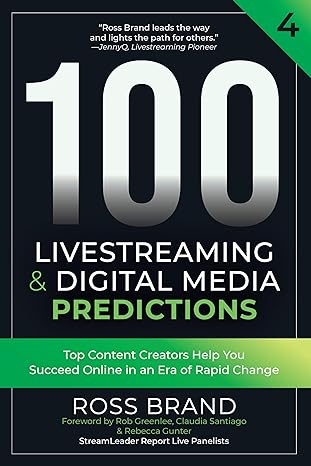

Ross Brand’s 100 Livestreaming & Digital Media Predictions brings together over 100 experts to provide a comprehensive guide for content creators navigating the rapidly evolving digital media landscape. This book is both timely and relevant, serving as a roadmap for the future of live streaming and digital media. It offers a wide range of predictions on emerging technologies, changing consumer behaviors, and innovative content strategies.
One of the book’s standout features is its authoritative stance on the controversial topic of AI. In an era where discussions about AI are highly divisive, the book’s balanced approach addresses both ethical and practical concerns, ensuring readers are well-informed about the benefits and potential pitfalls. This nuanced treatment of AI lends the book a credible and authoritative voice in the ongoing discourse.
The diversity of perspectives included in this book is another significant strength. Ross Brand has curated insights from across the digital media spectrum, from live streaming and podcasting to email marketing and community building. This comprehensive approach provides a well-rounded view of the industry’s collective opinion, enhancing the book’s credibility. The book features a variety of voices, each contributing unique insights. For example, Laura Clapp Davidson and Marisa Cali discuss the potential of micro-content, while Ross Quintana predicts a shift in advertising from traditional channels like TV to platforms like YouTube, alongside discussions on Web3 and VR/AR experiences. Bryan Kramer, on the other hand, highlights the enduring effectiveness of email marketing newsletters, particularly in an era of increasing privacy concerns and restrictive social media algorithms. While the book is rich in predictions, opinions, and discussions, its sheer variety offers a wealth of knowledge. I do feel that bit more thematic organization could enhance readers’ ability to digest the information seamlessly.
Ultimately, this book will open readers’ minds to a world of possibilities and re-energize their creativity. 100 Livestreaming & Digital Media Predictions reads like a captivating fairy tale rooted in reality, blurring the line between the two. It provokes thought and conversation about technology, its implications, and the opportunities the future holds.
Pages: 232 | ASIN : B0CSBCQSZR
Compiled by Ross Brand, an on-air personality and consultant for leading live video brands, this latest volume in our award-winning series (with 25 book awards to its name) is more than just a collection of predictions; it’s a roadmap to mastering the digital realm in 2024 and beyond.
Within these pages, 113 expert contributors, including Emmy winners, renowned YouTube influencers and Hall of Fame podcasters, share their foresight. They delve into how AI is redefining content creation, offering both foundational advice and groundbreaking strategies. From exploring AI’s role in enhancing productivity to addressing fears of losing authenticity, this book tackles the pressing questions every creator and entrepreneur faces:
What are the essential tools to integrate AI into your work?
How can AI be leveraged to maximize efficiency without sacrificing creativity?
What are the pitfalls of AI in digital media, and how can you navigate them?
How can you maintain a genuine connection with your audience in an AI-driven world?
“100 Livestreaming & Digital Media Predictions, Volume 4” isn’t just a window into the future; it’s a treasure trove of insights from industry leaders. You’ll find exclusive predictions that shed light on emerging trends and practical pathways to navigate the complex interplay of AI and human creativity. Whether you’re a seasoned creator or just starting, this book equips you with the knowledge to thrive in the dynamic digital media frontier.
Critics and peers alike praise the “100 Predictions” series for its depth, accuracy and utility. As the fourth installment, this volume continues the tradition of excellence, offering a unique blend of expert opinions and actionable advice.
Embark on a journey through the converging paths of AI and human ingenuity. Let the insights of seasoned experts arm you with the tools to not just anticipate the future but to shape it.
GET IT NOW and be part of the vanguard shaping the digital media landscape in 2024 and beyond.
EVERYTHING IS PERSONAL: Embracing Stewardship in The Workplace and Everyplace
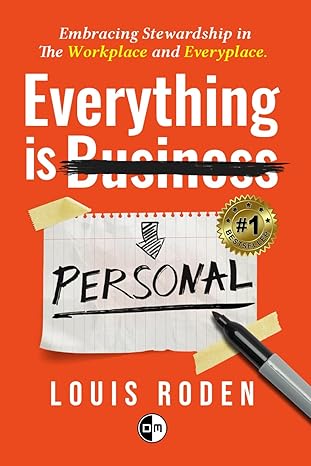
“There is a stark difference between organizations that are led and those that are merely managed.” This assertion is at the heart of Everything is Personal, a compelling guide to understanding the intricacies of true leadership. Louis Roden’s work highlights the significant distinction between textbook management and leadership infused with a personal touch. Challenging the conventional separation of personal and professional life, the book argues convincingly that every decision in business is profoundly individual. Through a series of insightful essays and reflections, Roden dismantles the notion that business decisions can or should be devoid of personal impact.
The book makes a powerful start with a critique of the phrase “it’s not personal, it’s business,” which Roden dismisses as nonsense and a cowardly evasion of responsibility. He argues that leaders must acknowledge the implications of their decisions, as these decisions shape the lives and well-being of their teams. This critical perspective will force readers to reconsider every instance they have used the phrase, ultimately agreeing that it indeed represents an evasion of responsibility. Roden’s writing is marked by its candid and often provocative tone, challenging readers to rethink their approach to leadership and workplace relationships. He emphasizes the significant amount of time individuals spend at work, arguing that workplaces must be more than impersonal environments focused solely on productivity. Roden’s unique perspectives challenge the notion that coworkers are not friends, urging readers to reconsider their relationships both at work and beyond. For instance, his reinterpretation of the golden rule—treating others as you would like to be treated—reveals it to be presumptuous and advocates for a more individualized approach to empathy and understanding.
Everything is Personal is strongly anchored in Roden’s personal experiences, following his own advice to let the personal reign. By drawing on his experiences, he illustrates his points effectively, making his suggestions practical and relevant to the real world. He calls for greater responsibility in shaping workplace culture, recognizing that empathy can transform soulless transactional engagements into meaningful, mutually beneficial relationships with coworkers and subordinates.
Everything is Personal is a thought-provoking read, especially in a world where the nature of work is rapidly changing. It advocates for a shift from workplaces that function merely as money-minting operations to fulfilling environments that employees look forward to each day. Roden’s passionate advocacy for personal accountability and genuine leadership makes Everything is Personal an essential read for anyone looking to transform their workplace culture into one that promotes trust, engagement, and long-term success.
Pages: 110 | ASIN : B0D55LW8VX
Unique Creations

Georange Horange’s Storange follows a young orange and a toy doctor who go on a mission to get the doctor’s new invention’s name added to the dictionary. What was the inspiration for your story?
I was washing the dishes one night in the middle of the week and I heard a character on the T.V. say “Nothing rhymes with orange.” For some reason, it struck me as being sad because it felt like the word was kind of alone. Dale had just retired from Sunny View P.S. and I immediately thought “Just create a word that rhymes with orange and solve the problem.”
That’s what the Toy Doctor program works to do every day with our students. They have an issue that is making them unhappy and the program always looks to find a unique way to solve that problem. Once I pictured Dale walking through at recess, seeing a sad crying orange, I knew it would break her heart and she would be able to solve the problem by creating something that rhymes with orange and would also make Georange happy again.
The art in this book is fantastic. What was the art collaboration process like with the illustrator?
The work of the amazing hand-painted illustrations in the story are completely due to the work of my sister in-law Julie Tait. There had already been a few family gatherings where Julie had displayed her artistic qualities but one Halloween stands out in my mind. She freehand carved an owl out of a pumpkin after just looking at it. I knew when it came to drawing, my efforts would never have come close to the details that Julie was able to so incredibly convey about the school, its students, Dale and of course, Julie’s visual representation of Georange Horange, whose facial expressions throughout the book really make him a heartfelt character. I can’t thank her enough for all the work she put into this book.
What is one thing that you hope readers take away from Georange Horange’s Storange?
Impossible is two letters too long.
That is the last line of the book and Dale painted this phrase on the wall of our shop. It is the only thing painted on the wall and Dale worked every day to prove the phrase is true. Every child at our school has their own unique issues that they work through every day. They require equally unique creations to help support them with those everyday needs. I always look at it like an equation. You have (A) what the student is capable of and (C) the goal the parents or teachers want the child to achieve. So I have to solve for (B) and create something that will allow the student to successfully go from what they are capable of doing, to what they need to do successfully as they grow and learn. There has never been a time where a solution wasn’t possible and I truly do believe that impossible is two letters too long.
Is this the first book in the series? If so, when is the next book coming out, and what can your fans expect in the next story?
I am currently working on another story called A Fishless Tank and the Tale of Two Snails based on a true story. It describes the adventures of two snails that live in a tank at Sunny View. The two snail friends must help their aquatic ornament friends (Diver, Clam, Plants, and Ship) to overcome their own individual issues, by all working together to correct the problems in the tank. I’m hoping to get the text finalized this summer so that Julie can start to visualize the story and get a grasp on what she can create for the watercolor artwork. I’m making sure to include the students at Sunny View again in the background so that they can once again see themselves represented in a storybook.
Author Links: GoodReads | Instagram | Website | Amazon
In this mesmerizing narrative, Ryan and Julie Tait pen and illustrate a tribute to Dale and the uplifting spirit of the children at Sunny View. “Georange Horange’s Storange” transcends a mere story-it is an exploration of wonder, kindness, and determination.
Introducing Georange Horange: a joyful and impeccably organized student, shining with positivity and purpose. Georange’s world is one where every child and every toy possesses extraordinary ability. As Georange teams up with Dale, they collectively embark on a whimsical quest to discover a truth: the word “impossible” is, indeed, two letters too long.
Adorned with exquisite illustrations, this narrative captures the profound interplay between life’s challenges and the magic that arises when one refuses to bow down. Through the tale of Dale and Georange, readers experience the powerful legacy of a woman whose life was dedicated to Sunny View’s courageous students. Their journey represents unity, compassion, and the unparalleled joy that emerges from facing and overcoming life’s obstacles.
“Georange Horange’s Storange” is destined to touch hearts across all ages, reinforcing timeless lessons of kindness, the resilience of community, and the transformative power of imagination.
Heroes and Heroines With Flaws

Blood Dagger: Thomas Berenford Chronicles follows a warrior visiting a small fishing village to relax who winds up being pulled into several jobs involving what he calls pest control. What was the inspiration for the setup of your story?
The story was inspired by one of my favorite movies, The Godfather. I imagined Berenford in a turf war between competing crime syndicates. Instead of mob bosses and their families, the story includes madams, magians, and an assassin that’s part man, part centipede. And violence, lots of it. One of my goals is to experiment with different genres.
I find the world you created in this novel brimming with possibilities. Where did the inspiration for the setting come from and how did it change as you were writing?
Big reveal here! The setting for Berenford’s travels takes place in a world that’s 100% geographically identical to this world. Same oceans, seas, rivers; same continents, mountain ranges, and valleys. The human element is completely different, of course. With that foundation, I followed the character’s footsteps, going east to west, and placed him on what would be, in this world, the southern United States. New Orleans, to be exact. Changes did take place as I was writing. Lore was added, plot points were written and rewritten, and characters revealed.
Your characters are well-developed and engaging, keeping readers hooked on your story. What character did you enjoy writing for? Was there one that was more challenging to write for?
Berenford was fun to write, especially when he struggled, which was often. Readers are attracted to heroes and heroines with flaws. The hardest character was the centipede demi assassin. His voice changed a few times. The danger with a character that demonic was to portray it in a trite, superficial manner. I’m not sure I succeeded.
When will book 2 be available? Can you give us an idea of where that book will take readers?
Actually, the next book will be the third book released, but since The Thomas Berenford Chronicles have not been written in order, I hesitate to call it book 2. In any case, The Broken Coil will tentatively be released at the end of 2024. It will take readers westward, with vistas of mountains, prairies, and blue skies that go on forever. And monsters. Sounds like the western genre, doesn’t it? With monsters!
Author Links: GoodReads | Facebook | Website | Amazon
Pest number one is a naïve kid with a huge heart and a knack for getting me into trouble. Pest two is an aging Madam of a brothel, with enough gold up her silky sleeve to hire my sword for yet another day. The final pest is the kid’s female cousin, a fiery warrior with a special spirit. She might be a better brawler than I.
Compounding the mayhem are ruthless bosses, brutal thugs, wily prostitutes, a swamp monster, and an assassin that’s half human and half insect—all conspiring to make my stay in this town a cursed ordeal. Lurking in the background is a pair of malevolent sorcerers who possess the power to seize control of the entire operation while sending all of us to an early grave.
Some call my job “Pest Control.”
I call it survival.
Reshape the Digital Landscape

Let’s Meet Blockchain educates readers on blockchain technology using terminology and examples that even those without a technological background can understand. What were some ideas that were important for you to share in this book?
My goal was to provide a thorough but fun and uncomplicated explanation of not only what the components of blockchain are and how they work, but also how they are being used around the world today using simple, easy-to-understand language. The book is broken down into four sections: Blockchain, Cryptocurrency, NFTs or non-fungible tokens, and Web3. Each section includes a bit of history for context, pop culture references, and websites where readers can go to get their feet wet.
What is a common misconception you feel people have about internet security?
To a certain degree, people assume technology is infallible.
What do you hope is one thing readers take away from Let’s Meet Blockchain?
I want readers to know that blockchain is a movement designed to protect online privacy and offer data protection, while at the same time reducing transaction costs by removing the middleman. It’s still in its infancy with great potential to reshape the digital landscape, upending the way we do business.
Author Links: GoodReads | X (Twitter) | Facebook | Website | Amazon
It’s called blockchain, and it promises to disrupt the way people interact with one another online, whether it’s messaging, banking, keeping up with medical records, land records, booking a vacation, socializing, or voting. Programs are also being developed to use blockchain to serve as one’s identity “papers.”
Blockchain technology is based on the idea that all online transactions should be between two people without the need for public or private third-party oversight. Blockchain technology developers believe thoughts and ideas should be shared, not quashed. It’s a world where web platforms are governed by their members, not a board of directors; privacy comes first, and one’s personal information is kept private, not for third parties to take and sell as they, please.
Blockchain technology offers everyone opportunities to take part. Anyone can participate in the fast-growing world using non-fungible tokens (NFTs), where works of art, music, literature, and poetry can be tokenized and sold or traded on a blockchain.
These components comprise the next generation of the World Wide Web, which is referred to as Web 3.0. Billions of dollars are being spent to create infrastructure to create a viable framework to mainstream blockchain.
This book offers a peek into this new world with examples of how this technology is being used today as well as the hurdles, including legal challenges, it must overcome to be viable.
So, if you’re ready, let’s meet blockchain.
Social Commentary About Conditioned Behaviors
God is an Atheist is a provocative collection of poems that delves into the complexities and contradictions of faith, humanity, and the institutions that govern them. What was the inspiration for the setup of your story?
Although I didn’t wake up one day and say, “God is an Atheist,” this collection came about by observing a lot of hypocrisy among the righteous – and those pretending to be righteous…and that probably goes back to 1966 when the congregation of the Steubenville (Kentucky) Baptist Church displayed attitudes that didn’t align with their values when they interacted with my divorced mother – and did not welcome me or my sisters into the flock’s fold. But it is not an esoteric micro-aggression collection – it is not a personal vendetta collection against the church; it is more of a social commentary about conditioned behaviors that don’t champion the church. In a way, God is an Atheist is very much a work that is pro-church.
What were some ideas that were important for you to share in this collection?
Hypocrisy is the first step to becoming an infidel.
It was difficult to escape the current social conditions when flags are flapping in your face off the backs of pick-up trucks and bibles are being used as props to gain political support from people who know better – again, hypocrisy was a driving theme behind GiaA. Conservative Republicans drive Buicks (it used to be Cadillacs!), and think they are on the highway to Heaven – but an American flag decal won’t get you into Heaven anymore (John Prine said that), and Jesus fed, comforted, and cleaned the feet of too many people to be a Conservative Republican – he had to be a liberal! So he would have driven a 1959 Plymouth Fury (maybe a Chrysler Imperial after resurrection, but still)…with the big fins! – and given people rides to where they needed to go.
What do you hope is one thing readers take away from your collection of poetry?
When I sign these books for readers, I simply say “Don’t think like me…Just think!” It’s a book that challenges people (I hope) to think and pay attention to the world they want to have controlled by other people (and governments…and churches) when they have the capacity to control it for themselves if only they would claim the volition and personal will to power – instead of praying against God’s Will…prayers keep asking for things (God bless America, for instance) instead of people seeing the results of God’s Will…is it possible to praise and worship God’s Will when you keep praying to have it changed?
What is the next book that you are working on, and when can your fans expect it to be out?
The galley-proof for I Felonites: First Letter to the Felonites is being reviewed today! As you might imagine by the title, it is a politically minded chapbook…so it should be out by the late summer (August/September). I also have 20 other collections (or so) that I finally typed up that are ready to shop around!
Author Links: GoodReads | Facebook | Amazon
Through vivid imagery, sharp critique, and personal testimony, author Benjamin B. White challenges traditional beliefs and invites readers on a journey of introspection and reflection.
A fearless critique of organized religion. White interrogates the hypocrisy, intolerance, and violence that have often been perpetrated in the name of faith, exposing the stark contrast between religious ideals and institutionalized practices. The poet’s unflinching examination of historical injustices, including colonialism and genocide, forces readers to confront uncomfortable truths about the darker aspects of their own lives.
‘God is an Atheist’ is a remarkable collection that transcends the boundaries of traditional poetry.
Family and Community
Morocco: A Remembrance of Childhood is a nostalgic journey through your early years living in Morocco as the son of a U.S. Navy pilot and the impact the culture had on your outlook on life and beliefs. Why was this an important book for you to write?
For reasons I couldn’t initially explain, I have retained many vivid memories of my formative years, ages 5-7, in Morocco. Although I’d never considered writing a memoir, the more I thought about those years, the more I became convinced that my adult perspectives on life had been determined largely by my experiences in Morocco. From that point forward, writing the book became somewhat of a compulsion, albeit one that took over three years to complete given the research involved as well as a one-year hiatus resulting from the sudden and unexpected death of my wife of 46 years.
What were some ideas that were important for you to share in this book?
On a personal level, I wanted to capture the wonders and joys that we all experience during the process of maturing, as well as the ecstasy and agony of growing up as a military brat. The former resulting from the opportunity to experience many different people and places and the latter resulting from constant need to move on and leave all such people and places behind. With regard to Morocco, I wanted to capture its colorful, fascinating and incredibly long history, as well as the unique religion and culture of its Berber and Arab populations, all of which have combined to produce what is arguably the most open, friendly and egalitarian population of humans on the planet. Finally, given my time in Morocco, during the mid 1950’s, I wanted to track the way in which the country’s Arab/urban population and it’s Berber/rural population became united in their efforts to rid the country of French colonists who had taken over their country as a result of the Treaty of Fez, executed in 1912–an effort that in numerous ways paralleled the struggle of Black Americans to attain their civil rights during the 1950’s.
What is something that you think will surprise readers the most in your book?
Unless you’re well-versed in medieval history, most readers will probably be surprised to learn that for a time Morocco was one of the richest and most powerful nations on earth, financed by camel caravans, transporting a river of wealth from sub-Saharan Africa, and pirates, plundering both European ships and coastal towns. Riding on the crest of such wealth, Berber horsemen captured much of northern Africa, all of modern-day Spain and even a small part of modern-day France. However, with the advent of modern shipping in the 1500’s, the river of wealth from the caravans gradually dried up and Morocco’s focus turned inward.
What do you hope is one thing readers take away from your story?
The Moroccan ethos, which is centered on family and community, provides humanity with a far better path forward than one focused on individual power, prestige and wealth.
Author Website
I hope you enjoy reading this book half as much as I enjoyed writing it. It was a labor of love for me to reach back and re-create my formative years, ages 5 to 7, growing up as the son of a U.S. Navy pilot in Port Lyautey, French Morocco, during the mid-1950’s, at a time when Morocco was the epicenter of the United States’ Cold War efforts to deter and contain the Soviet Union through aerial reconnaissance and nuclear weapons.
During my time in Morocco, the country’s Berber/rural and Arab/urban populations became united in their efforts to rid themselves of the French colonists who had taken over their country as a result of the Treaty of Fez, executed in 1912—an effort that in numerous ways paralleled the struggle of Black Americans to attain their civil rights during the 1950’s.
In addition to relating my personal experiences, both humorous and telling, dealing with the family dynamics of a Navy brat, I describe the many ways in which my life intersected the cross-currents emanating from the Cold War and colonialism.
To explore the unique relationship between the country’s Berber and Arab populations, I delve into Morocco’s incredibly long, colorful and interesting history, as well as the religious and cultural beliefs that have combined to produce what is, arguably, the most open, friendly and egalitarian human population on the planet.
Finally, I make the case that the Moroccan ethos, which is centered on family and community, provides humanity with a far better path forward than one focused on the attainment of individual power, prestige and wealth.



 LITERARY TITAN