Blog Archives
Blaming the Victim
The Soul’s Reckoning follows a woman as she passes through the Barrier into a vivid, confusing, and emotional afterlife where she is forced to confront former relationships and truths she had avoided in life. What was the inspiration for the setup of your story?
After my brain injury, my relationships went into a downward spiral. I became acutely aware of the differences between communities and countries in how they handled social life with people who’d suffered catastrophic injuries or whose communication styles had changed. Some communities or countries focused on maintaining the relationship while adjusting to the challenging needs of the injured member. Others blamed the injured one and left. Yet Christianity, or the church, anyway, continually teaches that God will restore relationships.
Does that happen, I asked. I’d read the Book of Job years ago, which realistically portrays how friends mischaracterize suffering, blaming the victim. And it reveals what God thinks about all that. Several years ago, I wrote an ebook and a Psychology Today post on the Book of Job, including God’s perspective on Job’s friends. The book’s lessons remained in the back of my mind, and I married those lessons with my own and others’ experiences of relationships after brain injury.
I think too many put off trying to restore relationships, perhaps because they don’t want to confront the bad thoughts, bad words, and bad actions that had led them to abandoning their injured loved one. Then that person dies, and it’s too late. Or is it? And how do you reconcile with a dead person? That’s what I sought to answer.
Was there anything from your own life that you put into the characters in your novel?
As I was writing The Soul’s Reckoning, the character Shireen Anne popped up. It was rather surreal watching her name appear on the screen as I typed. It was like my past self, or a version of who I used to be, hopped into my story, declaring, “Here I am!” I wasn’t sure what to make of her appearance. But I couldn’t delete her. Turns out Charlotte Elisabeth, who isn’t anything like me, needed a friend and guide like Shireen Anne. She appears again in novel three.
What was one scene in the novel that you felt captured the morals and message you were trying to deliver to readers?
This is a tough question. My immediate inclination is to suggest the scene where Charlotte Elisabeth reconciles with her client. From the moment she decides that’s her next goal until she leaves.
Can you tell us where the book goes and where we’ll see the characters in the third book?
Book three of The Q’Zam’Ta Trilogy follows Revelation’s storyline from the time just before the cataclysm to just after the Book of Life. I’d originally intended to go to the end of Revelation, but there is so much to explore and unpack in those metaphorical thousand years without Satan, governments, and elites, that I realized I had to end it at the Book of Life. I’m thinking I’ll write another trilogy to cover the last part of Revelation.
In the third book, titled The Soul’s Turning, the characters leave Heaven and return to Earth, either as resurrected beings or, in Charlotte Elisabeth’s case, in a specially created new physical body. She doesn’t lose her memory of her experiences in Heaven, yet she no longer exists as an energy being.
In The Soul’s Turning, she must learn who she is.
Like so many of us, she equates her identity with her job. But in order to avoid second death, she must let go of that myth and face herself and learn and accept alien concepts in order to unearth her created identity.
And she must do all this in a far-future world that’s experienced eight degrees of warming, whose population is divided by economic systems, without governments, and with The Reigners, a Council led by Jesus that ensures no elites can rise.
As she’s becoming comfortable with what she believes about herself and the world, the Accuser-Adversary is released, and Charlotte Elisabeth faces a final, deadly challenge that requires her to grow courageous insight she’s never had before or be obliterated in a galactic Lake of Fire.
Author Links: GoodReads | Bluesky | Website
In this powerful continuation of The Q’Zam’Ta Trilogy, the afterlife is not an ending but a crucible where souls are tested, relationships are stripped bare, and choices echo with eternal consequence.
The Soul’s Reckoning leads readers into a realm where mortality and eternity meet, where faith collides with doubt, and where the love that once brought comfort now demands sacrifice. Every step forward raises questions of loyalty, forgiveness, and the courage required to face the truth of one’s soul.
This Christian novel is more than a story of belief. It is a profound exploration of family dynamics, the complexities of Christian relationships, and the enduring power of friendship.
With lyrical prose and piercing insight, Shireen Anne Jeejeebhoy weaves the mystery of the afterlife with the raw struggles of human connection. The result is a moving book on the afterlife that illuminates the bonds that hold us together and the grace that can heal even the deepest wounds.
A novel for readers who seek Christian books that inspire, challenge, and linger in the heart, The Soul’s Reckoning invites you on a journey where every choice matters and redemption remains possible beyond this life.
Plunge into Charlotte Elisabeth’s reconciliation quest today.
What We Bury Doesn’t Disappear

From Wounds to Purpose is a spiritual guide that offers practical guidance and steady encouragement to turn suffering into strength. You write that pain is unavoidable, but our response to it is a defining choice. When did that idea become central to your work?
As stated in my book, my brother, Ronnie LaCombe, preached a Sermon, “We Serve A Stumbling God.” When he said, “I’m talking about the Almighty God that was manifested in the flesh. The God that stars and angels sang over his birthplace. They called his name Jesus. This was God’s eternal son.
He could change water into wine.
He could walk the turbulent waves of the deep like a pedestrian would walk across the street.
He could call the dead by name and they would be raised to life again.
He could touch the lame and they would walk.
He could give sight to the blind.
He could cleanse disease and demonic powers had to leave at his presence.
But listen to me, this visible image of this invisible God needed help to get his cross to the top of a hill.
Somebody had to help him carry his cross!”
As I listened to that sermon, tears flowing, I realized… That’s it!
That’s my ‘HOW’. That’s HOW I got through all those years!
And so my response is, that is when the ‘idea’ became not only the central to my life… but my work!
You encourage readers to turn toward their wounds rather than bury them. Why is that so difficult for many people?
Turning toward our wounds is difficult because it asks us to face what we’ve spent years trying to survive.
For many people, wounds are tied to pain, shame, fear, or loss—and the mind is wired to avoid what hurts. Burying pain can feel safer than reopening it. Avoidance becomes a form of protection:
If I don’t look at it, maybe it won’t hurt anymore. Unfortunately, what we bury doesn’t disappear—it simply goes underground and quietly shapes our thoughts, relationships, and choices.
Another reason it’s hard is that wounds often challenge the stories we tell ourselves. Facing them may mean admitting that something wasn’t okay, that we were hurt, abandoned, silenced, or misunderstood.
That truth can feel destabilizing, especially for people who learned early on to “be strong,” “move on,” or “not dwell on the past.”
There’s also fear of being overwhelmed. Many worry that if they turn toward their wounds, the pain will be too much—that they’ll fall apart or never recover.
What they don’t yet know is that unacknowledged pain has more power than pain that is lovingly faced.
This is the heart of From Wounds to Purpose: not asking readers to reopen wounds recklessly, but inviting them to gently, bravely, and truthfully turn toward what shaped them—so it no longer controls them.
How do you balance encouragement with honesty about how hard healing can be?
Balancing encouragement with honesty means refusing to sugarcoat the journey while never removing hope from it.
True encouragement doesn’t say, “This will be easy.”
It says, “This is hard—and you are not weak for finding it so.”
Healing asks people to sit with discomfort, grief, anger, and unanswered questions. Being honest about that difficulty builds trust. When we name the struggle, readers feel seen rather than pressured. They realize they’re not “failing” at healing—they’re experiencing it.
At the same time, honesty without hope can feel overwhelming. That’s why encouragement matters. Encouragement reminds readers that difficulty does not mean impossibility, and pain does not mean permanence.
We can say:
This will take time — without implying it will take forever.
You may feel undone at moments — without suggesting you’ll stay broken.
There will be setbacks — without denying real progress.
The balance comes from normalizing the mess while illuminating the meaning.
Honesty names the cost of healing.
Encouragement names the value of it.
What advice do you have for someone who feels resistant or stuck?
Here are several core pieces of advice from the heart of my book, offered without pressure and without judgment:
- Stop trying to force healing.
Healing does not respond well to demands. When we push ourselves with “I should be over this by now,” resistance grows stronger. The book invites readers to replace force with curiosity. Instead of asking, “What’s wrong with me?” ask, “What is this part of me protecting?” - Go smaller than you think you should.
Feeling stuck often comes from trying to take leaps when the nervous system only feels safe taking steps. The book encourages micro-movements. Progress measured in inches still moves you forward. - Honor resistance as a guardian, not an enemy.
Resistance usually formed during a time when it was necessary for survival. When resistance is respected rather than fought, it often softens on its own. - Separate your wound from your identity.
One reason people feel stuck is because pain has quietly become part of who they believe they are. The book reminds readers: You are not your trauma, your past, or your coping strategies. - Allow meaning to come later.
The book is clear: purpose cannot be rushed. If someone is still in pain, they don’t need to “find the lesson” yet. Healing comes first; meaning follows. Trusting that timing removes pressure and reduces shame.
Above all, the book offers this reassurance: Being stuck does not mean you are broken. It often means you are standing at the threshold of change.
From Wounds to Purpose doesn’t ask readers to push through resistance—it invites them to listen to it, honor it, and gently move with it, trusting that even slow steps are still steps toward freedom.
Author Links: GoodReads | Amazon
They’re proof of survival and strength.
This book is a healing companion for anyone who has lived through trauma, heartbreak, or brokenness. From Wounds to Purpose doesn’t just talk about pain—it shifts your perspective. Through honest reflections and Spirit-led encouragement, Sharon reminds you that your pain doesn’t have to be the end of your story. It can be the beginning of something greater.
This book offers honest, hope-filled, and deeply practical wisdom for anyone searching for meaning in their struggles.
More than a “self-help” book, this is a guide, a lifeline, and a reminder that your hardest seasons can birth your greatest calling.
Cutler’s Wonderful Creations: A Children’s Book About Finding Your God-given Identity


Cutler’s Wonderful Creations by Aaron P. Gordon is a thoughtfully written Christian children’s book that invites young readers to explore identity, purpose, and belonging through a gentle, faith-centered lens. The story centers on Mr. Cutler, a craftsman who owns a small shop where he creates forks, spoons, and knives. When he designs a special set of utensils for his daughter, Alina, each piece longs to be useful and to matter. As Alina grows, the utensils begin to notice differences in how often they are used. Spoon appears essential, while Fork and Knife are left waiting. Comparison creeps in. Discouragement follows. Over time, each utensil comes to understand that it was created with intention and that its purpose will be revealed at the right moment.
What makes this book especially effective is the clarity and warmth of its central message. It speaks directly to children without talking down to them. The story gently challenges the habit of comparison and rejects the idea that worth is defined by visibility or frequency of use. Instead, it affirms that every child is intentionally created, deeply loved, and uniquely designed by God. The utensil metaphor is simple yet powerful, turning an abstract spiritual truth into something tangible and accessible. Fork’s desire to be like Spoon, followed by his eventual realization of his own value, mirrors a struggle many children experience as they navigate feelings of inadequacy or being overlooked.
Patience and trust are also woven seamlessly into the narrative. Mr. Cutler understands his daughter’s future needs long before the utensils do. This dynamic reflects the Christian belief that God, as Creator, sees the full picture even when His creation cannot. The story reassures young readers that purpose often unfolds over time. Waiting does not mean being forgotten. Disappointment does not mean being unimportant. These ideas are presented with tenderness and hope.
The illustrations enhance the story beautifully. They are warm, expressive, and emotionally clear, allowing children to easily connect with each character’s experience. From Fork’s quiet sadness to the shared joy at the story’s resolution, the artwork deepens the emotional impact. The inclusion of children of color is especially meaningful, offering representation that helps more readers see themselves within the story.
The book concludes with discussion questions, memorable quotes, and song lyrics, extending the experience beyond the story itself. These additions invite families to reflect together and engage in meaningful conversation. Cutler’s Wonderful Creations is a reassuring and faith-filled read. It encourages children to value their individuality, trust God’s timing, and understand that difference is not a weakness, but a vital part of who they were created to be.
Pages: 54 | ASIN : B0G275TPXX

Literary Titan Book Award: Nonfiction

The Literary Titan Book Award recognizes outstanding nonfiction books that demonstrate exceptional quality in writing, research, and presentation. This award is dedicated to authors who excel in creating informative, enlightening, and engaging works that offer valuable insights. Recipients of this award are commended for their ability to transform complex topics into accessible and compelling narratives that captivate readers and enhance our understanding.
Award Recipients

















Visit the Literary Titan Book Awards page to see award information.
A Call to Repentance and Renewal

Words for a Wounded World is a striking collection of scriptural poetry that bridges devotion and art, journeying from the foundations of faith to the trials of endurance, calling readers to reflection, repentance, and renewal. What inspired you to write this particular collection of poems?
It all began with a young husband and father named Tucker. He was quietly losing a war few could see—caught in the grip of pornography and desperate for freedom but unsure how to reach it. As I walked with him through this struggle, the Holy Spirit stirred something unexpected in my heart: Write him a poem.
That poem became “Lured: The War for Your Soul.” It wasn’t meant to be creative expression—it was spiritual warfare. Every line was grounded in Scripture, confronting the enemy’s lies, exposing the spiritual battle, and calling Tucker back to the Truth of God’s Word. With the poem, I included companion Scriptures, reflection questions, and a call to repentance and renewal.
Weeks later, Tucker shared that the poem became his lifeline. He carried it with him. He turned to it in moments of temptation. And God used it to remind him that he wasn’t alone—and that freedom is possible through Christ.
After Tucker, the Lord continued placing people on my heart, along with specific burdens and Scriptures for each one. One poem became two, then three… until I realized the Lord wasn’t giving me isolated pieces—He was forming a collection. These became Words for a Wounded World, a book written for every soul wrestling with sin, sorrow, confusion, or spiritual longing, pointing them back to the healing power of God’s Word.
Do you have a favorite poem in the book, and if so, why does it hold special meaning for you?
That’s a tough question and a bit like asking which of your children you love most, (Lol) Each of the sixteen poems carries its own story, its own ministry moment, and its own spiritual burden. They were all born out of real conversations, real struggles, and real breakthroughs.
What makes them especially meaningful to me is how each poem teaches the Word of God in a reverent, compassionate, poetic, and even prophetic way. They are not just poems—they are invitations to encounter Scripture, to hear God’s heart, and to respond to His truth.
How has this poetry book changed you as a writer, or what did you learn about yourself through writing it?
I never set out to write a poetry book, and I certainly never saw myself as a poet. But when you follow the prompting of the Holy Spirit and immerse yourself deeply in God’s Word, you discover that God can do far more through you than you ever imagined.
The process was remarkable. For each poem, the Lord impressed a subject on my heart. I would turn to Scripture—searching, collecting, studying, meditating, wrestling, and praying—until the lines and stanzas began to take shape. After each poem came the reflection questions, journaling prompts, and the prayer prompts.
I didn’t know where any of it was heading until the twelfth poem. That’s when the vision of a full collection began to emerge. By the time the sixteenth poem was written, a four-part structure had taken shape—a structure I didn’t plan, but that God did.
Writing Words for a Wounded World has taught me that God delights in using imperfect people with imperfect words to point others to His perfect Word.
Have you received any feedback from readers that surprised or moved you?
The most meaningful feedback has been how readers are drawn from the poems directly into Scripture. Hearing that a line, a question, or a prayer prompt sent someone diving deeper into God’s Word—that’s the highest encouragement I could receive. The poems were never meant to stand alone; they were meant to be bridges leading people straight to the heart of God.
Author Links: GoodReads | Facebook | Website | Amazon
In this Spirit-led collection, author and Biblical teacher Mark Richard weaves together sixteen Scripture-inspired poems that speak life into dark places. Each poem is grounded in the timeless truth of God’s Word, accompanied by full biblical references, and deep devotional reflection questions-creating a rich three-part encounter with God’s truth.
These “hymn-like” poems were born in real moments of ministry-written for people facing doubt, anxiety, sickness, and sorrow. Now, they are offered to you-to awaken your soul, convict your heart, and strengthen your faith.
Israel – God’s Divine Decoy for Your Salvation


Israel – God’s Divine Decoy for Your Salvation, by Harlan Perry, takes a bold swing at a familiar story and tells it in a way that feels fresh. Perry argues that Israel’s long history of law, temple, and ritual was not the main stage but a setup. A divine headfake, as he calls it, meant to trick Satan into focusing on the wrong thing while God’s real plan, grace through Christ, stayed hidden until the right moment. The story unfolds in two acts, one calm and one stormy, covering everything from Lucifer’s fall to the cross, from Paul’s gospel to modern church struggles. The central idea is that grace was never an afterthought. It was always the plan, and everything else was a decoy.
The writing has a preacher’s fire, full of metaphors and jolts of energy that make the pages feel alive. I liked that it didn’t hide behind polite theology. It said things out loud that many only whisper. The sentences pile up like waves, crashing one after another. That rhythm kept me hooked, but at points I wanted a little space to process. The ideas shine through, even if the intensity of the delivery occasionally takes the spotlight.
What really stuck with me was the way Perry unmasks religion as a trap. He paints it as Satan’s favorite trick, the perfect counterfeit, and he insists that true freedom is only in grace. That hit me hard. It’s unsettling and liberating all at once. I felt my own habits and assumptions being poked at. I can’t say I agreed with every leap he made, but I couldn’t ignore the pull of his message. There’s something raw in his insistence that God never scrambles, never reacts, that everything is already written and finished.
I think Israel is best for people who feel worn out by church rules and hollow traditions, the ones who suspect there’s more to the gospel than guilt and performance. It’s a wake-up call. If you’re ready to be challenged, maybe even rattled, and if you don’t mind a bit of fire in the tone, then this book will hit you right where you need it.
Pages: 194 | ASIN : B0FNS1796Q

Christianity and Global Civilization

Conflict & Peace explores the struggles of twelve Biblical figures and their contributions to Christianity as it is known today. Why was this an important book for you to write?
Growing up as the son of a pastor, my Christian faith came to me as a young child. Growing into early adulthood, like many I came to question my faith. Seeing obvious (and less obvious) seeming inconsistencies in the Bible, I focused in on the often accepted but unspoken assumption that there is a complete harmony of the various gospel and other biblical accounts. For me, the breakthrough came when I realized that “harmonization” is nowhere mentioned in the Biblical text. Rather, I could take the approach of taking in whatever each biblical author has to say in that individual’s own voice. Accept and explain the conflict where possible. And where not, just let it be.
How much research did you undertake for this book, and how much time did it take to put it all together?
I have been at the research off and on for about 30 years – reading a wide range of authors, interacting as a teacher in a variety of one-on-one and group settings.
What were some themes that were important for you to explore in this book?
Once I got past the issue of forced harmonization, my next question and key theme for the book was the divine and earthly roles that Jesus of Nazareth played in observing, creating and/or resolving conflict. And then tracking how these conflicts of personality, theology and mission were experienced by the diverse characters that helped shape Christianity and global civilization.
What is one thing you hope readers take away from Conflict & Peace?
I hope that readers can draw from the experience of inevitable conflicts driving Christian pioneers to search out pathways for renewed peace. Day by day and at home with Jesus.
Author Links: X | Facebook | Website
In this book, author Eric Hovee traces a seemingly never-ending Christian dialogue and practice that may espouse peace but often engages in conflict. The author explores this interplay through the lives, beliefs, and practices of 12 pioneers who helped shape Christianity as it has been handed down to us today. We begin with the contrasting perspectives of the four gospel writers – Matthew, Mark, Luke, and John – and continue with pivotal, yet sometimes conflicted, early church leaders such as Paul, James, Peter, Thomas, and Mary Magdalene. The journey then skips forward three centuries to the Roman Emperor Constantine, who sought to marry church and state, before moving another millennium ahead to Martin Luther, who sought to radically reform it all, and finally circles back to our starting point: Jesus, as the one who intended it all.
How best to experience conflict, and yet find peace? Every day and through every phase of human existence, there is an opportunity for resolution and partnership, in step and at home with Jesus. We seek a Jesus who consistently demonstrates that, just when we think we have the answers, new questions arise. When we feel we’ve run the race, we find we’ve only just begun.
Conflict & Peace: At Home with Jesus
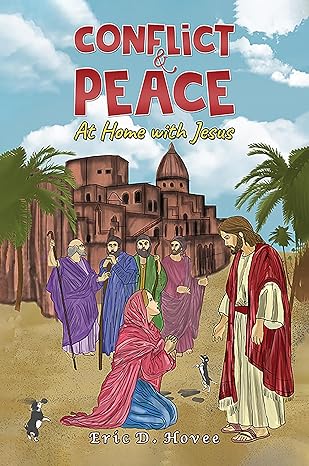
When I first opened Conflict & Peace: At Home with Jesus, I expected a familiar retelling of biblical stories, but instead I found something far richer and more layered. The book walks through twelve figures ranging from Matthew and Mark to Constantine and Luther and explores how each shaped, struggled with, or even fractured the Christian story. Eric D. Hovee doesn’t shy away from pointing out contradictions, tensions, and the uneasy balance between faith and evidence. What emerges is less a polished theology and more a raw chronicle of pioneers wrestling with belief, doubt, politics, and power. The book argues that Christianity has always lived at the crossroads of conflict and peace, heresy and orthodoxy, struggle and hope.
The writing style surprised me. It’s not slick or overly academic, and that’s what makes it work. Hovee mixes scholarship with a kind of candid storytelling that feels personal and searching. He admits where his own faith has faltered, where scholarship has raised more questions than answers, and where interpretations may lean too heavily in one direction. I appreciated this honesty. The detail can be overwhelming at times, with deep dives into language debates or church history that slow down the flow, but even then, I never felt the effort was wasted. It gave weight to his central claim that truth isn’t always clean or easy.
What I liked most, though, was the emotional undercurrent. This isn’t just about doctrine, it’s about Hovee’s father, about legacy, about the ache of wanting faith to feel real in a world of contradictions. I felt that ache with him. When he points out Matthew’s overreach on prophecy, or the way Constantine’s empire-building warped Christianity, I didn’t just learn facts, I felt the tension of a man trying to reconcile devotion with doubt. The book left me inspired. It made me look at my own beliefs with sharper eyes and a softer heart.
I think Hovee’s work is best for readers who want faith that is not easy, neat, or dogmatic. It’s for Christians wrestling with the weight of history, skeptics curious about the roots of belief, and anyone who values honesty over certainty. If you want a book that stirs you, challenges you, and leaves you thinking long after you close it, then Conflict & Peace: At Home with Jesus is well worth the read.
Pages: 401 | ASIN : B0F5641XR1



 LITERARY TITAN