Blog Archives
Medieval Mindset

Caterina by Moonlight follows a five-year-old girl who is abandoned at a convent, forced to marry at fourteen, and learns to navigate power, love, and loss to claim a life that finally feels like her own. What was the inspiration for the setup of your story?
I visited Florence for the first time in Oct 2019, and fell deeply in love with their city, the Medici, and Botticelli. When I got home, the characters dictated the book to me, and I spent the entire pandemic in the later 15th century with them.
Caterina’s voice evolves from innocence to sharp awareness. Why was it important to keep the narrative grounded in Caterina’s perceptions rather than broader historical commentary?
I think a reader learns more when they have a direct, first-hand experience through a character’s eyes. By immersion in Caterina’s experiences, one will hopefully be drawn into her emotions and her evolution, and absorb the actual history of the times by osmosis. Her transition from the medieval mindset (all is God’s will, and we must accept our lot and suffer in silence, and hope for reward in heaven after death) to the Renaissance expansion of mankind’s possibilities, the growth of humanism and secular accomplishment, and the ability to reinvent oneself, while enjoying creativity, beauty, music, and art. It is a struggle we still see today, between fundamentalism and progressive humanism.
The novel repeatedly asks what kind of life a woman can build within imposed limits. How did you explore that tension between restriction and self-determination?
Caterina is only exposed to church doctrine for the first decade of her life but finds it frustrating that the answer to all her questions is “Because it’s God’s will.” It is her friend, Lucretia, who first leads her to taste the outside world, who struggles against the restrictions of the time, and who helps expand her world. Lucretia is very clever when it comes to navigating the rules and living a full life. Even Botticelli, who paints Caterina as a muse, questions his own desire to paint other than religious-themed work, wondering if he will be damned for it. Caterina grows throughout the book and learns how to protect and assert herself, despite the imposed limitations of the era.
What do you hope readers take away about resilience, joy, and self-creation?
That we have the unlimited capacity for re-invention – to make the most of our lives, and that ultimately, love is the fabric of the universe that binds us together.
Author Links: Facebook | Website | The Renaissance Woman

Be Authentic

In Heart’s Dzyer, you share some of the most intimate aspects of your relationship with your boyfriend via letters exchanged during his time in prison. Why was this an important book for you to write?
This was an important book to write because his family was grieving, and I wanted to give them something about him that they may not have known.
I appreciated the candid nature with which you share your experiences. What was the most difficult thing for you to write about?
Even though I was candid and I wrote about difficult things, I did black out some private things that I didn’t think were appropriate to be shared with everyone.
What advice would you give someone who is considering sharing their own memoir?
I would advise that person to be authentic. I kept his spelling inaccuracies because, as someone with dyslexia, it would have been inauthentic to portray him as a perfect speller.
Did you learn anything about yourself in the course of putting Heart’s Dzyer together?
I don’t know if learning is the first thing that comes to mind. If anything, my experience dredged up a lot of emotions. Some days were harder than others. Sometimes I had to take a break because I needed to process emotions. So I guess I learned that I needed to give myself time to process, and I had to be compassionate toward myself as well.
Author Links: GoodReads | Facebook | Website | Amazon
Heart’s Dzyer


Heart’s Dzyer is a memoir built from more than 193 letters exchanged between author Woo-Ae Yi and her former boyfriend Snail between 2011 and 2015, then transcribed after his death in 2023. What begins as a prison pen-pal reconnection between two people who knew each other in middle school slowly opens into something stranger, riskier, and more intimate: a record of affection under surveillance, of art made in confinement, of addiction, depression, longing, manipulation, tenderness, and the way a person’s voice can outlive the body that carried it. The book moves through requests for photo enlargements and tattoo sketches, coded financial favors, flirtation, emotional collapse, private jokes, fox-and-hound imagery, and eventually the ache of loss, all while insisting on the rawness of the original letters rather than smoothing them into a cleaner memoir.
I was surprised by how alive Snail feels on the page, and how uneasy that aliveness can be. He can be lyrical one moment and coercive the next, self-deprecating and charming in the same breath. A line about a “6×9 labyrinth” gives way to instructions for mailing hidden cash; a meditation on loneliness turns into delight over stickers, cartoons, dubstep, or a glowing light box. That instability is the book’s power. Yi doesn’t sanitize him into a noble tragic figure, and I respected that. She lets the contradictions stand. I found that deeply moving, because love here isn’t sentimental at all. It’s full of care, fascination, danger, rescue fantasies, and blurred boundaries. The emotional truth comes precisely from the fact that the book refuses to turn this correspondence into something tidier than it was.
As writing, the book is rough in ways that are sometimes frustrating and often essential. The preserved misspellings, abrupt tonal swings, and sheer accumulation of letters can make the reading experience challenging. But that feels earned. Prison correspondence should not read like a polished novel. It should snag. It should circle. It should sometimes feel like being trapped in somebody else’s head. I also admired the way art keeps breaking through the prose. The requests to enlarge drawings, the graffiti pieces, the tattoo designs, the “Gentle” image caged in chain-link logic, even the odd tenderness of The Fox and the Hound references all give the relationship a visual pulse. The book’s ideas about identity, loneliness, performance, and survival aren’t laid out as arguments, but they accumulate by pressure. By the end, I felt I’d spent time not just with a doomed romance, but with a record of how people improvise meaning when freedom, time, and dignity have all been damaged.
I found Heart’s Dzyer messy, haunting, intimate, and brave. I finished it feeling tender toward both the love it preserves and the pain it refuses to disguise. This is a book I’d recommend to readers who are drawn to epistolary memoirs, prison writing, complicated love stories, and books that leave the seams showing, because those seams are the whole point.
Pages: 574 | ASIN : B0GKY4MF85

Freya the Deer


Freya the Deer is a literary coming-of-age novel with the strange shimmer of a fairy tale. It follows Freya Rubenstein, a young woman with autism who moves from Cambridge to a small college in the woods of Washington, carrying with her an intense love of animals, a restless curiosity about the soul, and a way of moving through the world that other people constantly misread. What unfolds is part campus novel, part moral reckoning, part dark fable: Freya falls into love, politics, and danger while trying to hold onto her own fierce sense of truth.
Author Meg Richman writes Freya with real conviction, and that matters because this book could have so easily turned her into a symbol, a lesson, or a bundle of quirks. Instead, she feels singular. Odd, funny, tender, literal, and sometimes almost severe in the way she sees things. I loved how the novel lets the world arrive through Freya’s mind rather than forcing her to translate herself into something more familiar for everyone else. The prose can be lush, but it is not showing off for the sake of it. It feels attached to the character. At its best, the book has that rare quality where the imagery actually deepens the person on the page instead of decorating her. The fairy-tale texture really worked for me. The woods, the red cloak, the animal imagery, the sense that menace and wonder are always standing close together. It gives the novel a charged atmosphere without floating away from real harm.
It was interesting, and at times unsettling, how the book handles morality. Freya is not written as innocent in a simple or sentimental way. She is perceptive, but her perceptions do not always line up with the social scripts everyone else is following, and that makes the novel ask harder questions than I expected. About consent. About ideology. About cruelty dressed up as righteousness. About whether love and truth can survive each other. The campus politics and arguments about justice, Israel, capitalism, race, and activism could have felt schematic, but Richman keeps dragging them back into lived experience, where ideas stop being neat. Some choices are messy on purpose. Some conversations feel jagged. I admired that, even when I was wincing. The book trusts the reader to sit in ambiguity, which I respect. It also made me think about how often people mistake clarity for coldness, especially in someone like Freya, when in fact her honesty may be the most morally serious thing in the room.
I’d recommend Freya the Deer most to readers who like literary fiction that takes risks, especially if they’re drawn to coming-of-age stories with a darker edge, socially engaged novels, or modern fairy tales that are more thorny than cozy. This is not a breezy read, but it is a memorable one. I think it will land best with readers who are willing to follow an unusual protagonist without needing her to become easier or more legible by the end. For me, that was the point. The book asks for patience, openness, and a little courage. I think the right reader will be grateful for all three.
Pages: 206 | ISBN : 978-1578692156
The Ripple Effect

Born of Dirt & Dust is a collection of short fiction stories ranging from social horror to feral love and tales of survival in a broken world. What draws you to write speculative flash fiction?
Writing speculative flash fiction ignited for me when I sat inside a tattoo studio in Lahaina, along the west coast of Maui, in May 2023, a few months before the horrific wildfire scarred the land and the many, many families affected by the tragedy. At the time of having a beautiful sea turtle tatted on my arm, I learned about the artist working on me. A young woman, approximately in her late twenties, who came to Maui to escape years of marriage with an abusive husband. I could see in her shadowed eyes, her flinching body language, the deep bruised color of her dyed hair, and the violent tattoos inked on her body, the degradation she felt. I could see her need for a portal, an escape, to a very different existence—a world beyond the pain and suffering inflicted upon her. She found that temporary reprieve in the warmth, beauty, and embracing culture of Lahaina. Yet, after only a few months, Hell broke loose, and she lost herself again. This time, in the fire that raged upon her world. It was that moment, seeing the devastation broadcast on the news, feeling the heartache, thinking about her, that I knew I had to write about bending space and time, about churning our world differently in order to find a place where we belonged, where we could—and would—survive, no matter how broken we felt inside. No matter how threatening or violent our environment. In writing speculative fiction, I wanted to capture the worst of what we faced, illustrate the blood we shed, and explore the rising of our spirit to become more than the shrinking ways our world defines us. I wanted to prove that human kindness and resilience win in the end.
Were there any personal experiences or observations that influenced the themes in this collection, and how did they shape the characters or stories?
Two stories in the collection specifically focus on the young life of a boy. “Henry Didn’t Have A Chance,” and “Stuck At A Dead End.” The premise behind the stories came to me from articles I heard on PBS NewsHour while driving to work. The first is about a toddler boy who died at a very young age. Local authorities arrested his mother and her boyfriend on suspicion of murder. The other story aired as a documentary about children of parents who served in the military and returned home with PTSD—how the traumatic affliction affected their children. I knew at this point in writing the stories for Born of Dirt & Dust that I wanted to open a lens for readers to fully experience the character’s world, how trapped they felt, how they chose to move forward, and the ripple effect of those choices. As human beings, we are connected in so many ways. I truly believe that every action and every reaction triggers a ripple effect that touches each of us. Most often in a very minuscule, microcosmic way. Yet it breathes upon us. A tiny molecule. It hits us. No matter how quickly we forget.
Which character in the collection was the most challenging or rewarding to write, and why?
I’m one of those writers who thinks the last story or chapter I’ve written is the best yet. The one that counts. The most brilliant of all. Of course, it’s wishful thinking that comes to light when I re-read what I’ve written a week later and spot the obvious corrections needed. In the case of Born of Dirt & Dust, I favor the story, “Hands That Make A Man.” I have a weak spot for wanting to see the best circumstances for young children in which they grow up to feel loved, secure, and happy. Although my stories tend to lean towards horror, sci-fi, and fantasy, I want the best for my characters. A type of freedom they never thought they would experience. No matter the deepest cuts to their heart and soul. The young boy in “Hands That Make A Man” adores his father, and when Dad is no longer alive, the boy takes something—stitches it to his own young body—and knows full well his life without his father will turn out all right. No matter the loneliness he may feel or the environment where he resides. He gains confidence and feels that he will do right in life.
What is the next book that you are working on, and when will it be available?
There are three books in which I’ve completed first and second drafts—a middle grade book about a young girl who adores space travel and yearns to be a scientist when she grows up; a young adult book about an otherworldly character who hides and survives in the bodies of the recently dead; and an adult thriller about a teenager gaslit by her parents who continue to bury the truth about a family member’s suspicious death. All three books still need another round of editing. The goal (fingers-crossed) is to have them published in the coming year.
Author Links: GoodReads | Facebook | Website | Amazon
Balance Between Closeness and Cost

Framed in Love follows a man who, after a lightning strike, has the ability to step inside a fading painting where he falls in love with a woman trapped inside it. What was the first spark behind the idea of stepping into a painting?
The story started with an actual painting that I own. The date of the painting is 1858; it is of a Victorian woman who has a striking resemblance to my wife. So, I thought, if I wanted to know this woman, how could I get to know her? I would have to enter the painting to strike up a conversation. Hence, the lightning strike, because there is something mysterious about lightning.
How did David evolve as you wrote the book?
I introduced the twist that the painting fades each time David enters. I did that for a reason. David, with the help of Abby, sees himself differently. Instead of viewing love as something risky or temporary, he begins to see it as transformative and grounding. Earlier in the story, David often reacts to situations emotionally or defensively. As his bond with Abby deepens, he becomes more intentional by choosing honesty over avoidance and commitment over uncertainty.
The book explores love as both connection and sacrifice. What drew you to that tension?
What drew me to that tension is that love rarely feels pure or simple in real life. Love is almost always a balance between closeness and cost. In Framed in Love, the relationship between David and Abby works because it recognizes that loving someone deeply often means giving something up: control, certainty, or even parts of the version of yourself you’ve carefully built.
What do you hope readers carry with them after finishing the book?
The most compelling love stories (to me) live in that uncomfortable middle space. Too much connection without sacrifice feels shallow. Too much sacrifice without connection feels destructive. I wanted readers to feel that push-and-pull. The fear of losing yourself versus the desire to belong, because that’s what makes emotional stakes feel real.
Author Links: Barnes & Noble | Website

Born of Dirt & Dust
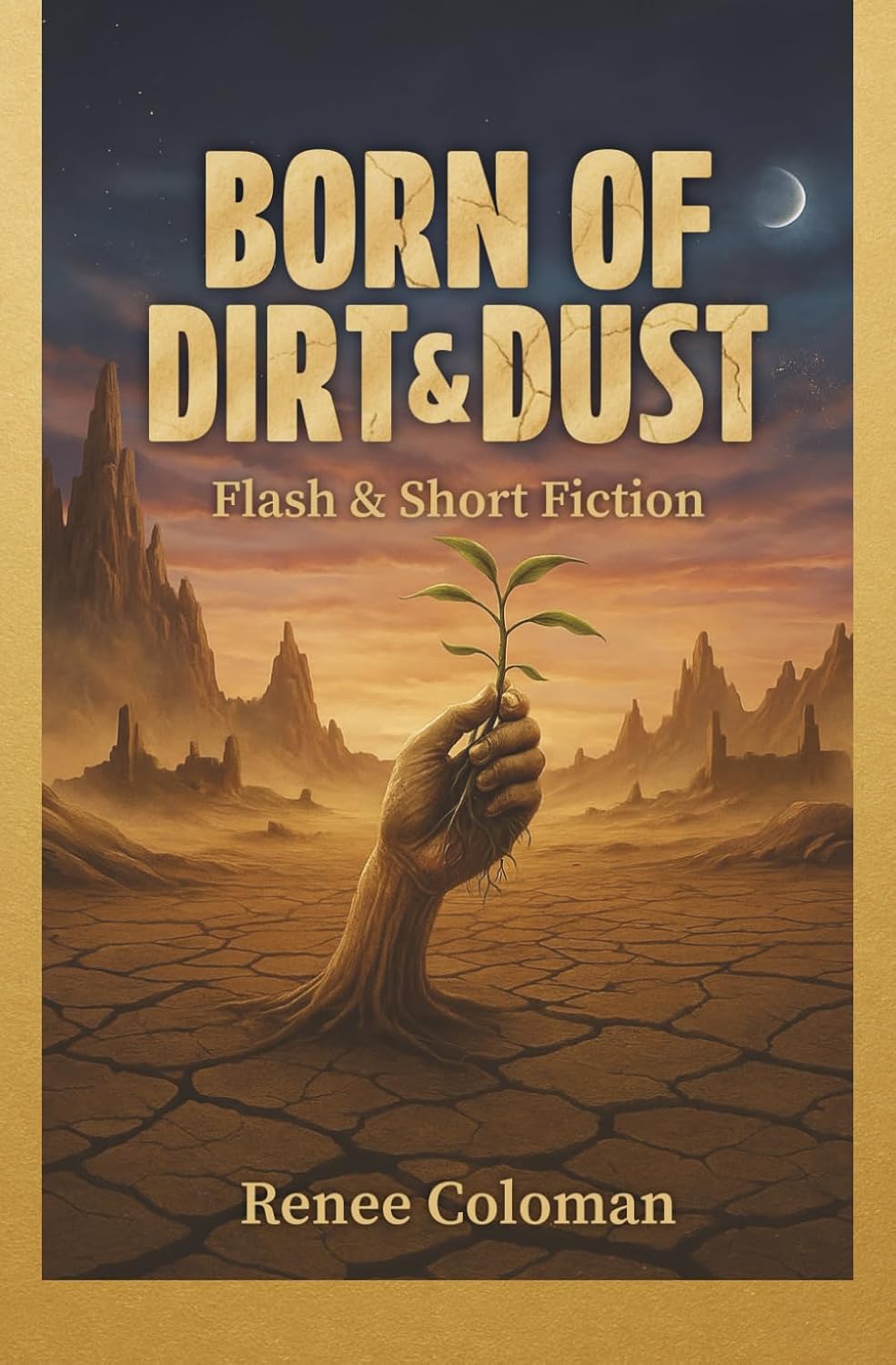
Born of Dirt & Dust is a sharp-edged collection of speculative flash & short fiction that keeps changing masks from urban dread, grief-myth, social horror, bruised fairy tale, while staying faithful to one obsession: what people do to survive when the world won’t stop chewing. Across stories like “Smokin’ with Death,” “Pretending,” “The Last of Our Kind,” and the title piece, Renee Coloman drops me into intimate, first-person rooms where love is feral, hope is conditional, and the aftertaste is usually smoke.
What hit me first was the voice: immediate, unvarnished, and weirdly tender even when it’s being crude. In “Smokin’ with Death,” the narrator sizes up Katelyn, pink hair, tattoos like warnings, a body already half-ghosted by addiction, and the dialogue snaps like a lighter: transactional, defensive, heartbreakingly ordinary. The story doesn’t ask me to approve of anyone; it asks me to recognize them, which is harder and more bracing.
As I kept reading, the book’s recurring textures started to feel intentional rather than merely intense: cigarettes as countdowns, bodies as battlegrounds, love as a dare. “The Last of Our Kind” is a brutal little poem of devotion, an oxygen tank, a warning label, and a woman who can’t stop reaching for flame anyway, as if self-destruction is the last language she and her husband share. And in “Born of Dirt & Dust,” Coloman leans into mythic framing, Adam’s rib, inherited venom, a woman trying to outgrow the “dirt and dust” she’s been assigned, turning family damage into something almost ritualistic. Sometimes the prose repeats or swells on purpose, like a chant you can’t quite step out of; for me, that worked more often than it wobbled.
Coloman’s collection is for readers who want speculative fiction, flash fiction, horror, dark fantasy, magical realism, stories that move fast but leave residue, stories willing to be ugly in the service of truth. If you’ve loved the bite-sized dread and emotional torque of Carmen Maria Machado, you’ll recognize the same appetite for turning private pain into a blade with a shine on it. Born of Dirt & Dust is a small book of big hauntings, each story a matchstrike in the dark.
Pages: 215 | ASIN : B0FZLMZR77
A Christian Perspective
Blue Jeans and Lavender Gowns follows two teenagers growing up in different circumstances who, over the years, struggle with faith, failure, broken marriages, and small-town judgment, for a chance and at love. Where did the image of “blue jeans” and “lavender gowns” come from?
The inspiration for this story came from a combination of personal experience, observation, and imagination. Some of the events in the book are based on real-life experiences, particularly things like the study hall scenes. I have become increasingly aware of young girls who were physically abused by their fathers, and later, by their husbands. Some of them were close friends, and their stories were tragic. That gave the basis of the story and, to a certain extent, a what-if scenario of how I might have responded to them had I been aware of their circumstances.
How important was the 1970s Midwest setting to the heart of the story?
Having grown up in the 1970s, it was easier to place things in that time setting. The window dressing of 8 tracks, school dances, small town attitudes, etc., helped shape a story that is quite relevant to any time and place, but gives it a ring of authenticity.
The story includes abuse, infidelity, and divorce. Why was it important not to shy away from these?
I wrote to emphasize these issues. Far too often, they are swept under the rug or ignored. The goal was to address these issues from a Christian perspective without being preachy. How should a Christian address these issues in real life, not from some lofty theological perspective? That was the goal. I hope that, at least to some extent, I achieved it.
What do you hope readers take away about faithfulness in ordinary life?
Real life is filled with people who are hurting, sometimes in private and unseen. Christians should open their eyes and recognize those who are hiding their scars and bruises with blue jeans or whatever else they might find. Responding compassionately and with God’s love can transform that hurting person into the beautiful person in the lavender gown, reflecting the glory of Christ.
Author Links: GoodReads | Facebook | Website | Amazon
Terry Deitz is fascinated with her the moment she walks into his life. She has dark-brown hair, and eyes—a beautiful smile and fair complexion. There is an artless grace about her. There’s only one problem; he has no idea who she is.
Debbie Douglas is bright, funny, and has a kind, quiet nature. But something is wrong, something Terry can’t quite put his finger on.
Debbie doesn’t understand Terry. Why is he determined to go to college to get a degree in history? Why does he insist on going to church four times a week? Does he look down on people like her?
Blue Jeans and Lavender Gowns promises laughter, tears and joy as it explores the relationship between two people who’ve grown up in different worlds. One world filled with love and happiness, the other with pain and suffering. Can their worlds ever come together?


