Blog Archives
Quiet Doubts
The Infinity Within tells the story of Gabe, a man haunted by strange, otherworldly experiences from childhood through early adulthood. This seems like a very personal story for you. How hard was it to put this story out in the world for people to read?
In many ways, it was one of the hardest things I’ve ever done—and also one of the most necessary. The Infinity Within may be written as Gabe’s journey, but much of what he experiences mirrors my own. To put those truths—those quiet doubts, soul-piercing questions, and hard-earned awakenings—onto the page was like pulling threads from the deepest parts of myself. It’s vulnerable. But I believe vulnerability is sacred, and if there’s even one person out there who finds themselves in these pages and feels less alone, more seen, or more empowered… then it’s worth every moment of discomfort. Sharing this story was never about telling people what to believe—it was about offering a mirror. One I wish I’d had during my own darkest nights.
What were some ideas that were important for you to share in this book?
At the heart of The Infinity Within is the idea that fear, doubt, and emotional heaviness aren’t signs that we’re broken—they’re sacred signals inviting us to remember who we truly are. I wanted to challenge the mainstream narrative that healing is about fixing yourself. What if nothing is broken? What if the pain is part of the awakening?
It was also important for me to explore the concept that life isn’t random—it’s a soul-designed journey. One of remembering, not achieving. Through Gabe’s dialogue with Elias, I wanted readers to feel invited into their own inner conversation, where their intuition could guide them more than any external doctrine ever could.
Lastly, I wanted to help dissolve the illusion of separation. Between self and Source. Between what we’ve been told is real and what we quietly feel to be true. If I could offer even a moment where someone says, “I’ve felt this too,” then I’ve done what I came to do.
What is one piece of advice someone gave you that changed your life?
“Stop trying to win the game—remember you designed it.”
That one sentence stopped me in my tracks. It reframed my entire perspective. I had spent years pushing, striving, fixing… believing life was something to conquer. But those words helped me realize that the obstacles, the fears, even the breakdowns—they weren’t punishments. They were invitations. Designed by me, for my own awakening.
That advice didn’t just shift how I lived—it became the foundation of The Infinity Within. It’s not about controlling life. It’s about remembering the deeper intelligence that’s always been guiding it.
What is one thing that you hope readers take away from The Infinity Within?
That they are not broken—they are remembering.
We live in a world that constantly tells us we need fixing, healing, or improving before we can be whole. The Infinity Within offers a different message: what if everything you’re going through is not a detour, but part of a sacred design calling you back to your true self?
If readers walk away with just one thing, I hope it’s this:
You already have the power. You already hold the map. And the moment you stop running from your fear and instead listen to it, you’ll find it was never the enemy. It was the doorway.
Author Links: GoodReads | X (Twitter) | Facebook | Website | Amazon
Break Through Fear, Trust Your Inner Power, and Create a Life That Reflects Who You Truly Are
Have you ever felt the faint pull of something larger than day-to-day routines—like an invisible current stirring in your gut, urging you to see beyond the grind? What if that pull wasn’t a dream, but a call to remember you’re far more than you’ve been told?
In The Infinity Within, you’ll join Gabe on a journey that shatters the illusion of limitation. From an eerie childhood moment when a toy train appeared weightless in his hands, to a near-fatal car crash where time bent and fate reversed, Gabe keeps stumbling into events that defy logic. Again and again, these flashes whisper: Reality is malleable—fear and doubt alone keep it fixed.
Desperate for clarity, Gabe tests the boundary between “impossible” and “everyday,” venturing at dawn into a quiet orchard. Under a hush that silences his busy mind, he attempts small but audacious acts—summoning a cardinal by sheer intention, almost teleporting across the grass—and glimpses cosmic teachers, from ancient spiritual icons to modern disruptors like Elon Musk. Each one demonstrates how unwavering faith outsmarts “that can’t be done,” hinting that a single moment of pure trust can shift the universe to meet us.
Yet The Infinity Within isn’t a catalog of miracles; it’s a map for releasing illusions. Gabe’s leaps of faith peel away layers of doubt, revealing the quiet truth that we all harbor a spark of the divine. This isn’t about gaining power to show off, but reclaiming the essence we lost behind fear and social conditioning.
You’ll see:
Near-Death Expansions where crisis ignites improbable survival
Orchard Illusions tested in a tranquil field at sunrise, proving how quickly the “impossible” crumbles
Real-World Parallels in teachers like Jesus, the Buddha, Eckhart Tolle, and even Musk—each boldly brushing aside limits in different domains
Practical Steps to cultivate your own orchard hush, dissolving doubt and empowering you to co-create the life you truly want
By the final pages, Gabe’s story intersects with yours: the illusions that once caged him are the same illusions blocking your next transformation. As you read, you’ll discover how to break through fear, trust your inner power, and craft a reality that aligns with who you really are—in your work, relationships, and personal calling.
Ready to taste life free of self-imposed walls? With each chapter, illusions recede, revealing an infinite spark inside you that’s always waited to shine. Gabe’s journey will nudge you to question every “I can’t,” forging a fresh perspective where possibility opens at every turn. The Infinity Within calls you to see past the illusions you’ve carried too long, urging you to step forward, awakened and alive, into a future of your own making.
Open these pages if you’re ready to challenge your limits, tap the hush of dawn in your own heart, and claim the boundless capacity that’s always been yours. Your leap begins now. Let the orchard hush guide you and watch your world transform as illusions unravel and your infinite self stands revealed.
True Prosperity and Abundance
Son of Osivirius follows a young pilot who crashes near a rebel base and forms a connection with the family that saves him, leaving him to decide what side of the battle he wants to be a part of. What was the inspiration for the setup of your story?
It was one of those serendipity moments. I was struggling to come up with an idea for a scene writing exercise where the prompt was ‘three characters, all with different goals’. I was getting super frustrated, beginning and discarding idea after idea. Imagine a ‘rip the paper out of the typewriter, scrunch it into a ball, then toss it into the pile littering the floor’ scenario. I’d actually given up for the day and was cooking dinner when I suddenly remembered a short story idea I’d jotted down months before:
“A helicopter pilot in a WWIII scenario crash-lands near a valley belonging to some people who are a bit like the Amish and refuse to be a part of the war effort, but the government is trying to force them into it. They look after him, and when the government eventually comes to their valley, he has to decide what to do.”
Suddenly, neurons were firing in all directions. I combined that premise with the vibes of Avatar, and boom! I had my scene mapped out. Not only my scene, but almost the entire book.
I find the world you created in this novel brimming with possibilities, especially the Masu. Where did the inspiration for the setting come from, and how did it change as you were writing?
I live in a rainforest, and have always been drawn to forest settings, and although I LOVE dragons, I wanted to do something a bit different. Big cats have always fascinated me–their power, elegance, and how they seem to stare into your soul–so giving them wings just seemed like the perfect choice. The intricacies of the world-building took several drafts to refine, but the Masu were the foundation for all the other elements.
I tend to discover things in the process of writing, and it was during the drafting of some dialogue in what was then chapter threed that I had Jayden ask, “How did you tame them?” In that moment, I knew what kind of creatures these were, and I had Flint respond, “We didn’t. They tamed us.” It was definitely not part of my original plan, but it just felt so right, and with those two lines of dialogue, my climax became crystal clear.
The dead zones evolved over the course of drafting. They were there from the start, but I encountered logic problems as I went along. At first, I ‘patch-fixed’ them, but that became more and more convoluted and complicated, which is never a good thing. It was during the beta reader stage that I talked to my daughter about the issues I was having, and that conversation opened up the simple, elegant solution that really brought the world alive.
What were some themes that were important for you to explore in this book?
It was really important to me to highlight a more connected way of living with the world, and letting it be our teacher. We tend to prioritise our comfort above all else, but that comes at great cost. So I really wanted to explore the idea of contentment, and what true prosperity and abundance look like.
I also wanted to explore how fear can subconsciously control us, and that it manifests in different ways depending on things like status, childhood trauma, and personality. Exploration of fear responses also naturally led into exploration of trust and betrayal.
The idea of worthiness was an interesting thing that came up in the process of writing. I know a lot of people struggle with thinking they’re not worthy, but I discovered my characters were acting from a belief that they did deserve more, but their worthiness was unrecognised. That seems to me how all revolutions begin.
Is this the first book in the series? If so, when is the next book coming out, and what can your fans expect in the next story?
There is potential there for a series, but I don’t have any clear plans yet. Right now, I’m switching my focus to a romantic fantasy trilogy. The world-building there also has a great emphasis on connection with the natural world and features a musical magic system.
Author Links: GoodReads | Facebook | Website | Amazon
Fledgling pilot Jayden is one of the first generation to be born on the newly colonised planet of Osivirius. Now he’s determined to get his family out of ‘Wormsville’, the part of the colony where people are little more than numbers. So when Commander Tun offers a huge reward for finding the location of the rebel base, he jumps at the chance.
Nettle hates everything to do with the colony-especially the military arm-and is fiercely protective of the simple, grounded ways of the rebels. So when she and her brother Flint discover Jayden after he crash-lands, she’s ready to slit his throat without a second thought. But as Flint nurses him back to health, Nettle’s antipathy turns to empathy, and then an unwanted attraction.
Jayden, meanwhile, has made secret plans to escape on a Masu, one of the giant flying cats the rebels ride, but when his chance to escape presents itself, he feels torn. His blood family still need him, but the lure of the valley might just prove stronger.
The connection to nature of Avatar and the dystopian political struggle of The Hunger Games meet in this action-packed and thought-provoking science fantasy novella.
A Confounding World

Not Yet Your Time follows a self-deprecating office worker whose mundane New York life derails after a near-death encounter with a mysterious woman, leading him to question everything he knows about time, fate, and faith. What was the inspiration for the setup of your story?
I have always felt that the best drama or comedy follows from individuals being placed in situations for which they are utterly unprepared. (Being trapped on Everest while climbing is not the same as crash landing on Everest in your swim trunks) I have also always had the sneaking suspicion that our history, our myths, and the foundations of our culture are on very wobbly grounds. Finally, as someone who spent a full career in marketing, I know that reality is just a press release away from changing.
I found Titus to be an interesting character who gets pulled into a strange situation and manages to adapt despite everything that happens to him. Were you able to achieve everything you wanted with the characters in the novel?
When I embark on creating, in effect, an entire world, I need a central character to react to, digest, and pass through it. I needed Titus to be that person. I gave him the vulnerabilities and hidden strengths to attempt to deal with a confounding world that has sucked him in against his will, only because he was attracted to a mysterious woman. I was also pleased with Kanenas, my, in effect, flawed and reluctant messiah. A good man with ideas, totally unprepared for the greatness that is hung on his shoulders. (Inside secret) I patterned him after the attitude and speech mannerisms of the late actor Peter O’Toole, also a great and deeply flawed person.
I found this novel to be a cutting piece of satire. What is one thing that you hope readers take away from your novel?
Absorb all you can in life from as many sources as you can tolerate because no one person or philosophy has all the answers.
What is the next book that you are working on, and when can your fans expect it to be out?
The world’s greatest historian has a dark secret. He travels back in time and gets deathbed confessions from great figures in history. A Gesture to the Wind is narrated by the historian’s unsuspecting assistant, who is drawn into a world of illegal historic relic dealers, Russian spies, EPA investigators, and the Battle of San Juan Hill, all while developing a deep and abiding friendship with a time-displaced Ben Franklin. (As you can see, I’m having fun.)
Author Links: GoodReads | X (Twitter) | Facebook | LinkedIn | Website | Amazon
This odd trio embark on a perilous odyssey that includes imprisonment in a labyrinthine security complex under the ruins of the World Trade Center; flight through a murky unfinished tunnel beneath the Hudson River, a safe house masquerading as a defunct museum; and a perilous train ride to link up with a terror cell. Ultimately, the reluctant Titus will face a rendezvous with life, love, death, and destiny in the green wilds of New York’s Hudson Valley.
Deadly Antagonist

The Whistle of Revenge finds Sherlock Holmes and Irene Adler married and living under assumed identities, fighting to rescue their son who has been kidnapped by their nemesis. What was the inspiration for the setup of your story?
I wanted to write book four of the Sherlock Holmes and Irene Adler Mysteries with kidnapping as the premise. Finding a worthy adversary for Holmes was the tricky part.
I enjoyed the shifts in perspective. What do you find to be the most challenging aspect of writing from various characters’ points of view?
After much deliberation, I decided on Jack Stapleton, the deadly antagonist from The Hound of the Baskervilles. Although Jack was presumed dead, meeting an a grisly end on the Great Grimpen Mire, his body was never found. He was such a great character to resurrect. I decided to give him his own POV so readers could get to know a bit more about the celebrated Detective’s old nemesis and discover what he’d been up to for the past seventeen years.
Writing from Jack’s perspective was the most challenging because so little was known about him. I enjoyed developing the character. Some of my readers told me they felt a little sorry for him at times.
How do you balance story development with shocking plot twists? Or can they be the same thing?
It’s tricky to balance the two. I am a panster writer, so plot twists and story development come to me as I go along. However, I did a fair bit of outlining for Whistle, mainly due to the complexity of the story.
Can fans look forward to more from Holmes and Adler? What are you currently working on?
I plan to start book five before the end of this year, which will find Sherlock and Irene in the USA, which will make a nice change from all those tricky Italian translations. It’s going to be another controversial story with a shocking plot twist that readers will not see coming, involving events from Sherlock and Irene’s past, which will have far-reaching consequences for our intrepid duo. I can’t wait to get started.
Author Links: GoodReads | X (Twitter) | Facebook | Website | Amazon
If you loved Conan Doyle’s, The Hound of the Baskerville, prepare to be enthralled by KD Sherrinford’s captivating follow-up, The Whistle of Revenge.
The deadly antagonist, Jack Stapleton, makes a spectacular return to the city of Milan in pursuit of his old nemesis, the celebrated Detective Sherlock Holmes.
Adopting the enigmatic persona of Janus, a vengeful Stapleton, along with the Italian mafia, wreak havoc on the Italian horse racing fraternity and fledgling car manufacturing industry, and kidnapping Holmes’s beloved son as part of their evil and well-executed master plan—Operation Whistle.
Will Holmes, Irene Adler, and their trusted ally, Inspector Romano, crack the code, rescue the boy, and unmask the deadly Janus?
Set against the backdrop of modern Milan, mind games and misdeeds of the highest order play out as the story reaches its thrilling and memorable conclusion.
War of the Words


Carol Karels’ War of the Words: The Office Revolution That Transformed the Lives of Women and the Men They Worked For is a fascinating mix of family memoir and tech history. Karels tells the story of Microsystems Engineering Corporation (MEC), the small family company her father and uncle founded in the late 1970s that created MASS-11, a powerful word processor that quietly helped shape the modern office. From NASA contracts to the early days of Digital’s VAX computers, she traces how a homegrown business rode and was eventually crushed by the wave of the Information Age.
What grabbed me right away was how personal it felt. Karels doesn’t hide the messiness: her brother’s public one-star review of her first book, her father’s fierce ambition, and the family’s chaotic dynamic all sit side by side with the story of a company at the center of a digital revolution. When she recalls their product being featured at the Paperless Office event at the Watergate Hotel or the excitement of reading Alvin Toffler’s The Third Wave, the scenes feel alive, filled with awe and possibility. Yet underneath, there’s tension, the sense that every success came at a cost.
I loved how Karels mixes technical history with heart. She writes about computers, word processors, and office automation, but always brings it back to people: her father’s restless drive, her brother’s pride, and her own search for purpose. Her prose has a natural rhythm, part storytelling, part confession, and even when she dives into details about the DEC VAX or the shift from typewriters to terminals, it feels human and intimate.
One of the most memorable moments for me was her father’s blunt advice: “Learning MASS-11 might be the best goddamn thing you ever do.” That line sums up the entire book, equal parts tough love and belief in possibility. Karels writes with humor, honesty, and just enough bite to keep you hooked.
War of the Words is perfect for readers who love memoirs that connect personal lives to cultural change. It’s about family, ambition, innovation, and the strange beauty of watching a dream take shape, and then fall apart. Anyone curious about women in tech or the human side of the computer revolution will find this story both moving and unforgettable.
Pages: 332 | ISBN : 978-1953728432

Suicide: Hope Beyond the Darkness
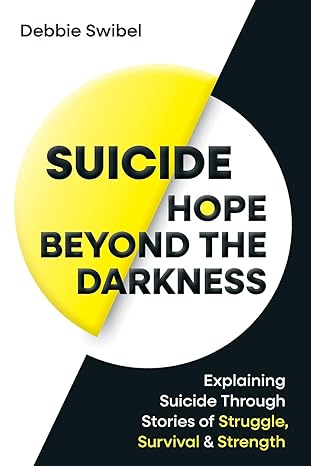
Debbie Swibel’s Suicide: Hope Beyond the Darkness is both heartbreaking and deeply hopeful. The book explores suicide through stories of people who have lived it, those who have tried to take their own lives, those who have lost loved ones, and those who’ve dedicated their lives to understanding and healing the pain behind it. It’s structured in four parts, blending firsthand accounts with Swibel’s professional insight as a suicidologist. The result is a raw, honest, and compassionate work that turns statistics and theory into human experience. Every story feels alive, sometimes painfully so, yet always threaded with the quiet pulse of hope that gives the book its title.
Reading this book was an emotional experience. I felt gutted at times, especially hearing the voices of people whose pain seemed bottomless, but I also found comfort in how Swibel handled each story. She doesn’t sensationalize suffering or rush toward neat conclusions. Instead, she lets silence and reflection do their work. I admired that restraint. The writing is simple but carries real weight. You can feel her empathy in the space she gives each voice. Swibel finds light in the small, steady acts of survival, therapy, friendship, words shared between strangers, that prove connection is often the thing that saves us.
What moved me most was Swibel’s balance between knowledge and humanity. She weaves psychology, cultural insight, and research into the stories, but she never loses sight of the people. Her explanations are clear and down to earth, and her belief in the power of storytelling feels genuine. The way she speaks about stigma, misunderstanding, and silence hit home. I found myself thinking about my own conversations, about how often we look away from pain because we don’t know what to say. This book reminds you that sometimes you just have to show up, to listen, to hold space.
I would recommend Suicide: Hope Beyond the Darkness to anyone who has been touched by suicide, whether personally or professionally. It’s for parents, friends, counselors, teachers, and anyone trying to understand what it means to live through pain.
Pages: 388 | ISBN : 978-0648758082
Friday at Four

Gert Richter’s Friday at Four opens as a story about a man, his marriage, and his dog, but it quickly becomes something far more mysterious. The narrator, David, is a researcher whose logical world begins to blur when he finds an unexpected way to communicate with his dog, Lea. What starts as an odd experiment turns into a quiet, haunting meditation on connection, identity, and what it really means to be understood. The novel moves gently between the ordinary and the uncanny, asking big questions in the smallest moments.
What I found most striking about this book is Richter’s ability to blend warmth with unease. The early scenes feel almost playful. David’s tone is ironic, funny, even a little smug, but slowly, the edges soften. There’s something raw and human beneath his intellect. Richter writes with an understated confidence that makes even the strangest moments feel believable. You can feel the pull between love and loneliness, curiosity and fear, running through every page.
The prose itself is clear and unhurried, yet full of quiet emotion. Richter’s descriptions of everyday things, a glance, a walk by the river, the silence after a conversation, carry a strange electricity. I found myself rereading certain lines just to feel their rhythm again. The book doesn’t lecture; it invites reflection. You sense the author’s fascination with how people and animals connect, how relationships can both reveal and dissolve who we are.
What makes Friday at Four memorable isn’t its plot, but its mood, the sense of drifting between clarity and confusion, between science and feeling. It’s not a loud book, but it lingers. I finished it feeling both calmed and unsettled, the way you might after a long, searching conversation that doesn’t quite end.
I’d recommend Friday at Four to readers who enjoy introspective fiction, books that take their time, that ask more questions than they answer. It’s especially for those who like stories that explore thought and emotion without ever spelling things out. If you’ve ever found yourself looking into your pet’s eyes and wondering what they see when they look back at you, this novel will feel strangely familiar.
Pages: 320 | ISBN : 978-2940364602
Give the World a Consciousness

Wasp Oil follows a haunted cop as she navigates a web of corruption and faces off with an otherworldly presence that feeds on fury. Where did the idea for this novel come from?
I’m a big Stephen King fan. In which some of his early novels had a messy direction and at times absurd riffing on certain subject matter. In the best way possible, of course. During the process of writing the first draft, I listened to the audiobook of his novel, Tommyknockers. It was strange, gripping, zig-zagged in theme and direction, basically, you had no idea where the story was gonna go, and there were so many moments where I paused and audibly said: WHAT? WHY STEPHEN, WHY?
Knowing he wrote the story while under the influence of drugs for the most part, I asked myself: What would a sober version of this story look like? Would it be tamer or in your face in such a stomach- clenching and suffocating way that the reader becomes swallowed by the atmosphere of the world and the character’s blood-curdling anger and anxiety?
In addition, when I was watching TV one day, totally spaced out from the program, becoming background noise while I was staring at my TV, I remembered the grossest injury I had. I was working at a zoo. Repurposing old shipping containers with lead-based paint and thinning rusty steel. I was cutting sections of a metal wall my co-worker and I had fabricated as a divider for the three black bears that were going to use these containers as a hibernating den. I had all my safety gear on and started cutting one of the center pieces with a grinder. Silly me forgot the blade spun in my direction and locked it on. Thinking I was safe. Well, a bur I couldn’t see snagged the disk, the grinder locked on it, then flew at my face. In a fraction of a second, I could’ve had my brain severed or my skull cracked. I swung out of the way as this red-hot tool flew at me, then bam!
The disk cut through my arm. Deep into my skin, fatty, and muscle tissue. I screamed my head off until I got paper towel to put pressure on my wound, then called for help while I was in shock. First aid came, giving me the courage to look at my gaping wound, which was surprisingly not bleeding, and then the rest was history. That moment of my life was so eye-opening and biologically invigorating, etched into my brain, that it inspired the brutality and ick factor in Wasp Oil.
What is it that draws you to the fantasy genre?
Fantasy allows me to embrace the level of imminent danger for mortal characters. While also creating questions of what the right circumstances are, I can impart on my characters and give the world a consciousness that could dictate what level of power and effectiveness it has on who or what drives the story forward. Fantasy also increases the reader’s interest, especially if I create characters with mortal limits. Furthermore, any characters with fantastical capabilities could either be seen as all-powerful or blind by the reasoning behind their otherworldly and even mortal agenda.
What were some themes that were important for you to explore in this book?
Anger was the most important theme. I spent so many years hating myself due to my belief that I had to behave a certain way to keep those closest to me happy. Give them a sense of trust in the version of me that makes them feel good in terms of what role I play in their life. Once I saw that my truer self didn’t bother anyone, and especially myself, I recognized how much toxic anger and energy I was wasting on destroying and even hiding from who I truly am. Even questioning if I ever was my true self. In my 20s I was actively dating and had friends come and go in my life. But none of those relationships were ever genuine because I was never kind to myself. I gave everyone I loved what I believed made them happy and feel safe. Hoping I’d get the same in return. Which I did in most cases, but the love and trust never felt real or steady.
Goods and evils of anger are what truly summarized all my thoughts as I was writing this book. I knew anger as the main theme, especially as an umbrella term for other themes such as anxiety, regret, and maddening drive, would rub people either the wrong way or be overwhelmed by the rawness of the extremes I put my characters through. Nevertheless, I fought my nerves that wanted me to stop writing and do it anyway. Even if some readers might be put off by how intense the story is.
Can readers look forward to seeing more releases from you soon?
I will be writing one more book taking place in Halburton. Making it third to Black Rose Cocoon and Wasp Oil. The book will be called: Dead Mirrors Follow. The theme being: How do we deal with the ghosts of our past? Be they people, our mistakes, and the moments in which we wished we reacted differently. As for the storyline, all I’ll say is that it won’t be as wonderfully messy as Wasp Oil, but it will surprise you, scare, and hold you in ways you might not know how to feel. Storytelling is not about making you feel, then move on with your life. It’s about giving you pause in the rhythm and pattern you created to reorient yourself and appreciate the good in your life.
Author Links: GoodReads | X (Twitter) | Facebook | Amazon



 LITERARY TITAN