Blog Archives
An Imperfect Hero

Holly S Ruddock Author Interview
The Warrior Arises follows a young fairy who must survive a world suddenly turned on its head and face world-changing challenges. What was the inspiration for the setup to this thrilling story?
My story is allegorical. I was inspired by C.S. Lewis and John Bunyan for a genre. But I was also inspired by my four military children and our life as a family who serves our country. I wanted to create parable-like circumstances that the reader could relate to—showing real-life situations in a fairytale setting—raising awareness of our world problems, such as bullying, fear, drug addiction, or human trafficking. I intended to introduce the gospel subtly to those who may not know a loving father. Beathra represents Jesus, and the fire seed our connection to him. The Whisper is the Holy Spirit, and the Great Ghost warrior in the Sky is Father God.
I wanted to create a character similar to that of David and Esther, where others may have been overlooked and viewed as insignificant. Still, God hid great gifts in a very common or dismissed individuals.
Ruby is a unique and intriguing character. What were some driving ideals behind her character development?
Ruby is based on me and my childhood. Many of the stories are real, like the bullying, harassment, social anxiety, and even the cruel teacher and practical jokes. It took me years to understand my quirky personality and appreciate it as a gift. I wanted the reader to relate to Ruby’s struggles of academics and social settings. As Ruby faces challenges, she has learned to hear the voice of Beathra and The Whisper and follow their leading. This connection was to display that God is always trying to speak to us; we just need to learn to listen. As for Rubys development: I hoped to show her grow in confidence and self-acceptance. I wanted to show an imperfect hero who makes mistakes, struggles with anxiety or fear, and must grow into her identity and destiny. Many of us feel like a square peg or displaced. As Ruby grows in confidence and strength, hopefully, the readers are encouraged to do the same, and they are inspired to view themselves as rare, rather weird.
I enjoyed the world you’ve created in this book. What were some themes you wanted to capture while creating your world?
As with most allegorical tales, I have hidden meanings throughout the story. Hope is the theme, and the enemy of hope is fear and despair. I show how the enemy targets our minds to focus on our biggest fears or insecurities, creating doubt or distrust in our Heavenly Father. The wild gidgies who live in the mountains are those who have run away from their call or fellowship with other believers. They lost heart and now hide from conflict, protecting themselves from future pain. Skawlterrin, of course, is the devil’s playground, luring the rejected, hopeless or desperate soul and offering false hope, a place to belong, and lying about acceptance. The Darphea wilderness is the journey those take running away. Havengothy is a land created to flourish, and for giddies to serve, love, and be loved. But Neeradima is bent on corrupting a world that is full of hope and purpose. The overall theme is to show that sometimes, what tries to destroy us, just might be where we are called to bring change. Ruby losing Sebastian propels her into her purpose, and Lewis and Trixie being tricked by the enemy catapulted them into their destiny.
This is book one in your Light Of Beathra series. What can readers expect in book two?
I actually wrote book two first but felt I need to give a back story to the characters. Book Two is where it really picks up. I want the reader to grow up with the characters. I was careful to keep too much horror from a young reader, but in book two, we will see more of Skawlterrin and evil. We will see a lot more of the liath, Stain. Billick will be a significant presence in Ruby’s life. We will follow Jo and Kody’s recovery from war, and watch Rubys struggle to join the Skyforce. There are character developments with Mr. Ryster, and we will also be introduced to the water gidgies. Kody gets married, and Jo changes careers due to his injuries he sustained. Ruby lives on her own and unknowingly begins to develop into a weapon for the King. We also see more of C.J and Callie and the Hyperion Lions and other marvelous and magical creatures.
Author Links: GoodReads | Twitter | Facebook | Website
![The Warrior Arises: a tale of an unlikely hero (The Light Of Beathra Book 1) by [Holly Sue Ruddock]](https://m.media-amazon.com/images/I/41WeG+v4lDL.jpg)
Heroes rise from the most unlikely places. For, what others might view as unusual or irrelevant, just might be the surprising weapons needed to defeat an enemy.
If Ruby existed in today’s world, she would possibly be labeled with learning disabilities and perhaps a slight case of social anxiety. She is unusual in many ways. With radiant pink wings and unruly hair, Ruby stands out. But never in the way she wanted to. It is the peculiarity that draws attention to her; from her vivid imagination to her misunderstood sense of humor; Ruby is a rare fairy indeed.
But even in a mysterious world where all is strange and unusual, different isn’t always celebrated.
The story begins at the end of Ruby’s senior year and takes you through an eighteen-month journey. Ruby attends Havengothy Gardening University with her best friends, Sebastian and Ellie. It is during her years of school that Ruby develops a stubbornness to overcome. She was bullied for her poor grades and her wild hair. And if that wasn’t enough, she was a bit of a klutz. But Ruby never let the bullies get the best of her. With the help of her best friends, Ruby was able to pull off some epic pranks of retaliation, usually ending with detention, but the crime was always worth the punishment.
After finding a book in one of her professor’s offices, her real adventures begin. The book documented magical charms that were once used by the caretaker of the garden, Neeradima. Neeradima was a forest spirit that lived in Havengothy long ago. But envy darkened her heart. Exiled for betraying her land, Neeradima had one goal; To destroy the two ruling spirits of her former home. But the only way to hurt them was to wound or distort their beloved creation.
Her servants cunningly lure the victims away from their safe garden. Targeting the lonely, unhappy, or unusual; manipulating them to question their king and his goodness. And then, the evil servants would offer a solution to end the misery of their victims; a new life. They only needed to sacrifice one thing.

The Master’s Garden
![The Master's Garden: An Allegory of Abiding in the Vine by [Rose Noland]](https://m.media-amazon.com/images/I/51k9SeklorL.jpg)

Young Violet is going through her own list of troubling times. She should be carefree and living a life of no worries, but that doesn’t seem to be in the cards for her. Luckily, Violet’s grandmother, Roselyn, has the answer. Roselyn, an avid gardener, knows exactly how to help Violet come to some important conclusions about her spiritual life, and she knows how to do it without pressuring Violet or making her feel the stress of decision-making. Once Roselyn begins telling her story, Violet is lost in a world of fantasy that takes her on her own journey of self-discovery.
The Master’s Garden: An Allegory of Abiding in the Vine, by Rose Noland, describes the relationship between God and his children in terms of the most beautiful metaphor of a gardener and the host of plants to which he tends with love and care. Noland’s characters are relatable and offer readers a multidimensional look into understanding God’s love and the patience we all must show while coming to the understanding that we are not perfect and were never meant to be.
Noland has created a cast of characters, talking plants, that, without question, convey the message she wants to provide her readers. She uses the story-within-a-story method to create an image for both her readers and for her character, Violet. It is through Violet’s eyes that readers watch the changing New Dawn discover herself and come to understand her purpose and the reasons for her trials and tribulations. Noland says to her readers what many are not able to convey. Her story is a truly wonderful metaphor for God’s love and will reach readers who are unable to see this message playing out in their own lives.
Violet, always eager to hear the stories her Grandmother has to tell, cannot help but be entranced by the story of the Master Gardener. I was especially taken with the way the author describes the purposes given each flower and plant and how their actions impact others either directly or indirectly. Violet is able to learn so much about herself from the story, but we, as readers, are just as taken with Roselyn’s tale of trust and growth.
I have never enjoyed being preached to outright about how much I should trust and believe throughout my hardships. That’s just a difficult thing for many of us to do–to listen and believe. Noland, however, teaches a very hard lesson in a way that is both easy to read and easy to believe and apply to our own lives. I highly recommend The Master’s Garden: An Allegory of Abiding in the Vine to any fan of inspirational readings or those who are looking for a book to renew their own beliefs. Rose Noland’s book is a comfortable walk of faith in uncertain times and is a wonderful tool for guiding young people in their own faith.
Pages: 95 | ASIN: B0887NJNFY
The Corruption of Power

The Fortieth Thief follows young Henry as he sets out to become a thief and learns a lot about life along the way. How did you uncover this fascinating story?
Well, like my other stories it just sprang up from my unconscious, or somewhere. So your ‘uncover’ is exactly right.
I now also see that, again like my other stories, it actually fits with my preconceptions and personality. I always like to think about the life of the underdogs – in a way the thieves were that, else why would they have been forced into that life? Like many people, alas, they probably had few if any choices open to them.
As an anthropologist too, I like to explore the lives of those (like taxi drivers, my next nonfiction project) that are not much noticed, possibly looked down on, and at any rate about whom we mostly know little. Since we can’t in practice do it for everyone in any particular category, we often focus down on a specific case or cases. Just like in this story.
So it happened that I started to wonder what those legendary thieves were like. We don’t know – where did they come from, what backgrounds, how recruited? were they all the same?
I went to sleep with those questions in my mind – and when I woke the story was just there. I can’t help feeling that in some other age or universe it did indeed happen just like this.
How did you set about bringing this story to life for modern readers?
I have to confess that at first I partly misremembered the story and thought that Ali Baba had been with the thieves all along. So I had to the change the start a little so as to explain that. I was happy to do so as it’s a familiar thing that power can go to your head – part of the moral (it happened to the thief leader too, can happen to us all).
All right the setting is in the long long ago – but what can be more contemporary than the bullying of powerless little Henry by the mighty gang or, all around us, the corruption of power?
I think the story was a morality tale, but also one of the natural world. What were some themes you wanted to capture in your story?
You’re quite right.
Well I suppose two, no three, main things.
First, at the start the idea that ‘power corrupts’. Yes, all around us.
Second, it takes me back to my core (not exclusive) discipline of anthropology, one that is now taking fiction seriously. Maybe it’s a case of the old saying that ‘fiction can be truer than truth’ – at least in a metaphorical or transferred kind of way.
From the story we can see, symbolically, that it is good to think with compassion and (same thing isn’t it?) understanding of those who, in a different way from ourselves seem to have gone wrong, even the biggily-yelling Thief Leader, let alone little loving Henry. And not just ‘thieves’ either.
And yes, nature. We are left with Henry’s gesture at the end of not keeping the jewels to himself or even his adored little sister but giving them (back?) to the sweetly flowing river, where (just to prove it’s true) we can see the signs of them still, glinting in the sun on the rocks. Like Henry, we need to recognise that the world’s riches are not for ourselves or for hiding uselessly away or for squandering but for returning to the earth from whence they came. Then heaven will look down, or the moon, or whatever, and keep our planet green and living and lovely. Quite a ‘green’, maybe even religious, message in fact, one with which, once a little barefoot Irish girl wandering with wonder through the trees, I wholeheartedly agree.
Author Links: Website | Twitter | Facebook | GoodReads
The Warrior Arises

The Warrior Arises by Holly S Ruddock is a captivating read. In an enchanted land, surrounded by magic and mystic, a young fairy adopts a special baby fairy. Ginny raises Ruby with all the love she can muster and in turn, despite standing out from her peers, Ruby grows into a young fairy that makes her mother proud. Neither of them could foretell the destiny that awaited Ruby. After all, Ruby had the usual challenges that came with being different to grapple with. Still, when their world is tossed into turmoil, Ruby is marked to play a key role. In fact, her friends, family and their authorities all have their roles to play. The bonds of friendship and family bolster their efforts and give them hope for the future.
The strength of familial bonds is a strong theme that carries through from the very first page to the last. It is demonstrated not only among the main characters Ruby and Ginny but among their friends and their families and their entire community. They deal with threats as a group. Everyone has a role to play, not only in addressing danger but also in keeping their society on track. There is also an emphasis on the characters coming of age. Their actions and thought processes demonstrate growth as the story progresses. This is not only shown in the development of romantic interest but also in the professional pursuits of characters and the choices they are forced to make. These types of thematic layers really humanize the characters in a way that readers can relate to.
Fundamentally, the characters are unique and the world-building deep and intriguing. The action seemed to take place in stops and starts, with some moments of tension building and then seeming to fizzle rather than climax. The reader is also told about a lot of the action rather than shown. However, it could also be said that even in the action and demonstration of evil by destructive forces, the reader is not subject to a complete sense of dread or destruction. Despite this, the world created in The Warrior Arises is an intricately woven backdrop to a story rich in magical realism. The beauty and charm of the creatures and their connectedness to nature evokes a dreamy feel. This is an imaginative start to The Light Of Beathra series that puts Holly S. Ruddock’s creativity on full display.
Pages: 293 | ASIN: B086BMJYBY
Tales of an Outcast Faerie

Allison Rose Author Interview
The Nameless follows Nola and Kelty as they’re faced with difficult decisions that affect both the Faerie and human worlds. What was the inspiration for the setup to this compelling story?
The Nameless was actually inspired by a nature preserve near where I live. It’s so magical, and my imagination is so overreactive, I dreamed up a story about a faerie creature with elemental magic. Then I thought, “What would happen if she met a human?” And the story developed from there.
Nola is an intriguing and well developed character. What were some driving ideals behind her character development?
From the start, I wanted Nola to be this character that was sympathetic to the faeries and so curious about them. Then as she encounters the world of faerie outcasts, she sort of evolves through the story into this stubborn, incredibly kind and brave force of good, and it’s been amazing to watch her come into her own.
The Outcasts faeries are fascinating. What were some themes you wanted to capture in their characters and world?
The outcasts are so interesting because they have been banished from faerie and are not allowed to return because of the faeries’ hatred of the humans. Yet, as is Kelty’s case, their crimes are not particularly egregious a lot of the time. This shows quite a lot of prejudice on the part of the faeries. It also shows how powerful the faerie courts truly are that they banish as a form of punishment rather than keeping dissenters in their own world.
This is book one in your Tales of an Outcast Faerie series. What can reader expect in book two, The Court of Outcasts?
The Court of Outcasts, Book Two, delves deeper into the world of the outcasts as a faerie with the power to influence minds offers Kelty the throne to the Court of Outcasts. Nola also finds herself in his clutches. And both will have to fight to survive with their minds and relationships intact. There is also a plot twist you won’t see coming.
Author Links: Facebook | Instagram | Website
![The Nameless (Tales of an Outcast Faerie Book 1) by [Allison Rose]](https://m.media-amazon.com/images/I/51vSTtmF4BL.jpg)
Outcasts of Faerie have lived unseen and secluded from humans. Until now.
When a strange dark magic threatens the human world, sixteen-year-old Nola seeks the help of Kelty, an outcast faerie she discovered with her rare magic sight, to help her stop it.
Reluctant and wary, Kelty must choose between turning her back on the helpless humans or sacrificing her chance to return to Faerie, which is only possible if she remains untainted by human contact.
The outcast responsible for Kelty’s banishment is playing his own dangerous game. He might be the answer to defeating the dark magic. He also might destroy them both.
Will the truth be discovered before the dark magic is unleashed upon the human world?
For fans of fast-paced YA fantasy, intense plots, and breathtaking magic, The Nameless is a tale unlike any other.
The Sea-Tossed Tale

Ruth Finnegan Author Interview
The Helix Pearl is an enchanting book that retells the story from Black Inked Pearl but this time from the perspective of the sea. How did the idea for this novel come to you?
I really don’t know because like my other novels it just arrived with me in my sleep. So maybe it already existed in the liminal space that anthropologists talk about and the students of the Enchanted know so well, the in-between space when you’re not awake, you’re not asleep and dreaming, and yet you’re both. A very receptive place.
So I didn’t really plan it, but I suppose in a way. yes, it is just that the plan was already there in my unconscious or in, should we call it , in the tapestry of the Universe that’s been there since the beginning of time and always will be, something that I, somehow, somewhat tap into when I’m in that mysterious ‘away’ place.
.
But then I suppose in another way it comes from my literary background. Not everyone likes this because it’s not written in, for example, the kind of grammar and so on that you were taught as ‘correct’ prose at age 12 or so. The wording seeps up, somehow, from the depths, from my knowledge of poetry, from my learning of the rhythms of African storytelling which I think now infuse all my creative writing, and above all from Greek myth, and maybe too from the shared collective unconscious that Jung talked about (when I was younger I used to think thtvnonsense – no longer).
The novel also comes, more directly, from my reading ( aloud) of Homer’s wonderful epics – songs, really – specially the sea-tossed tale of the Odyssey. Homer knew what he was talking about! He knew well those violent storms of the Mediterranean, He knew firsthand the ways of the sea, p the tossing of the waves and the fury of Poseidon, the raging god of the sea.
In fact the subtitle is a direct translation of Homer’s epithets or the sea – wine-dark and garrulous, chattering, always always talking, never still – have you really known a really quiet sea? Peaceful at times, certainly, magical, but always murmurs from the tiny little wavelets. And wine-dark – I don’t think that means dark in the sense of gloomy, more glowing like deep red wine. Homer also calls the sea ‘ever laughing’, isn’t that just right? never ever totally still but always moving, roaming , rambling ( the Literary Titan review puts it well), sometimes sparkling and laughing in the sun, sometimes laughing violently in storm as it engulfs ships and holds monsters in its depth.
The other bit of background, very deep in me, is from growing up by water: in part by the Donegal sea and in part by a great river, the Foyle, that opens out to the sea by my beloved native city of Derry, Columba’s oak grove. These memories, these experiences, run all the way through the book and give it meaning for me.
When writing from the Sea’s perspective what were some themes or feelings you felt were important to capture in the character?
I think the themes and feelings I wanted to capture were exactly those I’ve talked about in answer to the first question – the laughing of the sea, its storms, the way it’s always there, eternally laughing, so that its view somehow puts the familiar, story and characters into – yes this above all – a kind of universal perspective.
Isn’t that the way, the role, of literature? to bring out the universal? I think I wanted to make that happen.
And remember – the double helix, the mystic spiral, the curl of the wave, is the sign of life, of eternity, infinity: ‘heaven in a wild flower’. That too.
Also, thoiugh in essence it just arrived irrespective of my conscious planning, I did also work at the research on water. I searched out the songs and poems associated with the great rivers (they all had at least one, amazing) the huge number of rivers tun under London, maybe also under or anyway through many of the great cities of the world. I marvelled at what I found.
I was also amazed to discover how much of the earth’s surface is water. I know in another book I (well, I in my maternal grandfathers name, David Campbell Callender) talked about the importance of grass, the weed that so miraculously clothes the earth. But that’s just the dry land. What, to my astonishment, I discovered Pin The Helix Pearl is that most of our planet’s surface is water. In the novel I wanted to convey not just that fact but the wonder of it.
So I wanted that to come out but also, and maybe above all, the fairytale quality of the story.
Another surprise, which then for me became a central theme, was that I learnt more about Kate – about the many sides of her nature – from the book. Even more important possibly, I discovered more about the male character.He has become more central, someone whose nature we struggle to. unlock (more so in later books). In Black Inked Pearl he is shown in quite a bad light, inexplicably abandoning Kate, and though he heroically goes back to find her he’s pretty curt with her when he does and is only redeemed (if anything could really redeem his earlier betrayal) by his offered sacrifice at the very end
In The Helix Pearl, I began to understand that there was far more to him than I had realised, and that he hadn’t abandoned Kate, rather she just hadn’t followed him, in this book because of her fear of the water, a central motivation for the tale. Quite a discovery on my part.
You’ll notice my vocabulary – I think of the book as something I ‘discovered’, magically already there, not planned or invented.And yes, that is the feeling I would like readers get from the book.
What were some goals you set for yourself as a writer with this book?
Well, the things I’ve just been saying.
To be quite honest. I’ll have read it again, because I’ve forgotten almost all of it. It came so quickly in dreams or whatever. I don’t even remember the process of writing it.
I do know however this as with all my fiction and poetry and even a little bit with my screenplays and non-fiction. I wanted it to sound good. Here it is specifically the sounds of the sea and of water but always I want there to be rhythm and sonic echoes and cadences and resonancing. As with Homer and all ancient and mediaeval literary works it needs to be read aloud.
Do you have plans to continue to expand this story?
Well, as with all my writing I’ll just have to see what emerges.
But also yes, in the way, definitely.
In fact I have already expanded, or, rather, recycled, the story,
exploring its many dimensions in my own literary way. I know not all readers like my style, and that’s all right though I love it when people do warm to it and I get lovely understanding reviews (
Literary Titan’s for example!), but , really, I have no choice. That’s just the way of writing that’s been given to me.
So yes I’ll be re-doing the story. It will be a series that, once it reaches the full novel form, will go on being expressed in a poetic way steeped in implicit literary metaphors and associations, specially inspired by Shakespeare. Homer, Rumi and the Bible – and so much else from my life of reading and listening.
When you write out of sudden unsought inspiration, you don’t exactly have plans – all the same this is how I now see my ‘Kate-Pearl’ series eventually emerging.
Some are published, some already written and, in several cases, waiting for the illustrator, the fantastic Rachel Backshall. The final one is just a (very insistent) gleam in the eye – it will arrive when it’s ready.
So here’s the full.lst (double asterisk if published, single if written but not yet published, obelisk (!) if, for children, illustrated
Oh Kate! A block book * !
The magic adventure: Kris and Kate build a boat A picture book ** !
Kris and Kate’s second adventure: the Pearl-Maran A picture story book * !
The enchanted Pearl-Away A chapter book !
Voyage of Pearl of the Seas **! for young adults/adults
Black Inked Pearl **
The Helix Pearl **
Pearl of the Wind *
Thy Tears are Pearl
Let me explain. It is a projected series that, unlike most series, is not directed to a particular age group, set of interests or specific genre. Rather, as you can see, it runs through all ages (something like the British National Health Service is supposed do, ‘from cradle to grave’). It is all essentially the same story but told in a way suitable to its target audience, about, in the opening volumes Kate and a companion and her dog, Holly as their younger selves. After the first novel, Black Inked Pearl which for some reason was different, they’re all about setting out on the water in a boat that is in some way felt to be magical, and facing disaster – and coming through, strengthened and more mature.
The next novel will be Pearl of the Wind. It is complement not sequel to the earlier ones in that it is the same story but now told not in the third or first person, as with the previous two , but in the second, the vocative. Homer opened with ‘Sing oh goddess .., ‘, here it is ‘Sing oh Wind … ‘; and unlike the earlier focus on earth, then on water, it is the third element, air, that is invoked and that gives the setting.
The text of Pearl of the Wind is probably incomplete but I am not sure. It has an unusual origin. I was on a cruise, a ship in mid-ocean ( what more liminal … ) when I happened on an email about a competition to write a novel in 3 days – 3 days flat! You could have thought about it before (as I had, I’d just never had time to get it down) but the actual writing had to be done in just three days. A challenge! Well I did it, loved the process,and sent it off. Naturally I’ve heard nothing since but at least it’s there.
I can by now recall nothing – nothing – of its content ( some interspersed poetry about winds possibly?) just its POV – point of view. I guess it needs to be extended before going out – or maybe not. Anyhow time I looked at it again.
As for the final one – that will probably be the most complex and searching of the lot, so maybe not till my deathbed. It will of course be the same story – myth – again but this time bringing together the dimensions of the rest in terms of tense and person and material elements and love; and above all of the elusiveness of personal identity.
It’ll probably be called (I leave you to winkle out the Shakesoearean, as ever, allusion) ‘Thy tears are pearl’ , and though I already have quite a feel for the setting and perspective and central character I decline to say any more at this point. We’ll just have to wait and see (me too).
Till then my best writing wishes and thank you for reading this.
Author Links: Website | Twitter | Facebook | GoodReads
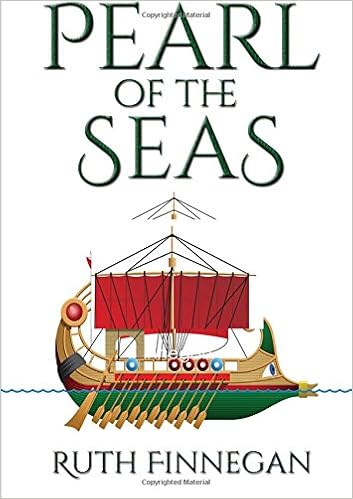 Inspired variously by the Odyssey,William Blake’s cosmologies, Rumi’s poems, and Charles Kingsley’s stories foryoungsters, this novel embraces the magic of childhood imagining. Kate andChris, along with Kate’s loyal dog, Holly, swim and frolic on a summer shore. Aship built from driftwood becomes their vessel: Kate’s the queen and Chris isthe Man of Action, the one who saves them both from wind and water. At first,Kate’s fear of sailing the high seas causes her to abandon ship, but a terribleloneliness sets in, and she regrets leaving. The sudden appearance of amagician saves the day; she answers his riddles to regain her berth. In theirboat, the Pearl of the Seas, Kate and Chris pilot through treacherousrocks and come ashore in a welcoming kingdom, where they learn a version of theTower of Babel story, “the very disaster of our world.” In this hybrid book ofnarrative blended with verse and song, different ways of telling a story mayappear on a single page. The King of Names instructs Kate that “for the deepthings it is poetry.” Such wise lessons fortify the children, but even happydreams must end. Their parting gifts include a magic pebble-pearl that rightsthe broken mast so they may return to the shore of reality and family. Though thePearl of the Seas may not buoy them to distant lands again, theydetermine that Black Inked Pearl–the written record of theirtravels–shall be their legacy. As in the novel for adults, Finnegan’s (BlackInked Pearl, 2015) “fairytale prequel” for younger readers delights in theassociative wordplay of sound and sense. A moment of canine joy provides avivid illustration: “Still in gleeful flightful lightsome delighting delight.Barking, sparking, larking.” A handful of superb black-and-white drawings by Backshallcomplements the work’s whimsical vision.
Not Enforcing Sameness

Rachael Higgins Author Interview
The Silver Tabby is a wonderfully illustrated children’s book about a kitten that struggles to fit in with the other cats. What was your inspiration behind this kids book?
The Silver Tabby was initially written as a high school English assignment. At the time, the class was studying the topic of myths and fairytales, and how the stories portrayed a message or lesson to pass on to the next generation. The assignment task was to write and illustrate a story that embedded a lesson relevant to our societal paradigm. In completing the assignment, I wanted to pass on the message that differences can be beneficial, and that no-one should be judged based on their appearance of being different. I was inspired by authors such as Beatrix Potter and A. A. Milne, with their use of animal characters to portray their stories. Having a love of animals myself, I wanted to use animals in my story to spread a message of hope, kindness, and reconciliation. I also followed the commonly heard writer’s advice of “write what you know” and incorporated some of my own experiences of being considered different, spending time alone; as a result, then receiving acceptance.
Over the years, since the original high school assignment, The Silver Tabby has been redrafted and revamped, but the inspiration and passion in telling the story have remained the same. I believe that passing on the message of accepting others for who they truly are, and not enforcing sameness, is an essential lesson to teach our future generations.
Are you a cat person or a dog person (I’m guessing a cat person)? Do you have any pets that this story was based on?
I would say that I am an animal person in general, not specific to being a cat person or a dog person. However, I have had both animals as pets in the past as well as guinea pigs, and most recently, rats. I’m the type of person who will go for a walk and rescue a lost or injured animal or will visit an animal shelter and want to adopt all the animals to make sure they have a happy, loving, and safe home.
When I originally started writing The Silver Tabby, I had a short-hair silver tabby cat named Silver who the main character of the book is based on. The real Silver was born from my families’ then neighbour’s cat, who had chosen the enclosed area where our hot water tank was stored, below our Queenslander-style home, as a warm, safe place to birth her litter of kittens. The kittens were a mix of tortoiseshells, ginger tabbies, and black furred kittens; Silver was the only silver tabby. Our neighbours called Silver’s mother, Mama Cat. Mama Cat would lead the kittens between our house and the neighbour’s; Silver would venture away from the litter and come inside our house and make herself comfortable while I read. I think Silver really ended up adopting me rather than the other way round.
I loved the illustrations in this book. What was the collaboration like between you and the illustrator Grace Elliott?
Grace is fantastic to work with; I would recommend any author seeking an illustrator for their children’s book to look Grace up on Instagram. Initially, I showed Grace a draft of the text and concept of illustrations that I had drawn years ago for the high school assignment; and later digitally remastered for a later draft. Then Grace worked her magic on the artwork for The Silver Tabby. I feel I made the right decision collaborating with Grace, rather than illustrating the story myself. Grace’s artwork compliments the text and sets the scenes of the story, bringing the characters to life, in a way that I couldn’t have done myself.
As an artist, Grace was willing to accept feedback and advice from other artists, as we amended drafts, and she shared my vision as the author for how the book might look as a finished product. Most of our collaboration was done online, as I spent a lot of the last year moving intercity and overseas, Grace was very patient and understanding throughout every pause and readjustment that was made during the production of The Silver Tabby. I am very grateful to have had Grace onboard for the project, and would gladly work with Grace again.
What is the next book that you are working on and when will it be available?
I have a couple of concepts that I am working on at the moment. Another illustrated book that poetically portrays the epic clash between Heaven and Hell. I expect this book will be available within the next year or two. The other concept is a romantic story of undetermined length, and availability, at this stage; although I anticipate the story to evolve into a novella if not a novel.
Author Links: Website | Facebook | Instagram
![The Silver Tabby by [Higgins, Rachael]](https://images-na.ssl-images-amazon.com/images/I/51mbsDygzBL._SX260_.jpg)
The Silver Tabby is about a kitten named Silver who struggles with being different from the other kittens in her litter.
Then one day, Silver manages to become the same as the other kittens. Excited to meet a new friend, all the kittens play happily together. But, Silver’s disguise does not last long.
When the other kittens discover their new friend is Silver, will she still be accepted?
A Dark Side of History

Micah Genest Author Interview
The Land of Ick and Eck follows Harlot’s strange encounters as she travels through a strange land. What was the inspiration for the setup to this intriguing story?
I’m fascinated by children’s stories that are strange and make you think, “Wait, What? Haha, did that just happen?!” Victorian literature for children, as well as older versions of fairy tales, are where I found inspiration for the setup up of this book; they so often make you take a step back, laugh, think, and then continue on with curiosity. These stories can sometimes be whimsically mature, exploring violence, sexuality, and/or morality in creative, imaginative ways. Not treating children like delicate sugar-flakes and allowing for such content adds so much depth to the meanings and understanding of the stories, something I have found difficult to come across in modern children’s literature.
So when I started writing, I wanted it to be something that that gave me similar feelings to when I read older, bizarre fairy tales. I wanted it to take place in a strange world, where things were non-sense, but also made sense if you had the knowledge to understand what was happening, especially when the reader becomes aware of the innuendos. Like many episodic folkloric tales, there is much more than what lies on the service, multiple understandings; that is what I really enjoy about such types of stories. This is one of them.
The world that you’ve built is enthralling and curious to say the least. What were some sources of inspiration for when creating this world?
Reading literature about/from the faerie, medieval, Georgian, and Victorian world was where some of my inspirations came from. I would often find myself reading, for example, faerie lore and tales, medieval fabliaux and chivalric romances, and strange episodic stories that involve children, such as Jerzy Kosiński’s The Painted Bird (a modern tale). I wanted to create something like Frank Baum’s The Wonderful Wizard of Oz and Lewis Carol’s Alice’s Adventures in Wonderland, but darker and with more macabre and questionable situations.
The realm of Ick and Eck needed to somewhere that made sense not necessarily for the human world but in the faerie world. It was to be a place that the mind of an imaginative child could easily follow and bring to life, but for adults, things might seem a little off (unless they still have the child within them). It needed to be absurd, but penetrable if you put yourself in a different sort of mind-set. To get this inspiration, I often found myself delving into the artworks of Brian Froud and other artists who have continued to add to the world of faeries and fantasy, also mixing them with some of my other interests.
One of those curiosities was religion. There are many religious characters in the book, ranging from the fat-Friar, empty moon creatures, Crowned-Alter-Fops, gluttonous monks, to name a few; I enjoy studying Abrahamic religious texts, traditions, as well as medieval stories of how clergy use power to control others. Several scenes in the book comment on these injustices, but they are mixed in with the faerie world to create a more folkloric feeling. Truth be told, no hesitation of satire was taken.
Another source of inspiration was the study of medieval and Victorian prostitution. As a reader would observe, the protagonist’s name is Harlot; yes, the story does indeed explore the ideas of a dark side of history, as well as a subject very much alive today. From the exploration of courtly love and the desperate knights in need of a doctor’s (i.e. a beautiful woman) cure to save them from love sickness, to the poetic grocery-list like booklets of women found in Harris’s List of the Covent Garden Ladies, these studies were an essential backbone and driving force of inspiration. The story is a critique of this behaviour. It is meant to bring light to a subject so many people want to hide.
The introduction of the book lays this out:
- Into a land of fantasy
- With haste we cast them all aside
- No tearing if you cannot see
- That is what we all make-believe
My list of inspiration could keep going on, so I will stop before I get carried away even more.
Harlot is a curious and innocent character that I found endearing. What were some driving ideals behind the character?
I wanted to create a character that constantly found interest in novel things, while at the same time never really learns much from their experiences. Even after Harlot is assaulted at the beginning of the book (i.e. her blue flower), deceived, used, and treated as inferior, she continues on. Some say this might be a weakness, others a strength, that is for the reader to decide.
I have found it quite funny though, how some people really like Harlot, while others really do not. Some like her curious and innocent perspective, while others think she is rude and inconsiderate, and do not want their children to read about her because she is a negative role model.
In any event, what drives Harlot is her curiosity, her unwavering innocence, and her ability to navigate such a strange place, the land of Ick and Eck. She is such a strong character, a feature I have seen in people who have been abused. I can never understand their strength. They are stronger than I could ever be.
What is the next book that you are working on and when will it be available?
I am currently working on a couple projects, but I am a very slow writer. It took me eight years to be contempt enough to pursue publishing The Land of Ick and Eck: Harlot’s Encounters. But in any event, I am working on a continuation to The Land of Ick and Eck, per say, following a girl named Perfume, as well in another section about Harlot. Each are separate and different stories, written in different styles, but in a way they meet together through common characters, situations, and absurdities.
I am quite excited about it, though I do not know how long it will take to complete.
Author Links: GoodReads | YouTube
![The Land of Ick and Eck: Harlot's Encounters by [Genest, Micah]](https://images-na.ssl-images-amazon.com/images/I/51AkbU%2BrMPL.jpg)
A much too trusting Harlot finds herself in the preyful Land of Ick and Eck, a place where she encounters peculiar creatures that have the most awful intensions of the carnal sort. By happenstance, she finds the company of a Ground Faerie, a Wood and Water Nymph, and a Butter-Maiden to assist her (sort of) along the way.
But Alas! How the outlandish figures are quite the handful, ranging from the likes of Spriggans, the-man-with-a-can-for-a-head, Jaw Skins, to Alter-Fops, a knight of courtly love, and a Nigwig (to name a few). Thankfully, there are moments of repose, such as those with the band of eunuchs with sacs on their heads, the beautiful Milk-Maidens, and the adventures within the Faerie Ring.
Though the bombardments continue to pursue her, Harlot’s innocent temperament, irrational faith, and devotion to feeding her curiosity provokes her forward, and thus her true strengths are revealed within the Land of Ick and Eck.



 LITERARY TITAN