Blog Archives
Line ‘Em Up!


Line ’Em Up! by Oscar Avery is a heartfelt, motivating children’s book about a classroom many have already written off. After three teachers walk away, a weary group of students, often labeled as misfits, meets a new teacher, Mr. Murant. He refuses to define them by their past. He shares pieces of his own story. Trust forms slowly, then steadily. With small but meaningful lessons, down to something as simple as standing tall in a straight line, Mr. Murant helps his students recognize their worth. Confidence builds. Self-perception shifts. The change feels real, and it lasts.
The story carries a more serious tone than many children’s titles. Even so, it stays warm, hopeful, and deeply encouraging. Oscar Avery handles complex themes with care. Self-doubt appears on the page. So does perseverance. Growth follows, step by step. Young readers are invited to engage without being overwhelmed. The book also raises awareness of CTE and other disabilities, introducing new vocabulary and ideas in a respectful, age-appropriate way. It trusts children to learn and reflect. It does not flinch, and it does not preach. Adults reading alongside them may find themselves learning too, about invisible challenges, and about the lasting impact of a teacher who chooses patience over judgment.
Docker’s illustrations bring the classroom to life on nearly every page. Each character looks distinct. Each expression feels intentional. Frustration shows up clearly. Uncertainty lingers in posture and eyes. Then, gradually, confidence arrives. The artwork captures these emotional turns with warmth and clarity, strengthening the reader’s connection to the students’ journey. For children who lean on visuals to process feeling and change, the illustrations add real accessibility.
What makes this book linger is its quiet reminder that confidence often grows in tiny increments. Mr. Murant never sells instant transformation. He offers belief. He offers structure. He offers time. In doing so, he shows his students they are capable of far more than they have been told. Line ’Em Up! is an inspiring, meaningful read for slightly older children, one that encourages empathy, self-belief, and a deeper understanding of difference, while delivering a story that stays with you long after the final page.
Pages: 45 | ISBN : 978-1-7345743-0-2
Line ‘Em Up!

Line ’Em Up!, by Oscar Avery, follows a class of kids who feel written off by everyone until a new teacher, Mr. Murant, walks in and completely changes their world. He teaches them pride and discipline and shows them how greatness starts inside. The class learns about science, math, football, and life, all while building confidence through something as simple as forming a straight line. Then the story shifts as the group discovers their beloved Mr. Murant has been struggling with CTE.
Reading this children’s book honestly resonated with me more than I expected. I went in thinking it would be a light little school story, and instead found myself caught up in the way Mr. Murant pushes his students to believe in themselves. The writing feels warm and punchy and a little chaotic in a fun way. It mirrors a real classroom where jokes fly, and kids interrupt, and learning happens sideways. I kept smiling at the little back-and-forth moments, especially when Savannah had something sharp to say. The pacing jumps fast from day to day, and that gives the whole thing a breathless energy that makes you want to keep reading.
The author doesn’t shy away from the hard stuff, and I really appreciated that. I felt the kids’ confusion and frustration, and that slow sinking feeling when they wonder whether they were truly cared for. The story handles disability and illness in a way that feels simple but sincere. It made me think about how much one adult can change a child’s whole view of themselves. The illustrations have such a warm, authentic classroom vibe that really draws you in. I love the soft, painterly texture. It gives each scene a gentle feel. Mr. Murant’s expressions are clear, and small details add a fun touch to the scenes.
I’d recommend Line ‘Em Up! to kids who enjoy stories about school life and friendship and to adults who love picture books with heart and a message that sticks. It’s great for classrooms, families, and anyone who wants a story that lifts you up while lovingly addressing coping with loss.
Blaming the Victim

The Soul’s Reckoning follows a woman as she passes through the Barrier into a vivid, confusing, and emotional afterlife where she is forced to confront former relationships and truths she had avoided in life. What was the inspiration for the setup of your story?
After my brain injury, my relationships went into a downward spiral. I became acutely aware of the differences between communities and countries in how they handled social life with people who’d suffered catastrophic injuries or whose communication styles had changed. Some communities or countries focused on maintaining the relationship while adjusting to the challenging needs of the injured member. Others blamed the injured one and left. Yet Christianity, or the church, anyway, continually teaches that God will restore relationships.
Does that happen, I asked. I’d read the Book of Job years ago, which realistically portrays how friends mischaracterize suffering, blaming the victim. And it reveals what God thinks about all that. Several years ago, I wrote an ebook and a Psychology Today post on the Book of Job, including God’s perspective on Job’s friends. The book’s lessons remained in the back of my mind, and I married those lessons with my own and others’ experiences of relationships after brain injury.
I think too many put off trying to restore relationships, perhaps because they don’t want to confront the bad thoughts, bad words, and bad actions that had led them to abandoning their injured loved one. Then that person dies, and it’s too late. Or is it? And how do you reconcile with a dead person? That’s what I sought to answer.
Was there anything from your own life that you put into the characters in your novel?
As I was writing The Soul’s Reckoning, the character Shireen Anne popped up. It was rather surreal watching her name appear on the screen as I typed. It was like my past self, or a version of who I used to be, hopped into my story, declaring, “Here I am!” I wasn’t sure what to make of her appearance. But I couldn’t delete her. Turns out Charlotte Elisabeth, who isn’t anything like me, needed a friend and guide like Shireen Anne. She appears again in novel three.
What was one scene in the novel that you felt captured the morals and message you were trying to deliver to readers?
This is a tough question. My immediate inclination is to suggest the scene where Charlotte Elisabeth reconciles with her client. From the moment she decides that’s her next goal until she leaves.
Can you tell us where the book goes and where we’ll see the characters in the third book?
Book three of The Q’Zam’Ta Trilogy follows Revelation’s storyline from the time just before the cataclysm to just after the Book of Life. I’d originally intended to go to the end of Revelation, but there is so much to explore and unpack in those metaphorical thousand years without Satan, governments, and elites, that I realized I had to end it at the Book of Life. I’m thinking I’ll write another trilogy to cover the last part of Revelation.
In the third book, titled The Soul’s Turning, the characters leave Heaven and return to Earth, either as resurrected beings or, in Charlotte Elisabeth’s case, in a specially created new physical body. She doesn’t lose her memory of her experiences in Heaven, yet she no longer exists as an energy being.
In The Soul’s Turning, she must learn who she is.
Like so many of us, she equates her identity with her job. But in order to avoid second death, she must let go of that myth and face herself and learn and accept alien concepts in order to unearth her created identity.
And she must do all this in a far-future world that’s experienced eight degrees of warming, whose population is divided by economic systems, without governments, and with The Reigners, a Council led by Jesus that ensures no elites can rise.
As she’s becoming comfortable with what she believes about herself and the world, the Accuser-Adversary is released, and Charlotte Elisabeth faces a final, deadly challenge that requires her to grow courageous insight she’s never had before or be obliterated in a galactic Lake of Fire.
Author Links: GoodReads | Bluesky | Website
In this powerful continuation of The Q’Zam’Ta Trilogy, the afterlife is not an ending but a crucible where souls are tested, relationships are stripped bare, and choices echo with eternal consequence.
The Soul’s Reckoning leads readers into a realm where mortality and eternity meet, where faith collides with doubt, and where the love that once brought comfort now demands sacrifice. Every step forward raises questions of loyalty, forgiveness, and the courage required to face the truth of one’s soul.
This Christian novel is more than a story of belief. It is a profound exploration of family dynamics, the complexities of Christian relationships, and the enduring power of friendship.
With lyrical prose and piercing insight, Shireen Anne Jeejeebhoy weaves the mystery of the afterlife with the raw struggles of human connection. The result is a moving book on the afterlife that illuminates the bonds that hold us together and the grace that can heal even the deepest wounds.
A novel for readers who seek Christian books that inspire, challenge, and linger in the heart, The Soul’s Reckoning invites you on a journey where every choice matters and redemption remains possible beyond this life.
Plunge into Charlotte Elisabeth’s reconciliation quest today.
Believe in Exceptions

In Wooden Dolls Game, readers follow a woman through a lifetime of dysfunction and chaos as she tries to undo past traumas via a set of curious wooden dolls. Where did the idea for this novel come from?
The main idea came from the extraordinary concept of rewinding time in order to fix mistakes from the past. I then combined that idea with several personal inspirations. One of them was meeting two little sisters during an acting course. I also worked at a company where I met a man who was my trainer at that time, and I was fascinated by how optimistic he was about life. The curious thing is that everything seemed to work exactly as he predicted. He became my inspiration for the character of Jhonatan. Finally, the story was also influenced by one of my favorite movies, The Butterfly Effect. During the pandemic, I had the time to work on this story daily, blending all of these elements together.
How did you navigate crafting the tumultuous relationship between Mary Jane and her sister?
When I was a girl, I had the chance to grow up with my stepsister. She was more intrepid, even though we were close in age. As a teenager, she was often getting into trouble, while I was the one who stayed at home. She was my main inspiration for the character of Antonia.
Is there any moral or idea that you hope readers take away from the story?
My premise is that people do not change the behavior they are naturally born with. What people carry deep in their hearts is what it truly is. That said, I do believe in exceptions and even in miracles.
Can we look forward to more work from you soon? What are you currently working on?
I am not sure how soon, but my next goal is to write a five-book series. The series is called Allies of the Stars. I am just starting this project, and while I already have the general ideas for all five books and their stories, I am still developing each one. As with all my stories, it will be a quotidian story with a touch of fantasy.
Author Links: GoodReads | Facebook | Website | Amazon
In a moment that shapes their lives forever, five-year-old twin sisters Mary Jane and Antonia find themselves embroiled in a rivalry over the simple act of choosing a bedroom in their new home. From that one event, their sisterly bond is broken. As MJ forges a life-long kinship with Olivia, the girl next door, Antonia’s jealousy continues to fester.
Amidst the twists and turns of fate, Mary Jane is presented with a peculiar gift from a local fair—a set of mysterious wooden dolls imbued with magical powers. But as MJ discovers the dolls’ ability to transport her through time, fear leads her to hide them away, burying the magic they hold.
As the years pass and the sisters drift further apart, Antonia’s jealously for Mary Jane deepens. And, as her hatred intensifies for her sister, it sparks a life-changing tragedy, forcing Mary Jane to confront her past and the dormant magic of the forgotten dolls.
But as she seeks to use the power held within the curious toys, can Mary Jane mend the shattered pieces of the past to reshape the future? Or are some destinies bound by forces beyond her control?
Sacred Celebrations: Designing Rituals to Navigate Life’s Milestone Transitions


Sacred Celebrations is a warm and soulful guide to marking life’s transitions with intention and love. Elizabeth Barbour weaves stories from her own life with practical teachings about rituals, ceremonies, and the ways we gather around beginnings and endings. The book moves through birth, marriage, loss, illness, and the everyday moments that often slip by. It shows how rituals can help us slow down, breathe, and feel anchored in a world that moves too fast. Her stories are tender and sometimes raw, and they shine a light on the human need for connection during joyful and difficult times.
Barbour’s writing carries an honesty that caught me off guard, and I kept pausing just to sit with her words. The scene where she describes her mother’s final days was emotional. I felt the weight of that love and conflict. I also laughed at simpler moments, like the chaos of celebrations that go sideways or the small joys tucked into everyday rituals. Her style is comforting. It’s like listening to a friend who has lived a lot and is willing to tell the truth about how messy life can be. I appreciated how she took rituals out of the realm of “big spiritual practices” and grounded them in regular life. This made the whole idea feel doable for anyone.
What struck me most was how gentle her guidance felt. She never pushes. She invites. The book nudged me to look at my own transitions, even the quiet ones I usually gloss over, and I found myself thinking about the moments I rushed through without honoring how they shaped me. Some parts made me emotional because they stirred up memories I didn’t expect to revisit. Other parts lit me up with curiosity. I kept thinking about how simple actions, like a walk to a creek or lighting a candle, can shift the way we move through the world. The book feels both practical and mystical in a way that surprised me. I kept underlining sentences and dog-ear pages.
I would recommend Sacred Celebrations to people who crave meaning in their routines, anyone moving through a major transition, and those who want to deepen their emotional or spiritual life without anything too complicated. It’s also a lovely fit for caregivers, coaches, therapists, ministers, or anyone who holds space for others. The book feels like a soft place to land, and it left me wanting to create more intentional moments in my own life.
Pages: 252 | ISBN : 0972468692

The Moments Between Choices


The Moments Between Choices tells the story of Omar Rashid, a man who drifts through life on autopilot until a sudden accident tears open the hidden cost of his choices. The book jumps between the present and his past. It shows the small moments where he hurt the people who loved him. It also shows the glimpses of kindness that hinted at the man he could have been. The final pages follow his quiet reckoning as his life slips out of his hands and into something stranger. The whole thing feels like watching a life replay in fast flashes that hit harder each time.
The language is simple, almost disarmingly so, and then a scene hits like a falling brick. Moments that seem harmless at first crack open into something sad. I kept thinking about the gap between intention and impact. The author doesn’t scream the message. He lets it sit there. The scenes with Omar ignoring his daughter or brushing off his wife felt too real. I felt annoyed with him at first. Then I felt uneasy. Then I felt guilty for how easy it is to slip into the same habits. The emotional rhythm jumps between warmth, frustration, and dread, and the shifts kept me on edge in a good way.
I also liked how the book handles memory. The childhood chapters were surprisingly vivid. The prank with the glue made me laugh. The pepper incident made me wince. The moment with the old janitor honestly touched me. These scenes felt like tiny snapshots that carried more weight than I expected. The book moves fast. I wanted more breathing room in a few spots, but the pace gave the story a kind of heartbeat. I never felt bored. I just sometimes felt shaken. And maybe that was the point. The structure carries this idea that life is stitched together through small choices. And those choices keep echoing, whether we like it or not.
By the time I reached the final chapter, I felt a mix of anger, pity, and something like hope. The ending left me quiet for a minute. It didn’t try to fix everything. It offered clarity. And I appreciated that. It made the story feel honest rather than preachy.
I’d recommend The Moments Between Choices to readers who enjoy emotional stories that keep you thinking about them. People who like character-driven arcs. People who reflect on their own habits and relationships. Anyone who wants a book that nudges them to sit and think about the tiny decisions they make every day. It’s not a light read, but it’s a meaningful one.
Pages: 116
One Last Question Before You Go: Why You Should Interview Your Parents
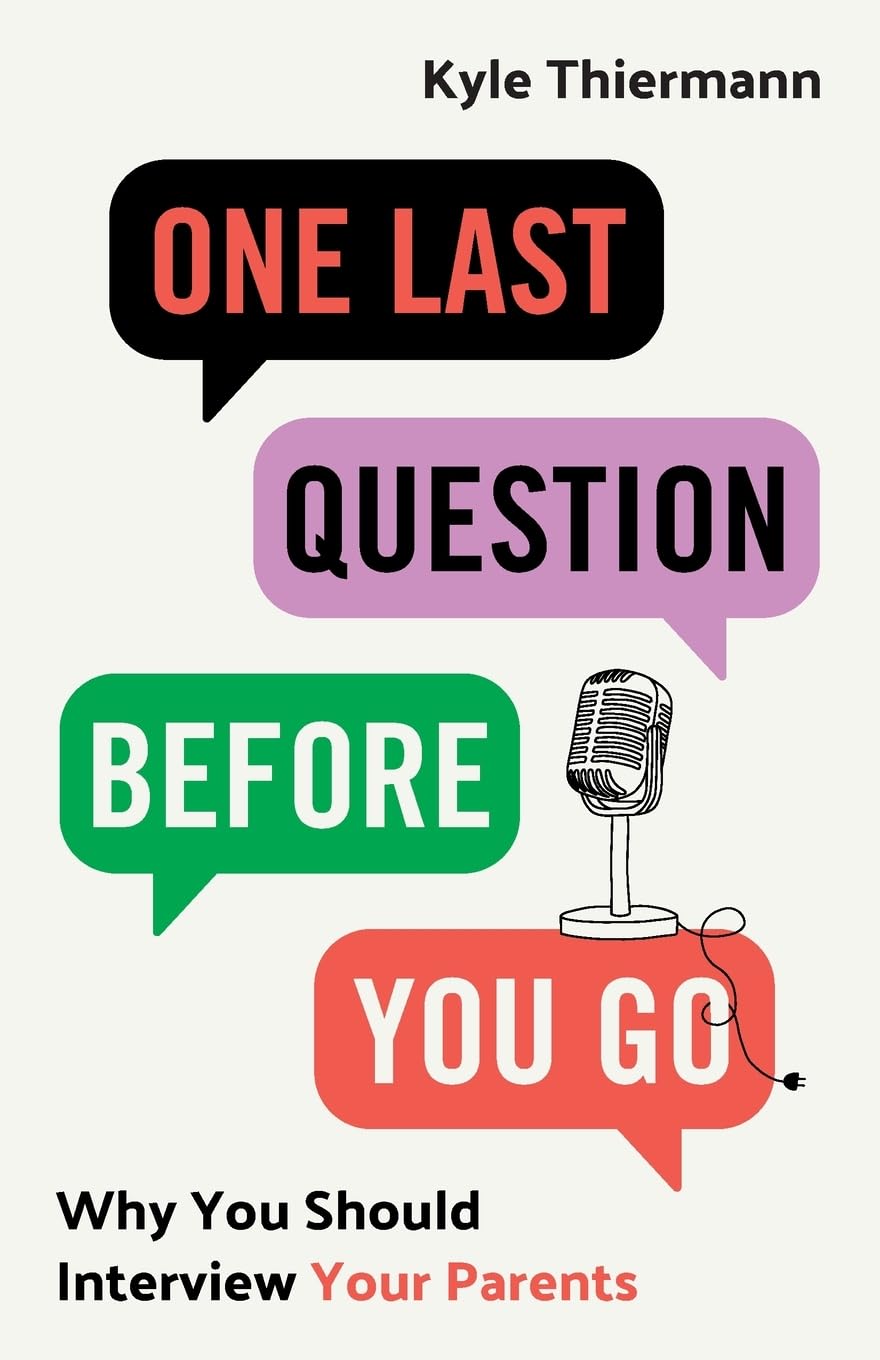
Kyle Thiermann’s One Last Question Before You Go is part memoir, part field guide for emotional courage. It begins as a practical project, recording conversations with his parents before it’s too late, but evolves into a moving exploration of love, misunderstanding, and reconciliation. Thiermann opens his life with remarkable honesty, describing a childhood shaped by idealism, tension, and unconventional choices. His storytelling blurs the line between instruction and confession, reminding readers that asking questions can be both a form of preservation and an act of healing.
Thiermann’s writing balances clarity and lyricism. He recounts moments from his youth in Santa Cruz with humor and unease: surf sessions laced with danger, family debates over truth and science, and a mother whose belief in conspiracy theories fractures their bond. When he writes, “Now when my mom and I look up at the same blue sky, she sees chemtrails, where I see clouds,” the simplicity of the line reveals something profound about distance and love. It’s this honesty, direct, unsentimental, but deeply felt, that gives the book its emotional weight.
His reflections on interviewing parents are both practical and philosophical. Thiermann treats listening as a skill that requires humility and patience. His advice to start with simple questions, to let silence breathe, feels genuine and attainable. He doesn’t posture as an expert but as someone learning in real time. When he describes forcing himself to write “bad questions” until something true appears, it captures the imperfect process of reaching toward another person.
The book’s rhythm is conversational yet purposeful. Thiermann alternates between intimate family vignettes and broader reflections on communication, mortality, and forgiveness. He resists the urge to offer neat resolutions, allowing discomfort and ambiguity to remain. That restraint makes his insights resonate more deeply.
One Last Question Before You Go manages to be both instructive and profoundly human. It’s a reminder that asking hard questions is not about control or closure, it’s about connection. This is a book for readers who value sincerity over polish, who want to bridge emotional gaps with their own parents, or who simply wish to understand their family stories before time takes them. Thoughtful, unguarded, and deeply affecting, Thiermann’s work lingers long after the final page.
Pages: 156 | ASIN : B0FR8JLM98
Finley’s Song

From the first page, Finley’s Song drew me into a story that mixes music, grief, and the stubborn hope that follows loss. At its heart, the book tells the story of Finley, a pianist whose husband dies in a sudden accident, leaving her to raise their son, Max, while stumbling through her own guilt and despair. The novel moves between their shared silence at home, their escape to Paris, and the healing they cautiously piece together through new connections, old memories, and the enduring pull of music. I liked how much this is not just Finley’s story but Max’s too, a portrait of a mother and son mourning in parallel yet trying to keep each other afloat.
The writing had me hooked and sometimes unsettled in the best way. Kathryn Mattingly paints grief with raw strokes, never dressing it up, never trying to make it neat. Some passages felt like a gut punch, especially when Finley blames herself for Simon’s death. The guilt is heavy, almost suffocating, and I could feel the weight of it. But then there are these glimmers, moments with Max by the river, or Finley staring at the Eiffel Tower, that break through like sunlight. I found myself both aching and rooting for them, wanting them to reach those fragile pockets of beauty again. The language isn’t flowery for the sake of it. It’s direct yet tender, and it left me pausing more than once just to sit with the feeling it stirred.
Sometimes Finley’s voice frustrated me. Her self-blame circles back so often that I caught myself whispering “let yourself breathe.” Yet, that honesty made her real. People stuck in grief do repeat themselves, and the author didn’t shy away from that truth. I also found Max’s perspective refreshing and painfully accurate. His teenage awkwardness, his longing for his father, his quiet way of observing the world, they rang true. If anything, his sections gave the book a balance it needed, grounding Finley’s spiraling thoughts with the bluntness of youth. That duality is what made the story so enjoyable for me.
Finley’s Song is filled with small, luminous moments that feel earned. I’d recommend it to anyone who wants to read about loss in a way that doesn’t smooth the edges but instead embraces the messiness of it. Fans of books like Little Fires Everywhere or Where the Crawdads Sing will find a similar mix of emotional depth and vivid sense of place, but Finley’s Song feels more personal and raw, like a private journal you’ve been allowed to read.
Pages: 226 | ISBN : 978-1952909344



