Blog Archives
Think Critically and Deeply
In Beyond Power, you present the idea that Western society is departing from its moral core and the ideas on which democracy was founded. How long did it take to research and compile this book?
I developed it over a period starting when there were severe tensions in Israel over democracy 2022 and strong anti-Israel post October 7th, 2023.
Did you learn anything while writing Beyond Power that surprised you?
Many of the issues plaguing society seem to have a common conceptual cause.
What is one thing you hope readers take away from your book?
To think critically (and deeply) about all we see, hear, and are told.
Author Links: GoodReads | Amazon
At first glance, these may seem like separate struggles, political, cultural, or geopolitical yet they are deeply connected.
By tracing the tensions between power and ethics, this work explores how successful democracies evolved, why politics so often devolves into hostility, why societies fracture, understanding more deeply the progressive agenda and why Israel in particular stands at the center of so much global controversy. It examines how democracies are corroded from within, how oppressive regimes weaponize ideology, the dynamics of geo political tensions and how Western progressivism redefines compassion.
Rather than despair, the book points toward renewal, offering diagnoses, practical proposals, within the context of a profound conceptualization of the notion of state itself, one capable of transcending today’s divisions.
A Graver Danger: White Chalk Crime, The Stunning First-Ever Explanation for School Shootings & How We End Them
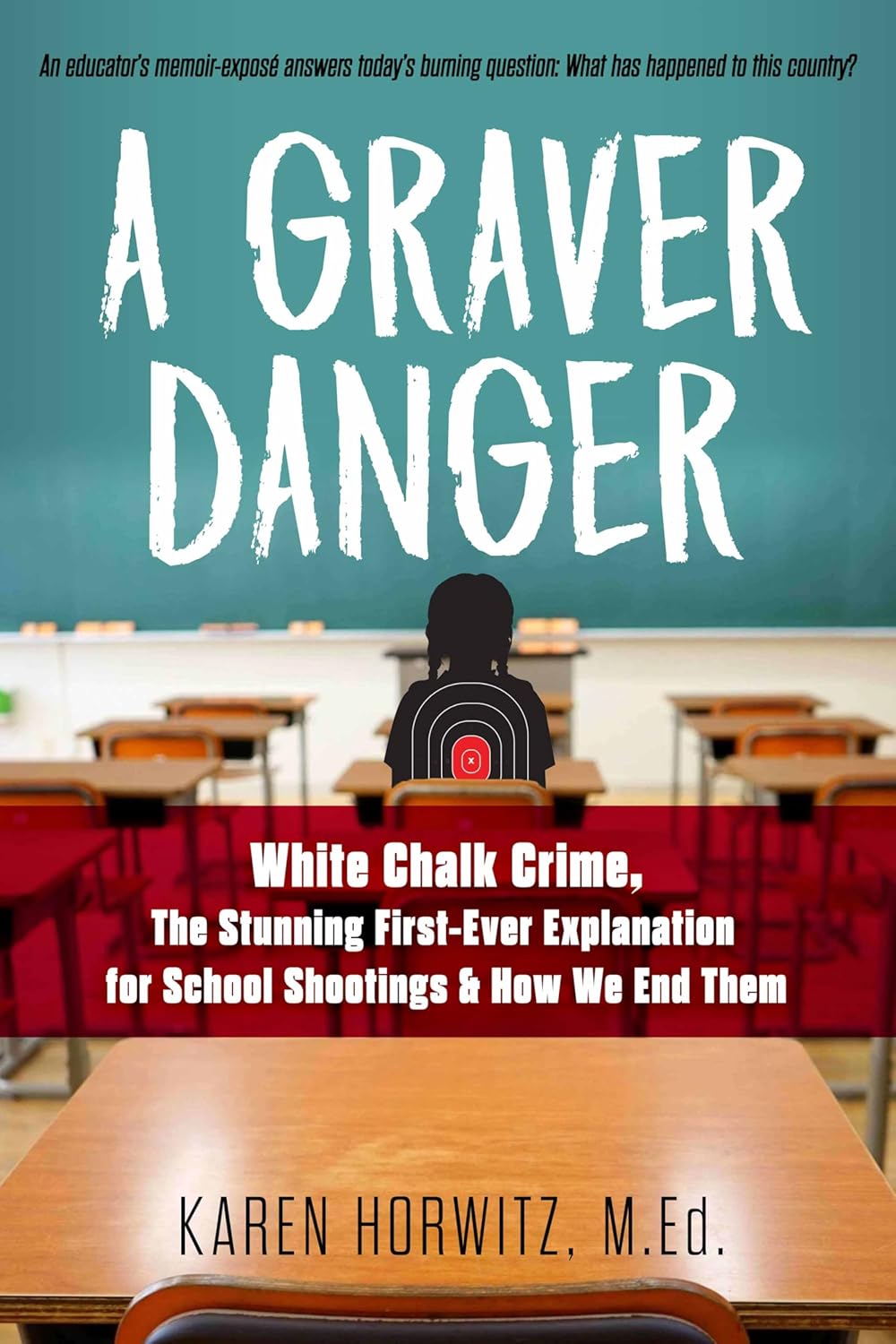

When I picked up A Graver Danger, I didn’t expect to be dragged so quickly into a whirlwind of ideas that felt both raw and unsettling. The book is part memoir, part exposé, and part call to arms. At its heart, it argues that corruption and abuse within America’s schools, what Horwitz calls “White Chalk Crime,” is the hidden engine behind many of our deepest social fractures, from the rise of authoritarian politics to the epidemic of school shootings. Horwitz stitches her own story of being pushed out of teaching into a broader narrative about how education has been hollowed out and how that void has rippled across society. It’s heavy, sometimes overwhelming, but undeniably urgent.
Reading her words, I felt a mix of frustration and admiration. The writing is blunt, even fiery, with no attempt to soften edges or hide her anger. At times, the writing felt especially intense, but then I’d pause and realize that intensity might be the most honest way to tell a story like this. She’s lived through years of being ignored, gaslit, and punished for speaking out, and that bruised persistence bleeds through every chapter. The book isn’t polished in a literary sense, but it’s alive. It jolts you. I found myself underlining sentences, not because they were poetic, but because they resonated with me.
What stuck with me most was her refusal to back down. There’s a loneliness to her fight, and it seeps through the pages. Sometimes I felt exhausted keeping up with the intensity, but then I thought about how exhausted she must be after decades of pushing this rock uphill. That gave me a deeper respect for the work. There were moments when the book revisited similar points from different angles. It’s a way of pressing important truths that have often been ignored.
By the time I finished, I wasn’t left with neat answers. I was left with unease, but also a spark of responsibility. I’d recommend this book to anyone who cares about schools, democracy, or just understanding why our culture feels so broken. It’s for people willing to consider that the roots of our national crises may be closer to home than we think. Teachers, parents, and citizens who still believe democracy is worth saving, this is for you.
Pages: 420 | ASIN : B0DHWJ944H

We Can Demand Better

Making Democracy Count explores the impact of mathematics on the many facets of the democratic process. Why was this an important book for you to write?
This book grew out of my various efforts in the math and democracy space. I teach a course called Math and Politics at Wellesley College and direct the Institute for Mathematics and Democracy. Through my many interactions and projects with students and researchers, I realized that there was a need for a book serving as a reader-friendly, gentle introduction to the math of democracy and that I actually had something to say about the subject.
How much research did you undertake for this book, and how much time did it take to put it all together?
If you count the years that I taught the Math and Politics class — which is when I learned much of the material that is in the book, tested the examples, and adjusted things based on student feedback — then it took more years than I care to admit. But once I sat down to start writing, it took about a year and a half to complete the book. The amount of research I had to do was immense, but also very fun since I had to learn a lot of statistics, history, political science, economics, and law which I knew nothing about before.
What is one misconception you think many people have regarding the election process?
The general misconception is that the democratic processes we use, including those that govern our elections, are the right ones and that they are unchangeable. We take so many things about the engine of our democracy for granted. We do not realize that the voting methods we use are flawed, that the Electoral College is a terrible relic of the past, that districting as we do it is a horrific instrument of disenfranchisement. But we can change these processes. We can demand better, more mathematically sound ones.
What is one thing you hope readers take away from Making Democracy Count?
Mathematics can point the way toward better democratic processes. Our democracy runs on algorithms, and mathematics can tell us which ones are flawed and which ones we should use instead. From the objective, non-partisan point of view of mathematics, things like ranked choice voting, multi-winner districts, and open primaries are clearly better because they provide more representation and a more complete picture of the will of the people. We should embrace the mathematical point of view and work to increase our political quantitative literacy.
Author Links: GoodReads | X (Twitter) | Facebook | Website | Amazon
How we can repair our democracy by rebuilding the mechanisms that power it
What’s the best way to determine what most voters want when multiple candidates are running? What’s the fairest way to allocate legislative seats to different constituencies? What’s the least distorted way to draw voting districts? Not the way we do things now. Democracy is mathematical to its very foundations. Yet most of the methods in use are a historical grab bag of the shortsighted, the cynical, the innumerate, and the outright discriminatory. Making Democracy Count sheds new light on our electoral systems, revealing how a deeper understanding of their mathematics is the key to creating civic infrastructure that works for everyone.
In this timely guide, Ismar Volić empowers us to use mathematical thinking as an objective, nonpartisan framework that rises above the noise and rancor of today’s divided public square. Examining our representative democracy using powerful clarifying concepts, Volić shows why our current voting system stifles political diversity, why the size of the House of Representatives contributes to its paralysis, why gerrymandering is a sinister instrument that entrenches partisanship and disenfranchisement, why the Electoral College must be rethought, and what can work better and why. Volić also discusses the legal and constitutional practicalities involved and proposes a road map for repairing the mathematical structures that undergird representative government.
Making Democracy Count gives us the concrete knowledge and the confidence to advocate for a more just, equitable, and inclusive democracy.
Making Democracy Count: How Mathematics Improves Voting, Electoral Maps, and Representation

Making Democracy Count is an intellectually stimulating exploration of how mathematics underpins the fabric of our democratic processes. Author Ismar Volić takes readers on a journey through the mathematical principles that govern voting, districting, and representation, revealing how these often-overlooked aspects are crucial to the fairness and functionality of democracy. From the nuances of voting methods to the complexities of gerrymandering, Volić unravels the intricacies with clarity and enthusiasm, making a strong case for the importance of mathematical literacy in civic life.
What struck me most about Volić’s writing is his ability to make complex mathematical concepts accessible without sacrificing depth. The opening anecdote about a classroom movie vote is a perfect example of how he distills abstract ideas into relatable scenarios. The discussion about the flaws in plurality voting is both compelling and eye-opening. Volić’s knack for storytelling shines as he connects everyday experiences with broader, systemic issues, effectively engaging readers who might not typically be drawn to mathematical discourse.
While the book is enlightening, it can occasionally feel overwhelming in its detail. The chapters on different voting methods and their mathematical justifications are fascinating but may require multiple readings for those not well-versed in mathematics. The depth of analysis, particularly in chapters like “The Impossible Democracy,” where Volić delves into Arrow’s Impossibility Theorem, is impressive but can also be dense. This level of detail provides a thorough understanding for dedicated readers.
Volić’s examination of gerrymandering and districting is a section that really stood out to me. The author explains the mathematical tools used to detect and prevent gerrymandering, such as symmetry and compactness tests, in a particularly insightful way. His discussion of the impact of these mathematical strategies on political representation is both timely and crucial.
Making Democracy Count is a must-read for anyone interested in the intersection of mathematics and democracy. It’s particularly well-suited for readers with a background in mathematics or political science, as well as educators and policymakers who want to deepen their understanding of how to improve democratic processes. Volić succeeds in showing that mathematics is not just a tool for scientists but a powerful framework for creating a more just and equitable society.
Pages: 394 | ASIN : B0CKPHRLHD

Our Nation’s Dysfunction

Twelve Steps for White America is a call to those who seek to understand the roots of systemic inequality and their personal connection to it, as well as those wishing to make meaningful changes to improve society. Why was this an important book for you to write at this time?
In January of 2020, I made the career decision to leave a job making $200k because my soul screamed “What are you going to do with the rest of your life?” By February 2020, Covid’s rampage brought the world to its knees. With people beginning to die and me not knowing if I were next, I spent that last chance for soul work diving into a brilliant presentation of the sanatana dharma in a book called The Jewel of Abundance by Yogacharya Ellen Grace O’Brian. In that deep soul stillness, I studied artha – the spiritual abundance that you can experience in pursuing your life’s soul purpose. In that fertile soul-soil, I and the world witnessed the extrajudicial killing of Mr. George Floyd. Millions were sickened by what sickened Black America for over 400 years. I was one of those millions whose pandemic hush perceived this horror with undivided attention and resolve. It yoked me into my responsibility. I finally had to “write that book.” Since so many others more brilliant than me have already weighed in, anything meaningful would have to be so personal from my lived experience, expertise, and education, that no other person could write it.
What were some ideas that were important for you to share in this book?
White America includes white Americans, but we are all complicit.
Like an alcoholic in recovery, white Americans need to make amends/repairs for the sake of our own personal repentance, atonement, and redemption.
Answering the call of James Baldwin for new standards, I’ve repurposed the underlying problem-solving principles of recovery movements and applied them to our nation’s dysfunction as a twelve-step treatment plan.
My Rigged Advantage Theory posits that elites coopted a mass of others who, in Colonial America came to be defined as white with elites to comprise a voting block of power to reproduce elite advantage.
We have never uprooted slavery. Legacies live on in cultural artefacts and behavioral norms such as minority rule in the Senate, SCOTUS, and the Electoral College; the white entitlement I call the “Presumption of Whereabouts Authority” which results in fugitive slave patrols persisting as disproportionate carceral state policing; and the presumption of incompetence, which is especially deadly for Black women.
Where did the idea to use the 12-step approach for addiction treatment come from, and how did you develop this into your plan of action to help change people’s thought processes?
My own recovery, now practiced for 37 years, requires me to “practice these principles in all my affairs.” In fact, my spiritual condition is the wall between me and relapse. My spiritual condition cannot afford for me to live deluded colluding in the rigged advantage of whiteness, which relies on white supremacy and anti-Blackness. I practice this spirituality in order for me to be well. With this practice en masse, a United States of America can be well.
What is one thing that you hope readers take away from Twelve Steps for White America?
In THE United States of America, the American experiment with democracy has not failed as much as we have yet to try it.
In A United States of America, where race no longer predicts outcomes because we did the work, we align who we say are with what we do.
In that integrity, we can actualize the sustainable order of democracy: justice THEN liberty THEN peace THEN prosperity.
There are no shortcuts.
But glory awaits our best days ahead, if we do the work.
Author Links: GoodReads | Website | LinkedIn | LinkTree | Amazon
Educator and former psychotherapist William Watson presents a treatment plan for democracy, an innovative framework of steps white Americans can take (and all individuals and organizations can incorporate) to right our nation’s course to peace and prosperity through justice then liberty for all.
The problem: Watson’s Rigged Advantage Theory presents U.S. democracy as compromised by advantage rigged to favor some, exploit others, and marginalize many. Rigged advantage operates a whiteness inclusion-collusion that relies on two codependent strategies-white supremacy and anti-Blackness.
The solution: Address elements of dysfunction common to both rigged advantage and alcoholism. Apply 12 steps of known recovery principles to unshackle the past, promote U.S. security and global competitiveness, and eliminate race as a predictor of democracy’s outcomes.
Twelve Steps for White America maps a pathway to truth, reconciliation, and renewal forged in a crucible of national repentance, atonement, and redemption.
Abiding Promise of Equal Rights
Revolt Against the K-12 Status Quo is a potent and meticulously researched critique of the systemic inequities in the U.S. public school system, particularly regarding the stark discrepancies in educational funding across different states. Why was this an important book for you to write?
Forgive me, but I have a long-winded answer. There are several reasons why it was important for me to write the Revolt Against the K-12 Status Quo.
I am, by disposition, repelled by injustice and have sworn hostility against injustice –especially government-sponsored injustice exemplified by the decades-long vast disparities in K-12 education funding & spending among the 50 states and the District of Columbia.
How can it be constitutionally acceptable in these ‘United’ States of America for Idaho, the lowest among the states, to have a per-pupil funding of $9,802, a measly 31.41%, not even a third, of the $31,205 per-pupil funding for the District of Columbia? Where in the US Constitution does it say that your youngster attending a public K-12 school would have to suffer—by accident of geography—from the deleterious impact of less-than-equal funding per pupil?
The idealist in me has long wondered why this all-important, consequential issue has slipped under the radar screens of education advocacy groups and/or civil rights organization; not one of them has raised a fuss and railed against the inequity, the injustice of unequal K-12 funding/spending per pupil.
As a super fan of American democracy, I am a true believer in America’s abiding promise of equal rights and opportunities for all. That said, and the staggering disparities that have bedeviled the current K-12 funding system, in my view, violate the letter and spirit of the EQUAL PROTECTION CLAUSE of the Fourteenth Amendment;
I wrote this book to serve as a wake-up call for the relevant policy-makers, elected and appointed, to engage in a national discourse that might lead to a re-examination of the sustainability of the long-standing policy that says K-12 education is merely a federal interest.
If the resulting conversations triggered by this book effectively helped to launch bona fide efforts to begin to mitigate–if not entirely eradicate–the unequal educational opportunities for young boys and girls across the nation…such a scenario could spell the start of inexorable progress toward equality for all in the educational arena. If, as a grateful immigrant, you have always wanted to make a difference–no matter how modest that difference might be–could you imagine a more consequential, a more satisfying, offering at the altar of American democracy?
What were some ideas that were important for you to share in this book?
A local responsibility, a state function, and merely a federal interest: this three-legged structure of the K-12 education system has produced vast disparities which are unjust as they are inequitable, by way of funding and spending disparities–appalling disparities with serious constitutional implications, chief among them the EQUAL PROTECTION CLAUSE of the Fourteenth Amendment.
Where does the blame lie? The American people’s inattentive embrace of the problematic policy–which says K-12 education is merely a federal interest–and the deafening silence on the part of education advocacy groups and civil rights organizations have allowed the vast disparities among the 50 states to fester for far too long.
The questions are: In a country which proclaims equal rights and equal opportunities for all, why have the educational opportunities of young boys and girls in the bottom low-funded states, been effectively snubbed, demeaned, and degraded – by the affliction of an unequal K-12 funding system? When will America’s young boys and girls in the low-funded states stop getting the short end of the stick, time and time again?
The American people’s inattentive embrace of the problematic policy which says education is merely a federal interest, must end. It’s time for a ‘revolt against the patently inequitable K-12 funding/spending status quo.
How much research did you undertake for this book, and how much time did it take to put it all together?
The basic research for the statistical and historical data contained in this book took me four months, with help from a Manila-based virtual assistant who worked with me a full three months. Looking back, I think I went overboard and put on my CPA-auditor hat by vetting and cross-checking the validity/accuracy of the statistical data by consulting other sources. But a big chunk of the research data –data related to student outcomes/standardized test scores–ended up in the waste basket. Although test scores were arguably somehow germane to the book’s thesis, I decided to keep the book’s focus on purely funding & spending levels.
What is one thing that you hope readers take away from Revolt Against the K-12 Status Quo?
It’s long past time for a ‘revolt’ against the inequitable K-12 funding status quo via a federal EQUALITY IN EDUCATION ACT. The sooner it happens, the better it will be for American democracy.
Author Links: Website | Amazon
In this book, you will find the gap between the top-funding/spending states and the low-funding/spending states to be as wide as the Grand Canyon. This book describes the inequity as appalling, astonishing, incomprehensible, mystifying, outrageous, and unbelievable. The book’s thesis: Society’s inattentive embrace of the problematic policy which says education is merely a federal interest must end. It’s time for a ‘revolt against the K-12 status quo. It’s time for a federal EQUALITY IN EDUCATION ACT to codify the Equal Protection Clause of the Fourteenth Amendment. The sooner it happens, the better it will be for American democracy. EQUALITY IN EDUCATION can get America on the road to a more perfect union.
The Decline of Democratic Society in the New Age
![The Decline of Democratic Society in the New Age by [Soriano, Giovanni]](https://images-na.ssl-images-amazon.com/images/I/51Tx23d7aNL.jpg)
In The Decline of Democratic Society in the New Age Giovanni delves deep into the failures of the US government since 2007 and the international effects of these failures. It has been a decade of relentless borrowing to cover ups economic gaps. No real steps have been taken to pull out of this hole.
In these times of confusion over politics, finance, economy, and social status, one needs a guide. Something to help understand the detriment of the decisions made by the governments. There is need for a collective uproar against fascism and other social injustices. This book is an essential tool for the awakening required to start the discussion.
The Decline of Democratic Society in the New Age is a critical analysis riddled with intellectual argument of the world today. It covers every facet of life. There are frequent references to Hitler and his leadership ways. This is meant to illustrate the slow decline into a fascist society where the governments deviate from the responsibility of protection of its people.
Giovanni Soriano does a great job of laying out his ideas and arguments without aggressively pushing his agenda. This book is very thought provoking. One will often find themselves pausing to agree to the ideologies. It is a vast subject matter presented in a simple format that appeals to people in all walks. This book is an eye opener.
If read with an open mind, this short rational analysis of the different societal factors will help start a conversation that is well overdue. The book and ideas presented are controversial and will leave one disconcerted; having had their eyes opened to the realities.
There is a good flow to the book. One will easily glide through the pages. The writing is good and the ideas quite interesting. The language and tone are simple. The author takes on a serious voice, which is apt for such serious matters.
Giovanni opens with some very shocking numbers that effectively communicates the severity of the situation before one has gone any further. The author is well informed and intelligent, which lends depth to his content.
This book is impeccable and the authors passion clearly shows. It is a treat for free thinkers and others who have previously been deaf and blind to the current political and social situations.
Pages: 95 | ASIN: B078NY51G3
The Sightseers Agency


The Sightseers Agency picks up with Richard Pencil leaving the government position he took up at the end of the previous book. With the new world order well underway, the big three-letter agencies are breaking up, and Richard is going back to work with Joe Fraser and the man known as the Inlooker. Richard also has an impressive upgrade to his extra-sensory detective powers. He’s joined by a new remote-viewer, Miss Plum Duff, whose talents were honed by alien intervention. Fraser hires them to launch the the Sightseers Agency, reporting to him and their mysterious benefactor. Their mission is to oversee the behavior of elected officials, and another secret goal is revealed later. Seb Cage, who is now a talented computer security specialist (along with the skills he gained from the Sombrella Syndicate), joins the agency as well.
The Sightseers soon discover that the greatest threat to earth isn’t just from rogue officials and politicians, but also hostile aliens who have been planning an attack for some time. Complications arise because some of the aliens on Earth are friendly, while some are more like tourists who take on human form just to experience something different. Ms. Plum Duff comes into her own here, since she, like Seb, has a long history with regard to aliens.
Like the previous agency novel, there is an overarching plot that is played out in several different investigations. While the book is described as a series of whodunits set in the future, each case is a link in a chain that ultimately brings conflict on both a personal and global scale. I was glad to see more about the use of psychic mind-reading to ferret out lies and criminal activity, and the manipulation of auras and even the soul itself. There’s also the fascinating angle of this “new world” society, run on a democracy-on-demand system with a goal toward a true meritocracy. While some of this society’s social practices seem dystopian, others, like the use of Tesla’s wireless transmission of energy, offer a utopia of readily-available power.
One of the things I’ve enjoyed throughout the Dreadnaught series is the author’s vivid imagination. His notes at the beginning of the books give real-world tales of psychics and UFO phenomenon that act as the launch pad for his stories. His humor and wordplay are also in full force, with inventive non-cuss words, ribald comedy—especially when it comes to Richard and his Lothario tendencies—and the continued jokes about “potties,” which are ubiquitous self-driving transport pods, giving “on the throne” a whole different meaning.
Overall, this series has been fun to read. The major recurring characters are so unique, each with their own set of skills, flaws, and quirks, that it’s a delight to follow them from one adventure to another. The Sightseers Agency ties up a lot of loose ends, answers questions, and ends on a hopeful note and fans of the series will be satisfied by the ending.
Pages: 307 | ASIN: B01KBAKX1E



 LITERARY TITAN