Blog Archives
The Art Collector’s Wife
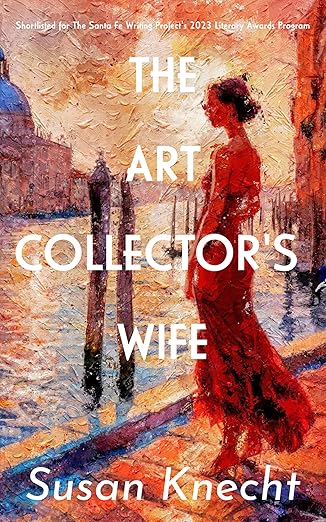

Susan Knecht’s The Art Collector’s Wife is an emotionally rich, time-skipping novel that weaves together post-war trauma, intergenerational secrets, art-world intrigue, and the sharp edges of teenage rebellion. It starts in the horror of Auschwitz, then unfolds decades later in sun-drenched Venice, following the fractured legacy of one family—particularly the women who survived and the granddaughter determined to uncover the past. It’s part historical drama, part coming-of-age, with a steady undercurrent of longing.
The prologue, set on the day Auschwitz was liberated, is devastating and lyrical—just brutal and beautiful all at once. Lila, the mother, trying to keep her friend and a pregnant girl alive, while praying for a glimpse of her son Leo, had me breathless. Knecht doesn’t hold back, and the imagery stuck with me long after I closed the book.
Then we shift to 1960s Venice, and things change gears in a really compelling way. Now we’re with Isabel, Lila’s teenage granddaughter, who’s navigating Catholic school, first love, and the weight of secrets no one will talk about. Isabel is such a great character—sharp, moody, defiant. I loved her scenes with Antonia, her chain-smoking bestie who has all the bad ideas and a heart of gold. When Isabel steals the ruby rosary and starts skipping school to flirt with Niccolo (who is equal parts charming and sketchy), the tension crackles. You can feel her aching for answers about her father and mother, and the way Knecht slowly drops hints about their story is fantastic.
But what really got me was the emotional layering. Knecht has a way of showing how grief and silence pass through generations like DNA. Lila is wrapped so tightly in control and shame, you feel her unraveling even when she says almost nothing. There’s a haunting scene at the cemetery where Isabel confronts her grandmother about her parents—Isabel demands answers, and Lila can’t speak. That silence? It screams. And Miriam, the family friend who carries so much of the emotional glue, is a favorite. She’s got this old-Hollywood flair, but also such deep loyalty and sadness. I kind of wanted a whole book just about her.
I loved this book. It’s heavy but worth it. The prose is poetic without being precious, the story moves through decades without losing momentum, and the characters feel real, flawed, and alive. If you’re into multi-generational family sagas, WWII fiction with a heart, or just crave a book that will grab you by the collar, The Art Collector’s Wife is for you.
Pages: 257 | ASIN : B0F38R8KBV

The Light of Faded Stars


The Light of Faded Stars is a detective novel, but it’s also a sprawling, introspective meditation on memory, mortality, and the quiet devastation of time. The story follows Jack Willington, a retired detective on his deathbed, as he reflects on his final, unsolved case—the brutal murder of a young woman named Evie MacMurrough. With the help of his eccentric, bookish partner Marcel, Jack recounts not only the details of the investigation but also the philosophical undercurrents that haunted both men as they waded through the shadows of humanity and themselves.
I was floored by how the book balanced grit with poetry. The crime scene where Evie is found is brutal, but not gratuitous. It’s haunting. And the prose reads like noir. The first-person voice has this almost cinematic texture—world-weary, vulnerable, even funny in that grim detective kind of way.
What really pulled me in, though, was the relationship between Jack and Marcel. Marcel is the type of character you both want to strangle and protect at all costs. He’s maddeningly intellectual, forever quoting French authors and waxing philosophical about death and dreams. But there’s a tenderness underneath, a haunted soul just trying to hold it together. The scene where Jack catches him hiding in his office, surrounded by French literature and cold coffee, was weirdly beautiful.
Another thing I really appreciated is how the city becomes its own character. Fog City, as they call it, is sad, damp, and falling apart. But the descriptions are lush and honest. There’s a passage during a drive where Jack describes the industrial buildings exhaling smoke and the morning sun fighting through the fog like it’s battling to be seen. It’s so rare to see a city rendered with such gritty affection. It’s not romanticized, but it’s not dismissed either.
Jack’s memory wanders. But it fits the voice. He’s dying. He’s reflecting. It’s messy because life is messy. Some readers might get impatient, but if you lean into the detours—into the tangents about dreams, wars, childhood, guilt—they’ll reward you with insight.
The Light of Faded Stars isn’t just a mystery. It’s a story about the damage we carry and the traces we leave. It’s for anyone who’s ever looked back and wondered what it all meant. I’d recommend it to readers who loved The Road by Cormac McCarthy, or those who like their crime novels with a side of existential dread and a dash of heart.
Pages: 206 | ASIN : B0DM97NLH7
Survive an Ancient Sorrow
Survive an Ancient Sorrow is an intimate tale of love, grief, obsession, and betrayal—set against a backdrop of salt-slick decks, jungle rivers, and a restless Caribbean horizon. It follows the narrator’s fevered relationship with Rita, a magnetic woman with the soul of a sailor and the scars to prove it. What starts as a lusty encounter on a docked sloop spirals into a jagged, doomed love story wrapped in the trappings of high-seas adventure and mythic melancholy. Rita dies early in the book, and everything that follows is a storm of memory, regret, and the aching need to understand why.
Greenwald doesn’t just write. He bleeds onto the page. The language is lush, visceral, and often startling in its bluntness. There’s a kind of poetry in how he describes Rita: “She could kiss with her mind,” he writes in the prologue, and that line alone told me this wasn’t going to be a standard love story. The voice feels lived-in, battered by the sea and years, full of dark humor and aching loss. He shifts from gritty details—like the squelch of bunker oil and the stink of a rotting skiff—to gorgeous lines that stop you in your tracks. It’s a chaotic mix, but it works.
The story isn’t told in a straight line, which I liked. It loops, wanders, lingers where it hurts the most. Greenwald doesn’t shy away from the ugliness—Rita’s downward spiral, her moments of despair, her complicated relationship with sex and survival. The scene where the narrator finds her body under the porch was so vividly rendered, so quiet and awful, I had to put the book down. And yet, just pages later, we’re in the wildness of their first meeting, full of fire and flirtation and grilled ribs. The emotional whiplash is intense but feels earned. That’s how memory works. That’s how loss works.
Rita herself is unforgettable. She’s not just a character—she’s a storm. Smart, broken, sensuous, maddening. She’s got big “stay away” energy, but you still find yourself inching closer. Her spiritual connection to her Nez Pierce roots, her deep relationship with the sea, her refusal to be anyone’s possession—all of it made her more than just a tragic figure. Even in her lowest moments, she had this defiant grace. And the author doesn’t let us turn away. He forces us to look at what it means to love someone wild and self-destructive, and how that kind of love can wreck you in ways you never recover from.
Sometimes it reads like a confession, sometimes like a drunken letter, sometimes like a howl into the wind. But it feels real. If you’ve ever loved someone you couldn’t save, or lost someone you couldn’t forget, this book will find you. I’d recommend it to anyone who likes stories that cut deep and don’t apologize—readers who want romance with salt and blood in it, who don’t mind the mess.
Human Stupidity

Endless Fall of Night follows a woman who is convicted as an insurrectionist and sent to prison, where she is compelled to join a mission to discover what has happened to the Martian colony that has gone dark and left severed heads in its wake. What was the inspiration for the setup of your story?
The set up was the novella Heart of Darkness by Joseph Conrad. Similar to that work, I wanted to show how the human condition and society has not changed much whether it is a Belgium Company’s outposts along the Congo River in Africa in 1899 or a US Swift Boat going up the Nung River in Vietnam in 1969, human emotions and behaviors construct our present day of 2025 and sets the stage for a future like 2126.
What are some things that you find interesting about the human condition that you think makes for great fiction?
Themes around prejudice, racisms, fascism, misogynistic and misanthropic bents will still be challenged by courage, strength in community and resilience are all part of being human. It is the journey that makes us. It is the discomfort and challenges that forge who we are.
What were some themes that were important for you to explore in this book?
Of all the themes presented, human stupidity is the focus of this story as defined by Carl Jung – blaming others for own flaws, inability to self-reflect, rigid thinking and dogmatism, lack of empathy and emotional intelligence, overconfidence without competence and repeating the same mistakes without learning.
Will there be a follow-up novel to this story? If so, what aspects of the story will the next book cover?
The Heavy Weight of Darkness, published in September 2024 follows one of the antagonists tasked with terminating the heroine, and then finds himself transformed.
Author Links: GoodReads | Instagram | Website | Second Website
Based on Joseph Conrad’s Heart of Darkness, we see our future that shows striking similarities to this age of imperialism, classism, and capitalistic expansion where racism is commonplace, slavery exists, and a minority of people are in absolute power. Instead of Belgium Company’s outposts along the Congo River in Africa in 1899 or a US Swift Boat going up the Nung River in Vietnam in 1969, this is the great Third Republic on Earth and colonies on Mars in the year 2126.
Cassandra XI, patrician and first-class citizen, is exposed to a traumatic experience that later has her questioning the established social order. She is eventually tried and convicted as an insurrectionist, her personal AI deactivated, social status and titles revoked, and she is sent to prison. Cassandra is then approached by Captain Willard Bennett of the light cruising ship the Jefferson Davis to investigate why the Martian colony New Georgia went dark, leaving severed heads on spikes and the message “Bring Cassandra Kurtz.”
With no choice but to go, Cassandra’s life is about to change in unimaginable ways.
Adding Depth to My Characters

The Oberon Stone follows a group of friends who are searching for an ancient artifact of immeasurable power, when one is kidnapped, turning their mission into a desperate rescue. What was the inspiration for the setup of your story?
I wanted the second book to break away from the artifact-hunting structure of the first, so I set up the story to make readers believe the search for the artifact was the main plot—only to subvert that expectation when the real quest became the Mage’s rescue. That shift came as a shock, flipping the narrative focus. If you look at the book’s climaxes, they’re tied more to the rescue than to the artifact itself, even in the “coming back home” moment. The artifact hunt ended up taking more of a side-quest role.
Removing the MC’s mentor was also intentional. It allowed other characters to step into the mentor role, shifting the dynamics from Book 1. The different quests also gave me the opportunity to define the rules of magic in more depth, breathing more life into the Downtown-verse—something I couldn’t fully explore in the first book without overwhelming the reader.
What character did you enjoy writing for? Was there one that was more challenging to write for?
Ada was a difficult character for me. I was very cautious about making her more than just an unpredictable sidekick. I wanted someone loud, someone who would steal the scene multiple times, but she also needed to be deeply flawed—a character that would play with the reader’s emotions. I couldn’t push her so far that readers would put the book down because of her, but I wanted to push right up to that emotional edge, making her memorable not for her wins, if that makes sense. The hardest part was figuring out where that fine line was for different readers.
I really enjoyed writing Montgomery. It’s easy to write a classic arch-enemy—just make them all bad and powerful. But if you know anything about me, you know I’d never lean into that cliché, just as much as I dislike Deus Ex Machina solutions. So yes, Montgomery needed to be awful, but he also needed a history behind his awfulness—one that readers could relate to, enough to humanize him. I loved crafting his background: the family dynamics, the bad parenting that shaped him, his desperate need for his father’s attention, and how discovering a half-brother only deepened his existing insecurities. I especially enjoyed writing Montgomery as a father—desperately overcompensating with Rachael, trying to give her the love he never had, without realizing he was creating another version of himself. Different paths leading to the same destination.
Yes, Montgomery was a fantastic creative process.
When you first sat down to write this story, did you know where you were going, or did the twists come as you were writing?
Mostly, yes — I knew where it was going, at least for the main ideas. But side stories and details tend to change as I populate the story. I base the overall plot on Vogler’s Hero’s Journey structure, which gives the main plot a very well-defined progression. Then, I break the story into bigger chunks, which usually turn into one or two chapters each. From there, I start layering the side stories — the events that make character interactions unique and develop each character’s individual trajectory.
For example, Bruno and Sarah’s broken romance is a side story. Sarah’s emotional progression — learning self-love and accepting that she often gives more than she receives — is another side arc in itself. These subplots, along with side quests, can shift as I write. I also tend to place unexpected obstacles in the characters’ paths that I hadn’t planned initially. This adds a sharp edge of anxiety to the quest, making readers wonder whether success is even possible. Sometimes I let the characters overcome these hurdles, and sometimes they are forced to find a workaround — a plan B. These choices often happen at the last minute. Yes, I’m the kind of author who ruins my characters’ lives — and you’ll love it.
When will book three be available? Can you give us an idea of where that book will take readers?
Book three (The Temporal Scythe) is already available for pre-order on Amazon (Kindle only). It will be released — along with the physical copies — on June 10th, 2025.
You can expect a deeper, darker, and more emotionally intense story, just as you could notice the progression from book 1 to book 2. The characters are also more emotionally mature, with their arcs intensifying both in magical knowledge and personal growth. The stakes are higher, and the long-awaited climax of the trilogy arrives, featuring the much-anticipated final battle between good and evil.
Without giving too much away, readers should prepare for the emotional rollercoaster they already know they will get from my works — only this time, with higher speed, sharper loops, and a broken track somewhere that might just as well launch them toward their doom.
Author Links: GoodReads | X | Facebook | Website | Trilogy Website
“This jam-packed, … cross-genre tale proves consistently entertaining! A smashing final-act turn makes checking out the sequels a virtual necessity.” – Kirkus Reviews
The Wishing Shelf Book Awards Nominee
Eric Hoffer Da Vinci Eye Nominee
Reader’s Favorite Five Stars YA SF / Dark Fantasy
_____________________________________________________________________
Liam Hale’s world spirals into chaos when he receives a message in his late mother’s handwriting-delivered by a friend who should no longer exist. This is no coincidence. As he searches for answers, he unearths something far worse: the prophecy foretelling the end times has been shattered, tearing apart the fragile barrier between the Houses of the Living and the Dead.
With the Megaverse on the brink of collapse, Liam and his companions-alongside the enigmatic druid Sarah and the unpredictable witch Bruno-set out to restore the balance. Their only hope lies in the Oberon Stone, an ancient artifact of immeasurable power. But when McCormick is kidnapped by the merciless Winifred family, their mission turns into a desperate rescue.
Devil’s Spit: Prequel to The Ironborn Saga

Devil’s Spit is a gritty, booze-soaked detective noir tucked inside a fantasy world teeming with corruption, gang violence, and moral rot. The story follows Inspector Jack Greaves, a rum-drenched city guard with a haunted past, as he investigates a brutal murder scene that turns out to be more than just another night in Ironbay. With a rookie constable at his side and enemies lurking around every corner, Greaves dives headfirst into a tangled mess of bodies, secrets, and vendettas that refuse to stay buried.
This book had me hooked from the first swig of devil’s spit. The writing is razor-sharp, fast-paced, and just oozes atmosphere. That opening scene? Chef’s kiss. Greaves gambling away his last coin while downing the nastiest rum in Ironbay, sitting across from Malrick “the Spider,” oozes tension and worldbuilding without ever slowing down. The rum hierarchy alone—ranging from royal honeysap to the gut-rotting devil’s spit—says more about the city’s soul than any info dump ever could. Cavanagh’s prose is tight, punchy, and unpretentious. You feel the, the weight of Greaves’ regrets, and the heavy buzz of danger around every alley corner.
What really made the story sing for me, though, was Greaves himself. He’s the perfect mess of jaded, broken, and quietly noble. I loved how he lies through his teeth, drinks like it’ll stop the ghosts in his head, but still throws himself into danger to protect a girl he doesn’t even know. That whole bit with Boulder—the sweet, gentle giant pretending to be an “angry dog” to scare off thugs was surprisingly wholesome in a book full of body parts and gangsters. Also, Greaves biting off a dude’s thumb and spitting it out mid-fight was horrifyingly satisfying. There’s violence, yeah, but it never feels gratuitous. Every drop of blood feels like it means something.
Devil’s Spit is a wild and bloody ride through a city where justice is hanging on by a thread and everyone’s got a knife hidden somewhere. If you’re into detective stories with a fantasy twist, flawed but fascinating characters, and a whole lot of creative cussing, you’re gonna love this. Fans of The Lies of Locke Lamora, grimdark fantasy, or even just gritty noir with heart—this one’s got your name written all over it.
The Secrets Kept from His Daughter
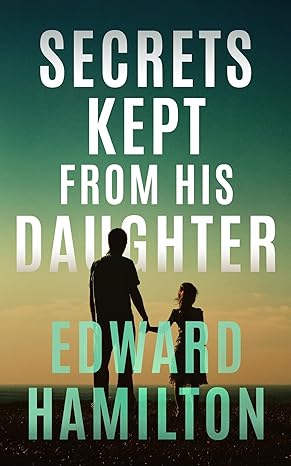
Edward Hamilton’s Secrets Kept from His Daughter is a rich, character-driven story that weaves heartbreak, guilt, and love into a slow-burning emotional unraveling. The novel follows Chris Thomas, a once-devoted husband and father, as he quietly vanishes from his home and family in the middle of the night, leaving behind a trail of unanswered questions. At its heart, the book explores the rippling effects of silence—how unspoken traumas and bottled-up emotions can fracture even the strongest bonds. Through a dual narrative of Chris and those he left behind, including his wife Carol and best friend Aaron, Hamilton examines the weight of regret and the human urge to run from what haunts us.
What grabbed me immediately was the rawness of Hamilton’s writing. The first chapter lands with a gut punch—Chris rolling away in the night, not as an act of cowardice, but a desperate bid to protect his family from his inner torment. It’s not flashy or dramatic; it’s quiet and devastating. That moment when Carol’s daughter, Melissa, tells her, “He kissed me butterflies and left,” actually choked me up. The writing isn’t trying to be clever—it’s just deeply honest. And I respect that. The scenes in Carol’s perspective are particularly strong. Her descent from confusion to devastation feels real, especially when she opens Chris’s manuscript and realizes he finished his book without telling her. That moment of betrayal hit hard, not just because of what he did—but because of what he didn’t do.
Some monologues felt a little too introspective—like the dream sequences with Aaron. While they helped build mood, I occasionally found myself pulled out of the story. But even then, I couldn’t help but admire how well Hamilton captured the feeling of being stuck between what you want to say and what you actually do. Aaron’s scenes with Sharon were some painfully familiar emotional disconnect. That confusion, that longing for someone to meet you halfway. Hamilton nails that quiet heartbreak. Not with big declarations—but in the silence between them.
Secrets Kept from His Daughter is not a fast read, and it’s not light. But it’s worth sitting with. It’s a story for people who have lived through messy relationships, who understand that love doesn’t always mean clarity, and that sometimes the ones we love most are the ones we hurt without meaning to. I’d recommend this to readers who enjoy introspective, emotionally layered fiction with real, flawed characters.
Pages: 237 | ASIN : B0DZPGK148



 LITERARY TITAN