Blog Archives
Voicings


Voicings, by Carroll Blair, is a collection of brief poems, meditations, aphoristic fragments, and more formally elusive lyric pieces that circle the inner life with unusual persistence. The book moves through solitude, spiritual hunger, artistic struggle, nature, language, ego, suffering, and the quiet courage required to keep becoming oneself. Its two parts feel less like separate sections than two movements of the same long listening: one rooted in the search for vision, the other widening into sharper social observation and a deeper tenderness toward the fragile, unfinished human soul.
I found the strongest pieces in Voicings to be those that marry plain-spoken insight with a sudden image that makes the thought bloom. “Never Completely Alone,” with its crickets singing through the cool of night, turns loneliness into something porous and living, while “Going On” compares the artist to a battered prizefighter still moving without quite knowing where the strength is coming from. That image stayed with me because it captures so much of the book’s emotional center: endurance without self-pity, faith without prettiness, and creativity as a form of survival. Blair’s ideas can be bracing, especially when he writes about ego, attention, and the cost of truth, but there’s warmth beneath the severity. He seems to believe that life wounds us into awareness, and I responded to that belief because it’s neither sentimental nor cruel. It has the ring of something earned.
The writing is at its best when Blair allows thought and image to lean into one another. I loved the musical simplicity of “Alphabets,” where letters become notes and words become “music for the eye as well as the ear,” and I admired the quiet grace of “A Child’s Exploration,” where the flower and the child seem to recognize each other. The book’s texture has force. Its language can be rough, gleaming, prophetic, tender, and strange, sometimes all within a few lines. I often felt challenged in a way I respected. Blair’s voice asks the reader to slow down, to accept difficulty, and to meet language as an event rather than a vehicle.
Voicings left me with the sense of having walked through a mind that refuses the small comforts of distraction. The closing poems, especially “Every Moment of One’s Life,” “Keeping On,” and “Who Lift Their Eyes,” gather the book’s many concerns into a final affirmation of attention, growth, and spiritual reach. It’s best for those who enjoy philosophical poetry, meditative fragments, and writing that treats the soul as both a wilderness and a workshop. I recommend Voicings to reflective readers who are willing to sit with mystery, wrestle with abstraction, and be rewarded by moments of sudden, piercing clarity.
Pages: 154 | ISBN : 978-1936430215

God’s Plants
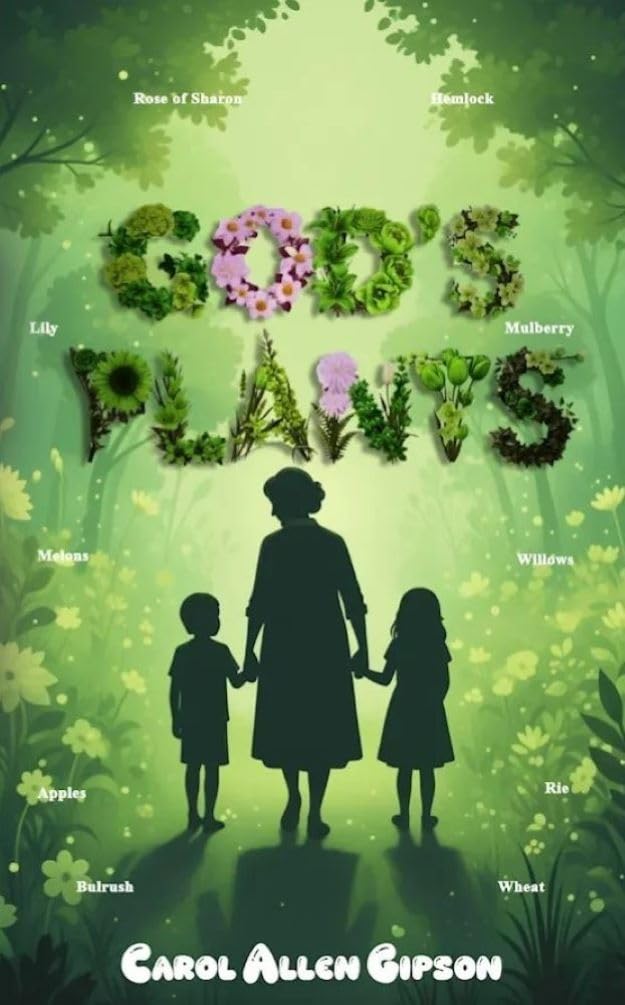

GOD’s Plants, by Carol Allen Gipson, follows three children, James, Marlene, and Robert, as they spend a sunny afternoon with their great-grandparents, Nana and Grandpa. What begins as a playful visit turns into a gentle backyard adventure when the children discover “biblical plant signs” placed among flowers, herbs, vegetables, and trees. Through their curiosity, Nana introduces them to the Bible, God, Jesus, prayer, and the meaning behind plants like mint, herbs, palm, and the Crown of Thorns.
There’s a sweetness in the way faith is presented through ordinary family time, not as a lecture but as a conversation that grows out of children noticing the world around them. I especially liked the garden setting because it gives the spiritual lessons something tangible to rest on. A child can smell mint, see a palm tree, touch a leaf, and then connect that sensory moment to a Bible verse. That idea feels thoughtful and memorable. The writing is warm and direct. The grandmotherly voice has a comforting quality, and I could feel the author’s desire to pass down faith, family memory, and a love of growing things.
The artwork gives the book a soft, welcoming atmosphere. The characters look kind and expressive, and the garden scenes have a glowing, storybook warmth that fits the tone beautifully. I was most drawn to the pages where the children explore among the herbs and signs, because those illustrations make the learning feel alive and playful. The Crown of Thorns section carries more emotional weight, and I appreciated that the book doesn’t avoid the seriousness of Jesus’ suffering, while still framing it gently for young readers. Some of the transitions can feel a little abrupt, especially when the story moves from plant hunting into deeper theology, but the tenderness of Nana’s explanations helps smooth that shift.
GOD’s Plants is a faith-centered picture book with a clear purpose and a deeply personal spirit. It’s best for Christian families, Sunday school settings, grandparents reading with grandchildren, or parents who want to introduce children to biblical ideas through nature and gardening. I’d recommend it especially for young readers who enjoy gentle family stories and hands-on connections between faith and the natural world.
Pages: 43 | ASIN : B0G5BQ1F9N
The Soundless Symphony: At the Heart of Night

The Soundless Symphony: At the Heart of Night is a poetry collection steeped in darkness, longing, nature, myth, and emotional survival. Stacy Seraphina White moves through grief, desire, silence, and renewal with a voice that often feels like it’s standing at the edge of night, listening for something tender beneath the hush. The book begins in an almost self-aware creative space with “The art of creation,” then drifts through poems of inner fracture, romantic ache, fantasy realms, and finally the natural world’s fragile light. By the time the collection reaches pieces like “To reach for Theia’s light” and “Familiarity,” it has become less a linear journey than a nocturnal procession, one where sorrow, beauty, and imagination keep brushing against each other in the dark.
What struck me most was the intensity of the imagery. This isn’t a quiet book in the plain sense, even though silence is one of its central moods. White writes in lush, shadowed textures, full of black roses, moonlit melodies, scarred palms, river pearls, pegasus wings, phoenix fire, and goddess light. At times, I found the poems almost baroque in their layering, especially in “Step into my realm,” where the speaker tumbles through a fantasy landscape of demons, fae, griffins, and a dark kingdom. That kind of abundance won’t be for every reader, but I admired how fully the book commits to its atmosphere. It believes in its own dream logic, and that sincerity gives the collection its emotional pull.
I also appreciated the ideas underneath the ornamentation. The book returns again and again to the cost of feeling too deeply, of being unseen, of turning pain into something that can be held without being simplified. “Reflection” captures that sense of being trapped by memory, while “Silence” turns grief into something thorned and alive. The love poems are often wounded rather than sweet, with desire mingling with abandonment in pieces like “Adrift” and “Heartache, a moonlit melody.” Even when the language is heavy with velvet and shadow, there’s a genuine emotional intelligence working beneath it. White understands that beauty doesn’t cancel ugliness. Sometimes it’s the only vessel strong enough to carry it.
I came away from The Soundless Symphony feeling as if I’d wandered through a candlelit gallery of grief, myth, and private weather. It’s a collection with a distinct sensibility, romantic, mournful, ornate, and deeply invested in transformation. This book is at its best when its darkness opens toward tenderness, when the night doesn’t merely consume but shelters. I’d recommend it to readers who enjoy atmospheric poetry, gothic romantic imagery, mythic flourishes, and emotionally saturated writing that lingers in sorrow without surrendering entirely to it.
Pages: 75 | ASIN : B0H1NCP5Z8
Adventures of Sher: Surviving the Tributaries of South America

Adventures of Sher: Surviving the Tributaries of South America, by Sherana Barakat, is a childhood memoir told with the wonder, alertness, and emotional honesty of a young girl discovering the shape of her world. Barakat looks back on a nomadic period of her life, moving from Georgetown to Dredge Creek, then into Venezuela’s Amacuro River region, and finally back toward Guyana. The book reads like a memory preserved in color: family, rivers, boats, food, animals, folklore, and danger all sit close together. It’s not just a travel story. It’s a personal record of what it felt like to grow up inside movement, uncertainty, and deep attachment to place.
One of the most appealing parts of the book is the narrator’s sense of freedom. Sher’s childhood isn’t presented as simple or easy, but it’s full of curiosity and confidence. She climbs trees, helps with fishing, watches waterways change color, and learns the rhythms of rural life by being right in the middle of it. When she says, “This was my first taste of living freely,” the line captures the spirit of the book beautifully. The natural world isn’t background scenery here. It’s a living presence, full of mango trees, caimans, piranhas, dolphins, mangroves, muddy waves, and night sounds that stay with her.
Barakat also gives the story a strong family center. Sher’s father stands out as the adventurous force of the book, a skilled navigator who can read the land, water, sun, and stars. Her mother brings steadiness, care, and resilience, especially during the family’s difficult moves. The memoir also honors storytelling itself, from bedtime reading to her grandfather’s folklore about turn tigers and giant creatures. Those stories blend naturally with Sher’s real experiences, especially during the frightening night at Shell Beach when the family believes a jaguar may be outside the door.
The illustrations add a lot to the reading experience. They have a hand-drawn softness that fits the memoir’s tone, and the colored-pencil texture makes the pages feel intimate, almost like entries from a remembered childhood sketchbook. The images of fruit, boats, mangrove roots, waterways, birds, and the child sitting near the river help make the setting feel tangible. Some pictures are especially effective because they don’t just decorate the text. They extend it, giving visual weight to the rivers, trees, and animals that shaped Sher’s memories.
Adventures of Sher is a warm and reflective memoir about a childhood shaped by migration, family courage, and the pull of wild places. Barakat’s voice feels sincere and personal, especially when she writes of the Amacuro River, “This peace and quiet was the perfect harmony for one’s soul.” That feeling runs through the book. It’s a story about looking back with gratitude, not because everything was comfortable, but because those experiences made life feel vivid. Readers who enjoy memoirs about childhood, nature, family history, and life in Guyana and Venezuela will find this a heartfelt and visually rich read.
Pages: 39 | ASIN : B0H2NBCYWK
One Leaf, One Life

One Leaf, One Life is a meditative blend of botanical art, memoir, science, and spiritual reflection, built around Ramiro F. Prudencio’s colored pencil portraits of autumn leaves and the essays they awaken in him. A retired urologist born in Bolivia and shaped by immigration, medicine, loss, aging, family, and art, Prudencio turns each leaf into a small threshold: into photosynthesis and color theory, into memories of Chicago autumns, into his childhood injury that cost him an eye, into his late discovery of colored pencils, into gratitude for the ordinary green machinery that lets us breathe.
What moved me most is how earnestly the book believes in attention. Prudencio doesn’t glance at a leaf, he almost courts it. A maple becomes a dancer, an elm becomes a question mark asking Quo vadis?, an artichoke rises like an “emperor thistle” dressed for coronation. That often feels tender and earned, especially because the author’s own life is folded into the observation. When he writes about losing an eye at five, and then later about learning to see inward, the metaphor of the leaf stops being decorative. It becomes personal. I felt that same quiet force in the story of his grandson bringing him leaves by color until he finally presents one as “a rainbow.” It’s a small scene, but it contains the whole book’s heartbeat, wonder passed between generations, and nature translated through affection.
The writing is at its best when it lets precision and feeling breathe together. I enjoyed the way Prudencio can move from chlorophyll, electromagnetic waves, and the xylem’s slow upward pull of water into something almost prayerful without seeming embarrassed by either science or awe. His background as a surgeon gives the book a steady hand. He loves process, tools, discipline, and the almost surgical patience of burnishing pigment into paper. There’s a genuine soulfulness here, and the repetition of certain ideas, aging, humility, service, purpose, gradually begins to feel less like insistence and more like a ritual.
The book feels beautifully made, with a level of craftsmanship that matches the patience of the artwork itself. The cover is elegant and inviting, the layout gives the leaf portraits room to breathe, and the production has a gallery-like polish that makes the reading experience feel contemplative. I also found the author’s training in ikebana especially distinctive, because it gives the book a sensibility that goes beyond botanical illustration. There’s a disciplined attention to line, balance, emptiness, and natural form that seems to shape the images and the way he thinks about aging, beauty, and impermanence.
By the end, I felt I had read not a conventional art book, and not exactly a memoir, but a late-life testament written by someone trying to make peace with time without surrendering curiosity. Its loveliest idea is that decline can still be radiant, that what is scarred, curled, spotted, or nearly spent may be carrying its deepest beauty at the very moment we’re trained to overlook it. I closed the book feeling calmer, a little more awake to the living world, and more grateful for small, perishable things. I’d recommend One Leaf, One Life to reflective readers, nature lovers, artists, retirees, caregivers, and anyone drawn to books that turn close observation into a gentle philosophy of living.
Pages: 169 | ISBN : 978-9917032519
Grandfather and Grandson

The Corridor follows a grandfather with vast knowledge of the Blue Ridge Mountains who sets out on a mission alongside his teenage grandson to document a wildlife corridor threatened by a resort development. What was the inspiration for the setup of your story?
I really wanted to do a reverse mentorship piece. I live in the Blue Ridge Mountains, and I see all the time grandfathers showing grandchildren the nature that surrounds us here. I thought it would be fun to explore a different type of relationship. One where Ellias, the grandson, takes exception to Richard, the grandfather’s, lack of motivation on saving the wildlife corridor, even when he has economic reasons, property values, and the knowledge to save it. This shift happens not only in Ellias’ familiarity with social media and technology but also in motivating Richard to do something. This is a wonderful dynamic between grandfather and grandson.
Richard’s emotional arc is so understated but powerful. How did you approach writing a character whose growth happens through small shifts rather than dramatic revelations?
That is something I like to present while writing. I think it’s important for writers to engage their readers by not presenting the obvious but to deliver it in such a way that it’s believable, and hopefully they understand this the way you did.
Nature writing can sometimes overpower character, but here, landscape and psychology feel inseparable. How did you balance the two?
That’s a great question. And the answer is that I see daily the subtle balance between people and nature. I see a family of black bears crossing the street, and people stop their cars, being very respectful to let them pass. Pulling their phones out recording the encounter. It truly is magical, and while writing, I can’t help but bring that perspective. And I’m happy that you noticed.
If Richard and Eli met again ten years later, what do you think each would have taught the other by then?
Ah, you are skipping ahead. The Corridor is the first book in a 6-book (novelette) series…stay tuned.
Arcadian Alcove

Arcadian Alcove, by Karen Black, is a cozy contemporary fantasy about Lia Alexander Sinclair, who inherits her great-aunt Melissa’s secluded North Carolina estate and discovers that the family stories about fae, telepathic cats, and hidden magic were never just stories. As Lia and her husband Eric settle into Arcadian Alcove, she becomes the guardian of its supernatural residents, including bropis, elves, talking animals, and Athena the telecat, while also fighting to protect the land from political greed and an eminent domain threat. It is a gentle fantasy with an environmental heart, built around inheritance, wonder, family, and the duty to protect what cannot protect itself.
What I liked most about the book is how sincerely it believes in its own magic. Karen Black doesn’t treat the fae as a clever twist or a dark secret waiting to explode. She lets them sit at the kitchen table, drink peppermint tea from thimbles, worry about their homes, and become part of Lia’s daily rhythm. That choice gives the story a warm, lived-in feeling. It’s not trying to be flashy. It’s trying to be kind. I found that refreshing. The writing is plainspoken and direct, sometimes almost old-fashioned in its sweetness, but that fits the genre and the mood. This is the kind of fantasy where the house matters, the garden matters, and a small creature’s fear can carry as much weight as a courtroom battle.
I also appreciated the way the book ties magic to responsibility. Lia does not just inherit land. She inherits a promise. That idea gives the story more shape than a simple “woman discovers magical world” plot. The conflict with Governor Lassiter and the highway project adds real stakes, and I liked that the book connects the survival of the fae with the survival of ordinary wildlife. The wolves, fish, frogs, birds, and little people all belong to the same fragile web. Some parts favor clarity and comfort, which gives the story a softer touch than more intense fantasy, but that gentleness feels in keeping with the book’s overall spirit. Still, I did not mind that much. The book’s heart is so clear. It wants to argue that belief is not childish when it leads to care, courage, and protection.
I would recommend Arcadian Alcove to readers who enjoy gentle fantasy, cozy magical realism, nature-centered stories, and books where family legacy and found community matter more than battles or darkness. It will especially appeal to readers who like talking animals, benevolent fae, protective homes, and a hopeful tone. This is a quiet, warm fantasy for anyone who wants a story that feels like stepping into a sunlit herb garden and finding out the whispers in the leaves are real.
Pages: 311 | ASIN : B0GDS6FCFB
Benjamin & Honka’s Backyard Adventure: Second Edition

Benjamin & Honka’s Backyard Adventure is a gentle picture book about a six-year-old boy who discovers a woodland duck near the pond in his backyard and names him Honka because of his funny, husky call. What begins as a simple encounter turns into a sweet friendship, with Benjamin learning how to care for Honka properly, including the important lesson that bread isn’t good for ducks and healthier treats are a kinder choice. The story settles into a warm rhythm of pond play, small discoveries, and the quiet promise that ordinary days can hold real wonder.
I liked the tenderness of this book most. It has the feel of a memory a parent might tell at bedtime, soft around the edges and full of backyard magic. The writing is simple and direct, which suits the age group, and I appreciated that the story doesn’t force a big, dramatic lesson. Instead, it lets care and curiosity do the work. Benjamin’s sadness when Honka disappears for a day felt especially true to childhood, that quick little ache children feel when something they love suddenly isn’t where it should be.
The artwork gives the picture book much of its charm. The pond scenes are especially calming, with muted greens, golden light, soft water, and little details like butterflies, reeds, and garden plants that make the backyard feel alive. I also liked how Honka is drawn with personality rather than exaggerated cuteness. He feels like a real animal, a child might observe closely and come to love. There are a few places where the text could be smoother, and some phrasing feels a bit uneven, but the heart of the book comes through clearly. Its best idea is a lovely one: children can learn compassion not through lectures, but through paying attention.
I found Benjamin & Honka’s Backyard Adventure to be an affectionate children’s book with a sincere love for animals and nature. It has a comforting sweetness that stayed with me after I finished it. I’d recommend it for young children who enjoy animal stories, backyard exploration, and gentle books about kindness, especially for parents looking for a calm read-aloud with a little real-world care lesson tucked inside.
Pages: 32 | ASIN : B0GRTCML8T


