Blog Archives
Moral Indignation


Moral Indignation: Embryonic Stem Cells, DNA, and Christians is a long, fiery walk through science, theology, and ethics from a very outspoken Christian point of view. Author Sherman P. Bastarache sets out to make a Christian case for supporting stem cell research and other modern biomedical tools. He moves from big questions about knowledge and faith, through DNA and evolution, into abortion, euthanasia, and the soul, then circles back to what it means to be truly “pro-life” in practice, not just in slogans. The book mixes Bible study, personal stories, popular science, and social commentary, and it ends with a push toward compromise and concrete ways to back research that aims to reduce human suffering.
I found the voice to be bold and charming. Bastarache writes like someone talking across a kitchen table, not like a distant academic. He leans on scripture, then jokes about Yoda, then swings into stem cell basics, and it holds together most of the time. I appreciated the very personal, unfiltered style of the writing. The chapters move freely, the arguments often circle back for emphasis, and some analogies linger in a way that lets the ideas sink in. The tone ranges from gentle and pastoral to strongly assertive, and even the occasional bit of coarse language highlights how deeply the author feels about the issues at stake.
His core line hits hard: ignorance is not holy, and refusing to use knowledge that could ease suffering is its own kind of moral failure. When he unpacks the old fear of “playing God” and reframes humans as responsible co-workers who need to grow up and act, I felt that was both theologically interesting and morally bracing. His use of real cases around high-risk pregnancies, late-term complications, and new reproductive technologies makes the debate feel grounded in actual lives. I appreciated that honesty. On the other hand, his strong feelings about certain pro-life arguments give the book a clear, unmistakable stance. He tends to focus on the human cost of inaction more than on every fine-grained worry about embryos and possible future abuses, which keeps the spotlight on real lives. I could feel the passion in those pages.
I would recommend Moral Indignation to Christians who feel torn between loyalty to their faith community and respect for modern science, and to believers who suspect that “do nothing” is not a morally neutral stance in medicine. It could also interest secular readers who want to see a serious Christian wrestle with stem cells, DNA, and bioethics without hiding behind easy platitudes. If you appreciate strong feelings and a very human voice that tries to drag faith and reason into the same room, you will find Bastarache’s thoughts inspiring.
Pages: 314 | ISBN : 978-0992159412

Lost in Bone Cave


The Adventures of Syd: Lost in Bone Cave tells the story of a girl named Syd who joins her scientist father on a real caving expedition in West Virginia. What starts as a planned research trip to observe bat colonies turns into a long, muddy, sometimes frightening journey through Bone Cave, complete with tight crawls, glowing rock walls, wildlife encounters, and a moment where things go genuinely wrong. The book follows Syd as she moves from curiosity and doubt into courage, responsibility, and trust in herself during an underground adventure that tests both her nerves and her judgment.
What struck me first was how grounded the writing feels. Author Danielle Simone clearly knows this world, and she takes her time letting readers learn it alongside Syd. The explanations about caves, bats, and equipment are woven into conversations instead of dropped like lessons, which makes them easier to absorb. I liked that Syd does not magically become brave overnight. She complains. She gets scared. She makes mistakes. The fear in the Devil’s Pinch crawl is especially well done. You can almost feel the dust in your throat and the panic tightening your chest, and it never tips into melodrama. It feels honest, like the kind of fear kids actually experience when something goes beyond what they expected.
I also appreciated the author’s choice to center the story on a parent and child working together. Syd’s dad is capable but not perfect, and that matters. Adults in this book do not have all the answers, and sometimes they get hurt too. That balance gives Syd room to grow without turning her into an unrealistic hero. The science elements, especially the focus on bats and White Nose Syndrome, add weight to the adventure. This is not danger for fun. There is a purpose, and that purpose keeps pulling the story forward.
Lost in Bone Cave fits squarely in the children’s adventure genre, with a strong thread of nature and science exploration running through it. I would recommend it to middle-grade readers who like outdoor stories, animals, and realistic challenges rather than fantasy quests. It would also be a great pick for kids who enjoy learning how things work while following a character their own age. If you have a reader who loves hikes, caves, or asking big questions but still feels nervous about new experiences, this book will likely feel like a steady hand on their shoulder, saying you can be scared and keep going anyway.
Pages: 104 | ASIN : B0FQDCNFDX
The Shift Worker’s Paradox

R.E. Hengsterman’s The Shift Worker’s Paradox lays out a clear and unsettling picture of how shift work breaks down human biology, piece by piece. The book moves through personal stories, science, and practical guidance, weaving together research on circadian disruption, metabolism, hormones, and the daily realities of working against the clock. It explains how sleep loss, mistimed eating, and chronic stress grind away at the body over time. The tone blends clinical insight with lived experience, and the message is steady and stark. Working nights or rotating shifts has a cost, and that cost shows up everywhere from cognitive performance to metabolic health to emotional stability.
The writing is plainspoken, almost blunt at times, and that worked for me. I never felt lectured at. Instead, I felt nudged, reminded, and sometimes warned. The book mixes biology with stories of real people in a way that hits harder than any abstract health advice. I could feel the frustration in the author’s voice when describing tragedies on the drive home, and I could feel the weight of his decades in healthcare shaping every paragraph. Some chapters made me pause, especially the parts explaining how the body’s internal clocks fall out of sync. I knew shift work was rough, but I didn’t fully grasp how many systems it drags down at once.
What surprised me most was how personal the book becomes. When the author admits to his own struggles, the tone shifts from educational to intimate. It felt like someone pulling up a chair and telling the truth that usually gets swallowed in break rooms and morning commutes. The mix of scientific detail and emotional honesty felt unique. Shift workers aren’t dealing with one problem. They’re dealing with an entire stack of them, and the writing mirrors that tangled reality. I found myself moved, sometimes unsettled, and sometimes hopeful when the author talked about small changes that can help realign a life that’s drifting.
This book is a lifeline for nurses, factory workers, first responders, warehouse workers, and anyone else who trades daylight for survival. It’s also helpful for families who want to understand what their loved ones go through. I would recommend it to anyone who works outside a typical schedule or cares for someone who does. The book is honest, practical, and quietly compassionate, and it might be the first time some readers feel truly seen.
Pages: 394 | ASIN : B0G2SK9QDM
Fungus Theory of Conscious Growth

Fungus Theory of Conscious-Growth is a speculative science and philosophy-of-consciousness nonfiction book that argues all life on Earth is really one vast, ancient fungus that exists to grow consciousness to its maximum potential, with humans as the spore that eventually carries that consciousness off the planet and into space. The author starts with cosmology, describing a universe that hides our true origin, limits our lifespans, and ties us to fragile biospheres, then walks through biology, evolution, technology, and psychology to claim that everything from slime mold to smartphones is part of one continuous fungal system pushing us toward “maximum conscious growth” and eventual evacuation of Earth.
Mark L. Christensen mixes straightforward explanation with capitalized concepts and acronyms. Underneath the terminology, though, the core ideas are simple: the universe is built so we can never fully know where we came from, we all die, and we are stuck on a planet that will eventually cook us, and those three constraints are what force intelligence and technology to grow. I appreciated how the chapters loop back to the same framing, so you never forget what the author is trying to prove. The long passages on cosmic expansion, black holes, and the difficulty of tracing any “true origin” were a bit dense, yet they set a clear mood of mystery and frustration that fits the book’s central question.
Where the book got most interesting for me was in the biology, technology, and psychology sections, where the fungus metaphor gets fleshed out. The idea that all plants and animals are variations of the same original fungus, and that this fungus has slowly prepared the planet for a bipedal creature with a big, hungry brain, is truly compelling. I liked the image of early fungi and plants essentially “setting the table” with rich fruits and vegetables, so a future human brain could have the calories it needs.
The technology chapter frames every tool, from early adaptations to modern spaceflight, as a kind of informational mycelium spreading through minds, with certain thinkers as “spikes” in the network that accelerate the whole system. The psychology chapter leans into this even more, describing a “void of psychosis” that opens when humans become aware that they cannot know their true origin, and arguing that our drive for identity, conflict, communication, and eventually space travel all come from trying to fill that void. I did find myself thinking about how much of my own motivation comes from not knowing, and from not wanting life to feel pointless.
I see Fungus Theory of Conscious Growth less as a strict scientific thesis and more as a big thought experiment in speculative science. It asks you to imagine the entire history of life as one fungal organism trying to launch itself into the dark, and to see humanity as the spore that might carry that effort into the galaxy. If you like big-picture questions, cosmic timelines, and philosophical riffs on evolution and technology, there is a lot here to chew on. I would recommend this book most to readers who are comfortable living with unanswered questions, who like their popular science mixed with metaphysics, and who do not mind a bold, unified theory that sits somewhere between lecture and late-night conversation about why we are here at all.
Pages: 402 | ASIN : B0CVXCNBY7
An Ever-Opening Poem

In A Wave Without a Shore, you explore both science and soul through the introspective poetry in this second installment of the Entangled Universes Trilogy. What was the biggest challenge you faced in putting together this poetry collection?
Honestly, my writing flows unlike anything I have ever experienced. Since August 2019, I have written 2500 poems, so the challenge is mapping ~200 of them to the eleven chapters in a way that helps elevate the poetry to a “shore our galaxy will only pass by” in our future.
How do you approach writing about deeply personal or emotional topics?
With ease. I am an INFJ personality type with introverted intuition and deep empathy. These topics are like an ocean that I never leave.
How has writing this poetry trilogy changed you as a writer, or what are you learning about yourself through writing it?
My writing has absolutely evolved since I began writing poetry at the start of the global pandemic. It’s almost like six years ago, I had just stepped into this realm, completely unaware of what I was experiencing. I never studied writing poetry; instead I only read poets (Whitman, Hesse, Rimbaud, Hemingway, Milton, Dickerson, Homer, Keats).
I’ve learned that the universe is an ever-opening poem in which our lives are immersed and entangled, almost like the words we use to express it.
Can you give us a glimpse inside the final installment of the Entangled Universes Trilogy? Where will it take readers?
We were born inside a star. Everything that makes up our experience within this universe came from our mother sun, Sol. Here’s an example of how my poetry will resonate in Tides of Light:
The Fragile Silence of Becoming Our Real
We trade light in a dance we were born to make
Your words find mine almost as if they know us
When we met eons past each poem was a song
I’ll know you again, sweet when we’ll sing them.
Flush with our demurs love asks how to be now
When we decide our fates even time plays along
Fragile silences frame thoughts as if we’re alone
When you’re lost remember that light we shared.
I’ve ventured on lonely highlands in search of us
Komorebi shadows taste like a kiss only you gift
Guardian angels perfect our course through time
When you’re ready to dance love, hold my eyes?
Author Links: GoodReads | X (Twitter) | Facebook | Jazz on the Coast | Website | Amazon
Unique Voices

Winston the Titan Terrier: Adventures in Ancient Egypt follows a superhero dog who unexpectedly travels back in time to ancient Egypt, where he discovers dinosaurs are present and must figure out how they got there and fix history. What were some educational aspects that were important for you to include in this children’s book?
Mia and I approached the sequel with a clear goal: to deepen the engagement that readers loved in the first book. We focused on three main areas to achieve this.
The Power of Engagement: Puzzles and Fun
First and foremost, we expanded the interactive elements. Both Mia and I share a passion for brain teasers, so we wove numerous puzzles and riddles into the narrative of Book 2. This wasn’t just filler; it was a deliberate strategy to maintain a high level of reader engagement and, as our young audience told us with the first instalment, to genuinely ‘get their minds working.’ We see this as a way to make the reading experience active, not passive.
Weaving in Surprising, Up-to-Date Knowledge
Secondly, we made a point of ‘sprinkling in’ fascinating, recently discovered facts and snippets of knowledge. We didn’t want to rely on old, common knowledge. A great example of this is a scene where we highlight how a domestic cat, like our character Smokestrike, is actually capable of running faster than a fully grown Tyrannosaurus rex at its estimated speed. This is based on new research from fossilised footprints, which suggests that large theropods could only walk or trot due to the mechanical limits of their weight and bone structure.
Another discovery we used was acknowledging that Queen Cleopatra was not Egyptian but Greek, a descendant of Ptolemy, one of Alexander the Great’s generals. These details add unexpected depth and authenticity, correcting common misconceptions for our young readers.
Authentic Detail and Historical Context
Finally, we committed to integrating authentic historical details through our research. For example, we feature ‘biltong,’ the famous South African dried-meat snack, as Winston’s all-time favourite snack. Our research revealed that dried meat was historically very common in ancient Egypt for preservation, as there definitely weren’t any fridges back in those times. So connecting a modern detail to an ancient practice and adding a vivid, believable layer to the narrative, where we learnt something new about ancient Egypt.
Perhaps the most fascinating discovery we wove into the story was the Ahramat Branch, a now-extinct arm of the Nile River that once flowed right past the Giza and other pyramid complexes. This newly identified river branch may explain how the ancient Egyptians transported their massive stones to the pyramids. We featured this detail prominently in our cover artwork and several illustrations.
What character did you enjoy writing for? Was there one that was more challenging to write for?
Most enjoyable character to write for…
Mia won a reversible yellow octopus at the arcade shortly after our first book was released. It was a yellow reversible super grumpy Octopus, that she instantly nicknamed as “Sadface.” I began speaking to Mia in character as the persona of a friend who used to complain about numerous events and situations on a constant basis, which sparked endless laughter from her.
We both kind of knew this work in the Winston universe and our readers as a formidable yet hilarious antagonist who could inject both chaos and entertainment into future storylines.
Most challenging character to write for…
We found great satisfaction in developing the full range of our characters, and it was rewarding to bring their individual personas and unique voices into the narrative of this book.
Where can your fans expect to find Winston, Diesel, and Teddy next?
Future Storylines and Book 3
One of the most enjoyable parts of the creative process for Mia and myself was the discussions and debates about future storylines. We’re currently mapping out Book 3, and it’s set to be our most ambitious adventure yet.
The Stakes in Ancient Egypt
The first half of Book 3 will address the cliffhanger from the sequel. Our heroes, Teddy and Diesel, are now equipped with their newly discovered superpowers, and they have some unfinished business: they must first save Ancient Egypt from the remaining dinosaurs and successfully retrieve Winston from that ancient timeline. This means facing huge, new dangers, such as the gigantic Mosasaurus lurking in the Nile and any remaining pteranodons still patrolling the skies with powers they haven’t really mastered yet, which could have some hilarious outcomes.
Expanding the Scope: A New Realm of Danger
From there, the scope of the story expands dramatically. Once they return to the future, their main goal will be to track down and battle their persistent foe, Sadface, and other infamous creatures known for destroying large ships. This chase takes them through a new, unpredictable realm filled with hidden dangers and legendary underwater locations that challenge the heroes’ new abilities.
Author Links: GoodReads | Facebook | Website | YouTube | The Chaos King | Amazon
From multiple award-winning storytellers Mia van Dongen and Colin van Dongen comes the next thrilling instalment in the “Winston The Titan Terrier” series!
Get ready for Winston’s new epic journey where futuristic chaos collides with ancient history! In Adventures In Ancient Egypt, our beloved superhero dog, Winston, and his best mate Teddy with his super-hyperactive dad Diesel, find themselves catapulted into more unbelievable new challenges against Smokestrike the naughty ninja cat and new intergalactic villains.
Following their discovery of a secret, magical tunnel system beneath the Bone Shop, Winston and his crew thought they’d seen it all. But when the mischievous alien Disco Duck unleashes a new time-twisting plot, Winston is hurled back to the scorching sands of 51 BC Ancient Egypt, under the reign of Queen Cleopatra herself!
Armed with his incredible Cosmic Bone, a shape shifting, language decoding, enemy outsmarting marvel, and a backpack full of transforming nanotech gadgets. Winston must navigate a world of ancient wonder and dinosaurs?! That’s right! A super grumpy, chaos-loving alien octopus known as Sad Face, is intent on destroying Earth by transporting prehistoric creatures into future timelines, with the help of a modified time twister device!
Can Winston, with the help of ancient allies and a surprise assist from a certain naughty ninja cat, stop Sad Face before he unleashes intergalactic mayhem and turns history into his own personal movie set?
Prepare for a laugh-out-loud, action-packed adventure filled with:
⏳🚀 Time-traveling escapades
🦖👽 Epic action packed chases with prehistoric beasts and alien villains
🧠🧩 Clever riddles and mind-bending challenges
❤️😂 Heart warming friendships and hilarious antics
🐶🐱 And a whole lot of canine and feline courage!
Perfect for young readers aged 6 to 10 years and families who love dogs, cats, dinosaurs, ancient history, and a good dose of intergalactic fun. Join Winston on his wildest adventure yet! From the imagination of a 7 year old.
Grab your copy of Adventures In Ancient Egypt today!
UK Book Band : Brown Level (7+ Year olds)
Year Group 3+
Oxford Reading Level 12
Big Cat Band : Copper
Suitable for shared reading for kids (Ages 5+) that love dinosaurs and adventure with parents and carers
Ellie Ment and the Material Matter
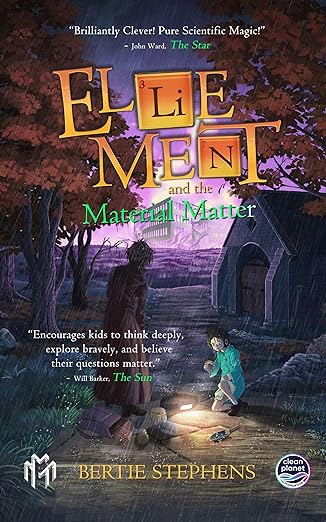
Ellie Ment and the Material Matter, by Bertie Stephens, is a quirky and fast-paced middle-grade adventure that blends science, humor, and environmental themes with a heavy dose of curiosity and chaos. It follows the story of Ellie, an 11-year-old self-proclaimed scientist living in the endlessly rainy town of Hapsie. After witnessing her brand-new school go up in strange purple flames, Ellie is drawn into a mystery that includes jam jar experiments, mysterious adults, glowing embers, suspicious teachers, a secret science club, and a new girl who seems just a little too perfect. Armed with a fierce love of science and a head full of questions, Ellie digs deeper into what’s really going on, and ends up discovering more about the world (and herself) than she bargained for.
The writing is seriously fun. Bertie Stephens has a wild energy in his prose that feels like Roald Dahl with a scientific twist. There’s a real rhythm to the way he plays with narration, slipping in clever asides and running gags that make you grin without feeling overdone. The world-building in Hapsie is rich in detail, from a pothole nicknamed “Stego-hole” to an art teacher who inexplicably wipes down students’ faces with talcum powder. It’s packed with oddball characters and moments that are both funny and surprisingly touching. I loved how the book never talks down to the reader; it trusts kids to understand big ideas, and that trust feels earned. The science woven into the story isn’t just accurate, it’s exciting. Ellie’s obsession with the periodic table, her experiments with rainwater, and her balloon hypothesis all made me want to pull out a notebook and start investigating things myself.
Ellie is a joy. She is relatable, sharp, stubborn, and delightfully flawed, but Kami, her main “rival,” didn’t feel quite as developed early on. I found myself wanting to understand her a bit more beneath the confident, polished surface. Some of that depth does come through later. I loved the fast pace and witty writing. While a few moments felt a little rushed or slightly tangled, there were still plot twists that surprised me in the best way. This is a story that’s bursting with creativity, warmth, and just the right amount of scientific mayhem.
Ellie Ment and the Material Matter is one of those rare stories that feels smart and silly in equal measure. It’s great for curious kids who love science, adventure, or just getting into a little trouble in the name of learning. Teachers and parents will appreciate its environmental message and the way it champions creative thinking without preaching. It reminded me how important it is to question the world around us and to never accept “that’s just the way it is” as an answer. If I had this book when I was eleven, I would’ve read it twice.
Pages: 284 | ASIN : B0F6T1ZMFX
“Time” is Not Our Enemy
Understanding Time and Eternity takes readers on a thought-provoking and ambitious journey to explore how humans perceive, conceptualize, and live within the realms of time and eternity. What was the inspiration for the original and fascinating idea at the center of the book?
The idea to write this book came to me many years ago, seeking to understand the connection between us and “time”. I have always been concerned with how time “flows” and how it influences us. I was also interested in how time “modifies” our bodies, aging them. I wondered if there were no more eternity, would we be eternal?
My visit to Japan in 2023 catalyzed the process of writing this book and gave it its final form. Following this visit, I tried to understand “time” in a broader way, going beyond just the Western vision of time. I studied the Western and Eastern visions of the concepts of “time” and “eternity” in comparison. To my surprise, I found that they have many common elements, of course, in addition to the elements specific to each religion or philosophy.
One thing that stood out was the extent of your research and how you drew from multiple disciplines to form your theory, rather than relying solely on science or religion. Did you find anything in your research of this story that surprised you?
Yes. While doing research for this book, I was often surprised to find many common elements in both Eastern and Western religions or philosophies. I was surprised that “time” as a concern of man has been at the core of human philosophy since ancient times. Man – regardless of faith – has correlated the idea of “time” with the concept of divinity. Another “goal” that appeared almost obsessively was how man seeks to continue his own earthly existence in a certain way through “eternity.” It was also surprising for me to observe how different and sometimes opposing the Western vision is to the Eastern one regarding certain aspects of “time” or “eternity” and at the same time how close this same vision is for other views related to “time” and “eternity”.
What were some ideas that were important for you to share in this book?
Through this book, I tried to convey more of the idea.
First of all, understanding the concepts of “time” and “eternity” helps us to better integrate into society and have a broader vision of humanity. Also, understanding how these concepts influence people’s thinking and shape their religious beliefs contributes to the general progress of humanity.
“Understanding Time and Eternity” shows my own vision of “time”, namely the fact that time “exists” in the form of “timelines” that can be individual or societal, as well as my vision that time can also be in the form of “loops”, not only cyclical or linear. I also emphasized the idea that these “timelines” can “interact” with the “eternity lines” as well as my concept related to “time travel”.
However, I concluded that the emergence of a new temporal system is inevitable in the future due to the evolution of human society and the increasing influence of artificial intelligence.
What is one thing that you hope readers take away from Understanding Time and Eternity?
Through my book, I would like readers to understand that knowing ourselves and our relationship with what is around us will come to define us as individuals. When we appear in this world, we are not asked, and when we leave this world, we are also not asked for the accord. We come to this world from eternity, and after we die, we go again into eternity. From these aspects, we should start our introspection and analysis of the relationship between us and “time”.
We must understand that “time” is not our enemy and death is not the end. Regardless of our philosophy of life or our faith, temporality and eternity are intertwined, and we must each find our own “niche” that ensures our emotional stability and personal fulfillment.
I wish that my readers in the West gain a better understanding of Eastern philosophy and those in the Far East gain a clearer vision of how Westerners live their daily lives.
But are we really in a battle with time? Is it our enemy? Can’t we make it our friend during our earthly life? Regardless of whether we consider it a friend or an enemy, time leaves visible the effects of its passage through our individual lives or our collective lives as a society.
In this book, I was exclusively concerned with time in a philosophical sense, specifically with how humans perceive it and how they relate time to their philosophical conceptions and religious beliefs. I explored the relationship between temporality and eternity, and I have concluded that, although time and eternity are opposites from all points of view (in the general view), in my view—which I have presented in this book—they are not as opposites. Still, they interpenetrate and influence each other.
I have concluded that not only does the past influence our future, but the future can also influence the past.
This book is a continuation of my previous works, which explore philosophical and religious themes and complement my philosophical and theological vision regarding the reality around us and what lies beyond it.
I have analyzed the concept of time from a philosophical and theological perspective.
I examined the concepts of “time” and “eternity” from the perspective of the Abrahamic religions (Christianity, Islam, Judaism) but also from the standpoint of Eastern religions/philosophies from the Far East (Buddhism, Daoism, Hinduism, Shintoism, Confucianism, Jainism). It was essential for me to examine how humans relate to “time” and “eternity,” as well as the impact of these philosophical concepts on the lives of common people throughout the millennia.
A significant chapter was the realization of a comparative analysis between Eastern and Western thought regarding temporality and eternity.
At the end of the book, I conclude that the emergence of a new temporal system is inevitable in the future, given humanity’s evolution and the increasing influence of AI on human society.
Understanding the concepts of “time” and “eternity” helps us integrate better into society and have a broader, more inclusive vision of humanity.
I hope that the readers from the West will gain a deeper understanding of Eastern philosophy and that those from the Far East will have a clearer vision of how Westerners live their daily lives.
This book aims to decipher the “energies and philosophies” that shape a community’s behavior, whether it behaves similarly or differently from other communities. Religions and philosophies are essential for the health of communities, and the concepts of “time” and “eternity” are crucial to them Therefore, their understanding is essential for the general progress of humanity.


